
Intracardiac Echocardiography Market Report Scope and Overview:
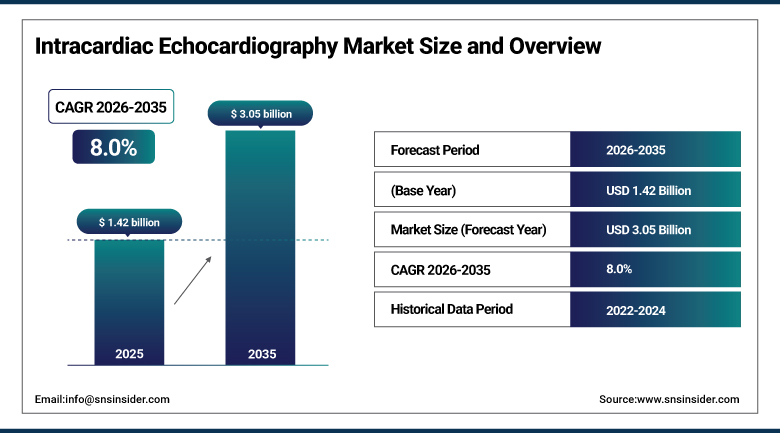
The Intracardiac Echocardiography Market was valued at USD 1.42 Billion in 2025 and is projected to reach USD 3.05 Billion by 2035, registering a CAGR of 8.0% from 2026 to 2035.
The Intracardiac Echocardiography Market is transforming interventional cardiology and electrophysiology by giving clinicians real-time, catheter-based imaging from within the heart, reducing reliance on transesophageal echocardiography and general anesthesia. The market is characterized by rising adoption of ICE-guided atrial fibrillation ablation, growing use in left atrial appendage closure and structural heart interventions, and accelerating migration from 2D to 3D and 4D imaging catheters capable of volumetric, multiplanar visualization. Significant growth is being witnessed in the deployment of AI-enabled mapping integration, single-use catheter designs, and steerable, miniaturized ICE platforms, considering that electrophysiology labs, cardiac catheterization laboratories, and ambulatory surgical centers continue investing heavily in imaging technology that shortens procedure time, reduces radiation exposure, and improves first-pass procedural success.
In 2025, Johnson & Johnson MedTech launched its SOUNDSTAR CRYSTAL Ultrasound Catheter, an advanced 2D ICE catheter integrated with the CARTO 3 Mapping System's AI-powered CARTOSOUND FAM module, giving electrophysiologists clearer intracardiac imaging during complex ablation procedures.
To Get more information Intracardiac Echocardiography Market - Request Free Sample Report
Intracardiac Echocardiography Market Trends
-
Rising adoption of ICE-guided atrial fibrillation ablation continues reducing dependency on fluoroscopy and transesophageal echocardiography.
-
Growing migration from 2D to 3D and 4D ICE catheters continues improving volumetric visualization during structural heart procedures.
-
Increasing use of ICE in left atrial appendage closure continues expanding the technology beyond core electrophysiology applications.
-
Expanding adoption of AI-enabled mapping integration continues streamlining anatomical reconstruction during ablation procedures.
-
Growing preference for single-use, steerable ICE catheters continues reducing reprocessing costs and cross-contamination risk.
U.S. Intracardiac Echocardiography Market Outlook
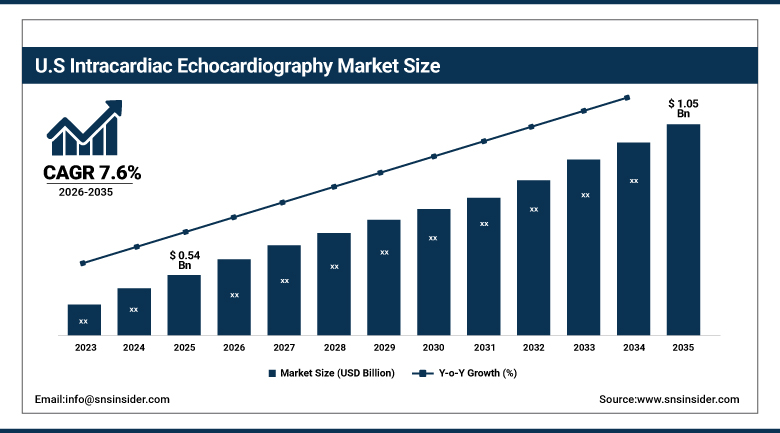
The U.S. Intracardiac Echocardiography Market was valued at approximately USD 0.54 Billion in 2025 and is projected to reach approximately USD 1.05 Billion by 2035, registering a CAGR of approximately 7.6% from 2026 to 2035.
In the United States, the demand continued to be shaped by a dense concentration of high-volume electrophysiology labs, rising atrial fibrillation prevalence among an aging population, and favorable reimbursement pathways for ICE-guided ablation and left atrial appendage closure procedures. Rising deployment of 3D and 4D ICE catheters by leading academic medical centers running complex structural heart programs continued reinforcing the country's position as both the largest and most technologically advanced ICE market. Growing adoption across ambulatory surgical centers and community cardiac catheterization laboratories added further layers of sustained domestic demand well beyond the technology's traditional academic-hospital base, with rising electrophysiologist training volumes and expanding same-day ablation programs increasingly relying on real-time, catheter-based cardiac imaging.
In 2025, GE HealthCare continued expanding its NUVISION 4D ICE Ultrasound Catheter availability across the United States, distributed in partnership with Biosense Webster and compatible with Vivid E95 and Vivid S70N ultrasound systems, giving electrophysiologists 360-degree rotational imaging during complex left atrial appendage closure procedures.
Intracardiac Echocardiography Market Segment Analysis
-
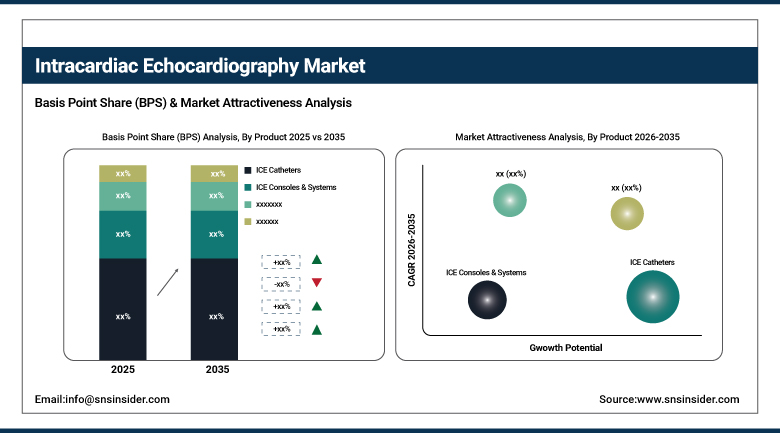
By Product, ICE Catheters segment dominated the Intracardiac Echocardiography Market in 2025 with 58.19% share; Software & Accessories segment is the fastest growing segment, registering a CAGR of approximately 9.2% during 2026–2035.
-
By Imaging Technology, 2D ICE segment dominated the market in 2025 with 66.12% share; 3D/4D ICE segment is the fastest growing segment, registering a CAGR of approximately 10.5% during 2026–2035.
-
By Application, Electrophysiology Procedures segment dominated the market in 2025 with 54.08% share; Left Atrial Appendage Closure segment is the fastest growing segment, registering a CAGR of approximately 10.0% during 2026–2035.
-
By End-User, Hospitals & Surgical Centers segment dominated the market in 2025 with 61.21% share; Ambulatory Surgical Centers segment is the fastest growing segment, registering a CAGR of approximately 9.5% during 2026–2035.
By Product, ICE Catheters Lead, Software & Accessories Emerge as Fastest-Growing Segment
The ICE Catheters segment dominated the Intracardiac Echocardiography Market in 2025, driven by their role as the primary consumable used in every ICE-guided procedure, from atrial fibrillation ablation to structural heart intervention. Repeated procedure volumes across high-throughput electrophysiology labs sustained steady replacement demand for single-use and limited-reuse catheters, while migration toward advanced 2D and emerging 3D/4D catheter designs kept average selling prices elevated even as procedure counts continued rising. Growing use of steerable, miniaturized catheter tips capable of navigating complex anatomical sites, combined with expanding indications across left atrial appendage closure and transcatheter valve procedures, reinforced catheter revenues as the single largest contributor to total market spending throughout the base year.
The Software & Accessories segment is the fastest growing in the Intracardiac Echocardiography Market owing to rising demand for AI-enabled mapping integration, automated anatomical reconstruction algorithms, and catheter fixation and workflow accessories that streamline procedural setup. Deeper integration between ICE imaging and electroanatomical mapping platforms is driving hospitals to invest in software upgrades that improve reproducibility and reduce operator dependence during complex ablation cases. Growing vendor emphasis on subscription-based software licensing and expanding accessory ecosystems, including catheter stabilization devices and workflow-management tools, continues extending the value captured from existing console and catheter installations across busy electrophysiology and structural heart programs.
By Imaging Technology, 2D ICE Dominates, 3D/4D Systems Gain Fastest Momentum
The 2D ICE segment dominated the Intracardiac Echocardiography Market because of its established clinical protocols, lower catheter costs, and broad compatibility with existing electroanatomical mapping and ultrasound console infrastructure across hospitals and ambulatory surgical centers. Decades of validated 2D imaging use in electrophysiology procedures have made this technology the default choice for routine atrial fibrillation ablation and standard structural heart cases. High levels of clinician familiarity, together with well-established reimbursement pathways and broad catheter availability across major vendors, sustained 2D ICE use across the majority of electrophysiology and interventional cardiology procedures performed throughout the base year.
The 3D/4D ICE segment is the fastest growing due to rising adoption of volumetric, multiplanar imaging catheters that provide 360-degree rotational visualization comparable to transesophageal echocardiography without the need for general anesthesia. Growing clinical evidence supporting 3D ICE guidance in left atrial appendage closure, transcatheter aortic valve implantation, and MitraClip procedures continues expanding adoption among structural heart programs seeking more physiologically complete anatomical visualization. Rising vendor investment in 4D catheter platforms capable of simultaneous multiplanar acquisition continues accelerating clinician transition away from conventional 2D systems across leading academic and high-volume community cardiac centers.
By Application, Electrophysiology Procedures Lead, Left Atrial Appendage Closure Grows Fastest
The Electrophysiology Procedures segment dominated the Intracardiac Echocardiography Market due to the central role ICE plays in guiding transseptal puncture, catheter positioning, and lesion monitoring during atrial fibrillation and other arrhythmia ablation procedures. Rising global prevalence of atrial fibrillation, combined with growing adoption of catheter ablation as a first-line rhythm-control strategy, has sustained high procedure volumes across established and emerging electrophysiology programs. Increased use of ICE to avoid complications such as pulmonary vein stenosis and cardiac perforation, alongside its role in reducing fluoroscopy and radiation exposure, contributed to sustained segment dominance throughout the base year.
The Left Atrial Appendage Closure segment is the fastest growing as ICE increasingly replaces transesophageal echocardiography for device sizing, deployment guidance, and post-procedural leak assessment during left atrial appendage occlusion. Rising adoption of left atrial appendage closure as a stroke-prevention alternative for atrial fibrillation patients ineligible for long-term anticoagulation continues expanding procedure volumes across structural heart programs. Growing clinical preference for ICE-only guidance, which avoids general anesthesia and shortens procedure time compared with transesophageal echocardiography, is driving faster adoption across high-volume structural heart centers worldwide.
By End-User, Hospitals Dominate, Ambulatory Surgical Centers Grow Fastest
The Hospitals & Surgical Centers segment dominated the Intracardiac Echocardiography Market due to their comprehensive electrophysiology and structural heart program infrastructure, and their ability to support high-acuity procedures requiring general anesthesia backup and multidisciplinary care teams. Large academic and tertiary hospitals continue running the highest procedure volumes across atrial fibrillation ablation, left atrial appendage closure, and transcatheter valve programs, sustaining consistent catheter and console demand. Continued investment in dedicated hybrid electrophysiology and catheterization laboratories, equipped with advanced 3D/4D imaging and mapping integration, reinforced hospital-based segment dominance throughout the base year.
The Ambulatory Surgical Centers segment is expected to witness the fastest growth in the Intracardiac Echocardiography Market as more routine ablation and select structural heart procedures migrate toward lower-cost, outpatient settings supported by favorable reimbursement changes. Growing numbers of electrophysiologists performing same-day discharge ablation procedures increasingly rely on ambulatory surgical centers equipped with ICE-compatible ultrasound consoles to deliver hospital-comparable procedural safety in a more cost-efficient setting. Expanding ambulatory surgical center accreditation for complex electrophysiology procedures continues attracting a broadening base of cost-conscious health systems.
Regional Analysis
|
Region |
Major Country |
Share within Region, 2025 (%) |
|---|---|---|
|
North America |
United States |
86.00% |
|
Europe |
Germany |
22.80% |
|
Asia Pacific |
China |
28.40% |
|
Middle East and Africa |
Saudi Arabia |
23.50% |
|
Latin America |
Brazil |
34.20% |
North America Intracardiac Echocardiography Market Insights
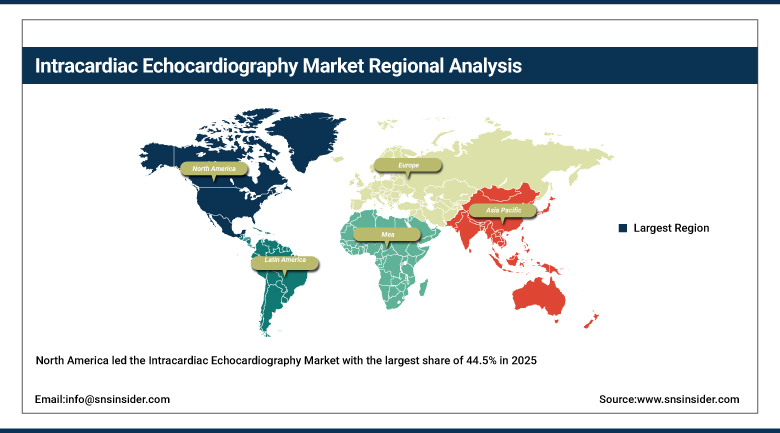
North America led the Intracardiac Echocardiography Market with the largest share of 44.5% in 2025. High atrial fibrillation prevalence, a dense concentration of high-volume electrophysiology labs, and favorable reimbursement pathways for ICE-guided ablation and left atrial appendage closure procedures continued reinforcing this dominant regional position. A deep concentration of leading device manufacturers, academic medical centers, and structural heart programs headquartered across the continent gave regional clinicians early access to next-generation 3D and 4D ICE catheter platforms well ahead of most other regions.
The United States accounted for highest share of regional revenue, anchored by a dense cluster of high-volume academic and community electrophysiology programs, rising catheter ablation adoption, and expanding same-day discharge protocols across ambulatory surgical centers. Canada added further regional demand through its own growing structural heart intervention volumes and expanding public health system investment in advanced cardiac imaging, and that combined strength kept the continent the largest addressable market for ICE vendors through the forecast period.
Get Customized Report as per Your Business Requirement - Enquiry Now
Europe Intracardiac Echocardiography Market Insights
Europe held a meaningful share of global revenue, supported by rising atrial fibrillation prevalence, expanding national reimbursement coverage for catheter ablation, and continued growth of structural heart intervention programs across the region's major economies. Regulatory harmonization under the EU Medical Device Regulation and continued expansion of high-volume electrophysiology training centers continued lowering historically significant barriers to advanced ICE technology adoption across the continent.
Germany led demand of European revenue supported by its substantial hospital infrastructure and high per-capita electrophysiology procedure volumes among the region's largest economies. The UK and France contributed substantial additional demand through their own expanding structural heart and electrophysiology programs, and continued European investment in cardiac imaging infrastructure should keep regional demand for intracardiac echocardiography technology climbing through the forecast period.
Asia Pacific Intracardiac Echocardiography Market Insights
Asia Pacific is growing in fastest pace among all regions at a CAGR of approximately 10.4% from 2026 to 2035, driven by rapidly rising cardiovascular disease burden, expanding electrophysiology training infrastructure, and growing government-backed investment in advanced cardiac care across the region's largest economies. That combination of rising procedure volumes and expanding domestic device manufacturing capacity kept the region's growth trajectory well ahead of every other region tracked in this report.
China led the pack, supported by rapid expansion of catheter ablation infrastructure and growing domestic ICE catheter manufacturing capability. Japan and India contributed meaningful additional demand, with India's fast-growing electrophysiology training base and Japan's advanced structural heart intervention programs both reinforcing the region's position as the fastest-growing market tracked in this report.
MEA and Latin America Intracardiac Echocardiography Market Insights
The Middle East and Africa and Latin America both showed steady growth, driven by expanding cardiac catheterization laboratory infrastructure, rising government investment in tertiary cardiac care, and growing clinician training in ICE-guided electrophysiology and structural heart procedures across both areas. As these markets continued building out modern interventional cardiology infrastructure, intracardiac echocardiography proved a genuinely efficient way to expand advanced procedural capability without the decades-long buildout wealthier nations required.
Saudi Arabia led Middle East and Africa demand, supported by the country's substantial cardiac care investment under its national healthcare transformation programs. The UAE contributed further demand through its own expanding private hospital network and structural heart intervention capability. In Latin America, Brazil accounted for the largest share of regional revenue, with growing catheter ablation adoption and academic electrophysiology training continuing to anchor regional demand for intracardiac echocardiography technology.
Market Dynamics
Growth Drivers: Rising Atrial Fibrillation Prevalence and Growing ICE-Guided Structural Heart Interventions
The industry is driven by rising global prevalence of atrial fibrillation and other arrhythmias, growing adoption of ICE-guided left atrial appendage closure and structural heart interventions, increasing preference for minimally invasive procedures that avoid general anesthesia, and expanding electrophysiology training infrastructure across established and emerging healthcare systems. As catheter ablation continues gaining favor as a first-line rhythm-control strategy, the need for reliable, real-time intraprocedural imaging continues driving adoption of intracardiac echocardiography technology.
Rising clinical evidence supporting ICE as a viable alternative to transesophageal echocardiography continues reinforcing this driver, as more structural heart programs adopt ICE-only guidance protocols that eliminate the need for general anesthesia and shorten total procedure time. Growing integration between ICE imaging and AI-enabled electroanatomical mapping platforms continues improving procedural reproducibility and reducing operator learning curves, and that combination of clinical validation and workflow efficiency is exactly what keeps demand climbing at such a steady, sustained pace.
Restraints: High Procedure Costs and Limited Reimbursement in Emerging Markets
The substantial per-procedure cost of single-use ICE catheters continues posing a genuine restraint on faster market-wide expansion, particularly across emerging healthcare systems and smaller community hospitals without the procedure volumes needed to justify premium imaging technology adoption. That cost profile has kept large-scale, ICE-guided procedural capability concentrated among a comparatively small number of well-resourced academic and tertiary care centers.
Limited or inconsistent reimbursement coverage for ICE-guided procedures across several emerging markets continues posing a further restraint, as hospitals in cost-constrained health systems often default to lower-cost fluoroscopic or transesophageal guidance rather than investing in dedicated ICE catheter and console infrastructure. That reimbursement gap keeps some smaller healthcare systems reliant on conventional imaging guidance rather than adopting catheter-based intracardiac imaging of their own.
Opportunities: 3D/4D Catheter Adoption and Expanding Structural Heart Programs
Rising investment in 3D and 4D ICE catheter platforms represents a genuinely significant opportunity, as structural heart programs increasingly seek volumetric, multiplanar imaging capable of guiding complex left atrial appendage closure and transcatheter valve procedures without general anesthesia. Vendors positioned early in next-generation catheter and console technology optimized for structural heart applications stand to capture meaningful share as this capability continues expanding from specialized academic centers into mainstream community cardiac practice.
Closing procedural infrastructure gaps across emerging cardiac care markets offers a second substantial opportunity, as government initiatives aimed at expanding tertiary cardiac care capacity continue creating fresh demand for accessible, cost-effective intracardiac imaging infrastructure. Vendors with proven, affordable catheter and console platforms stand to capture meaningful share as developing economies increasingly view in-house electrophysiology and structural heart intervention capability as a genuinely practical way to reduce dependency on overseas cardiac care referrals.
Recent Developments:
-
2024: Biosense Webster launched its CARTO 3 System Version 8 software, featuring the CARTOSOUND FAM and CARTO ELEVATE AI-enabled mapping modules to improve efficiency and reproducibility during catheter ablation procedures.
-
2024: Fujifilm Corporation introduced a specialized transducer for on-pump intracardiac echocardiography designed for septal myectomy procedures, enabling real-time image analysis during open-heart surgical visualization.
-
2025: Koninklijke Philips N.V. continued expanding clinical validation of its VeriSight Pro ICE catheter, compatible with the EPIQ ultrasound system, supporting both 2D and 3D intracardiac and intraluminal visualization during percutaneous cardiac procedures.
Intracardiac Echocardiography Market Key Players are:
-
Johnson & Johnson MedTech (Biosense Webster)
-
Koninklijke Philips N.V.
-
GE HealthCare Technologies Inc.
-
Abbott Laboratories
-
Boston Scientific Corporation
-
Fujifilm Holdings Corporation
-
Medtronic plc
-
Edwards Lifesciences Corporation
-
Canon Medical Systems Corporation
-
Terumo Corporation
-
Argon Medical Devices, Inc.
-
YorLabs, Inc.
-
CIRCA Scientific, LLC
-
MicroPort Scientific Corporation
-
Innolcon Medical Technology Co., Ltd.
-
Shenzhen Mindray Bio-Medical Electronics Co., Ltd.
-
Esaote S.p.A.
-
Samsung Medison Co., Ltd.
-
Chison Medical Technologies Co., Ltd.
Intracardiac Echocardiography Market Report Scope:
| Report Attributes | Details |
|---|---|
| Market Size in 2025 | USD 1.42 Billion |
| Market Size by 2035 | USD 3.05 Billion |
| CAGR | CAGR of 8.0 % From 2026 to 2035 |
| Base Year | 2025 |
| Forecast Period | 2026-2035 |
| Historical Data | 2022-2024 |
| Report Scope & Coverage | Market Size, Segments Analysis, Competitive Landscape, Regional Analysis, DROC & SWOT Analysis, Forecast Outlook |
| Key Segments | • By Product (ICE Catheters, ICE Consoles & Systems, Software & Accessories) • By Imaging Technology (2D ICE, 3D/4D ICE) • By Application (Electrophysiology Procedures, Left Atrial Appendage Closure, Transcatheter Aortic Valve Implantation, MitraClip Implantation & Mitral Valvuloplasty, Other Applications) • By End-Use(Hospitals & Surgical Centers, Ambulatory Surgical Centers, Cardiac Catheterization Laboratories, Diagnostic Centers) |
| Regional Analysis/Coverage | North America (US, Canada), Europe (Germany, UK, France, Italy, Spain, Russia, Poland, Rest of Europe), Asia Pacific (China, India, Japan, South Korea, Australia, ASEAN Countries, Rest of Asia Pacific), Middle East & Africa (UAE, Saudi Arabia, Qatar, South Africa, Rest of Middle East & Africa), Latin America (Brazil, Argentina, Mexico, Colombia, Rest of Latin America). |
| Company Profiles | Johnson & Johnson MedTech (Biosense Webster), Koninklijke Philips N.V., GE HealthCare Technologies Inc., Siemens Healthineers AG, Abbott Laboratories, Boston Scientific Corporation, Fujifilm Holdings Corporation, Medtronic plc, Edwards Lifesciences Corporation, Canon Medical Systems Corporation, Terumo Corporation, Argon Medical Devices, Inc., YorLabs, Inc., CIRCA Scientific, LLC, MicroPort Scientific Corporation, Innolcon Medical Technology Co., Ltd., Shenzhen Mindray Bio-Medical Electronics Co., Ltd., Esaote S.p.A., Samsung Medison Co., Ltd., Chison Medical Technologies Co., Ltd. |

Frequently Asked Questions
The major growth factor is rising global prevalence of atrial fibrillation, growing adoption of ICE-guided left atrial appendage closure and structural heart interventions, and increasing preference for minimally invasive procedures that avoid general anesthesia.
The ICE Catheters segment dominated the Intracardiac Echocardiography Market by product, representing the largest share of revenue in 2025.
Key opportunities include rising adoption of minimally invasive cardiac procedures, increasing electrophysiology interventions, advanced imaging integration, and growing demand for real-time intracardiac visualization.
