
Quadruped Robot Market Report Scope & Overview:
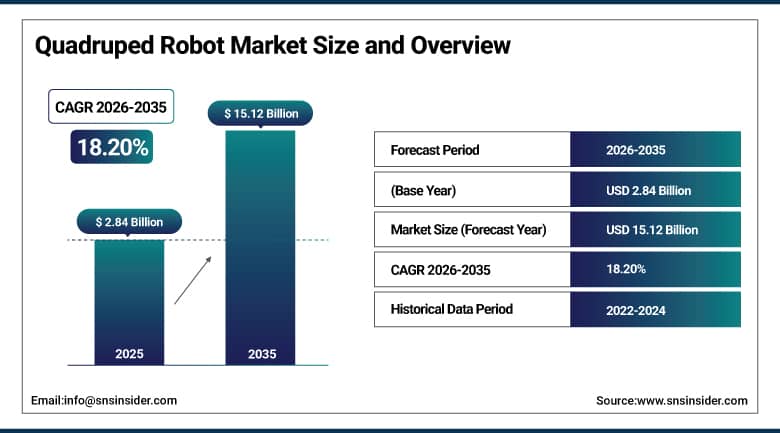
The Quadruped Robot Market size was valued at USD 2.84 billion in 2025 and is expected to reach USD 15.12 billion by 2035, growing at a CAGR of 18.20% from 2026–2035.
The global quadruped robot market is witnessing rapid growth in the global market owing to increasing adoption across defense, industrial, and commercial applications. Rising investments in autonomous robotics, artificial intelligence, and advanced mobility technologies are boosting market development. Growing deployment for inspection, surveillance, logistics, and hazardous environment operations is supporting market expansion. Manufacturers are focusing on intelligent navigation, payload optimization, and durable robotic platforms for diverse operational requirements. Rising demand from military modernization, industrial automation, and critical infrastructure inspection is driving product innovation and commercialization. Increasing integration of AI-enabled systems, edge computing, cloud connectivity, and multi-sensor fusion technologies is further accelerating market adoption.
As reported in the International Federation of Robotics World Robotics 2025, the total number of installed industrial robots worldwide, where 74% are installed in Asia. The International Organization for Standardization released the new standard for robotics systems ISO 10218-1:2025 and ISO 10218-2:2025. On the other hand, the Department of Defense of the USA and NATO have been fastening their investigation process on autonomous quadruped robots for various purposes including intelligence gathering.
To Get More Information On Quadruped Robot Market - Request Free Sample Report
Quadruped Robot Market Trends
-
AI-powered autonomous navigation has contributed to better decision-making and efficiency in various uses of quadruped robots.
-
Smart infrastructure development in cities has helped speed up the use of quadruped robots for inspection, surveillance, and utility maintenance.
-
The growth in industrial automation has led to higher demands for intelligent quadruped robots in manufacturing, energy, utilities, and logistics.
-
Integration with edge computing technology makes data processing fast and cuts down latency in autonomous inspection and monitoring.
-
Predictive maintenance and digital twin technologies have improved asset management with the help of autonomous inspection of infrastructure.
-
Robotics developers and smart infrastructure developers are working together to innovate and bring advanced quadruped robots to the market.
U.S. Quadruped Robot Market Size Outlook
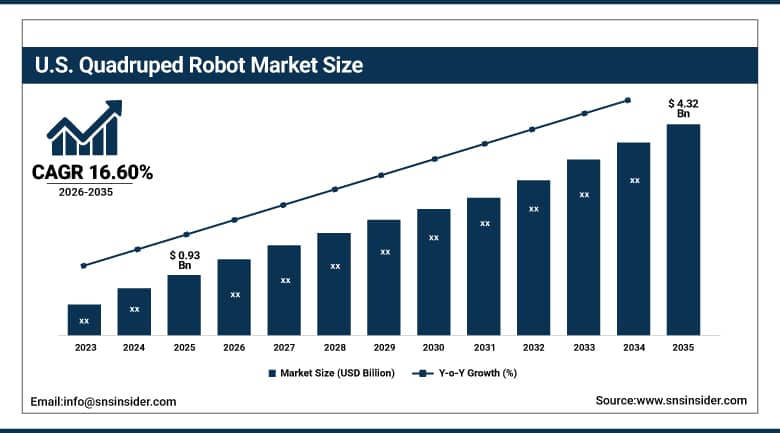
The U.S. Quadruped Robot Market was valued at USD 0.93 billion in 2025 and is expected to reach around USD 4.32 billion by 2035, growing at a CAGR of 16.60% from 2026–2035.
The U.S. quadruped robot market is expanding rapidly owing to rising defense modernization initiatives and increasing demand for autonomous robotic platforms. Growing adoption across military, industrial inspection, public safety, and critical infrastructure applications is supporting market growth nationwide. Rising investments in artificial intelligence, autonomous navigation, and advanced robotic mobility technologies are driving operational efficiency and mission effectiveness. Growth in warehouse automation and hazardous environment inspection applications is further accelerating quadruped robot deployments across industries. Manufacturers are focusing on intelligent perception, edge computing, modular payload integration, and durable robotic platforms across operational environments. Increasing use in defense organizations, logistics operations, industrial facilities, and research institutions is strengthening long-term market penetration.
According to the FY 2025 budget of the U.S. Department of Defense and Defense Innovation Unit, the development of autonomous ground robotics system has been identified as a priority area for modernization. The mobility and obstacle test standard is used by the National Institute of Standards and Technology to evaluate quadruped robots. Furthermore, according to the National Safety Council that makes use of statistics from the Bureau of Labor Statistics of the U.S., there has been a rising trend in the use of quadruped robots.
Quadruped Robot Market Segment Analysis
-
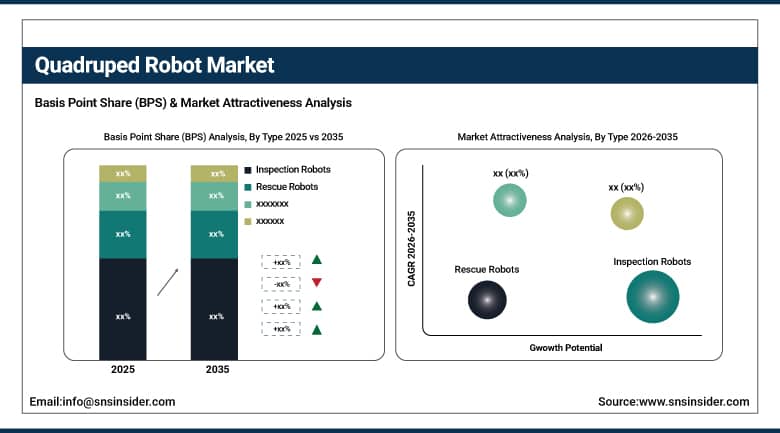
By Type, inspection robots dominated the market with 42.68% share in 2025; while rescue robots are the fastest growing segment with CAGR of 22.43% during 2026 to 2035.
-
By Technology, autonomous navigation dominated the market with 47.35% share in 2025; while AI-enabled systems are the fastest growing segment with CAGR of 22.39% during 2026 to 2035.
-
By Application, military dominated the market with 45.83% share in 2025; while industrial is the fastest growing segment with CAGR of 21.71% during 2026 to 2035.
-
By End Use, defense organizations dominated the market with 43.91% share in 2025; while logistics & warehousing is the fastest growing segment with CAGR of 22.03% during 2026 to 2035.
By Type, inspection robots dominated the quadruped robot market, while rescue robots are the fastest growing segment.
Inspection robots segment held the top spot in the quadruped robot market with the dominated share in terms of revenue in 2025. This dominance was facilitated by rising usage in industrial plants, energy infrastructure, mining operations, and utility inspections all over the world. The use of quadruped inspection robots was seen among companies to ensure the safety of workers and minimize downtimes. Ongoing developments in sensors technology, autonomy, and AI-based inspection solutions have reinforced its position.
Rescue robots segment is poised to see the fastest CAGR over the period of forecast from 2026-2035. Rising investment in disaster management, emergency services, and hazardous environment explorations in both developed and emerging economies will fuel the growth. Governments and emergency response agencies have been deploying quadruped rescue robots for their search and firefighting activities. Ongoing developments in mobility, autonomy, and situational awareness have propelled the growth of this segment.
By Technology, autonomous navigation dominated the quadruped robot market, while AIS-enabled systems are the fastest growing segment.
The Autonomous Navigation segment led the quadruped robot market and held the dominated revenue share in 2025 due to its extensive use in defense applications, industrial inspection applications, and public safety activities that require self-navigation. There was an increase in the preference for autonomous robots to minimize human interference, increase the efficiency of operation, and achieve higher accuracy of the task performed. The consistent innovations in perception systems, LiDAR, and navigation algorithms have made the technology more widely adopted.
The AI-enabled systems segment is predicted to witness the fastest CAGR during 2026-2035. Significant developments in artificial intelligence, machine learning, and computer vision technologies are transforming the quadruped robot industry in several applications and industries. Increased need for intelligent decision-making, navigation, and obstacle avoidance is driving the adoption of technology. Increased spending on edge AI computing, autonomous mission planning, and sensor fusion will contribute to future growth of the market.
By Application, military dominated the quadruped robot market, while industrial is the fastest growing segment.
The military segment held the dominated share of quadruped robot market revenue in 2025. The growing number of defense modernization and investments in autonomous robots has supported the segment’s leadership in the market. The rising applications of reconnaissance, surveillance, logistics, explosive ordnance disposal, and hazardous operations have been propelling procurement. The continuous innovations in AI-based mobility and sensing capabilities have further boosted the leadership of the Military segment.
The industrial segment is projected to be the fastest-growing segment in terms of CAGR during 2026-2035. The growing use of quadruped robots in industrial inspections, predictive maintenance, warehouse management, and hazardous environment monitoring has been fueling the market growth. There is a rising trend of the deployment of robots for improving worker safety, productivity, and asset reliability in industries.
By End Use, defense organizations dominated the quadruped robot market, while logistics & warehousing is the fastest growing segment.
The defense organizations segment is leading the quadruped robot market with the dominated share of revenues in 2025 due to increased government spending on autonomous military technology and defense upgrades which has helped immensely in deploying quadruped robots for crucial operations. The robotic systems proved to be quite useful in tasks such as reconnaissance, surveillance, logistics, explosives ordnance disposal, and border security with added safety. Rising procurement by the military and improvements in autonomous movement have further contributed to the dominance of the segment in the market.
The logistics & warehousing segment is anticipated to exhibit the fastest CAGR from 2026-2035. Growing adoption of e-commerce, warehouse automation, and advanced material handling solutions is fueling the need for efficient quadruped robots that can move around in distribution centers and perform various tasks. The robotic systems can easily move materials, inspect inventories, and move through warehouses without any human assistance. Increased investments in intelligent warehouse operations and automation solutions will boost the segment's growth during the forecast period.
Regional Analysis:
|
Region |
Major Country |
Share within Region, 2025(%) |
|---|---|---|
|
North America |
United States |
84.76% |
|
Europe |
Germany |
24.68% |
|
Asia Pacific |
China |
41.37% |
|
Middle East & Africa |
UAE |
16.24% |
|
Latin America |
Brazil |
44.15% |
North America Quadruped Robot Market Insights.
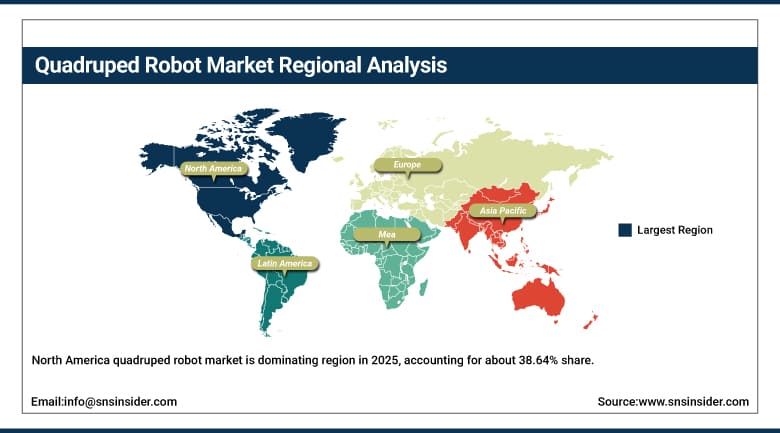
North America quadruped robot market is dominating region in 2025, accounting for about 38.64% share, driven by strong defense spending, advanced robotics innovation, and widespread adoption of autonomous robotic technologies. The region benefits from established defense contractors, leading robotics developers, and extensive artificial intelligence research capabilities. Increasing investments in military modernization, industrial automation, and infrastructure inspection are strengthening market growth. Expansion of autonomous surveillance, logistics operations, and public safety applications further reinforces the region’s dominant position in the market.
As per IFR World Robotics 2025, in 2024, the US has deployed 34,164 units of industrial robots, placing itself as the third-biggest market in the world. As per the reports of the Association for Advancing Automation, North America has received 31,311 robot orders in manufacturing, logistics, and life sciences. In addition, the US Department of Defense has increased funding in autonomous ground platforms for FY 2025 & FY 2026, which has led to the deployment of quadruped robots.
Get Customized Report as Per Your Business Requirement - Enquiry Now
Europe Quadruped Robot Market Insights.
Europe quadruped robot market is characterized by stable growth in 2025 owing to increasing adoption of autonomous robotics across industrial, research, and defense applications. Key countries include Germany, France, United Kingdom, Italy, and Spain. Rising investments in Industry 4.0 technologies, intelligent automation, and robotic inspection systems are supporting market expansion. Increasing emphasis on smart manufacturing and digital transformation is strengthening long-term industry development. Technological advancements continue encouraging autonomous mobility, precision inspection, and operational efficiency across the region.
As per IFR World Robotics 2025 Report by International Federation of Robotics, Europe constituted 16% of total industrial robot installations globally in 2024, which amounted to approximately 85,000 robots. The Horizon Europe program of the European Commission has been funding robotic systems that have the capability to autonomously navigate via AI in both industrial and public environments. This is helping quicken the deployment of quadruped robots in different sectors across Europe.
Asia Pacific Quadruped Robot Market Insights.
Asia Pacific is the fastest growing region in the quadruped robot market, registering a CAGR of about 20.01% during 2026–2035. Rapid industrialization and expanding automation adoption are driving strong market demand across China, Japan, India, South Korea, and Southeast Asia. Increasing investments in smart manufacturing, defense modernization, and artificial intelligence technologies are accelerating regional market growth. Rising industrial productivity requirements and expanding robotics research continue supporting widespread quadruped robot adoption.
Asian region accounted for 74% of industrial robots installed globally in 2024, according to IFR's World Robotics 2025 Report. China has installed 295,045 robots, accounting for 54% of the world's total installs, with Japan and South Korea being other significant regions. China launched its 2026 Robotics Action Plan by its Ministry of Industry and Information Technology, and Japan developed non-manufacturing automation schemes, leading to an increase in quadruped robots installations.
Middle East & Africa and Latin America Quadruped Robot Market Insights.
The Middle East & Africa along with Latin America regions are witnessing steady growth due to expanding industrial automation and increasing investments in defense modernization programs. Key contributing countries include Saudi Arabia, UAE, South Africa, Brazil, Mexico, and Argentina. Growing infrastructure development, mining activities, and industrial digitalization are supporting market expansion. Continued investments in autonomous robotics, artificial intelligence, and smart industrial solutions are strengthening long-term regional opportunities.
As per the IFR World Robotics 2025 report, installations of industrial robots in the Americas stood at 50,100 units in 2024. According to the World Bank, the share of urban population in Latin America and the Caribbean stands at 82%, while that of Sub-Saharan Africa is at 44%. As more investments are being made in smart infrastructures, industrial diversification, and workplace safety, the adoption of quadruped robots is growing fast.
Market Dynamics
Growth Drivers: Industrial automation and smart infrastructure inspection are accelerating intelligent quadruped robot adoption globally.
Increasing automation in industry has led to the extensive use of quadruped robots in a variety of industries such as manufacturing, energy, utilities, and inspection of infrastructures. The industries need autonomous robots that can perform inspections in unsafe or hard-to-reach conditions. These robots help in improving the accuracy of the inspection process and decrease the cost of operations. Investments in smart factories and predictive maintenance programs are further driving the technological adoption. Use of artificial intelligence, machine vision, and mobility solutions has made it easy to perform inspections in industrial environments. Increasing digitalization drives the adoption of quadruped robots globally.
As per the ITU and U4SSC, there are over 250 cities in the world that are adopting digital infrastructure standards for their transformational and sustainable development. At the same time, quadruped robots are seeing an increase in their deployment in industrial inspection, hazardous environmental monitoring, and city-level applications due to the advancements in the field of embodied AI and autonomous navigation.
Restraints: Limited battery endurance and harsh environments restrict continuous autonomous quadruped robot operations globally.
Low battery performance impacts efficiency while performing extended duties in industrial, defense, and emergency response applications all around the world. The quadruped robots need a lot of energy for their autonomous movement, high-level sensors and AI systems. Battery charging limits their efficiency during inspection or surveillance operations that require extended working periods of time. Extreme climate, terrain, and environmental conditions bring additional technological difficulties. Better batteries and energy storage systems play an important role in wider usage of these robots. Such operational issues have been continuing to affect purchases in several end-use industries.
Opportunities: AI, edge computing, and smart cities accelerate autonomous quadruped robot deployment across industries.
As the implementation of smart cities grows, there will be more applications for autonomous robots within urban infrastructure management. The application of artificial intelligence, edge computing, cloud computing, and digital twins allows for making intelligent decisions and monitoring processes remotely. Robotic systems are being utilized by municipal governments for inspections, safety, and utility services. Ongoing developments in intelligent transportation systems, energy infrastructure, and environmental monitoring support the use of technology. Increasing cooperation between the robotics companies and the providers of smart infrastructure will contribute to the development of new products.
As per the report IFR World Robotics 2025 and smart city metrics of ITU, robot usage across the globe increased immensely as there were 542,000 industrial robots in use along with an increase of 9% in professional service robot usages. Over 250 cities have embraced the United for Smart Sustainable Cities framework of the ITU. The evolution in the field of AI, IoT and edge computing is making the usage of autonomous quadruped robots very popular.
Recent Developments
-
2026: Yokogawa Electric Corporation integrated its OpreX Robot Management Core software with ANYbotics' ANYmal quadruped robots to automate industrial inspections.
-
2025: Unitree Robotics achieved mass-production output exceeding 6,500 units specifically for its pure humanoid robot line.
-
2025: DEEP Robotics launched the LYNX M20 wheel-legged robot designed for navigating and inspecting highly unstructured industrial environments.
-
2024: Ghost Robotics finalized a strategic partnership following a 240-million-dollar acquisition of a 60 percent controlling stake by LIG Nex1.
Quadruped Robot Companies are:
-
ANYbotics
-
Unitree Robotics
-
Ghost Robotics
-
Weilan
-
Xiaomi
-
Tencent
-
Sony
-
Kawasaki Heavy Industries
-
Honeybee Robotics
-
Agility Robotics
-
PAL Robotics
-
Clearpath Robotics
-
Lynxmotion
-
Chironix
-
Mecanum
-
Aubo Robotics
-
Keyi Tech
-
Direct Drive Tech
Quadruped Robot Market Report Scope:
| Report Attributes | Details |
|---|---|
| Market Size in 2025 | USD 2.84 Billion |
| Market Size by 2035 | USD 15.12 Billion |
| CAGR | CAGR of 18.20% From 2026 to 2035 |
| Base Year | 2025 |
| Forecast Period | 2026-2035 |
| Historical Data | 2022-2024 |
| Report Scope & Coverage | Market Size, Segments Analysis, Competitive Landscape, Regional Analysis, DROC & SWOT Analysis, Forecast Outlook |
| Key Segments | • By Type: Service Robots, Inspection Robots, Rescue Robots, Research Robots • By Technology: Autonomous Navigation, Remote Control, Tele-operated, AI-Enabled Systems • By Application: Military, Industrial, Agriculture, Surveillance • By End Use: Defense Organizations, Logistics & Warehousing, Healthcare Institutions, Research & Academic Institutes, Others |
| Regional Analysis/Coverage | North America (US, Canada), Europe (Germany, UK, France, Italy, Spain, Russia, Poland, Rest of Europe), Asia Pacific (China, India, Japan, South Korea, Australia, ASEAN Countries, Rest of Asia Pacific), Middle East & Africa (UAE, Saudi Arabia, Qatar, South Africa, Rest of Middle East & Africa), Latin America (Brazil, Argentina, Mexico, Colombia, Rest of Latin America). |
| Company Profiles | Boston Dynamics, ANYbotics, Unitree Robotics, Ghost Robotics, DEEP Robotics, Weilan, Xiaomi, Tencent, Sony, Kawasaki Heavy Industries, Honeybee Robotics, Agility Robotics, PAL Robotics, Clearpath Robotics, Lynxmotion, Chironix, Mecanum, Aubo Robotics, Keyi Tech, Direct Drive Tech |

Frequently Asked Questions
The quadruped robot market is expected to grow at a CAGR of 18.20% from 2026 to 2035.
The inspection robots dominated due to industrial inspections, safety improvements, asset monitoring, and reduced operational downtime.
The major growth factors include autonomous robotics adoption, AI investments, advanced mobility technologies, inspection demand, hazardous deployment, and integration of edge computing with multi-sensor fusion systems.
The quadruped robot market was valued at USD 2.84 billion in 2025.
