
RF Transceiver Market Report Scope & Overview:
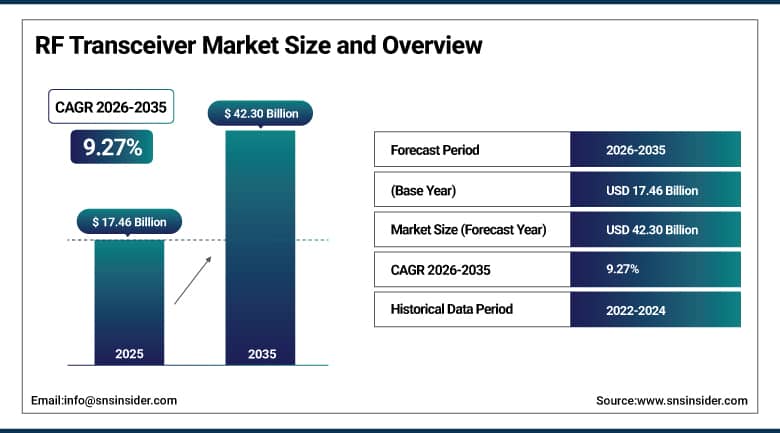
The RF Transceiver Market size was valued at USD 17,110.8 million in 2025 and is expected to reach USD 34,052.9 million by 2035, growing at a CAGR of 7.16% from 2026–2035.
The global RF transceiver market is witnessing steady growth in the global market owing to increasing demand for advanced wireless communication technologies. Rising deployment of 5G infrastructure, software-defined radios, satellite communication systems, and IoT connectivity is accelerating market expansion. Semiconductor manufacturers and communication equipment providers are focusing on multi-band integration, low-power architectures, high-frequency operation, and AI-enabled signal processing capabilities. Growing investments in defense modernization, aerospace communication networks, industrial wireless automation, and next-generation connectivity solutions are supporting technology advancement. Increasing demand for secure data transmission, spectrum efficiency, public safety communications, and high-peRFormance RF systems is further driving market adoption.
As stated by the International Telecommunication Union Facts and Figures 2025 report, global deployment of wireless communication infrastructure shows substantial acceleration, with advanced 5G networks now covering 55% of the global population. This network expansion directly drives extensive adoption of advanced radio frequency component hardware, as global 5G subscriptions reached 3 billion, representing one third of all mobile broadband connections, although network coverage remains concentrated at 84% in wealthy nations.
To Get More Information On RF Transceiver Market - Request Free Sample Report
RF Transceiver Market Trends
-
Increasing deployment of 5G infrastructure is accelerating demand for high-performance RF transceiver solutions worldwide.
-
Industrial IoT adoption is expanding RF transceiver integration across smart factories and automated manufacturing environments.
-
AI-enabled signal processing is enhancing communication efficiency, reliability, and spectrum utilization in RF transceivers.
-
Growing adoption of software-defined radios is driving demand for flexible and multi-band RF transceiver architectures.
-
Rising investments in private wireless networks are strengthening deployment across industrial and enterprise communication systems.
-
Low-power and high-frequency RF transceiver technologies are supporting next-generation wireless connectivity and digital transformation initiatives.
U.S. RF Transceiver Market Size Outlook
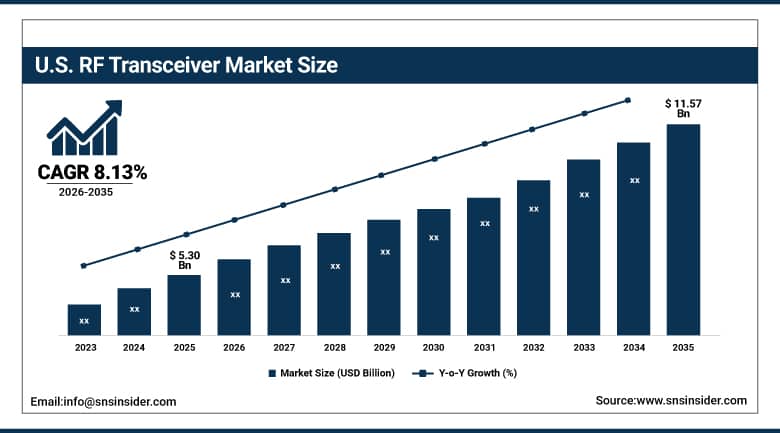
The U.S. RF Transceiver Market was valued at USD 4,546.0 billion in 2025 and is expected to reach around USD 7,769.9 million by 2035, growing at a CAGR of 5.53% from 2026–2035.
The U.S. RF transceiver market is expanding steadily owing to rising deployment of advanced wireless communication infrastructure across critical industries. Increasing adoption by defense organizations, telecommunications operators, aerospace companies, and industrial enterprises is supporting market growth nationwide. Rising investments in 5G networks, satellite communication systems, software-defined radios, and high-peRFormance semiconductor technologies are driving connectivity efficiency and communication reliability. Growth in defense modernization and next-generation wireless connectivity initiatives is further accelerating RF transceiver deployments across industries. Manufacturers are focusing on multi-band integration, low-power architectures, AI-enabled signal processing, and advanced spectrum management technologies across diverse applications. Increasing demand for secure wireless communication, high-speed data transmission, and reliable RF connectivity is strengthening long-term market penetration.
As stated by EMC radiated immunity test standards such as IEC 61000-4-3, modern wireless technologies should be capable of showing a reliable peRFormance when exposed to strong electromagnetic fields. Multi-band Software Defined Networks using Sub-6GHz 5G New Radio bands should pass EMC tests in an electromagnetic range between 0.1 – 30 Volts per meter (V/m). EMC testing standards demand that the measurement uncertainty of the electromagnetic field should not exceed ±6dB, whereas lab calibration is ±3dB.
RF Transceiver Market Segment Analysis
-
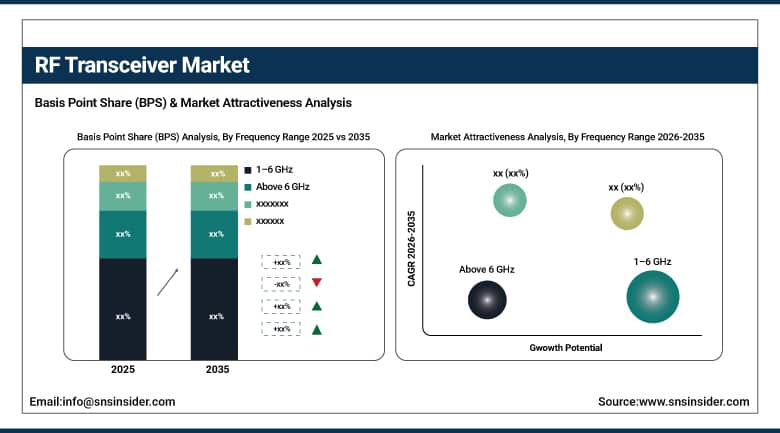
By Frequency Range, 1–6 GHz dominated the market with 52.1% share in 2025; while above 6 GHz are the fastest growing segment with CAGR of 8.19% during 2026 to 2035.
-
By Product Type, single channel (1Rx/1Tx) dominated the market with 54.5% share in 2025; while multi-channel (More than 4Rx/4Tx) are the fastest growing segment with CAGR of 8.78% during 2026 to 2035.
-
By SDR Platform, embedded SDR modules dominated the market with 53.7% share in 2025; while portable SDR systems are the fastest growing segment with CAGR of 8.0% during 2026 to 2035.
-
By Application, telecommunications and wireless infrastructure dominated the market with 26.9% share in 2025; while satellite communications is the fastest growing segment with CAGR of 9.75% during 2026 to 2035.
By Frequency Range, 1–6 GHz dominated the RF transceiver market, while above 6 GHz are the fastest growing segment.
The 1-6 GHz segment accounted for the dominated share in the RF transceiver market revenue in 2025 due to its peRFect balance between coverage, capacity, and peRFormance. This frequency band is widely used in 4G/5G networks, Wi-Fi networks, industrial wireless systems, defense communications, and satellite communications. Extensive compatibility with ecosystem solutions, maturity in semiconductor technology, and infrastructure deployment are making the demand stronger in commercial and government communication networks worldwide.
The above 6 GHz segment is projected to witness the fastest CAGR during the forecast period, 2026-2035 due to growing applications of high-capacity wireless communication solutions that need ultra-high-speed data transfer. The expanding use of 5G mmWave networks, advanced radar systems, satellite communication solutions, and defense systems is driving the growth. Innovations in RF semiconductor design, beamforming technology, and spectrum management are further contributing to market expansion in new applications.
By Product Type, single channel (1Rx/1Tx) dominated the RF transceiver market, while multi-channel (More than 4Rx/4Tx) are the fastest growing segment.
Single channel (1Rx/1Tx) segment held the dominated market share by revenue in the RF transceiver market during 2025. This dominance stems from the segment’s critical importance as the fundamental transceiver architecture used in the largest number of RF applications worldwide, ranging from consumer internet-of-things (IoT) devices, industrial wireless sensors and public safety radio terminals, to low-end software-defined radio systems and legacy telecommunications networks where single-antenna architectures still reign commercially supreme.
Multi-channel (More than 4Rx/4Tx) segment would show the fastest CAGR during 2026–2035 due to increasing adoption of high-capacity wireless communication, beam forming techniques, and Massive Multiple Input Multiple Output (MIMO) architecture in next-generation network infrastructures. Multi-channel RF transceivers allow more effective spectrum utilization, higher data rate, and better communication reliability under any conditions. Growing investments in defense equipment upgrades, satellite communication systems, and 6G technologies research projects have been driving their fast growth.
By SDR Platform, embedded SDR modules dominated the RF transceiver market, while portable SDR systemsare the fastest growing segment.
Embedded SDR systems accounted for the dominated market share in the RF transceiver market in terms of revenue in 2025, attributed to the growing usage in smaller wireless equipment, autonomous platforms, and IoT technology. Embedded SDR Modules offer small form factor, low power consumption, ability to update software and enhanced multi-band communication capability. Adoption of embedded SDR modules in unmanned systems, edge computing applications, smart industrial machinery, and wireless communication technology is boosting growth of the market.
It can be noted that the portables SDRs will experience the fastest CAGR during the period from 2026 to 2035, mainly due to the growing usage of wideband frequency-agile portable radio systems in various applications including defense tactical communications, electronic warfare reconnaissance, spectrum monitoring and regulation, public safety communications, and academic applications, as the flexibility of the portable SDR system gives a distinct advantage over the fixed frequency radio terminals.
By Application, telecommunications & wireless infrastructure dominated the RF transceiver market, while Satelliet Communications are the fastest growing segment.
Telecommunication & wireless infrastructure segment was the major contributor of revenue share to RF transceiver market due to growing adoption of 5G and future 6G network infrastructures. Increasing spending on base stations, small cells, private wireless network, and high capacity backhaul infrastructure is driving growth within RF transceivers segment. Increasing need for low latency connectivity, efficient spectrum usage, and seamless data transmission is also boosting rapid growth within telecommunication infrastructure segment.
The Satellite Communications market segment will post the highest CAGR from 2026 to 2035 due to the revolutionary growth of the satellite communications market sector due to the rise in development of large LEO broadband satellite communications constellations like SpaceX Starlink, Amazon Kuiper, OneWeb, and Telesat Lightspeed, which all together will need tens of millions of RF transceiver chips for user terminals as well as ground gateway stations and satellite payloads transponder RF transceivers.
Regional Analysis
|
Region |
Major Country |
Share within Region, 2025(%) |
|---|---|---|
|
North America |
United States |
89.3% |
|
Europe |
Germany |
23.3% |
|
Asia Pacific |
China |
36.9% |
|
Middle East & Africa |
Saudi Arabia |
30.14% |
|
Latin America |
Brazil |
35.4% |
North America RF Transceiver Market Insights
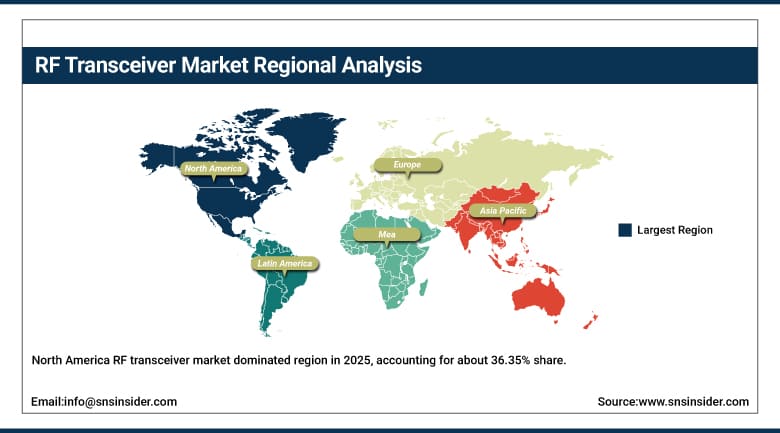
North America RF transceiver market accounted for about 29.75% share in 2025, driven by increasing deployment of advanced wireless communication infrastructure across defense, aerospace, and commercial sectors. The region benefits from a strong semiconductor ecosystem, continuous defense modernization, and leading communication technology companies. Increasing adoption of software-defined radios, 5G infrastructure, satellite communication systems, and high-frequency wireless networks is strengthening market growth. Expansion of next-generation connectivity technologies further reinforces the region’s dominant position in the market.
As described in the 2025 IEEE International Symposium on Antennas and Propagation and North American Radio Science Meeting framework document, state-of-the-art microarchitecture in sub-terahertz radio frequency transceivers has led to an excellent optimization of compact physical footprint sizes to precisely 0.24 by 0.42 lambda. The structural enhancement spans the local hardware footprint and allows for the achievement of 39% fractional impedance bandwidth along with 42% radiation efficiency on low resistivity silicon substrate process technology.
Get Customized Report as Per Your Business Requirement - Enquiry Now
Europe RF Transceiver Market Insights
Europe RF transceiver market is characterized by stable growth in 2025 owing to increasing investments in advanced wireless communication infrastructure and semiconductor innovation. Key countries include Germany, France, United Kingdom, Italy, and Netherlands. Rising deployment of industrial wireless networks, satellite communication platforms, and secure defense communication systems is supporting market expansion. Increasing adoption of software-defined radios and next-generation connectivity technologies is strengthening long-term industry development. Technological advancements continue encouraging efficient spectrum utilization and reliable wireless communication across the region.
In accordance with the Connectivity Coverage in Europe 2025 report by the European Commission, fast-paced growth in digital infrastructure created considerable regional demands for wireless communication devices. As a result, 5G network coverage in the 27 member countries of the European Union stood at 96.8% in mid-2025 compared to 94.4% in the previous year. Besides, coverage of the gigabit networks rose to 84.3% and coverage of fixed very high-capacity networks was found to be at 85.5%.
Asia Pacific RF Transceiver Market Insights
Asia Pacific domianted and is the fastest growing region in the RF transceiver market, registering a CAGR of about 8.55% during 2026–2035. Rapid industrialization and increasing deployment of 5G infrastructure are driving strong market demand across China, Japan, India, South Korea, and Southeast Asia. Rising investments in semiconductor manufacturing, satellite communication systems, and industrial wireless connectivity are accelerating regional market growth. Growing digital transformation and expanding IoT ecosystems continue supporting widespread RF transceiver deployment across communication infrastructure.
According to UNCTAD 2025 statistics, the global digital economy is growing at the pace of 10% to 12% every year, faster than conventional economic growth measured in terms of GDP. Internationally traded goods and services that can be delivered digitally had grown to about USD 5.4 trillion as digital networks spread into the developing countries and Asia Pacific nations. E-commerce sales worth about USD 27 trillion are driving demand for advanced electronic equipment.
Middle East & Africa and Latin America RF Transceiver Market Insights
The Middle East & Africa along with Latin America regions are witnessing steady growth due to expanding wireless communication infrastructure and increasing investments in digital connectivity projects. Key contributing countries include Saudi Arabia, UAE, South Africa, Brazil, Mexico, and Argentina. Growing adoption of 5G networks, satellite communication systems, industrial IoT, and secure wireless technologies is supporting market expansion. Continued investments in telecommunications infrastructure are strengthening long-term regional opportunities.
According to the Facts and Figures 2025 report by the International Telecommunication Union, the regional telecommunication infrastructure that supports hardware components such as RF transceivers has increased immensely to a point where there were 89% mobile broadband subscriptions around the world. The internet penetration was at 36% in Africa, 70% in the Arab States, and 88% in the Americas. Although 55% of the global 5G network population coverage has been achieved, there is just 4% in low-income countries.
Market Dynamics
Growth Drivers: Rapid 5G infrastructure expansion drives global demand for advanced RF transceiver technologies.
The growing usage of 5G base stations and private wireless networks is leading to consistent demand for modern RF transceivers. Telecom service providers are making huge investments in the deployment of fast and efficient communication systems for enhanced data transfer and better network coverage. The increasing use of software-defined radios, edge computing, and massive IoT connectivity is enhancing the product usage. The regular progress in terms of spectrum efficiency, low latency communications, and high-frequency signal processing is enhancing operating capabilities. Increasing digitization efforts in commercial, industrial, and public domains are driving growth prospects.
In accordance with the International Telecommunication Union and China's Ministry of Industry and Information Technology, global 5G network coverage was at 55% of the population by 2025. The number of 5G subscriptions worldwide stood at 3 billion, while China increased its base station installations to 4.838 million with an average of 34.4 base stations per 10,000 persons. Such deployment necessitates massive deployment of key components because the new infrastructure needs to cater to 1.204 billion domestic subscribers.
Restraints: Spectrum regulations and evolving compliance requirements increase complexity for RF transceiver deployment.
Wireless communications technologies function within stringent regulatory schemes that regulate spectrum use, transmission powers, and electromagnetic compatibility standards worldwide. Constantly, there is need for redesigning of products to match the ever-changing requirements of regulation schemes in different regions. The process of certification leads to an increase in time and cost required for developing and marketing the products in various geographic regions. Regulatory standard variations among different countries make it even more difficult to deploy products internationally. This has remained a problem to date for radio-frequency transceivers.
Opportunities: Industrial IoT adoption is expanding intelligent RF transceiver deployment opportunities globally.
There is growing need for robust wireless communication systems that can facilitate efficient real-time operations as industrial automation and connected manufacturing facilities are gaining more ground. The increasing adoption of smart factories, autonomous machines, and IoT-based industrial devices is fueling the demand for sophisticated RF transceivers. Companies are embedding advanced communication systems enabled by AI, power-efficient solutions, and wireless security in next generation industrial solutions. Increasing investments in infrastructure development and digital manufacturing are opening up market avenues. Expansion of industrial ecosystems is anticipated to drive RF transceivers market growth ahead.
According to data by the International Telecommunications Union in 2025, the number of 5G cellular networks that provide coverage for about 55% of the entire world’s population rose, while the total number of 5G subscribers increased to roughly 3 billion individuals. The enormous amount of development in infrastructure is what fuels the deployment of smart transceivers since current manufacturing plants incorporate low-latency wireless networks for monitoring of their automation equipment through industrial IoT networks.
Recent Developments
-
2026: Texas Instruments showcased a 64 GSPS direct RF sampling transceiver operating up to 40 GHz for Ka-band multi-mission systems.
-
2025: STMicroelectronics launched the ST60A3H0 60GHz V-band connectivity transceiver featuring low power operation and eUSB2 compliance.
-
2025: Analog Devices expanded its wireless portfolio by offering the ADRV9006 dual narrow-band and wide-band RF transceiver.
-
2024: NXP Semiconductors implemented zero-emission sustainability goals, targeting transition to 100% renewable electricity across its global fabs.
RF Transceiver Companies are:
-
MAXLINEAR
-
RENESAS ELECTRONICS CORPORATION.
-
SILICON LABORATORIES.
-
STMICROELECTRONICS
-
FILTRONIC PLC
-
LIME MICROSYSTEMS LTD.
-
QUALCOMM INCORPORATED
-
NXP SEMICONDUCTORS
-
QORVO US, INC
-
RADIOMETRIX LTD.
-
SEMTECH CORPORATION
-
SEQUANS
-
SIGNALCHIP
-
SIVERS SEMICONDUCTORS AB
-
TEXAS INSTRUMENTS INCORPORATED
-
ANALOG DEVICES, INC.
-
BROADCOM
-
MEDIATEK
RF Transceiver Market Report Scope:
| Report Attributes | Details |
|---|---|
| Market Size in 2025 | USD 17,110.8 Million |
| Market Size by 2035 | USD 34,052.9 Million |
| CAGR | CAGR of 7.16% From 2026 to 2035 |
| Base Year | 2025 |
| Forecast Period | 2026-2035 |
| Historical Data | 2022-2024 |
| Report Scope & Coverage | Market Size, Segments Analysis, Competitive Landscape, Regional Analysis, DROC & SWOT Analysis, Forecast Outlook |
| Key Segments | • By Product Type (Single Channel (1Rx/1Tx), Dual Channel (2Rx/2Tx), Quad Channel (4Rx/4Tx), Multi-Channel (More than 4Rx/4Tx)) • By Frequency Range (Sub-1 GHz, 1–6 GHz, Above 6 GHz) • By SDR Platform (Fixed SDR Systems, Portable SDR Systems, Embedded SDR Modules) • By Application (Military & Defense, Telecommunications & Wireless Infrastructure, Satellite Communications, Aerospace & Avionics, Public Safety & Emergency Communications, Industrial & IoT, Research & Academia, Others) |
| Regional Analysis/Coverage | North America (US, Canada), Europe (Germany, UK, France, Italy, Spain, Russia, Poland, Rest of Europe), Asia Pacific (China, India, Japan, South Korea, Australia, ASEAN Countries, Rest of Asia Pacific), Middle East & Africa (UAE, Saudi Arabia, Qatar, South Africa, Rest of Middle East & Africa), Latin America (Brazil, Argentina, Mexico, Colombia, Rest of Latin America). |
| Company Profiles |
MAXLINEAR, MICROCHIP TECHNOLOGY INC., RENESAS ELECTRONICS CORPORATION, SILICON LABORATORIES, STMICROELECTRONICS, FILTRONIC PLC, LIME MICROSYSTEMS LTD., NORDIC SEMICONDUCTOR, QUALCOMM INCORPORATED, NXP SEMICONDUCTORS, QORVO US, INC., RADIOMETRIX LTD., SEMTECH CORPORATION, SEQUANS, SIGNALCHIP, SIVERS SEMICONDUCTORS AB, TEXAS INSTRUMENTS INCORPORATED, ANALOG DEVICES, INC., BROADCOM, MEDIATEK. |

Frequently Asked Questions
North America dominated the RF transceiver market in 2025.
The RF transceiver market was valued at USD 17.46 billion in 2025.
The major growth factors include 5G deployment, software-defined radios, satellite communications, Industrial IoT, defense modernization, and advancements in AI-enabled signal processing, multi-band integration, and low-power RF technologies.
The dual channel (2Rx/2Tx) dominated in 2025 due to reliable performance, low power consumption, and broad applications.
The RF transceiver market is expected to grow at a CAGR of 9.27% from 2026 to 2035.
