
Astable Multivibrator Market Report Scope & Overview:
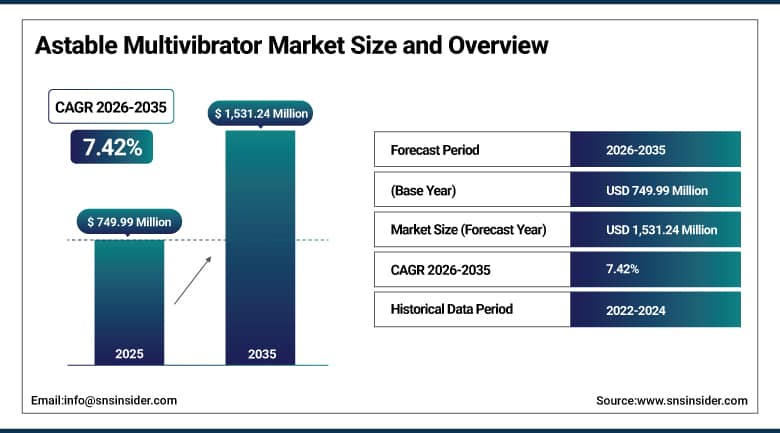
The Astable Multivibrator Market size was valued at USD 749.99 million in 2025 and is expected to reach USD 1,531.24 million by 2035, growing at a CAGR of 7.42% from 2026–2035.
The global astable multivibrator market is witnessing steady growth in the global market owing to increasing demand for electronic timing and pulse generation solutions. Rising adoption across consumer electronics, telecommunications, automotive systems, industrial automation, and embedded electronic devices is boosting market development. Growing investments in integrated circuit technologies, transistor-based designs, and operational amplifier configurations are supporting market expansion. Manufacturers are focusing on frequency stability improvement, waveform accuracy enhancement, and low-power circuit designs. Rising demand from timing applications, signal processing systems, and automated electronic equipment is driving technology modernization. Increasing integration of compact semiconductor components, advanced circuit architectures, and intelligent electronic technologies is further accelerating market adoption.
As per the World Semiconductor Trade Statistics report and the European Commission’s European Chips Act, increased semiconductor production has bolstered worldwide electronics manufacturing. There has been an increase in the demand for integrated circuits used in industrial automation, automotive electronics, and consumer devices, which has made the use of timing solutions more imperative than ever before. Increasing investments in semiconductor fabrication are encouraging the widespread use of astable multivibrators.
To Get More Information On Astable Multivibrator Market - Request Free Sample Report
Astable Multivibrator Market Trends
-
-
Rising Industry 4.0 adoption is accelerating demand for precision timing and pulse generation circuits across manufacturing facilities.
-
Smart factories increasingly integrate astable multivibrators for reliable signal synchronization and automated process control applications.
-
Semiconductor manufacturers are developing compact, energy-efficient astable multivibrator solutions with improved frequency stability and reliability.
-
Growing embedded electronics adoption is expanding astable multivibrator applications across automotive, industrial, and consumer electronic devices.
-
Increasing investments in semiconductor fabrication are supporting innovation in low-power timing and oscillator circuit technologies globally.
-
Advanced industrial automation and intelligent electronic systems continue driving long-term demand for high-performance astable multivibrator solutions.
-
U.S. Astable Multivibrator Market Outlook
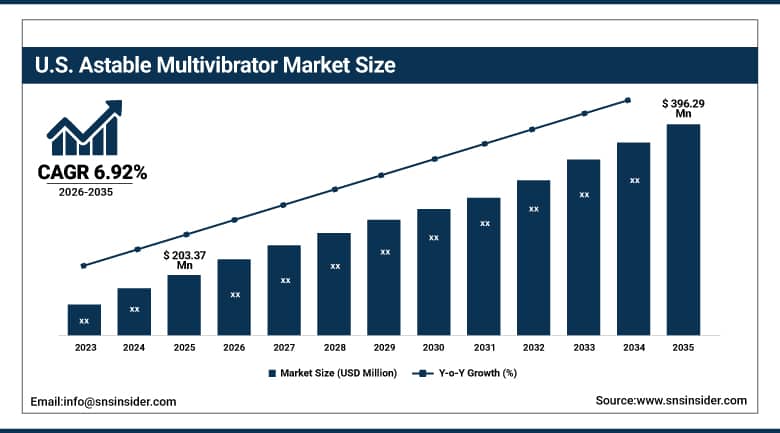
The U.S. Astable Multivibrator Market was valued at USD 203.37 million in 2025 and is expected to reach around USD 396.29 million by 2035, growing at a CAGR of 6.92% from 2026–2035.
The U.S. astable multivibrator market is expanding steadily owing to rising demand for electronic timing and pulse generation solutions. Increasing adoption across consumer electronics, industrial automation, automotive electronics, and telecommunications equipment is supporting market growth nationwide. Rising investments in advanced integrated circuits, transistor-based designs, and operational amplifier technologies are driving operational efficiency and improved timing performance. Growth in embedded electronic systems and next-generation automation applications is further accelerating astable multivibrator deployments across industries. Manufacturers are focusing on low-power designs, miniaturization, and advanced semiconductor integration capabilities across multivibrator systems. Increasing use in timing circuits, frequency generation, and electronic control applications is strengthening long-term market penetration.
The International Telecommunication Union notes that increased connectivity throughout the globe is resulting in the growing need for electronic timekeeping technologies. The increase in usage of automation systems, consumer electronics, and communication gadgets is necessitating more accurate pulse generators and oscillator circuits. Increased sophistication in semiconductor and embedded system usage is promoting the use of astable multivibrators across the globe. Such technological developments have continuously been helping in the production of small and efficient electronics.
Astable Multivibrator Market Segment Analysis
-
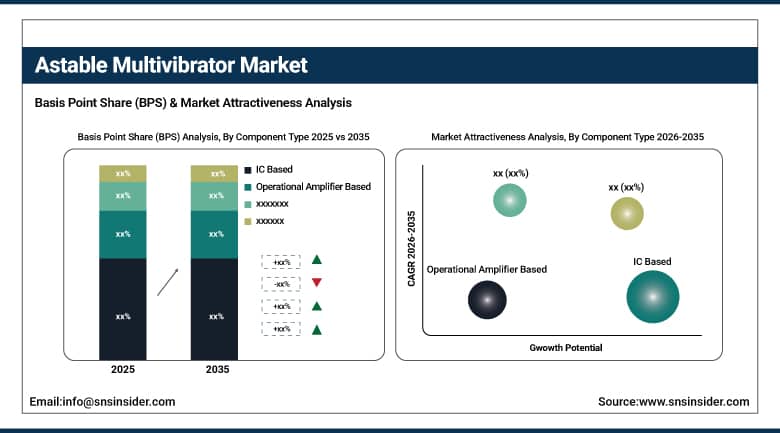
By Component Type, IC based dominated the market with 45.60% share in 2025; while operational amplifier based are the fastest growing segment with CAGR of 9.40% during 2026 to 2035.
-
By Application, timer circuits dominated the market with 32.45% share in 2025; while pulse generation are the fastest growing segment with CAGR of 10.11% during 2026 to 2035.
-
By Distribution Channel, distributors dominated the market with 45.40% share in 2025; while online retail is the fastest growing segment with CAGR of 11.06% during 2026 to 2035.
-
By End Use Industry, consumer electronics dominated the market with 36.80% share in 2025; while industrial automation is the fastest growing segment with CAGR of 10.39% during 2026 to 2035.
By Component Type, IC based dominated the astable multivibrator market, while operational amplifier based is the fastest growing segment.
The IC based segment captured the dominated market share in terms of revenue in 2025. The dominance was owing to the increased use of the component in consumer electronics, telecommunication devices, automobiles, and industrial automation devices where there is a need for compact and reliable timers. ICs have advantages such as low power consumption, better frequency stability, low number of components, easy manufacturing process, and economical mass production, which led to its increased adoption in various electronic devices around the globe.
The operational amplifier-based segment is projected to witness the fastest CAGR during 2026-2035. The growth of the segment is due to the growing preference for precise waveform generation, frequency adjustment, and ease in designing the circuit configuration. Operational amplifier-based astable multivibrators offer increased accuracy in signals and flexibility in designing, making them suitable for advanced analog systems. Increased investment in instruments, automation systems, and electronics education is also contributing to the same.
By Application, timer circuits dominated the astable multivibrator market, while pulse generation is the fastest growing segment.
The Timer Circuits segment held the dominated revenue share in the astable multivibrator market in 2025 due to the widespread use of these circuits in consumer electronics, industrial control systems, automotive, and communications devices that need stable timer functions. This circuit generates stable clock pulses or signals, offers periodic pulse generation, and provides economic performance for a variety of electronic applications.
Pulse Generation is projected to register the fastest CAGR between 2026 and 2035. The increasing demand for high-speed digital electronics, embedded systems, industrial automation, and communications has been driving the adoption of these circuits. Increasing usage of pulse generation circuits for signal generation, waveform generation, testing equipment, and microcontroller operations needing accurate output is fueling segment growth.
By Distribution Channel, distributors dominated the astable multivibrator market, while online retail is the fastest growing segment.
Distributors held the dominated market share with highest revenue share in 2025 due to wide availability of products in industrial and commercial markets. Availability of established relations with suppliers, technical services, bulk purchasing capacity, and proper inventory management help in the supply of components efficiently. Distribution channels catering to consumer electronics, telecommunication companies, automotive, and industrial automation manufacturers increased the dominance of distributors while catering to procurement and continuous production requirements.
Online retail segment will witness the fastest CAGR between 2026-2035 due to increasing adoption of digitalization among organizations and individuals. Increasing e-commerce websites providing wide range of choices, cost-effective options, easy procurement process, and quick deliveries in various geographical locations are contributing towards the growth of online retail segment. Increasing demand from small manufacturers, educational institutes, electronics enthusiasts, and prototype designers are adding to the growth of online purchases.
By End Use Industry, consumer electronics dominated the astable multivibrator market, while industrial automation is the fastest growing segment.
The consumer electronics segment held the dominated revenue share of the astable multivibrator market in 2025. This is due to the extensive use of timing circuitry in smartphones, wearables, televisions, game consoles, and other home electronic appliances. Astable multivibrators have the ability to generate pulses, time clocks, and flashes within compact electronic applications. Moreover, the rising demand for small, efficient, and feature-laden electronic devices amongst consumers has been adding impetus to its adoption globally.
The industrial automation segment is projected to witness the fastest CAGR during 2026-2035. This is due to growing use of automated machines, PLCs, robots, and intelligent production systems in industrial plants. Astable multivibrators are used extensively in the timing control, signal synchronization, and pulse generating applications of automation equipment. Increasing adoption of smart factories and process control solutions has been boosting the market growth further.
Regional Analysis
|
Region |
Major Country |
Share within Region, 2025(%) |
|---|---|---|
|
North America |
United States |
78.60% |
|
Europe |
Germany |
24.80% |
|
Asia Pacific |
China |
41.20% |
|
Middle East & Africa |
UAE |
17.10% |
|
Latin America |
Brazil |
43.60% |
North America Astable Multivibrator Market Insights.
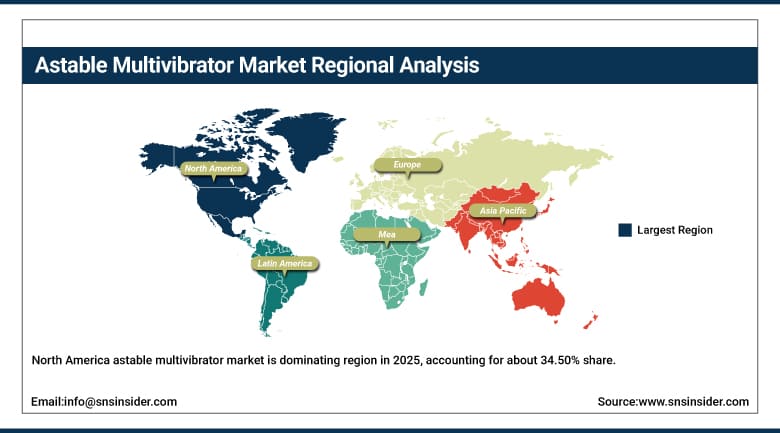
North America astable multivibrator market is dominating region in 2025, accounting for about 34.50% share, driven by strong demand for advanced electronic control systems, semiconductor innovation, and widespread adoption of industrial automation technologies. The region benefits from established electronics manufacturing capabilities and high investments in aerospace, automotive, and telecommunications sectors. Increasing deployment of embedded systems and intelligent electronic devices is strengthening market growth. Expansion of next-generation automation technologies further reinforces the region’s dominant position in the market.
According to the US Semiconductor Industry Association and US Department of Commerce CHIPS Program Office, the increase in domestic fabrication capacity for semiconductors is improving the manufacture of advanced electronics. Increased manufacture of integrated circuits means that there will be more demands for timing and pulse generation solutions by different industries. The widespread use of consumer electronics, industrial automation, automotive electronics, and telecommunications equipment will keep favoring the use of astable multivibrator circuits.
Get Customized Report as Per Your Business Requirement - Enquiry Now
Europe Astable Multivibrator Market Insights.
Europe astable multivibrator market is characterized by stable growth in 2025 owing to increasing demand for industrial automation systems and advanced electronic technologies. Key countries include Germany, France, United Kingdom, Italy, and Spain. Rising investments in smart manufacturing, automotive electronics, and industrial control equipment are supporting market expansion. Increasing adoption of integrated semiconductor solutions is strengthening long-term industry development. Technological advancements continue encouraging efficient timing control and high-performance pulse generation circuits across the region.
As per the reporting on the Digital Decade by the European Commission and Eurostat data sets, the increased use of 5G networks and industrial production is resulting in growing demands for advanced electronic timing components. The increased use of telecoms components, automotive parts, and automation equipment makes synchronization essential. As the digital nature of automobiles and industries is growing, astable multivibrators are increasingly being integrated into these applications.
Asia Pacific Astable Multivibrator Market Insights.
Asia Pacific is the fastest growing region in the astable multivibrator market, registering a CAGR of about 9.17% during 2026–2035. Rapid industrial automation and expanding semiconductor manufacturing capabilities are driving strong market demand across China, Japan, India, South Korea, and Southeast Asia. Increasing investments in consumer electronics production and embedded electronic systems are accelerating regional market growth. Rising adoption of smart manufacturing and advanced electronic technologies continues supporting widespread astable multivibrator integration.
According to UNIDO monitoring, high-tech production in the region continues its dynamic growth due to active automation and digitalization programs. Such an intensive development of control systems, IoT and high-speed communication technologies results in a large commercial need for high-performance timing and synchronization devices such as integrated MEMS oscillators and PLL clock generators.
Middle East & Africa and Latin America Astable Multivibrator Market Insights.
The Middle East & Africa along with Latin America regions are witnessing steady growth due to expanding electronics manufacturing activities and increasing investments in industrial infrastructure. Key contributing countries include Saudi Arabia, UAE, South Africa, Brazil, Mexico, and Argentina. Growing adoption of automation technologies, rising consumer electronics demand, and expanding telecommunications services are supporting market expansion. Continued investments in semiconductor manufacturing and electronic equipment are strengthening long-term regional opportunities.
The ITU ICT Development Index 2025 states that the increase in digital infrastructure installation in emerging regions is boosting the need for state-of-the-art electronic synchronization circuits. Smart grid installations along with automation projects are leading to the use of timing technology for communication and control systems applications. Increasing use of the internet and telecom services is aiding the development of new timing technologies, whereas astable multivibrators are still providing pulse generation and frequency stabilization capabilities to electronics systems.
Market Dynamics
Growth Drivers: Semiconductor investments drive compact astable multivibrator adoption across diverse electronic applications.
The rapid increase in the production of semiconductors around the world is leading to high demand for timing and oscillator devices with enhanced capabilities. Manufacturers of integrated circuits are designing electronic products that offer better frequency stability along with low power consumption. Astable multivibrators play a very important role in the design of various electronics, communications, automobiles, and industrial controls. Higher production of smart consumer goods has led to increased use of integrated circuits for timing purposes. Innovations in semiconductor manufacturing techniques have improved the reliability and efficiency of circuits.
As per the CHIPS Program Office of the U.S. Department of Commerce, increased investments in semiconductors' manufacturing process are contributing to better capabilities in producing electronic devices in the nation. Increased fabrication plants have increased the demand for better timing, oscillation, and synchronization technologies in various industries. Industrial automation, consumer electronic products, and communication equipment all need good clock generation technology.
Restraints: Semiconductor price fluctuations and supply disruptions hinder production and product availability.
Uncertainties still arise as a result of semiconductor shortages and unstable prices of materials used in production. High costs occur when there is price instability for components such as integrated circuits, transistors, and operational amplifiers. There is also disruption of logistics, resulting in delays in the manufacture of consumer goods and industrial automation devices. The smaller manufacturers may encounter problems sourcing the materials when there is shortage of components. High cost of logistics adds to the high cost of operations in electronic manufacturing.
Opportunities: Industry 4.0 adoption increases demand for advanced electronic timing technologies globally.
The fast embracement of Industry 4.0 technologies has led to greater use of intelligent automation systems within manufacturing plants. Stable multivibrators are becoming increasingly popular as a component for time control, synchronization of signals, and pulsing within the automated industrial equipment. Increasing expenditure on robots, programmable controllers, and smart manufacturing systems is helping meet greater demands in products. Manufacturers are still stressing the importance of precise electronic timing devices for industrial processes. Growth in digital manufacturing infrastructure is offering better chances for development of oscillators.
Industry 4.0 implementation on a worldwide scale has been increasing in pace due to automation, IoT, and smart manufacturing, according to UNIDO’s industrial digitalization metrics. The increased use of robots and sensors necessitates accurate electronic time measurements. New generation industrial systems have been adopting advanced time synchronization technologies. Astable multivibrators keep providing pulses and timing measurements for various electronic control systems around the world.
Recent Developments
-
2026: Analog Devices signed a definitive agreement to acquire Empower Semiconductor to expand its high-density power portfolio for AI.
-
2025: NXP Semiconductors completed the strategic acquisition of TTTech Auto for USD 625 million to expand its software-defined vehicle portfolio.
-
2025: Texas Instruments reported total revenue of USD 17.68 billion, representing a thirteen percent growth compared to the prior year.
-
2024: onsemi announced a USD 2 billion investment to establish a vertically integrated silicon carbide manufacturing facility in the Czech Republic
Astable Multivibrator Companies are:
-
Analog Devices
-
NXP Semiconductors
-
onsemi
-
STMicroelectronics
-
Microchip Technology
-
Renesas Electronics
-
Diodes Incorporated
-
Toshiba Electronic Devices & Storage Corporation
-
Nexperia
-
Rohm Semiconductor
-
Skyworks Solutions
-
MaxLinear
-
Silicon Labs
-
Semtech Corporation
-
Lattice Semiconductor
-
Alliance Memory
-
Nisshinbo Micro Devices
-
Panasonic
Astable Multivibrator Market Report Scope:
| Report Attributes | Details |
|---|---|
| Market Size in 2025 | USD 749.99 Million |
| Market Size by 2035 | USD 1,531.24 Million |
| CAGR | CAGR of 7.42% From 2026 to 2035 |
| Base Year | 2025 |
| Forecast Period | 2026-2035 |
| Historical Data | 2022-2024 |
| Report Scope & Coverage | Market Size, Segments Analysis, Competitive Landscape, Regional Analysis, DROC & SWOT Analysis, Forecast Outlook |
| Key Segments | • By Component Type (Transistor Based, IC Based, Operational Amplifier Based) • By Application (Timer Circuits, Pulse Generation, Frequency Generators, LED Flasher Circuits) • By Distribution Channel (Online Retail, Offline Retail, Distributors) • By End Use Industry (Consumer Electronics, Telecommunications, Automotive, Industrial Automation, Other) |
| Regional Analysis/Coverage | North America (US, Canada), Europe (Germany, UK, France, Italy, Spain, Russia, Poland, Rest of Europe), Asia Pacific (China, India, Japan, South Korea, Australia, ASEAN Countries, Rest of Asia Pacific), Middle East & Africa (UAE, Saudi Arabia, Qatar, South Africa, Rest of Middle East & Africa), Latin America (Brazil, Argentina, Mexico, Colombia, Rest of Latin America). |
| Company Profiles | Texas Instruments, Analog Devices, NXP Semiconductors, onsemi, STMicroelectronics, Microchip Technology, Renesas Electronics, Infineon Technologies, Diodes Incorporated, Toshiba Electronic Devices & Storage Corporation, Nexperia, Rohm Semiconductor, Skyworks Solutions, MaxLinear, Silicon Labs, Semtech Corporation, Lattice Semiconductor, Alliance Memory, Nisshinbo Micro Devices, Panasonic. |

Frequently Asked Questions
The astable multivibrator market was valued at USD 749.99 million in 2025.
The major growth factors include electronic timing demand, consumer electronics adoption, semiconductor investments, embedded systems expansion, Industry 4.0 growth, and low-power circuit advancements.
North America dominated the astable multivibrator market in 2025.
The astable multivibrator market is expected to grow at a CAGR of 7.42% from 2026 to 2035.
