
Mixed Reality Capture Card Market Report Scope & Overview:
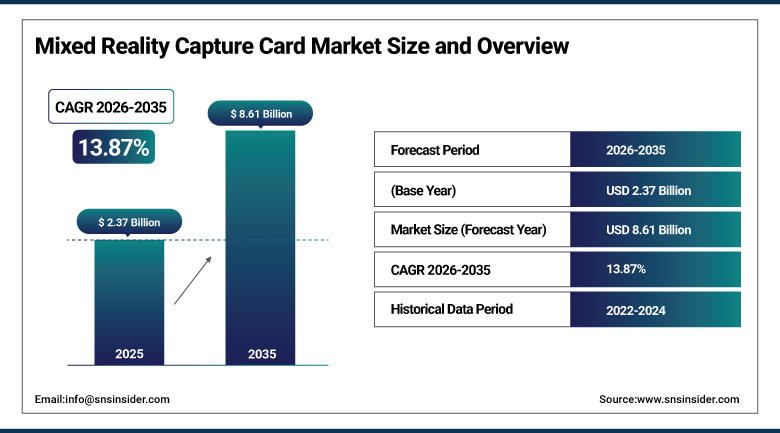
The Mixed Reality Capture Card Market was valued at USD 2.37 billion in 2025 and is expected to reach USD 8.61 billion by 2035, growing at a CAGR of 13.87% from 2026–2035.
The mixed reality capture card market is witnessing strong growth in the global market owing to rising demand for immersive digital content. Increasing adoption of mixed reality applications across gaming and enterprise environments is boosting market expansion. Growing popularity of live streaming and professional content creation is supporting hardware demand. Manufacturers are focusing on low-latency processing and high-resolution capture technologies. Rising deployment across education, healthcare, and virtual events is further accelerating market adoption.
According to the IDC Worldwide AR/VR Headset Tracker, the shipments of global XR devices saw a significant upturn of 44.4% in 2025 owing mainly to a consumer-driven boost in display-less AI smart glasses, while conventional mixed reality headsets were focused on top-of-the-line media and gaming applications. With such an increasing eco-system, there is an expected employment increase of between 15% and 28% for professional digital creators, according to job data. In addition, it was observed by the FCC that 95% of the U.S. households already had access to fixed broadband of at least 100 Mbps.
To Get More Information On Mixed Reality Capture Card Market - Request Free Sample Report
Mixed Reality Capture Card Market Trends
-
The growing use of AI-based video optimization and editing capabilities is increasing the efficiency of mixed reality capture technology.
-
Streaming through cloud services is helping creators to collaborate and produce scalable content without any geographical limitations.
-
The adoption of mixed reality solutions by businesses is increasing rapidly to be used in training, collaboration, and virtual production.
-
Digital transformation is being used for making significant investments in advanced recording and broadcasting technology infrastructure across different industries.
-
The need for hybrid and immersive virtual events is fueling advancements in capture cards technology.
-
There is sustained demand from education, healthcare, manufacturing, and media industries for high-performance mixed reality capture cards solutions.
U.S. Mixed Reality Capture Card Market Outlook
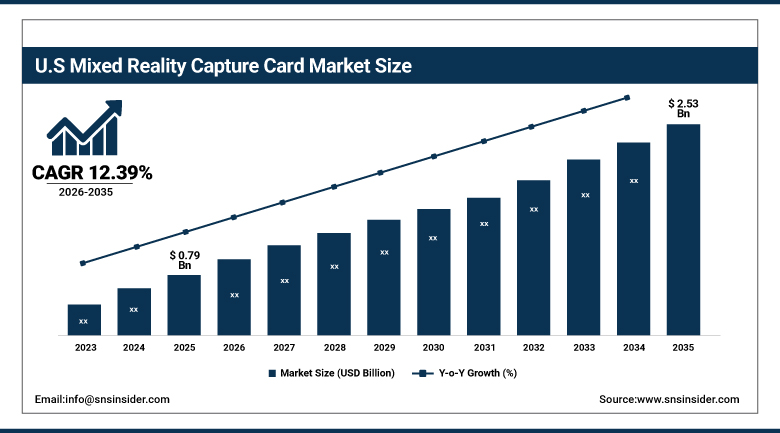
The U.S. Mixed Reality Capture Card Market was valued at USD 0.79 billion in 2025 and is expected to reach around USD 2.53 billion by 2035, growing at a CAGR of 12.39% from 2026–2035.
The U.S. mixed reality capture card market is expanding steadily owing to strong demand for immersive content creation solutions. Increasing adoption of live streaming and professional gaming is supporting market growth. Rising investments in mixed reality technologies across enterprises are driving product adoption among commercial users. Growth in virtual events and digital media production is further accelerating demand. Manufacturers are focusing on low-latency performance and high-resolution video capture capabilities. Increasing use across education, healthcare, and enterprise collaboration is strengthening market penetration.
Based on figures provided by the Bureau of Labor Statistics and the U.S. Census Bureau, there is sustained growth of employment in the computer systems design and software publishing sectors at much higher-than-average rates, forming the engineering groundwork for immersive content production technology. Concurrent with the development of such talent, figures from the U.S. Federal Communications Commission indicate that 95% of the U.S. homes have local availability to fixed broadband service capable of achieving 100/20 Mbps speed, allowing for the necessary bandwidth structure for 4K and mixed reality video streams.
Mixed Reality Capture Card Market Segment Analysis
-
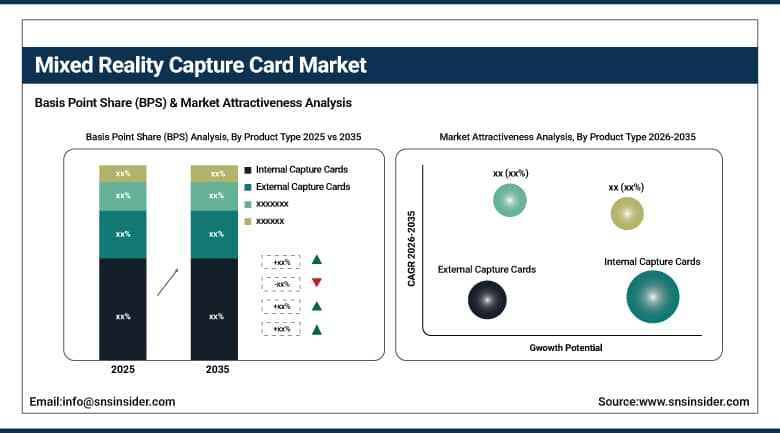
By Product Type, internal capture cards dominated the market with 67.40% share in 2025; while external capture cards are the fastest growing segment with CAGR of 16.70% during 2026 to 2035.
-
By Platform, personal computer (PC) dominated the market with 60.80% share in 2025; while mobile devices are the fastest growing segment with CAGR of 22.14% during 2026 to 2035.
-
By Application, gaming dominated the market with 44.20% share in 2025; while virtual events are the fastest growing segment with CAGR of 19.92% during 2026 to 2035.
-
By Distribution Channel, online dominated the market with 71.60% share in 2025 and is projected to register the fastest CAGR of 15.03% during 2026–2035.
-
By End-User, individual dominated the market with 56.90% share in 2025; while enterprise is the fastest growing segment with CAGR of 20.03% during 2026 to 2035.
By Product Type, internal capture cards dominated the mixed reality capture card market, while external capture cards are the fastest growing segment.
Internal Capture Cards captured the largest revenue share in the mixed reality capture card market in 2025 due to their high acceptance rate by professionals such as gamers, broadcasters, and content creators who need reliable performance. This product category provides low latency, high bandwidth, and easy integration with the computer. Increased demands for high-quality video capture and live streaming have bolstered adoption. Hardware improvements and compatibility with latest graphic platform helped maintain market dominance.
External Capture Cards will record highest CAGR during the forecast period from 2026 to 2035 due to increasing demand for portable and plug-and-play solutions from varied user base. The growing trend of mobile content creation and hybrid working environments has opened up many opportunities. Compatibility with laptop computers, gaming consoles and multiple operating systems makes the deployment of these products easier. The expanding live streaming activities and mixed reality uses cases will drive rapid market growth over the forecast period.
By Platform, personal computer (PC) dominated the mixed reality capture card market, while mobile devices are the fastest growing segment.
The Personal Computer (PC) segment had the dominated share of revenue generated in the mixed reality capture card market in 2025. This is because the segment has widespread usage by professional gamers, content creators, and broadcasting studios globally due to its capacity for high-performance computing, which allows for low-latency video capture and processing capabilities for mixed reality. The increase in demand for high-resolution streaming, advanced editing workflow, and immersive gaming experience contributed to the dominance of this segment in the market.
The Mobile Devices segment will be the one that will register the fastest CAGR between 2026-2035. With the increasing processing capacity of smartphones and increased mobile gaming ecosystem, the demand for mobile mixed reality capture cards is on the rise. The rising trend of live content generation through mobile devices is expected to drive the usage of this segment within the market.
By Application, gaming dominated the mixed reality capture card market, while virtual events are the fastest growing segment.
Gaming segment led in the mixed reality capture card market, accounting for the dominated revenue share in 2025 due to the high requirement for capturing high-definition game recordings and professional broadcasts. Rise in popularity of esports tournaments and social platforms for creators was the primary reason for high growth in hardware sales in the gaming community. The increasing innovations in high-definition capture, low latency performance, and multiplatform functionality contributed to the dominance of the Gaming segment.
The Virtual Events segment is anticipated to be the fastest-growing at a CAGR from 2026 to 2035 due to the growing use of mixed reality technologies for organizing conferences, exhibitions, and collaboration events. Companies are increasingly using immersive broadcasting options for increasing engagement in virtual events.
By Distribution Channel, online dominated the mixed reality capture card market and is also the fastest growing segment.
The Online Segment was at the forefront of the mixed reality capture card market as far as the dominated share of revenues was concerned in 2025. It was owing to the strong preference among consumers for digital purchasing mediums and competitive pricing for the products that contributed to the dominance of the segment. Leading brands have been promoting direct-to-consumer sales by setting up branded websites and selling their products via e-commerce platforms.
The Online Segment is likely to record the fastest CAGR between 2026 and 2035. The growing use of digital retailers, cross-border e-commerce, and omnichannel marketing would be driving its growth in the coming years. The manufacturers would be leveraging online launches, recommendation engines, and customer support systems to increase their sales. Demand from content creators and enterprises buying advanced capture cards from online portals would be boosting the market growth.
By End-User, individual dominated the mixed reality capture card market, while enterprise is the fastest growing segment.
The Individual Segment occupied the dominant position in the mixed reality capture card market by generating the dominated market share in revenue in 2025. The large-scale use of the technology by gamers, content creators, and live streamers greatly assisted the segment in occupying its leading position in the market around the world. Growing popularity of video sharing websites inspired consumers to purchase top-notch capture cards. Affordable costs of high-quality recording devices coupled with growing interest towards immersive mixed reality experiences have greatly assisted in maintaining the dominance of the segment.
The Enterprise Segment is forecast to experience the fastest CAGR during 2026-2035. Investments being made in mixed reality technologies in order to facilitate training sessions, collaboration sessions, and product visualizations have greatly fueled the growth of adoption rate. Companies are making use of highly advanced capture card solutions in order to effectively conduct virtual events and facilitate remote communication.
Regional Analysis
|
Region |
Major Country |
Share within Region, 2025(%) |
|---|---|---|
|
North America |
United States |
86.80% |
|
Europe |
Germany |
24.60% |
|
Asia Pacific |
China |
39.80% |
|
Middle East & Africa |
UAE |
16.40% |
|
Latin America |
Brazil |
43.10% |
North America Mixed Reality Capture Card Market Insights.
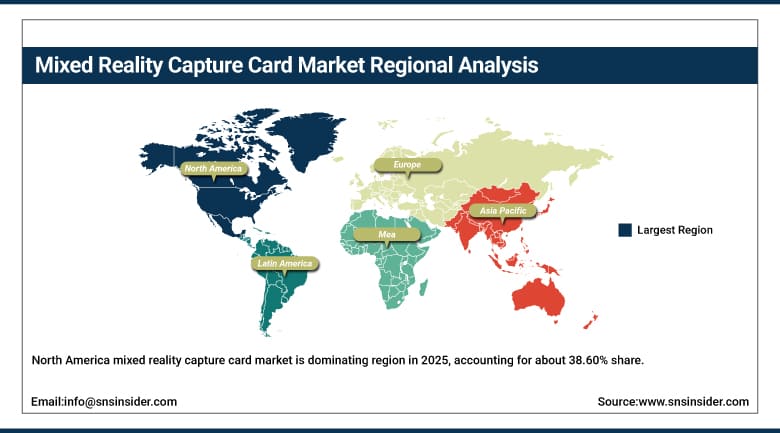
North America mixed reality capture card market is dominating region in 2025, accounting for about 38.60% share, driven by strong demand from gaming and professional content creation. The region benefits from advanced digital infrastructure and widespread adoption of mixed reality technologies. Increasing investments in esports and live streaming are significantly strengthening product demand. Expansion of virtual production studios is accelerating adoption. A strong presence of leading hardware manufacturers further reinforces the region’s dominant position in the market.
According to the U.S. Federal Communications Commission and ITU monitoring, the North American digital infrastructure keeps expanding in terms of high bandwidth, with the low band 5G network coverage reaching more than 90% in the U.S., while the mid-band networks are growing fast to provide the low-latency channels essential for mixed reality data transfer. Supported by CTA forecast and Census Bureau data, the video gaming, virtual broadcasting, and live creator’s industries demonstrate healthy dynamics. This is additionally proven by U.S. Department of Commerce data on consistent volume growth in advanced computer and electronic products manufacturing.
Get Customized Report as Per Your Business Requirement - Enquiry Now
Europe Mixed Reality Capture Card Market Insights.
Europe mixed reality capture card market is characterized by stable growth in 2025 owing to increasing adoption of immersive media technologies across commercial sectors. Key countries include Germany, France, United Kingdom, and Italy. Rising investments in virtual production and broadcasting are driving product adoption. Increasing demand for professional live streaming solutions is boosting market growth. Growth in gaming and creative industries is further supporting market expansion. Strong digital innovation initiatives are encouraging development of advanced capture technologies.
According to the European Commission’s Digital Decade monitor, Europe’s digital infrastructure is developing further as there is 94.3% basic 5G population coverage and development of Very High-Capacity Networks enabling mixed reality services. Moreover, the European Broadcasting Union mentions that UHD/4K and HDR usage in live broadcasting becomes more common. Lastly, according to the data by Eurostat, 95% of EU companies use fixed broadband Internet access.
Asia Pacific Mixed Reality Capture Card Market Insights.
Asia Pacific is the fastest growing region in the mixed reality capture card market, registering a CAGR of about 15.65% during 2026–2035. Rapid digitalization and expanding gaming communities are driving strong demand across China, India, Japan, South Korea, and Southeast Asia. Rising investments in esports and creator economies are boosting market growth. Increasing mixed reality adoption across education and entertainment is further accelerating demand. Expansion of electronics manufacturing hubs is supporting large scale product availability.
According to ITU Facts and Figures 2025, more than half of the total 6 billion global internet users are from Asia-Pacific. GSMA Mobile Economy Asia Pacific expects that the 5G connections in the region will surpass 1.4 billion in 2030. In addition to this, 4.39 million 5G base stations have been set up by China's Ministry of Industry and Information Technology.
Middle East & Africa and Latin America Mixed Reality Capture Card Market Insights.
The Middle East & Africa along with Latin America regions are witnessing steady growth due to expanding digital infrastructure and increasing online content creation. Key contributing countries include Brazil, Mexico, UAE, Saudi Arabia, and South Africa. Rising adoption of gaming and live streaming platforms is driving product demand. Growth in virtual events and digital education is further supporting market expansion. Increasing investments in communication technologies are boosting regional market development.
As indicated by the ITU Facts and Figures, internet penetration across the globe has hit 74% of the total population. Regional penetration shows different digital ecosystems where the Americas have 88%, the Arab States have 70%, and Africa is expanding its digital footprint to 36%. In terms of infrastructure, there are more than 50% of the world's population connected via 5G mobile networks, with 5G connections making up 36% of mobile broadband subscriptions.
Market Dynamics
Growth Drivers: Growing enterprise adoption of mixed reality technologies across training, collaboration, and virtual production is strengthening hardware deployment worldwide.
There has been an increase in investments by businesses in mixed reality applications used in training and remote collaboration platforms. The increasing use of virtual production processes is resulting in the rising requirement of professional capture cards. Companies are embracing immersive technologies in order to increase efficiency and customer interaction within different industries. Digital transformation projects are motivating the adoption of sophisticated recording and broadcasting systems across the world. There have been steady investments in education, healthcare, manufacturing, and media industries, and thus there are more commercial prospects in these industries.
The ITU Facts and Figures states that the total number of internet users globally has reached 6 billion people; therefore, roughly 74% of the global population currently utilizes internet services. Additionally, according to the global telecommunications statistics, there has been a fast increase in the number of connections on 5G networks reaching 3 billion subscriptions, securing the low latency infrastructure required to support large-scale spatial applications. Such global developments in connectivity are fueling immersive tech ecosystem implementations across corporations, training centers, and virtual productions.
Restraints: Rapid technological advancements create shorter product lifecycles and increase replacement pressure for manufacturers and end users alike.
Frequent innovations in processors, graphics, and connectivity standards ensure that capture hardware becomes obsolete almost immediately. Companies have to make considerable investments in R&D to stay ahead of technological advancements at an international level. Frequent changes in software and mixed reality platforms call for continual improvement in hardware components to maintain compatibility. The end user often waits to purchase due to the imminent release of new products. Changes in supply chain and availability of semiconductors are additional factors that affect the cost of production and delivery schedules.
Opportunities: Integration of artificial intelligence and cloud-based streaming technologies is unlocking new possibilities for next-generation capture card development.
AI is increasing the ability to optimize videos, automated editing, and intelligent content management in streaming apps. The adoption of cloud-based workflows is helping creators and businesses work together effectively from various geographic locations. High demand for hybrid events and virtual production settings is motivating the development of scalable capture solutions. The emphasis of companies on AI-driven processing abilities and remote management functions can help improve efficiency in operations. Rising adoption of cloud-based mixed reality ecosystems is likely to create lucrative opportunities for the market.
According to the ITU Facts and Figures report, the number of people online worldwide is 6 billion, which translates to around 74% of the world's population. The number of 5G connections worldwide stands at 3 billion, making up almost one-third of the mobile broadband connections. Eurostat indicates that 19.95% of the EU businesses use artificial intelligence, increasing to 62.52% for the information and communication business sector.
Recent Developments
-
2026: AVerMedia Technologies, Inc. introduced the MultiStudio Core GC750, a professional multi-platform streaming capture device, at Computex 2026.
-
2025: AJA Video Systems, Inc. introduced the IP25-R 4K mini-converter to support advanced hybrid IP and baseband infrastructures.
-
2025: Blackmagic Design Pty. Ltd. announced the DeckLink IP 100G, a new PCIe Gen 4 video capture cards.
-
2024: Corsair Gaming, Inc. launched the Elgato 4K X and 4K Pro game capture cards for content creators.
Mixed Reality Capture Card Market Key Players are:
-
Corsair Gaming, Inc.
-
AVerMedia Technologies, Inc.
-
Blackmagic Design Pty. Ltd.
-
Magewell Electronics Co., Ltd.
-
Razer Inc.
-
Epiphan Systems Inc.
-
Datapath Limited
-
Hauppauge Digital, Inc.
-
Yuan High-Tech Development Co., Ltd.
-
StarTech.com Ltd.
-
ASUSTeK Computer Inc.
-
AJA Video Systems, Inc.
-
Matrox Electronic Systems Ltd.
-
Bluefish Technologies Pty Ltd
-
Videndum plc
-
IO Industries Inc.
-
Euresys S.A.
-
Shenzhen DIGITNOW Technology Co., Ltd.
-
Shenzhen Uniscom Technology Co., Ltd.
-
INOGENI Inc.
Mixed Reality Capture Card Market Report Scope:
| Report Attributes | Details |
|---|---|
| Market Size in 2025 | USD 2.37 Billion |
| Market Size by 2035 | USD 8.61 Billion |
| CAGR | CAGR of 13.87% From 2026 to 2035 |
| Base Year | 2025 |
| Forecast Period | 2026-2035 |
| Historical Data | 2022-2024 |
| Report Scope & Coverage | Market Size, Segments Analysis, Competitive Landscape, Regional Analysis, DROC & SWOT Analysis, Forecast Outlook |
| Key Segments | • By Product Type (Internal Capture Cards, External Capture Cards) • By Platform (Personal Computer (PC), Console, Mobile Devices) • By Application (Gaming, Live Streaming, Virtual Events, Education, Healthcare, Other Applications) • By Distribution Channel (Online, Offline) • By End-User (Individual, Commercial, Enterprise, Others). |
| Regional Analysis/Coverage | North America (US, Canada), Europe (Germany, UK, France, Italy, Spain, Russia, Poland, Rest of Europe), Asia Pacific (China, India, Japan, South Korea, Australia, ASEAN Countries, Rest of Asia Pacific), Middle East & Africa (UAE, Saudi Arabia, Qatar, South Africa, Rest of Middle East & Africa), Latin America (Brazil, Argentina, Mexico, Colombia, Rest of Latin America). |
| Company Profiles | Corsair Gaming, Inc., AVerMedia Technologies, Inc., Blackmagic Design Pty. Ltd., Magewell Electronics Co., Ltd., Razer Inc., Epiphan Systems Inc., Datapath Limited, Hauppauge Digital, Inc., Yuan High-Tech Development Co., Ltd., StarTech.com Ltd., ASUSTeK Computer Inc., AJA Video Systems, Inc., Matrox Electronic Systems Ltd., Bluefish Technologies Pty Ltd, Videndum plc, IO Industries Inc., Euresys S.A., Shenzhen DIGITNOW Technology Co., Ltd., Shenzhen Uniscom Technology Co., Ltd., INOGENI Inc. |
Frequently Asked Questions
The major growth factors include rising demand for immersive digital content, expanding mixed reality adoption, increasing live streaming, advanced low-latency capture technologies, and growing applications across education, healthcare, enterprise, and virtual events.
The mixed reality capture card market was valued at USD 2.37 billion in 2025.
The mixed reality capture card market is expected to grow at a CAGR of 13.87% from 2026 to 2035.
