
Intent-Based Networking Market Report Scope & Overview:
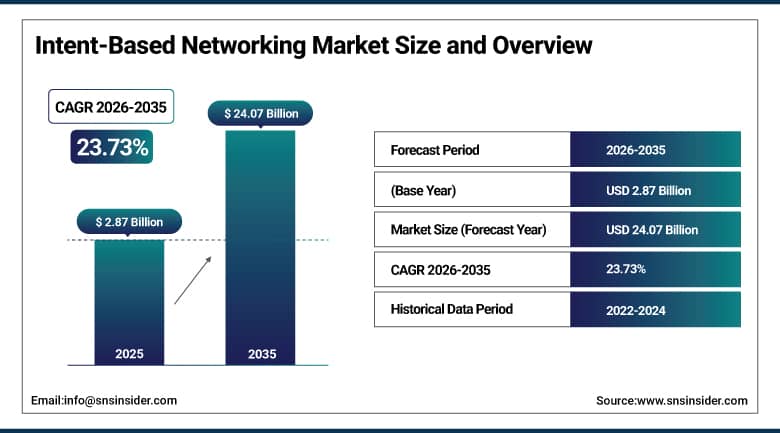
The Intent-Based Networking Market was valued at USD 2.87 billion in 2025 and is expected to reach USD 24.07 billion by 2035, growing at a CAGR of 23.73% from 2026-2035.
The Intent-Based Networking Market is witnessing rapid growth the increasing complexity of network infrastructure, increased demand for automation, and need for effective network management are some of the factors fueling the growth of intent-based networking market. Intent-based networking solutions are being adopted by organizations to convert their business policy to automate network configuration and facilitate real-time monitoring, optimization and problem solving. The growing popularity of cloud computing, 5G network, Internet of Things (IoT) and software defined network is also contributing towards the increasing demand for intelligent and automated network infrastructure. Improvement in artificial intelligence, machine learning, network analysis and automation has further made networks more visible and operational.
IETF describes intent assurance as the capability to validate and monitor whether the network is adhering to the intended outcomes, creating feedback for optimization.
To Get More Information On Intent-Based Networking Market - Request Free Sample Report
Intent-Based Networking Market Trends:
-
Rising adoption of AI/ML-driven network automation.
-
Growing demand for self-healing and autonomous networks.
-
Increasing deployment across cloud and hybrid-cloud environments.
-
Integration with 5G, edge computing, and IoT networks.
-
Rising focus on network security and zero-trust policies.
-
Growing use of predictive analytics and closed-loop assurance.
-
Increasing adoption of managed and subscription-based networking services.
U.S. Intent-Based Networking Market Outlook:
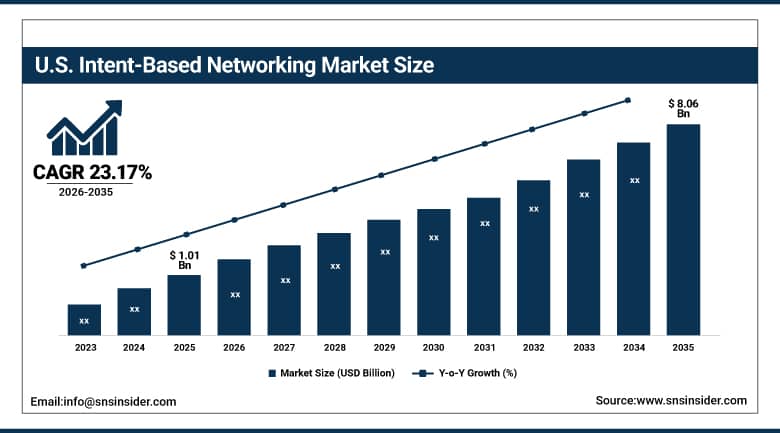
The U.S. Intent-Based Networking Market was valued at USD 1.01 billion in 2025 and is expected to reach USD 8.06 billion by 2035, growing at a CAGR of 23.17% from 2026-2035.
The U.S. Intent-Based Networking Market is witnessing rapid growth because of the increasing complexities of the networks, increasing demands for automation, and the necessity for better network management. Intent-Based Networking is becoming very popular among organizations, as these technologies help in translating business requirements into network configurations in an automated way. With increasing use of cloud computing, 5G, Internet of Things (IoT), and software-defined networking, the demand for intelligent network infrastructure is increasing even more. Additionally, developments in the field of artificial intelligence, machine learning, predictive analysis, and network automation are helping in increasing the efficiency of the network. The requirement of avoiding configuration mistakes, enhancing the security of the network, optimizing the resources, and developing scalable digital infrastructure is adding to the increasing popularity of intent-based networking in the US.
NIST identifies the increasing scale and complexity of networks as requiring new approaches to network design, deployment, and operation.
Intent-Based Networking Market Segment Analysis:
-
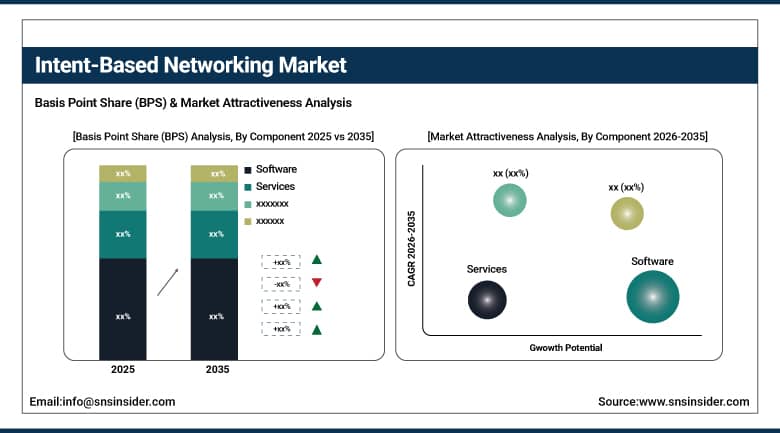
By Component, Software dominates the Intent-Based Networking Market with 62% share in 2025; Software is expected to grow at the fastest CAGR of 24.26% from 2026–2035.
-
By Deployment Model, Cloud dominates the Intent-Based Networking Market with 66% share in 2025; Cloud is expected to grow at the fastest CAGR of 24.05% from 2026–2035.
-
By Network Domain, Data Centers dominate the Intent-Based Networking Market with 41% share in 2025; WAN is expected to grow at the fastest CAGR of 25.03% from 2026–2035.
-
By Function, Network Automation dominates the Intent-Based Networking Market with 34% share in 2025; Network Automation is expected to grow at the fastest CAGR of 25.08% from 2026–2035.
-
By Industry, IT and Telecommunications dominate the Intent-Based Networking Market with 34% share in 2025; Manufacturing is expected to grow at the fastest CAGR of 25.93% from 2026–2035.
By Component, Software dominates the Intent-Based Networking Market, Software grows fastest.
Software segment dominated the Intent-Based Networking Market with the highest revenue share of about 62% in 2025 because of the importance of such technology in implementing business requirements into automated network policies, configurations, monitoring, and optimization. Software facilitates control, minimizes manual involvement, and increases efficiency in networks. The use of AI, automation, cloud networks, and software defined infrastructure makes global implementation possible.
Software segment is expected to grow at the fastest CAGR of 24.26% from 2026-2035 due to growing need for smart, automatic and policy-enabled network management. With advances in artificial intelligence, machine learning, analytics and orchestration, software is becoming more powerful. The complexity of networks, hybrid infrastructures, the need for security, cloud and real-time optimization have added fuel to this trend towards intent-based networking software.
By Deployment Model, Cloud dominates the Intent-Based Networking Market, Cloud grows fastest.
Cloud segment dominated the Intent-Based Networking Market with the highest revenue share of about 66% in 2025 as a result of their scalability, flexibility, centralized management, and reduced infrastructure needs. Cloud computing facilitates fast implementation of intent-based policies in distributed networks and automates the process. Increasing adoption of cloud computing, hybrid infrastructure, remote management, and digital transformation makes cloud deployment even more advantageous.
Cloud segment is expected to grow at the fastest CAGR of 24.05% from 2026-2035 As a result of increased migration to cloud-native and hybrid network designs. Intent-based cloud networking provides benefits such as scalability, policy management, automation, and effective resource utilization. Increasing multi-cloud use, workload distribution, artificial intelligence-driven operation, and flexible network infrastructure requirements are some other factors driving the growth of intent-based cloud networking.
By Network Domain, Data Centers dominate the Intent-Based Networking Market, WAN grows fastest.
Data Centers segment dominated the Intent-Based Networking Market with the highest revenue share of about 41% in 2025 owing to the nature of complexities and demands of contemporary data center networks. IBN allows automatic configuration, policy enforcement, monitoring, and optimization. The increase in cloud computing, virtualization, AI workloads, and data center modernization is another driver for the rise in intelligent network management solutions..
WAN segment is expected to grow at the fastest CAGR of 25.03% from 2026-2035 because of the growing trend of distributed networking, cloud computing, remote working, and software-defined WAN technology. Intent-based network can simplify the configuration, routing, security, and optimization of WAN. More connectivity needs within enterprises, multisite operations, mixed IT infrastructure, and need for low latency communication further propel the growth of WAN.
By Function, Network Automation dominates the Intent-Based Networking Market, Network Automation grows fastest.
Network Automation segment dominated the Intent-Based Networking Market with the highest revenue share of about 34% in 2025 because of the rising demand for automated configuration, provisioning, monitoring, and troubleshooting. Network automation decreases the necessity for manual intervention, mistakes, and complexity. The size of the network is increasing, along with the use of clouds, virtualization, and demands for rapid deployment of services.
Network Automation segment is expected to grow at the fastest CAGR of 25.08% from 2026-2035 Because of the growing need for self-operated networks and optimizations in real time. AI can help networks make automatic transformations from the business needs into configurations and corrections. Network complexity, cybersecurity concerns, growth of the cloud, and the need to save on operating expenses also contribute to the adoption of network automation.
By Industry, IT and Telecommunications dominate the Intent-Based Networking Market, Manufacturing grows fastest.
IT and Telecommunications segment dominated the Intent-Based Networking Market with the highest revenue share of about 34% in 2025 because of large-scale network infrastructure, heavy data traffic, and high demand for automation and reliability. Intent-based networking aids in optimizing such complicated networks and minimizing workloads. Growth in cloud services, 5G implementation, virtualization, and digital transformation also help in this regard.
Manufacturing segment is expected to grow at the fastest CAGR of 25.93% from 2026-2035 because of the growing popularity of industry 4.0, industrial IoT, connected machines, and smart factories. Intent-based networking offers automated network configuration, management, security, and optimization of the network. The increasing digitization of factories, edge computing, automation, and need for connected operations continue to drive adoption.
Regional Analysis:
|
Region |
Major Country |
Share within Region, 2025 (%) |
|---|---|---|
|
North America |
United States |
91.0% |
|
Europe |
Germany |
24.0% |
|
Asia Pacific |
China |
38.0% |
|
Middle East & Africa |
UAE |
18.0% |
|
Latin America |
Brazil |
42.0% |
North America Intent-Based Networking Market Insights
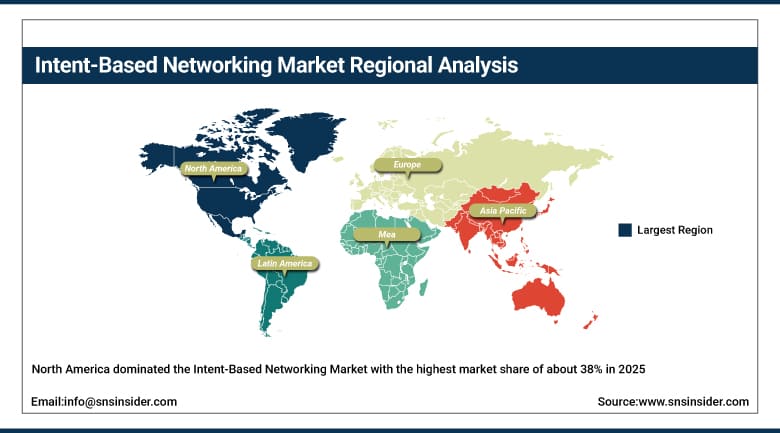
North America dominated the Intent-Based Networking Market with the highest market share of about 38% in 2025, backed by network infrastructures, wide acceptance of cloud, and high demand for automation of networks. Investments in AI and machine learning, 5G and network security, and the availability of networking technologies vendors are some factors that help in making Intent Based Networking dominant in the region.
The U.S. Intent-Based Networking Market accounted for a market share of 91.0%, Backed by advanced network infrastructures, wide adoption of cloud computing, and high demand for automatic network management systems. High investments in AI, machine learning, 5G technology, and cybersecurity are fueling the adoption process. Availability of leading networking technology suppliers, large enterprise networks, and high demand for efficiency are making contributions to market development in the United States.
Get Customized Report as Per Your Business Requirement - Enquiry Now
Europe Intent-Based Networking Market Insights
Europe Intent-Based Networking Market is witnessing steady growth, backed up by increasing adoption of cloud technology, upgrades in networks, and growing need for automation and security of the networks. Enterprises are opting for an intent-based approach in order to make their complex infrastructures easier to manage. Investments in AI-driven networking, 5G technology, cybersecurity, and digital transformation are also contributing to the growth of the market.
The Germany Intent-Based Networking Market accounted for a market share of 24.0%, It is fueled by telecommunications infrastructure, increased use of cloud computing and digitalization of industries. Increasing need for automatic configuration and improvement of network performance is driving its adoption. Investments in AI-powered networking, 5G technology, Industry 4.0, and enterprise networking upgrade will provide more momentum to this trend.
Asia Pacific Intent-Based Networking Market Insights
Asia Pacific is expected to grow at the fastest CAGR of about 25.08% from 2026–2035, backed by rapid digitalization, expanding cloud infrastructure, and 5G deployment. Increasing use of artificial intelligence, Internet of Things, software-defined networking, and network automation in China, India, Japan, and South Korea are driving demand. Increasing need for enterprise connectivity and investments in advanced telecommunications infrastructure are also contributing to the regional growth.
The China Intent-Based Networking Market accounted for a market share of 38.0%, backed up by fast 5G rollouts, expansion of cloud computing, and rising digital transformation. The rising use of artificial intelligence, IoT, software-defined networks, and network automation is fueling the demand. Digital solutions backed by the government, the rise of smart cities, enterprise connectivity demands, and investments in next-generation telecommunication networks.
Middle East & Africa and Latin America Intent-Based Networking Market Insights
The Middle East & Africa and Latin America Intent-Based Networking Market is expanding gradually owing to growing digitization, use of clouds, and upgrading of telecommunication infrastructure. Increasing need for automated, secure, and efficient network management presents an opportunity. Investment in 5G, AI, IoT, data centers, smart cities, and enterprise network upgrades is adding to the growth of the regional market.
The UAE Intent-Based Networking Market accounted for a market share of 18.0%, Driven by rapid digitalization, well-developed telecommunication networks, and increased availability of 5G networks. Increased investments into artificial intelligence, cloud computing, Internet of Things (IoT), and smart city infrastructure are stimulating its adoption. Various government-driven digitalization programs, higher connectivity needs of enterprises, and automation of the network management process are other factors fueling market growth.
Growth Drivers: Increasing network complexity and demand for automated network management are accelerating adoption of intent-based networking
The increasing complexity of enterprise, cloud, data center, and telecommunications networks is a major driver for the Intent-Based Networking Market. Modern businesses have to deal with highly distributed settings that include hybrid clouds, multi-cloud, edge computing, IoT, 5G technologies, and multi-vendor networking gear. The old approach of individual device configuration and problem detection may overload operations and bring risks of incorrect configuration. Intent-Based Networking is capable of solving all the problems by transforming the high-level business goals into network policies and implementing these policies as well as monitoring the network operation. According to industry research, the complexity of networks and their automation needs are among the major driving forces behind the IBN growth.
Restraints: High implementation complexity and integration costs can limit adoption of intent-based networking solutions
The deployment of intent-based networking can require significant investment in network controllers, automation platforms, analytics capabilities, software-defined infrastructure, and integration services. Network organizations which have traditional network architectures may encounter further challenges with linking legacy devices and management tools with new intent-based platforms. Networks that have multi-vendor architecture may present further interoperability issues since each device uses varied API, protocol, configuration, and telemetry. Moving away from a traditional network management process to a policy and closed-loop driven approach may require much redesign, testing, employee training, and operational adjustments. This will make the implementation process lengthy and costly, especially for businesses that have complicated infrastructure or inadequate IT budget. According to industry research, implementation complexity, legacy, and interoperability are some of the key barriers to IBN adoption.
Opportunities: Integration of generative AI and machine learning with intent-based networking is creating significant growth opportunities
The integration of generative AI, machine learning, and advanced analytics provides substantial opportunities for IBN platform providers. AI would help enhance the capacity of the networks to understand the requirements of operations, correlate telemetry across different domains, detect anomalies, predict potential performance degradations, and suggest measures for correction. On top of that, the use of generative AI can help achieve natural language interaction between networks and management systems, where the administrators could specify what outcome they want instead of manually designing configurations. Together with closed-loop automation, AI would help take IBN a step further towards autonomous operation of networks, which would continuously monitor conditions, apply policies, and optimize network resources.
Recent Developments:
-
2026 : Cisco Systems, Inc. expanded its intent-based networking capabilities by integrating AI-driven automation, real-time telemetry, and policy-based network management to enable more autonomous network operations.
-
2026 : Hewlett Packard Enterprise Company advanced intent-based networking through its HPE Aruba Networking portfolio, strengthening AI-powered network management, automated configuration, and policy-driven optimization across campus, branch, and data-center environments.
-
2026 : Nokia Corporation continued advancing intent-based network automation through its autonomous networking initiatives, enabling operators to translate high-level service requirements into automated network configuration, assurance, and optimization.
-
2025 : Forward Networks, Inc. strengthened its intent-based networking capabilities through its digital twin platform, enabling organizations to validate intended network behavior, analyze configurations, and automate network changes before deployment.
Intent-Based Networking Market Key Players are:
-
Cisco Systems, Inc.
-
Arista Networks, Inc.
-
Hewlett Packard Enterprise Company
-
Nokia Corporation
-
Huawei Technologies Co., Ltd.
-
Extreme Networks, Inc.
-
Ericsson
-
Fortinet, Inc.
-
Forward Networks, Inc.
-
Gluware, Inc.
-
Anuta Networks, Inc.
-
A10 Networks, Inc.
-
Ciena Corporation
-
Netcracker Technology Corporation
-
NEC Corporation
-
Dell Technologies Inc.
-
Versa Networks, Inc.
-
Itential, Inc.
Intent-Based Networking Market Report Scope:
| Report Attributes | Details |
|---|---|
| Market Size in 2025 | USD 2.87 Billion |
| Market Size by 2035 | USD 24.07 Billion |
| CAGR | CAGR of 23.73% From 2026 to 2035 |
| Base Year | 2025 |
| Forecast Period | 2026-2035 |
| Historical Data | 2022-2024 |
| Report Scope & Coverage | Market Size, Segments Analysis, Competitive Landscape, Regional Analysis, DROC & SWOT Analysis, Forecast Outlook |
| Key Segments | • By Component (Hardware, Software, Services) • By Deployment Model (On-Premises, Cloud) • By Network Domain (Campus/Enterprise LAN, Data Center, WAN, Other Network Domains) • By Function (Network Automation, Network Monitoring, Network Security, Policy Management, Network Optimization, Other Functions) • By Industry (IT and Telecommunications, BFSI, Healthcare, Manufacturing, Government and Defense, Others) |
| Regional Analysis/Coverage | North America (US, Canada), Europe (Germany, UK, France, Italy, Spain, Russia, Poland, Rest of Europe), Asia Pacific (China, India, Japan, South Korea, Australia, ASEAN Countries, Rest of Asia Pacific), Middle East & Africa (UAE, Saudi Arabia, Qatar, South Africa, Rest of Middle East & Africa), Latin America (Brazil, Argentina, Mexico, Colombia, Rest of Latin America). |
| Company Profiles | Cisco Systems, Inc.; Arista Networks, Inc.; Hewlett Packard Enterprise Company; Nokia Corporation; International Business Machines Corporation (IBM); Huawei Technologies Co., Ltd.; Extreme Networks, Inc.; Ericsson; Fortinet, Inc.; Forward Networks, Inc.; Gluware, Inc.; NetBrain Technologies, Inc.; Anuta Networks, Inc.; A10 Networks, Inc.; Ciena Corporation; Netcracker Technology Corporation; NEC Corporation; Dell Technologies Inc.; Versa Networks, Inc.; and Itential, Inc. |

Frequently Asked Questions
Key players in the Intent-Based Networking Market include Cisco Systems, Inc., Juniper Networks, Inc., Nokia Corporation, Huawei Technologies Co., Ltd., and Hewlett Packard Enterprise Company, among others.
Key opportunities in the Intent-Based Networking Market include expansion of autonomous networking, increasing adoption of cloud and 5G infrastructure, and growing demand for automated network management and optimization.
The market is driven by increasing network complexity and demand for automation, along with growing adoption of AI, cloud computing, 5G, and IoT technologies.
The Software segment dominated the Intent-Based Networking Market, accounting for approximately 62.00% market share.
The North America region dominated the Intent-Based Networking Market in 2025 with a 38.50% share, driven by high firearm sales and strong defense procurement.
