
Pass-By Noise Testing Market Report Scope & Overview:
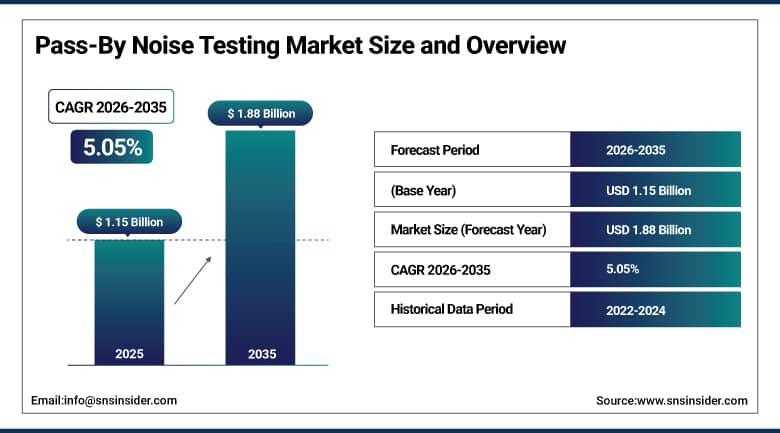
The Pass-By Noise Testing Market was valued at USD 1.15 Billion in 2025 and is projected to reach USD 1.88 Billion by 2035, expanding at a CAGR of 5.05% during the forecast period 2026–2035.
The pass-by noise testing market for vehicles is getting bigger because car makers have to follow rules about how noise a car can make outside. These rules are getting stricter and car makers are spending a lot of money on engineering to make cars quieter. This is called Noise, Vibration and Harshness or NVH engineering. People in charge of making these rules in car markets are making sure that car makers and testing labs use very good equipment to measure noise. They have to use machines that can test cars automatically and software that can analyze the results.
All of these things are making companies invest money in smart testing equipment. This is helping to make pass-by noise testing all, over the world. Companies that make testing equipment for cars are now using intelligence to help with noise testing. They are also using platforms that can connect to the internet and automatic systems to collect data.
Market Size and Forecast:
-
Market Size 2026E: USD 1.21 Billion
-
Market Size 2035: USD 1.88 Billion
-
CAGR: 5.05% from 2026 to 2035
-
Fastest Growing Region: Asia Pacific
-
Largest Region: North America
To Get More Information On Pass-By Noise Testing Market - Request Free Sample Report
Pass-By Noise Testing Market Trends:
-
Rising implementation of stringent global vehicle exterior noise regulations.
-
Growing adoption of automated pass-by noise testing and digital NVH validation platforms.
-
Increasing deployment of AI-enabled acoustic analysis and real-time signal processing software.
-
Expanding validation requirements for electric and hybrid vehicle acoustic performance.
-
Rising investments in cloud-based testing infrastructure, intelligent measurement systems, and automated compliance reporting.
U.S. Pass-By Noise Testing Market Size Outlook:
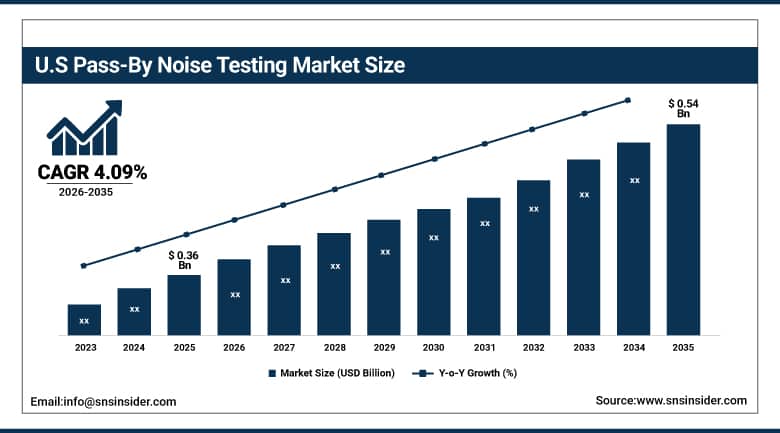
The U.S. Pass-By Noise Testing Market was valued at USD 0.36 billion in 2025 and is expected to reach approximately USD 0.54 billion by 2035, expanding at a CAGR of 4.09% during 2026–2035.
The United States is still the market in North America. This is because it has a system for making cars and it has rules in place for checking vehicles. Also it spends a lot of money on research and development. Automotive companies, parts suppliers, engineering firms and testing labs in the United States are using tools like automated outdoor testing systems and special microphones to make testing better and faster. They are also using computers to analyze the data. This helps them make products and get them ready to sell more quickly.
The United States has smart roads. This means that companies need to have systems to test the noise that cars make so they can meet the rules that are always changing. Several companies that work on cars and testing have started using software that works with the internet to measure noise and make reports automatically. They are also using computers to help with analyzing noise. This helps them get their products approved and sold quickly and it makes their work more efficient. The United States companies are using these tools to make their work better and to make the process of developing new vehicles faster.
Pass-By Noise Testing Market Segment Analysis:
-
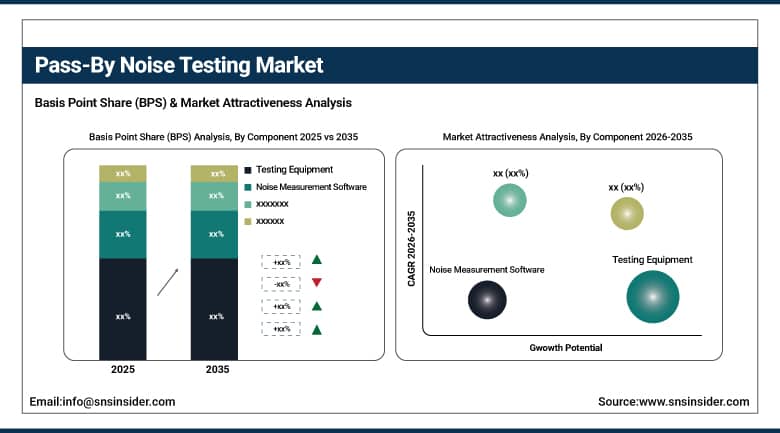
By Component, testing equipment dominated the market with 42.00% share in 2025, while noise measurement software is projected to witness the fastest growth with 7.08% CAGR during the forecast period.
-
By Vehicle Type, passenger vehicles dominated the market with 46.00% share in 2025, while electric vehicles are projected to witness the fastest growth with 9.40% CAGR during the forecast period.
-
By Application, vehicle certification dominated the market with 39.00% share in 2025, while regulatory compliance is projected to witness the fastest growth with 6.30% CAGR during the forecast period.
-
By End User, automotive OEMs dominated the market with 44.00% share in 2025, while tier-1 suppliers are projected to witness the fastest growth with 6.30% CAGR during the forecast period.
By Component, testing equipment dominated the market, while noise measurement software fastest-growing segment.
The testing equipment segment had the share of revenue at 42.00% in 2025. This is because companies need to measure noise accurately to meet the rules for vehicle noise. Automotive manufacturers and testing facilities are spending money on equipment like microphones and data systems to make sure their products are good and meet the rules. They want to be sure that their vehicles are quiet enough. Testing Equipment is used for passenger vehicles, commercial vehicles and electric vehicles. From 2025 to 2026 HBK made its Testing Equipment better. Now it can measure noise of vehicles automatically and check the noise of vehicles digitally.
The noise measurement software segment is going to grow fast at 7.08% per year. Automotive manufacturers are using software that can do a lot of things automatically like check the noise of vehicles and make reports. This software uses intelligence to help engineers. It can even make copies of vehicles and check if they meet the noise rules. This makes it easier for engineers to test vehicles and make them quieter. As more vehicles become electric it is getting harder to check the noise of vehicles. With this software it is becoming easier to find the sources of noise like the tires or the wind.
By Vehicle Type, passenger vehicles dominated the market, while electric vehicles are the fastest-growing segment.
The passenger vehicles segment had the part of the market with 46.00% in 2025. This is because many passenger cars are being made all over the world and the rules for vehicle certification are getting stricter in all the major automotive markets. The companies that make vehicles are spending a lot of money to make sure the noise outside the vehicle is as low as possible when they are developing vehicles. They want to follow the rules set by UNECE and other regional groups. They also want to make their customers more comfortable and make the vehicles overall. New passenger vehicle models are being introduced quickly and old models are being updated all the time.
The electric vehicles segment is expected to grow the fastest with a rate of 9.40% during the time we are looking at. Electric vehicles are very quiet when they move so the people who design them are now focusing on the noise made by the tires on the road the noise made by the air moving around the vehicle and the noise made by systems in the vehicle. This means they need advanced ways to test the noise of vehicles as they drive by. The people in charge of making the rules are still working on how to test vehicles.
By Application, vehicle certification dominated the market, while regulatory compliance is the fastest-growing segment.
The vehicle certification segment had the share of revenue at 39.00% in 2025. This is because every new Vehicle Certification needs to be approved before it can be sold in the market. Automotive companies need to do noise tests to show that they meet the rules. They have to do these tests to sell their vehicles in countries. More and more vehicles are being exported to countries and the rules for certification are changing. So companies are investing in testing facilities and equipment to measure noise accurately.
The regulatory compliance segment is going to grow fast at a rate of 6.30%. Governments over the world are making new rules to reduce noise pollution from traffic. They want to make cities cleaner and quieter. Because of these rules Vehicle Certification companies have to do more tests to make sure they are following the rules. They also have to update their testing equipment to meet the international standards. There are digital platforms that help companies manage these rules and test reports. This makes it easier for them to follow the rules. In 2025 and 2026 the rules for vehicle noise were.
Regional Insights:
|
Region |
Major Country |
Share within Region, 2025 (%) |
|---|---|---|
|
North America |
United States |
93.00% |
|
Europe |
Germany |
24.00% |
|
Asia Pacific |
China |
30.00% |
|
Middle East & Africa |
UAE |
6.00% |
|
Latin America |
Brazil |
6.00% |
North America Pass-By Noise Testing Market Insights
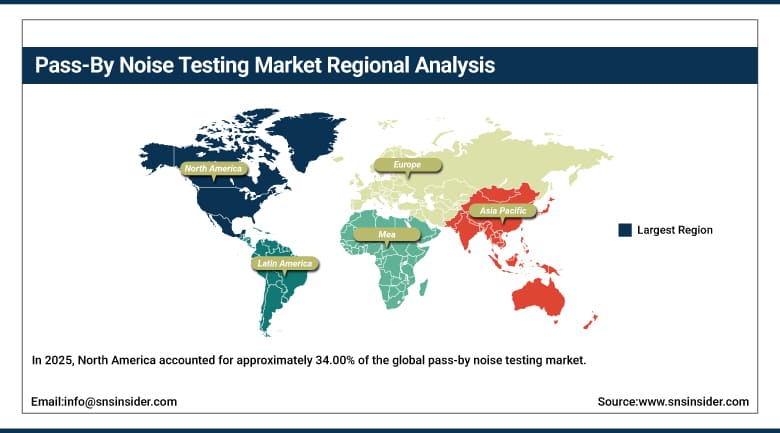
In 2025, North America accounted for approximately 34.00% of the global pass-by noise testing market, making it the largest regional market. The region benefits from a highly established automotive manufacturing ecosystem, advanced vehicle certification infrastructure, and stringent regulatory requirements governing exterior vehicle noise. Automotive OEMs, Tier-1 suppliers, and accredited testing laboratories continue investing in automated pass-by noise testing systems, precision acoustic instrumentation, AI-enabled measurement software, and digital NVH engineering platforms to accelerate vehicle development while ensuring compliance with domestic and international standards. The rapid commercialization of electric vehicles and connected mobility solutions is further increasing demand for sophisticated acoustic validation technologies across the United States and Canada.
Get Customized Report as Per Your Business Requirement - Enquiry Now
Europe Pass-By Noise Testing Market Insights
Europe has a lot of rules about vehicles they’re very detailed. This is because they have been making cars for a time and they are always trying to make them better. Countries like Germany, France, Italy and the United Kingdom have places to test cars to make sure they are not too loud. They have to follow the rules made by the UNECE about how loud cars can be. Car companies are using technology to make their cars better and to make sure they follow the rules. They are using software to analyze the sounds cars make and they are connecting their testing equipment to the internet. They are also using automated systems to test cars.
Asia Pacific Pass-By Noise Testing Market Insights
The Asia Pacific region is going to have the growth rate of 6.38 % during the time we are looking at. This region will make up 30 percent of the whole market by 2025. The Asia Pacific region is making a lot of cars really fast. They are also making electric vehicles and following international vehicle certification standards. Countries like China, Japan, South Korea and India are spending a lot of money on car testing labs. These labs have good sound sensors, automatic outdoor testing systems and smart data collection platforms. The Asia Pacific region is also sending a lot of cars to countries. This means that car makers need to make sure their cars meet global safety standards.
Middle East & Africa and Latin America Pass-By Noise Testing Market Insights
The Middle East and Africa are seeing a lot of growth because governments are making rules for cars making sure cars are good quality and putting money into places that make cars. The United Arab Emirates and Saudi Arabia are starting to use the rules for checking cars that everyone else uses. They are also getting better at testing cars to help make cars in the area. People want cars that meet standards so companies are investing in new technology to test how loud cars are.
Latin America is also growing, with Brazil, Mexico and Argentina making cars. Car companies in these countries are updating the way they test cars and using equipment to make sure their cars meet international rules. Big car companies are working with companies in Latin America, which is helping them use technology to test cars and make sure they meet rules. In 2025 car companies, in the Middle East, Africa and Latin America kept updating the way they test cars so they can meet international rules for how loud cars can be.
Growth Drivers: Increasing stringency of global vehicle noise regulations driving demand for advanced testing.
The main thing that is helping the pass-by noise testing market to grow is that the rules about vehicle noise are getting stricter over the world. The people in charge of these rules are making them tougher to reduce the noise that vehicles make and to make the roads safer. So the companies that make vehicles are spending a lot of money on equipment that can measure noise well on systems that can test vehicles automatically on software that can process signals digitally and on platforms that use artificial intelligence to analyze noise and vibration. This is because they want to make sure their vehicles meet all the rules and can be sold quickly.
In 2025 HBK was still growing its business in the sector by adding new systems for measuring pass-by noise and new digital solutions for analyzing noise and vibration. These new systems and solutions are helping vehicle manufacturers, over the world to meet the rules and sell their vehicles.
Restraints: High capital investment and complex testing infrastructure requirements.
The big problem with this is that it costs a lot of money to set up a place to test the noise that cars make when they drive by. The rules say that these places have to be very good at testing the noise so they need good microphones and other equipment to measure the sound. They also need tracks to test the cars on and equipment to check the weather. They need special software to make sure everything is okay. In April 2026 some big companies that test cars decided to spend money on special equipment to make testing easier and cheaper in the long run.
Opportunities: Electric vehicle expansion creating new demand for precision acoustic validation.
The chance to get into the electric vehicle market is creating a need for precise acoustic validation. The world is moving towards cars really fast and this is a big opportunity for the pass-by noise testing market in the long run. Electric vehicles are very quiet because they do not make much noise as regular cars so when we test them for noise outside we have to pay attention to the noise the tires make on the road the air moving around the car and other systems like the warning sounds. Companies are putting money into engineering, testing that happens virtually and special computers that can predict what the noise will be like.
In 2025 Siemens Digital Industries Software kept making its Simcenter program better by adding features to help with noise and acoustic engineering, for electric vehicles, which will help with development and making sure they follow the rules.
Recent Developments:
-
2026: HBK (Hottinger Bruel & Kjaer) enhanced its automotive NVH and pass-by noise testing portfolio by expanding advanced acoustic measurement solutions, automated data acquisition systems, and software capabilities designed to support vehicle homologation, exterior noise compliance, and electric vehicle acoustic validation across global automotive testing facilities.
-
2025: Siemens Digital Industries Software continued strengthening its Simcenter portfolio with enhanced noise, vibration, and harshness (NVH) simulation and acoustic engineering capabilities, enabling automotive manufacturers to accelerate virtual validation, optimize vehicle acoustics, and improve regulatory pass-by noise compliance throughout the product development cycle.
-
2026: DEKRA expanded its automotive testing and certification capabilities by strengthening vehicle validation, homologation, and regulatory compliance services, supporting OEMs in meeting evolving international exterior vehicle noise and safety requirements through accredited testing infrastructure.
-
2025: TUV SUD continued investing in advanced automotive testing laboratories equipped with digital acoustic measurement technologies and automated validation systems to support vehicle certification, regulatory compliance, and next-generation mobility development across global automotive markets.
Pass-By Noise Testing Market Key Players:
-
Bruel & Kjaer
-
Siemens Digital Industries Software
-
HEAD acoustics GmbH
-
Muller-BBM VibroAkustik Systeme GmbH
-
Dewesoft d.o.o.
-
GRAS Sound & Vibration
-
PCB Piezotronics, Inc.
-
National Instruments Corporation
-
Dewetron GmbH
-
NTi Audio AG
-
OROS Inc.
-
imc Test & Measurement GmbH
-
DEKRA SE
-
TUV SUD AG
-
TUV Rheinland AG
-
Applus+ IDIADA
-
ATESTEO GmbH
-
HORIBA, Ltd.
-
Microflown Technologies
-
Signal.X Technologies LLC
Pass-By Noise Testing Market Report Scope:
| Report Attributes | Details |
|---|---|
| Market Size in 2025 | USD 1.15 Billion |
| Market Size by 2035 | USD 1.88 Billion |
| CAGR | CAGR of 5.05% From 2026 to 2035 |
| Base Year | 2025 |
| Forecast Period | 2026-2035 |
| Historical Data | 2022-2024 |
| Report Scope & Coverage | Market Size, Segments Analysis, Competitive Landscape, Regional Analysis, DROC & SWOT Analysis, Forecast Outlook |
| Key Segments | • By Component (Testing Equipment, Noise Measurement Software, Microphones & Sensors, Engineering Services, Others) • By Vehicle Type (Passenger Vehicles, Commercial Vehicles, Motorcycles, Electric Vehicles, Others) • By Application (Vehicle Certification, R&D Testing, Production Validation, Regulatory Compliance, Others) • By End User (Automotive OEMs, Testing Laboratories, Tier-1 Suppliers, Government & Regulatory Agencies, Others) |
| Regional Analysis/Coverage | North America (US, Canada), Europe (Germany, UK, France, Italy, Spain, Russia, Poland, Rest of Europe), Asia Pacific (China, India, Japan, South Korea, Australia, ASEAN Countries, Rest of Asia Pacific), Middle East & Africa (UAE, Saudi Arabia, Qatar, South Africa, Rest of Middle East & Africa), Latin America (Brazil, Argentina, Mexico, Colombia, Rest of Latin America). |
| Company Profiles | Bruel & Kjaer, Siemens Digital Industries Software, HEAD acoustics GmbH, Muller-BBM VibroAkustik Systeme GmbH, Dewesoft d.o.o., GRAS Sound & Vibration, PCB Piezotronics, Inc., National Instruments Corporation, Dewetron GmbH, NTi Audio AG, OROS Inc., imc Test & Measurement GmbH, DEKRA SE, TÜV SÜD AG, TÜV Rheinland AG, Applus+ IDIADA, ATESTEO GmbH, HORIBA, Ltd., Microflown Technologies, Signal.X Technologies LLC |
Frequently Asked Questions
The market is expected to expand at a CAGR of 5.05% during the forecast period.
The Testing Equipment segment dominated the market, accounting for 42.00% of the total revenue share in 2025.
North America dominated the global Pass-By Noise Testing Market in 2025, accounting for 34.00% of the total market revenue.
The Pass-By Noise Testing Market was valued at USD 1.15 Billion in 2025.
The market is projected to reach USD 1.88 Billion by 2035.
