
Peptide and Oligonucleotide CDMO Market Report Scope & Overview:
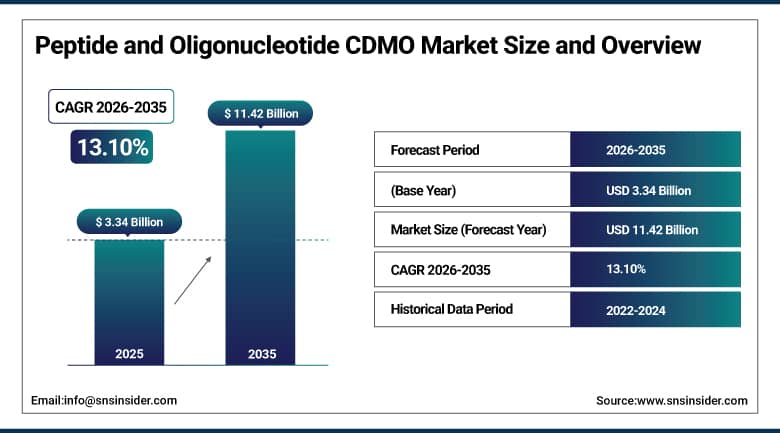
The Peptide and Oligonucleotide CDMO Market was valued at USD 3.34 Billion in 2025 and is expected to reach USD 11.42 Billion by 2035, growing at a CAGR of 13.10% from 2026–2035.
The Peptide and Oligonucleotide CDMO Market is witnessing strong growth in the global market owing to increasing outsourcing of biopharmaceutical manufacturing. Rising demand for peptide-based therapeutics is supporting market expansion. Expanding use of oligonucleotide drugs in precision medicine is driving adoption. CDMO companies are investing in advanced synthesis technologies. Growing pipeline of biologics and genetic therapies is improving production demand. Increasing focus on cost-efficient manufacturing is further accelerating market growth.
As reported by U.S. Food and Drug Administration and European Medicines Agency biologics manufacturing guidelines updates, more than 120 therapeutic candidate molecules based on oligonucleotides and peptides are currently being developed clinically worldwide, as well as more than 15 oligonucleotide medicines and 10 peptide therapeutics that are approved till 2025. According to the data provided by OECD biotechnology indicators and ICH manufacturing quality guidelines, the ongoing developments in solid-phase synthesis techniques ensure that the amount of process-related impurities falls below 5%. As noted by U.S. National Institutes of Health, more than 60% of nucleic acid therapeutic agents use outsourced CDMO manufacturing processes.
To Get More Information On Peptide and Oligonucleotide CDMO Market - Request Free Sample Report
Peptide and Oligonucleotide CDMO Market Trends
-
The growing use of automated peptide and oligonucleotide synthesis systems is leading to improved efficiencies, scalable, and consistent operations at CDMO facilities around the world.
-
Use of digital technology and process analytics is leading to improved production monitoring and efficient workflows at CDMO facilities.
-
Investments in adaptable and modular manufacturing facilities are contributing to the ability to achieve fast scale-up capacity for complicated therapeutic needs.
-
Growing complexity of peptides and oligonucleotides for drug manufacturing is leading to increased use of technologically advanced and specialized CDMOs around the world.
-
Increased use of personalized medicines and precision drugs is leading to the need for custom-made small batch manufacturing solutions.
-
More pharmaceutical companies are outsourcing their manufacturing processes to CDMOs in order to simplify the process and accelerate development of the drugs.
U.S. Peptide and Oligonucleotide CDMO Market Outlook.
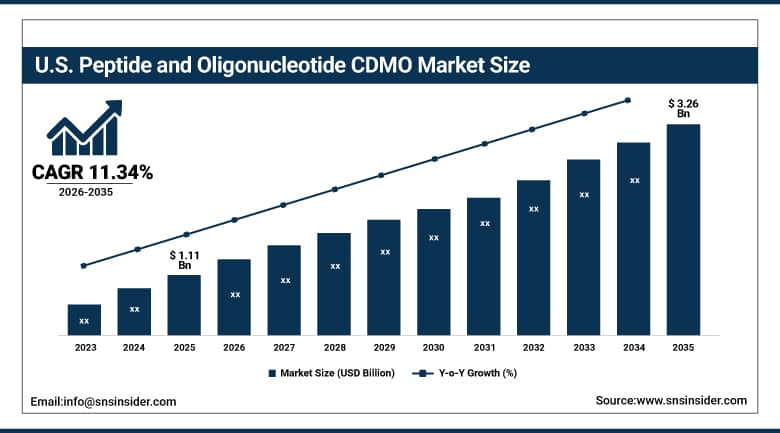
The U.S. Peptide and Oligonucleotide CDMO Market was valued at USD 1.11 Billion in 2025 and is expected to reach around USD 3.26 Billion by 2035, growing at a CAGR of 11.34% from 2026–2035.
The U.S. Peptide and Oligonucleotide CDMO Market is growing steadily owing to strong demand from biopharmaceutical outsourcing activities. Increasing adoption of advanced peptide therapeutics is supporting market expansion. Rising use of oligonucleotide-based precision medicines is driving consistent demand. Growth in biologics and gene therapy pipelines is further increasing outsourcing requirements. CDMO companies are focusing on high-efficiency synthesis technologies. Advancements in automated and scalable manufacturing are improving production quality.
According to the 2025 FDA drug manufacturing inspections, over 70% of advanced therapy medicinal products manufacturing facilities utilize CDMOs at least at one stage in their production process. It is also reported by the United States’ National Institutes of Health that the number of clinical trials involving oligonucleotides has grown by more than 35% in the last five years.
Peptide and Oligonucleotide CDMO Market Segment Analysis
-
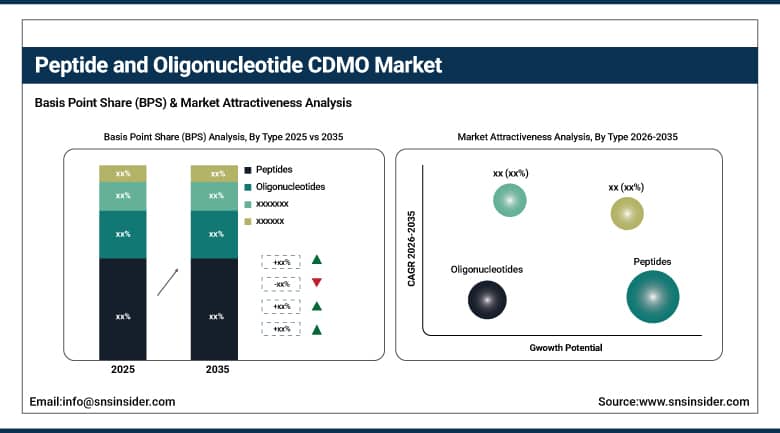
By Type, peptides dominated the market with 58.40% share in 2025; while oligonucleotides are the fastest growing segment with CAGR of 16.38% during 2026 to 2035.
-
By Application, pharmaceuticals dominated the market with 71.60% share in 2025; while diagnostics are the fastest growing segment with CAGR of 17.05% during 2026 to 2035.
-
By Synthesis Route, solid-phase synthesis dominated the market with 64.80% share in 2025; while automated synthesis are the fastest growing segment with CAGR of 19.96% during 2026 to 2035.
-
By Scale, clinical dominated the market with 46.85% share in 2025; while preclinical are the fastest growing segment with CAGR of 16.05% during 2026 to 2035.
By Type, peptides dominated the Peptide and Oligonucleotide CDMO Market, while oligonucleotides are the fastest growing segment.
Peptide peptides accounted for the dominated market share in terms of revenues in 2025. The high adoption rate in therapeutic drugs' development and usage in cancer therapy and metabolic disorder treatments contributed significantly to this domination. Well-established manufacturing processes and superior stability than other molecules further drive demand. Outsourcing of large-scale peptide manufacture by the CDMO drives its leading market position.
The oligonucleotides market is estimated to experience the fastest CAGR during the period from 2026 to 2035 owing to increased demand for precision medicines and genetic medicines. The increasing application of oligonucleotides in treating rare diseases and genetic diseases further drives their adoption rate. The technological advancement in synthesis and delivery systems continuously improves efficiency. Increasing clinical pipeline approvals and robust investments in RNA-based medicines are further boosting the growth in the industry significantly.
By Application, pharmaceuticals dominated the market, while diagnostics are the fastest growing segment.
The Pharmaceuticals division accounted for the dominated revenue share in the Peptide and Oligonucleotide CDMO Market in 2025. The rise in demand for peptide-based drugs and oligonucleotide medicines is fueling the dominance in the treatment of chronic diseases. Outsourcing drug manufacturing to CDMOs is facilitating large-scale production, while rising investments in biological drugs and precision medicines are boosting pharmaceuticals demand.
The Diagnostics sector is anticipated to register the fastest CAGR between 2026 and 2035 owing to an increased use of molecular and genetic techniques. The growing need for early detection and personalized medicine is increasing the use of oligonucleotide diagnostics. The development of healthcare facilities and growing awareness regarding preventive screening is further propelling the industry growth.
By Synthesis Route, solid-phase synthesis dominated the market, while automated synthesis are the fastest growing segment.
The Solid-phase Synthesis segment accounted for the dominated share of the revenues in the Peptide and Oligonucleotide CDMO Market. The reasons include the high efficiency and reliability of the process and the high purity of the peptide and oligonucleotide sequences obtained through this method. In addition, the scalable nature and wide industry acceptance of the process make it one of the leaders in the global CDMO environment.
The Automated Synthesis segment is likely to record the fastest CAGR in the 2026-2035 forecast period due to the rising demand for highly efficient and error-free manufacturing methods. The use of this technology minimizes the human factor in the production of peptides and oligonucleotides and increases their reproducibility. An increase in the adoption of robotics and AI-driven solutions speeds up the process.
By Scale, clinical dominated the market, while preclinical are the fastest growing segment.
The Clinical Segment held a dominated revenue share than any other in the Peptide and Oligonucleotide CDMO Market in 2025. The clinical segment holds the leading market position since there is high demand for late-stage drug development and clinical trial materials manufacturing. Additionally, an increased trend in the outsourcing of services by pharmaceutical and biotechnology companies will increase its revenue share. There is an increased complexity in the manufacturing of peptides and oligonucleotides during the clinical phase that increases dependency on CDMOs.
The Preclinical Segment is expected to register the fastest CAGR from 2026 to 2035 owing to the growing activities of drug discovery in the initial stages. There is increased demand for toxicology and proof of concept studies due to the increased number of novel candidates for peptides and oligonucleotides. Increased utilization of screening technologies will fuel the outsourcing trend in the preclinical segment. In addition, there is increased emphasis on reducing development time and costs.
Regional Analysis
|
Region |
Major Country |
Share within Region, 2025(%) |
|---|---|---|
|
North America |
United States |
86.40% |
|
Europe |
Germany |
29.10% |
|
Asia Pacific |
China |
43.20% |
|
Middle East & Africa |
UAE |
19.40% |
|
Latin America |
Brazil |
48.10% |
North America Peptide and Oligonucleotide CDMO Market Insights.
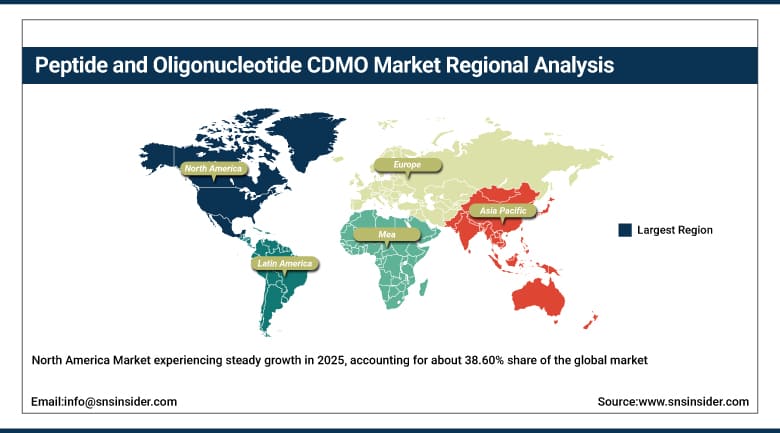
North America Peptide and Oligonucleotide CDMO Market is experiencing steady growth in 2025, accounting for about 38.60% share of the global market, owing to strong biopharmaceutical outsourcing demand. The region benefits from advanced R&D infrastructure and high adoption of biologics manufacturing. Increasing use of peptide-based therapeutics is improving outsourcing needs. Expansion of precision medicine and gene therapy pipelines is driving demand. Strong regulatory framework and quality standards are further supporting market growth.
According to the U.S. Food and Drug Administration Center for Drug Evaluation and Research 2025 biologics and advanced therapeutics framework, over 70 oligonucleotide-based therapies have entered clinical development stages globally, with North America accounting for a significant share of investigational new drug applications. As per the U.S. National Institutes of Health National Human Genome Research Institute data, over 3,000 gene-related clinical trials are active, supporting peptide and oligonucleotide demand in contract development and manufacturing services.
Get Customized Report as Per Your Business Requirement - Enquiry Now
Europe Peptide and Oligonucleotide CDMO Market Insights.
Europe Peptide and Oligonucleotide CDMO Market is characterized by stable growth in 2025 owing to strong pharmaceutical manufacturing regulations and research funding. Key countries include Germany, France, United Kingdom, and Switzerland. Rising demand for advanced therapeutics is driving CDMO adoption. Increasing focus on precision medicine and biosimilars is boosting outsourcing activities. Expansion of clinical trial networks is further supporting market growth. Strong regulatory compliance standards are shaping production quality requirements.
According to the European Medicines Agency and the European Commission’s 2025 pharmaceutical strategy implementation updates, over 30 oligonucleotide and peptide-based therapies are currently authorized or under active clinical review within the EU regulatory pipeline. As per the European Federation of Pharmaceutical Industries and Associations R&D monitoring indicators, more than 25% of all advanced therapy medicinal product clinical trials in Europe now incorporate peptide or nucleic-acid-based modalities.
Asia Pacific Peptide and Oligonucleotide CDMO Market Insights.
Asia Pacific is the fastest growing region in the Peptide and Oligonucleotide CDMO Market, registering a CAGR of about 15.52% during 2026–2035. Rapid expansion of biotech manufacturing hubs in China, India, Japan, and South Korea is driving strong demand. Increasing investments in biologics production and clinical research are boosting CDMO services. Rising cost advantages and skilled workforce availability are further accelerating market growth. Expanding pharmaceutical outsourcing from Western countries is also supporting regional expansion.
According to FDA biologics approval and inspection data from the United States, over 35% of global clinical trials involving advanced medicines, comprising peptide and oligonucleotide-based compounds, are currently being conducted within APAC nations. In addition, OECD data suggests over 50% growth in the construction of regional biomanufacturing capabilities over the last ten years.
Middle East & Africa and Latin America Peptide and Oligonucleotide CDMO Market Insights.
The Middle East & Africa along with Latin America regions are witnessing steady growth due to expanding pharmaceutical infrastructure and rising clinical research activities. Key contributing countries include Brazil, Mexico, UAE, Saudi Arabia, and South Africa. Increasing investment in biotechnology and healthcare modernization is driving CDMO adoption. Growth in contract manufacturing partnerships is further supporting market expansion. Rising demand for affordable therapeutics is boosting regional outsourcing activities.
As per the WHO Global Health Observatory and UNODCCP Pharmaceutical Manufacturing Indicators, low- and middle-income areas, including some parts of Latin America and Africa, represent only about 20% of the world’s manufacturing capacity of advanced biologics, with peptide and oligonucleotide production being predominantly undertaken in North America, Europe, and East Asia. As stated in the UNESCO Science Report 2025, more than 60% of Latin American countries have increased their investment in infrastructure for biotechnology research, but only about 30% of African countries have formulated regulatory frameworks for manufacturing advanced therapy medicinal products.
Market Dynamics
Growth Drivers: Increasing complexity of peptide and oligonucleotide synthesis driving adoption of specialized contract development and manufacturing services
Increasingly complex nature of peptides and oligonucleotides used in contemporary medicines is posing technical problems in their manufacturing process. Highly precise and sophisticated methods of synthesis need to be employed for these substances along with purity and scalability issues. Contract manufacturers possess necessary know-how and infrastructure to handle such situations. Increasing demand for personalized and highly pure therapeutics is providing another impetus to this trend. Pharma companies would like to outsource to alleviate themselves of the burden.
As per 2025 biologics and advanced therapies from the U.S. FDA CDER and European EMA, over 40% of new therapeutic modalities approved by the organizations have been found to be complex biologics, including peptides and oligonucleotides. As per the 2025 drug shortage and manufacturing quality report by the FDA, over 70% of complex injectable and nucleic acid-based treatments have outsourcing of manufacturing processes because of multi-step synthesis and stringent quality control measures.
Restraints: Supply chain limitations and technical challenges in large scale production restricting efficiency of CDMO operations worldwide
The limited availability of pure raw material is one challenge that causes supply chain constraints. The difficulty of scaling up the manufacture of peptides and oligonucleotides from research laboratory to commercial level still poses technical difficulties. The variation of batches and inefficiencies in process optimization affect the efficiency and the quality of the products. Reliance on highly sophisticated instruments adds more complexities to the operations. Another challenge posed by geographical clustering of manufacturing abilities.
Opportunities: Technological advancements in automated synthesis and scalable manufacturing enabling higher efficiency and global market expansion
Automation in synthesis platforms is increasing efficiency, effectiveness and scalability in the operations of the CDMO firms. New technologies in the manufacturing processes are making the process more efficient and consistent. Digital solutions and process analytics are helping to increase efficiency. Increase in investment in flexible production facilities is helping to make rapid scale-up possible. Such innovations are helping the CDMO companies to meet the growing demand around the globe. Continuous advancements are making growth opportunities very lucrative for the market.
According to FDA 2025 regulatory tracking information for biologics and oligonucleotides, more than 80% of oligonucleotide products that have been approved use automated solid-phase synthesis technique in their manufacturing process, indicating a heavy reliance on automated processes. According to EMA guidelines for ATMP manufacturing, more than 65% of peptides in development are manufactured using scalable continuous and semi-continuous synthesis techniques.
Recent Developments
-
2026: Thermo Fisher Scientific continues expanding pharma services and oligonucleotide manufacturing capabilities through global CDMO infrastructure investments and upgrades.
-
2025: Samsung Biologics expanded large scale biomanufacturing capacity with Plant 5 operations ramp and digital automation initiatives.
-
2025: Lonza reported strong 2025 growth with Vacaville integration progress and expanded biologics manufacturing network supporting CDMO demand.
-
2024: WuXi AppTec tripled solid-phase peptide synthesis capacity to 32,000 liters through new Changzhou and Taixing facility commissioning.
Peptide and Oligonucleotide CDMO Market Key Players are:
-
Lonza
-
Thermo Fisher Scientific
-
AGC Biologics
-
Samsung Biologics
-
WuXi AppTec
-
Bachem
-
PolyPeptide Group
-
CordenPharma
-
AmbioPharm
-
CPC Scientific
-
Almac Group
-
Evonik Industries
-
Siegfried Holding AG
-
Piramal Pharma Solutions
-
Pharmaron
-
Asymchem Laboratories
-
SK pharmteco
-
Porton Pharma Solutions
-
GenScript
-
Recipharm
Peptide and Oligonucleotide CDMO Market Report Scope:
| Report Attributes | Details |
|---|---|
| Market Size in 2025 | USD 3.34 Billion |
| Market Size by 2035 | USD 11.42 Billion |
| CAGR | CAGR of 13.10% From 2026 to 2035 |
| Base Year | 2025 |
| Forecast Period | 2026-2035 |
| Historical Data | 2022-2024 |
| Report Scope & Coverage | Market Size, Segments Analysis, Competitive Landscape, Regional Analysis, DROC & SWOT Analysis, Forecast Outlook |
| Key Segments | By Type (Peptides, Oligonucleotides, Conjugates) By Application (Pharmaceuticals, Diagnostics, Cosmetics) By Synthesis Route (Solid-phase Synthesis, Solution-phase Synthesis, Automated Synthesis) By Scale (Preclinical, Clinical, Commercial) |
| Regional Analysis/Coverage | North America (US, Canada), Europe (Germany, UK, France, Italy, Spain, Russia, Poland, Rest of Europe), Asia Pacific (China, India, Japan, South Korea, Australia, ASEAN Countries, Rest of Asia Pacific), Middle East & Africa (UAE, Saudi Arabia, Qatar, South Africa, Rest of Middle East & Africa), Latin America (Brazil, Argentina, Mexico, Colombia, Rest of Latin America). |
| Company Profiles | Lonza, Thermo Fisher Scientific, AGC Biologics, Samsung Biologics, WuXi AppTec, Bachem, PolyPeptide Group, CordenPharma, AmbioPharm, CPC Scientific, Almac Group, Evonik Industries, Siegfried Holding AG, Piramal Pharma Solutions, Pharmaron, Asymchem Laboratories, SK pharmteco, Porton Pharma Solutions, GenScript, Recipharm |
Frequently Asked Questions
The peptide and oligonucleotide CDMO market was valued at USD 3.34 Billion in 2025.
The major growth factors include rising outsourcing, increasing peptide therapeutics demand, expanding oligonucleotide use in precision medicine, growing biologics pipelines, automated synthesis adoption, and focus on cost efficient scalable manufacturing solutions.
The Peptides segment dominated the market in 2025 due to strong therapeutic adoption, oncology use, established processes, and large scale outsourcing.
North America dominated the peptide and oligonucleotide CDMO market in 2025 due to strong outsourcing demand and advanced R&D infrastructure.
