
Pico Projector Market Report Scope & Overview:
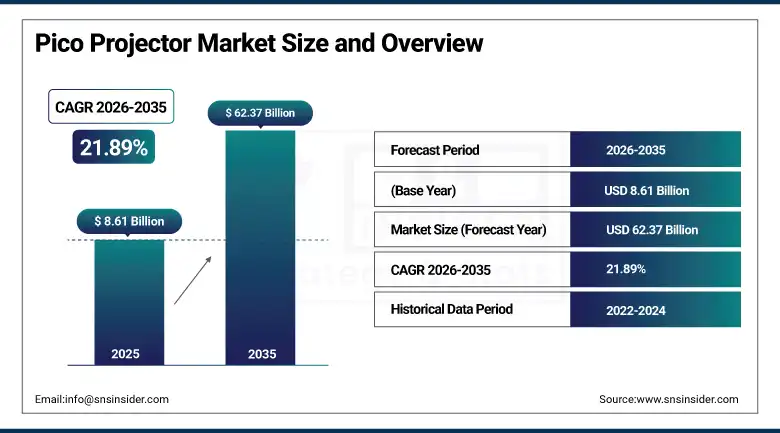
The Pico Projector Market size was valued at USD 8.61 Billion in 2025 and is expected to reach USD 62.37 Billion by 2035, growing at a CAGR of 21.89% from 2026–2035.
The global Pico projector market is growing at an exceptional and transformative pace. Pico projectors, also known as pocket or handheld projectors, are compact projection devices integrating miniaturized light engines, optics, and processing electronics into form factors ranging from smartphone-embedded modules to standalone palm-sized devices. The market is expanding rapidly driven by the growing demand for portable, lightweight, and energy-efficient display solutions that deliver high-quality visuals in small form factors. The strong growth trajectory reflects increasing consumer and enterprise demand for on-the-go visual experiences, integration with mobile devices, and expanding automotive HUD and healthcare imaging applications.
In 2024, Samsung launched the Freestyle 2nd Generation Pico projector with enhanced Smart TV functionality, auto keystone correction, 360-degree rotation, and up to 180-inch projection in a palm-sized form factor. The device’s built-in streaming capability across Netflix, Disney+, and YouTube, combined with its Bluetooth audio output and ambient lighting modes, demonstrates the commercial direction of premium Pico projector development toward all-in-one entertainment hub functionality whose convenience value sustains premium pricing above conventional portable projector alternatives.
To Get more information On Pico Projector Market - Request Free Sample Report
Pico Projector Market Trends
-
Holographic laser projection is gaining traction in AR, XR, and metaverse applications by enabling interactive 3D visuals and immersive user experiences.
-
Micro LED and laser light sources are improving brightness, energy efficiency, and performance in ambient lighting conditions.
-
Automotive integration of Pico projectors in head-up displays is creating new growth opportunities within connected and smart vehicle ecosystems.
-
AI-powered auto-focus, keystone correction, and content optimization are simplifying setup and enhancing user convenience.
-
5G-enabled wireless projection is supporting seamless, low-latency content sharing from smartphones and other connected devices.
U.S. Pico Projector Market Size Outlook
The U.S. Pico Projector Market was valued at approximately USD 2.10 Billion in 2025 and is expected to reach approximately USD 15.22 Billion by 2035, growing at a CAGR of approximately 21.79%.
The U.S. is the most commercially significant Pico projector market within the fastest-growing North American region. Samsung, Sony, LG, Anker Nebula, and ViewSonic’s U.S. commercial operations serve the domestic consumer and enterprise markets. The U.S.’s advanced consumer technology adoption culture, enterprise mobile workforce’s portable presentation device demand, and the healthcare sector’s medical imaging portable display requirement collectively sustain above-average per-unit commercial value. The automotive industry’s HUD programme and the entertainment sector’s home cinema portable projector adoption create diverse application channels that sustain U.S. market growth.
Anker Nebula expanded its Cosmos laser Pico projector series in 2024 with the Cosmos Laser 4K with Android TV 11.0, delivering 4K HDR projection at 2400 ANSI lumens from a portable unit whose auto-focus, auto-keystone, and built-in streaming eliminate setup complexity that conventional projectors require.
Pico Projector Market Segment Analysis
-
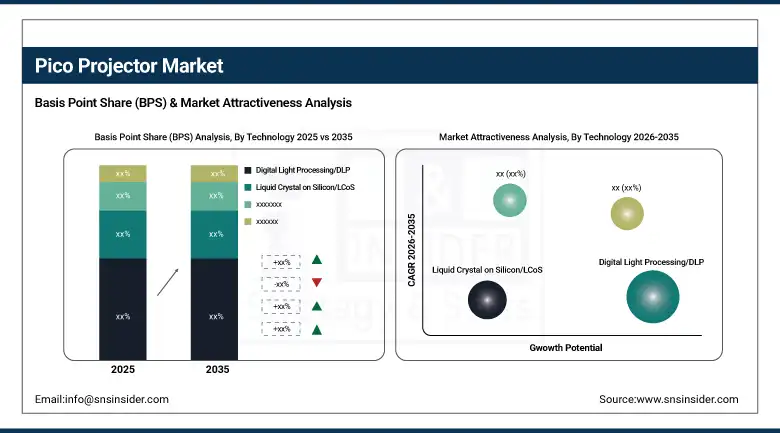
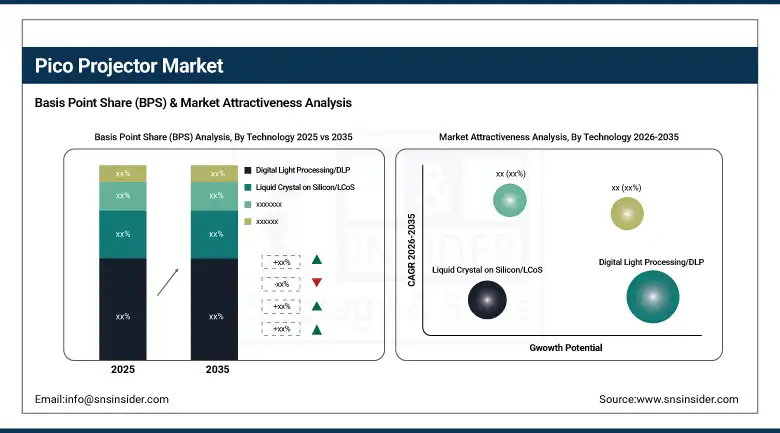
By Technology, the Digital Light Processing (DLP) segment dominated the pico projector market in 2025, while the Holographic Laser segment is the fastest growing as metaverse.
-
By Product, the Standalone/Non-Embedded Pico Projector segment dominated the pico projector market with approximately 62% share in 2025, while the Embedded/Integrated segment is the fastest growing as smartphone manufacturers, automotive OEMs.
-
By Application, the Consumer Electronics segment dominated the pico projector market with approximately 45% share in 2025, while the Business Presentations & Education segment is the fastest growing as mobile workforce presentation.
-
By End User, the Retail/Consumer segment dominated the pico projector market with approximately 52% share in 2025, while the Corporate & Enterprise segment is the fastest growing as mobile workforce’s portable presentation requirement.
By Technology, DLP dominates, holographic laser grows fastest
DLP retained the dominant technology position in the Pico projector market in 2025. DLP’s commercial primacy reflects its position as the most mature and commercially validated Pico projector technology whose Texas Instruments’ DLP chip’s miniaturization has enabled Pico projector integration at progressively smaller form factors and lower cost. The DMD chip’s micro mirror array’s fast switching speed creates superior motion reproduction and color accuracy that direct LED display alternatives cannot match in the same form factor. Each consumer Pico projector manufacturer’s DLP specification creates procurement relationships with Texas Instruments’ DLP component supply whose aggregate creates commercial scale that sustains the technology’s dominant market position.
Holographic laser projection is the fastest-growing technology because the metaverse, spatial computing, and extended reality application’s demand for immersive 3D projection capability creates new premium market development that conventional flat-plane projection technologies cannot address. Each holographic laser projector that creates volumetric 3D displays without glasses creates experiential differentiation whose novelty value sustains premium specification. The automotive industry’s augmented reality HUD application and the enterprise training sector’s immersive simulation requirement create structured holographic projection demand that sustains above-average technology investment.
By Application, consumer electronics dominates, business & education grows fastest
Consumer electronics retained the dominant application position with approximately 45% of the Pico projector market in 2025. The extraordinary consumer demand for portable home cinema, gaming, and personal content display creates the most commercially significant aggregate Pico projector application. Each household that adopts a Pico projector as a portable television supplement or replacement creates consumer procurement whose aggregate across the progressively growing home cinema category sustains consumer’s dominant application share. The social sharing and entertainment culture’s demand for large-screen experiences in any location creates Pico projector specification motivation whose convenience value compounds with product performance improvement.
Business presentations and education is the fastest-growing application because mobile workforce proliferation, classroom technology investment, and the corporate meeting room’s portable display infrastructure create structured above-average procurement. Each enterprise mobile worker who adopts a Pico projector for portable client presentation eliminates the venue projector dependency whose logistical constraint reduces presentation flexibility. Each classroom that deploys Pico projectors for interactive lesson content creates education institutional procurement whose government STEM investment programme sustains adoption.
By Product, standalone dominates, embedded grows fastest
Standalone Pico projectors retained the dominant product position with approximately 62% of the Pico projector market in 2025. The standalone device’s commercial independence from smartphone specification creates a complete projection system whose self-contained processing, wireless connectivity, and streaming capability creates versatile deployment beyond mobile device display extension. Each standalone Pico projector whose Android TV or similar OS enables direct streaming without smartphone connection creates convenience that sustains consumer specification preference. The enterprise market’s preference for dedicated presentation devices whose battery and processing capability is optimized for projection creates institutional procurement that sustains standalone’s dominant commercial position.
Embedded integration is the fastest-growing product category because smartphone manufacturers’ progressive exploration of integrated projection, automotive OEM’s HUD module integration, and smart glasses’ micro-projection development create volume embedded deployment whose unit scale at millions or billions of devices substantially exceeds standalone annual shipments. Each automotive model that integrates a Pico projector-based HUD creates per-vehicle embedded procurement whose aggregate across global vehicle production creates commercial scale.
By End User, consumer dominates, enterprise grows fastest
Retail and consumer end users retained the dominant position with approximately 52% of the Pico projector market in 2025. Consumer’s commercial primacy reflects the personal entertainment market’s volume adoption whose portable home cinema and gaming projection creates consistent procurement. The content streaming ecosystem’s extraordinary growth creates consumer motivation for large-screen display experiences in diverse locations whose Pico projector’s portability advantage over fixed television creates specification motivation. Each new streaming platform subscriber whose content library sustains regular viewing creates Pico projector replacement and upgrade procurement whose cycle sustains consumer segment’s dominant commercial position.
Corporate and enterprise is the fastest-growing end user because the mobile-first enterprise culture’s portable presentation investment, smart meeting room technology standardization, and the hybrid work model’s flexible workspace requirement create structured above-average enterprise Pico projector procurement. Each enterprise that standardizes Pico projector provision for its mobile sales and consulting workforce creates institutional procurement whose per-device specification reflects the organization’s productivity investment standard.
Regional Analysis
|
Region |
Major Country |
Share within Region, 2025 (%) |
|---|---|---|
|
North America |
United States |
87.4% |
|
Europe |
Germany |
22.3% |
|
Asia Pacific |
China |
44.8% |
|
Middle East & Africa |
UAE |
38.4% |
|
Latin America |
Brazil |
44.2% |
North America Pico Projector Market Insights
North America is the fastest-growing regional Pico projector market, driven by enterprise mobile workforce adoption, automotive HUD investment, and consumer home cinema market expansion. The United States accounts for approximately 87.4% of North American revenues through Samsung, Anker Nebula, ViewSonic, and XGIMI’s commercial operations, the enterprise mobile presentation market’s premium specification, and the consumer entertainment market’s large-screen experience demand.
Canada contributes approximately 12.6% of North American revenues through its consumer technology adoption, the enterprise sector’s portable presentation investment, and the education system’s classroom technology upgrade programme.
Europe Pico Projector Market Insights
Europe is a technically sophisticated Pico projector market where enterprise presentation culture, automotive industry’s HUD development, and consumer entertainment adoption create structured demand. Germany accounts for approximately 22.3% of European revenues through its automotive industry’s HUD integration programme, the enterprise technology market, and the consumer electronics adoption.
The United Kingdom, France, and the Netherlands are significant secondary markets where mobile workforce, education technology investment, and consumer entertainment adoption create consistent Pico projector procurement.
Asia Pacific Pico Projector Market Insights
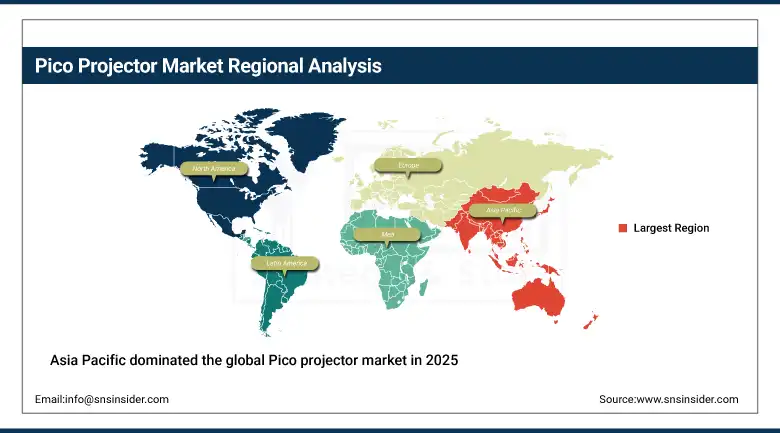
Asia Pacific dominated the global Pico projector market in 2025 with the highest revenue share, driven by its strong consumer electronics manufacturing infrastructure, high adoption of portable display solutions, and rapidly growing middle class. China accounts for approximately 44.8% of Asia Pacific revenues through its position as the world’s largest consumer electronics market, the manufacturing hub for major Pico projector brands, and the domestic technology ecosystem’s projection entertainment adoption.
Japan’s premium consumer electronics market, South Korea’s Samsung and LG’s Pico projector product leadership, and India’s rapidly growing consumer technology adoption create significant secondary markets whose combined procurement sustains Asia Pacific’s dominant regional position.
Get Customized Report as per Your Business Requirement - Enquiry Now
MEA & Latin America Pico Projector Market Insights
UAE leads MEA revenues at approximately 38.4% through its advanced consumer technology adoption, enterprise mobile workforce, and smart office investment. Brazil leads Latin American revenues at approximately 44.2% through its consumer technology market and the growing enterprise mobile presentation sector.
Market Dynamics
Growth Drivers: Mobile workforce portable presentation demand and consumer home cinema adoption
The extraordinary growth of mobile and remote working is the Pico projector market’s most commercially consistent enterprise demand driver. Each enterprise professional whose remote client presentation requirement creates portable display motivation creates Pico projector procurement whose aggregate across the global mobile workforce creates commercial scale. The hybrid work model’s proliferation creates corporate investment in portable presentation infrastructure whose Pico projector specification creates above-average per-device commercial value.
Consumer demand for large-screen entertainment experiences in any location creates the most commercially scalable volume growth driver. The streaming content ecosystem’s extraordinary library value creates motivation for large-screen experience beyond the household television’s fixed location whose portability constraint creates Pico projector specification opportunity. Each Pico projector that replaces or supplements a household television creates consumer adoption whose aggregate across progressively growing home cinema markets creates commercial scale.
Restraints: Brightness limitations in ambient light and battery life constraining portable use duration
Pico projector brightness typically ranging from 100-2000 ANSI lumens falls substantially below conventional projector and large-screen television alternatives whose 500-5000 nit brightness creates ambient light performance that Pico projectors cannot match without premium laser light source investment. Each application environment whose ambient light level exceeds the Pico projector’s effective display brightness creates adoption limitation that moderates adoption in daytime and well-lit settings.
Battery life limitations of 2-4 hours for portable Pico projectors create usage duration constraints that moderate the all-day mobile use case whose appeal requires extended battery capacity. Each mobile workforce user whose presentation duration exceeds battery capacity creates inconvenience that moderates adoption preference over alternative display solutions.
Opportunities: Automotive HUD integration and AR/VR immersive projection development
Automotive head-up display integration represents a structured commercial procurement opportunity whose per-vehicle Pico projector component value compounds with global vehicle production. Each automotive OEM that integrates AR-HUD Pico projection for navigation, ADAS warning, and entertainment creates embedded procurement whose design win creates multi-year supply relationships.
AR/VR and metaverse application’s holographic projection requirement create the most commercially premium Pico projector development category whose interactive 3D projection capability creates experiential value that 2D display alternatives cannot provide. Each holographic projection application that achieves compelling user experience creates adoption momentum that sustains premium technology investment.
Recent Developments:
-
2024: Samsung launched the Freestyle 2nd Generation Pico projector in 2024 with enhanced Smart TV functionality, 360-degree rotation, auto keystone correction, and up to 180-inch projection, demonstrating the commercial advancement toward all-in-one entertainment hub functionality.
-
2024: Anker Nebula expanded its Cosmos laser Pico projector series in 2024 with the Cosmos Laser 4K featuring Android TV 11.0, 4K HDR projection, and 2400 ANSI lumens with auto-focus and auto-keystone for television-replacement home cinema capability.
-
2024: XGIMI launched the MoGo 3 Pro portable projector in 2024 with Google TV, Dolby Vision, and 400 ISO lumens in a 1.6kg portable form factor targeting the professional mobile workforce and home entertainment markets with streaming-integrated projection capability.
Pico Projector Companies are:
-
Samsung Electronics Co., Ltd. (Freestyle)
-
Sony Corporation (MP-CD1)
-
LG Electronics Inc. (MiniBeam)
-
Anker Innovations (Nebula)
-
XGIMI Technology Co., Ltd.
-
ViewSonic Corporation
-
BenQ Corporation
-
AAXA Technologies Inc.
-
Texas Instruments Inc. (DLP)
-
PLUS Vision Corp.
-
Acer Inc.
-
Lenovo Group Limited
-
ZTE Corporation
-
Bosch Sensortec GmbH
-
Philips (TP Vision)
-
Epson America Inc.
-
RIF6 LLC
-
Showtec (Highlite)
-
Miroir USA
Pico Projector Market Report Scope:
| Report Attributes | Details |
|---|---|
| Market Size in 2025 | USD 8.61 Billion |
| Market Size by 2035 | USD 62.37 Billion |
| CAGR | CAGR of 21.89% From 2026 to 2035 |
| Base Year | 2025 |
| Forecast Period | 2026-2035 |
| Historical Data | 2022-2024 |
| Report Scope & Coverage | Market Size, Segments Analysis, Competitive Landscape, Regional Analysis, DROC & SWOT Analysis, Forecast Outlook |
| Key Segments | • By Technology (Digital Light Processing/DLP, Liquid Crystal on Silicon/LCoS, LED-Based, Laser/Holographic Laser) • By Product (Standalone/Non-Embedded, Embedded/Integrated) • By Application (Consumer Electronics, Business Presentations & Education, Automotive HUD, Healthcare & Medical Imaging, Others) • By End User (Retail/Consumer, Corporate & Enterprise, Education Institutions, Healthcare, Automotive) |
| Regional Analysis/Coverage | North America (US, Canada), Europe (Germany, UK, France, Italy, Spain, Russia, Poland, Rest of Europe), Asia Pacific (China, India, Japan, South Korea, Australia, ASEAN Countries, Rest of Asia Pacific), Middle East & Africa (UAE, Saudi Arabia, Qatar, South Africa, Rest of Middle East & Africa), Latin America (Brazil, Argentina, Mexico, Colombia, Rest of Latin America). |
| Company Profiles | Samsung Electronics Co., Ltd. (Freestyle), Sony Corporation (MP-CD1), LG Electronics Inc. (MiniBeam), Anker Innovations (Nebula), XGIMI Technology Co., Ltd., ViewSonic Corporation, BenQ Corporation, Optoma Corporation, AAXA Technologies Inc., Texas Instruments Inc. (DLP), PLUS Vision Corp., Acer Inc., Lenovo Group Limited, ZTE Corporation, Bosch Sensortec GmbH, Philips (TP Vision), Epson America Inc., RIF6 LLC, Showtec (Highlite), and Miroir USA |
Frequently Asked Questions
The Pico Projector Market is expected to grow at a CAGR of 21.89% from 2026 to 2035.
The Pico Projector Market was valued at USD 8.61 Billion in 2025.
Rising demand for portable, lightweight, and energy-efficient display solutions delivering high-quality visuals in compact form factors, and mobile workforce’s portable presentation requirement creating enterprise procurement that compounds with consumer home cinema adoption globally.
DLP dominated the Pico Projector Market in 2025, while Holographic Laser is the fastest growing technology segment.
Asia Pacific dominated the Pico Projector Market in 2025 with the highest revenue share, while North America is the fastest-growing region.
