
Positron Emission Tomography Scan Market Report Scope & Overview:
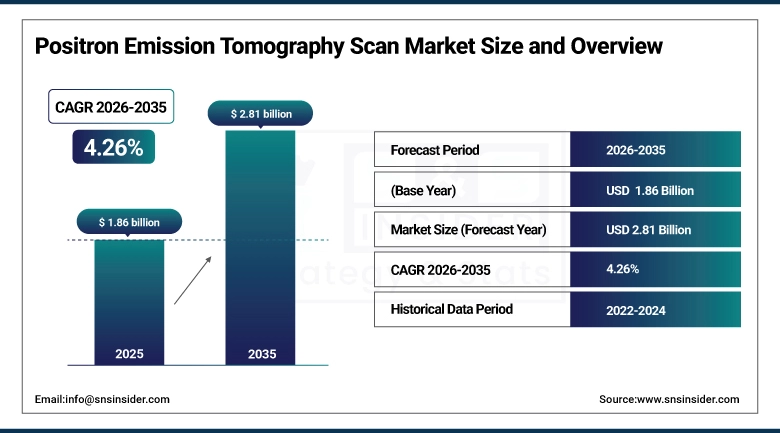
The Positron Emission Tomography Scan Market was valued at USD 1.86 billion in 2025 and is expected to reach USD 2.81 billion by 2035, growing at a CAGR of 4.26% from 2026–2035.
The market for Positron Emission Tomography (PET) Scans is predicted to see rapid growth due to an increasing occurrence of various health conditions such as cancer, heart problems, and neurological disorders in individuals, a rising need for more efficient and reliable diagnostic imaging techniques, and increased use of imaging modalities that are integrated into hybrid PET-CT and PET-MRI scanners. The growing cases of chronic ailments, rise in geriatric population, and increasing amount spent on healthcare are promoting the adoption of highly advanced molecular imaging solutions in hospitals and imaging clinics. Apart from this, growing awareness about the importance of preventive diagnoses, positive government policies towards PET scans in developed nations, and increasing investment in healthcare infrastructure will continue to boost the market for Positron Emission Tomography (PET) Scan systems.
In 2026, U.S. National Cancer Institute (NCI) and healthcare imaging reports highlighted the increasing adoption of PET imaging technologies for oncology diagnosis and treatment monitoring, driven by rising cancer incidence, advancements in hybrid imaging systems, and growing emphasis on precision medicine and early disease detection across healthcare facilities nationwide.
To Get more information on Positron Emission Tomography Scan Market - Request Free Sample Report
Positron Emission Tomography Scan Market Trends
-
Healthcare facilities are increasingly adopting hybrid imaging systems for improved diagnostic accuracy and faster disease detection. PET-MRI adoption is rising particularly in neurology and precision oncology applications.
-
AI-powered PET imaging solutions are improving image reconstruction, lesion detection, and workflow efficiency. Hospitals are increasingly implementing AI-enabled platforms to enhance diagnostic precision.
-
Digital PET scanners with advanced detector technologies are offering higher sensitivity and shorter scan times. These systems also support low-dose imaging and improved patient comfort.
-
Research on novel radiotracers is expanding PET applications in oncology, cardiology, and neurology. Advanced tracers are improving disease-specific imaging and diagnostic accuracy.
-
Total-body PET systems are gaining popularity due to reduced radiation exposure and faster imaging capabilities. These technologies support real-time disease monitoring and precision diagnostics.
-
Emerging countries are witnessing rising PET scanner installations due to increasing cancer cases and healthcare investments. Asia-Pacific is becoming a major growth region for PET imaging technologies.
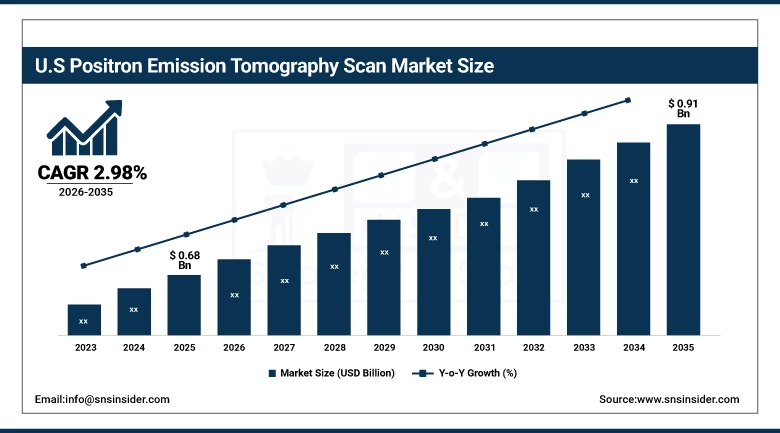
United States Positron Emission Tomography Scan Market was valued at USD 0.68 Billion in 2025 and it is expected to reach USD 0.91 Billion by 2035, growing at a CAGR of 2.98% over the forecast period of 2026–2035.
The U.S. Positron Emission Tomography Scan Market is the largest regional market globally, driven by advanced healthcare infrastructure, high adoption of molecular imaging technologies, and increasing prevalence of cancer, cardiovascular diseases, and neurological disorders supported by favorable reimbursement policies and strong healthcare spending. Furthermore, the growing adoption of PET-CT and PET-MRI systems through hospitals, diagnostic imaging centers, and research institutions is expected to offer an impetus for market growth.
With regards to the adoption of PET imaging technologies by health institutions, an increased focus on early detection and precision medicine is fueling the market growth. There is also growing traction from healthcare professionals keen to increase diagnostic efficiency and effectiveness to minimize overall disease management costs.
In 2026, the U.S. National Cancer Institute (NCI) reported that the increasing burden of cancer and chronic diseases in the United States, along with rising demand for early-stage diagnosis and advanced imaging technologies, is driving higher adoption of PET scan systems across hospitals and diagnostic centers nationwide.
Positron Emission Tomography Scan Market Segmentation Analysis
-
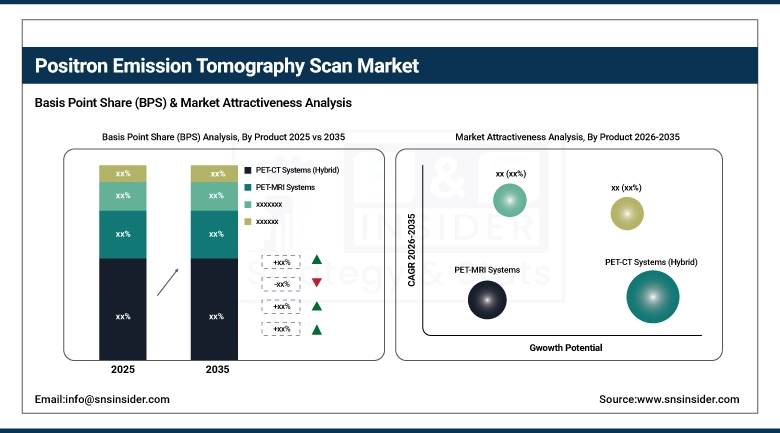
By Product, PET-CT Systems (Hybrid) dominated the Positron Emission Tomography Scan Market with 82.00% share in 2025; PET-MRI Systems fastest growing (CAGR).
-
By Modality, Fixed PET Scanners dominated the Positron Emission Tomography Scan Market with 93.10% share in 2025; Portable / Mobile PET Scanners fastest growing (CAGR).
-
By Application, Oncology dominated the Positron Emission Tomography Scan Market with 55.00% share in 2025; Neurology fastest growing (CAGR).
-
By End User, Hospitals & Surgical Centers dominated the Positron Emission Tomography Scan Market with 50.00% share in 2025; Diagnostic & Imaging Centers fastest growing (CAGR).
By Product, PET-CT Systems (Hybrid) segment dominates the Positron Emission Tomography Scan Market, while PET-MRI Systems segment is expected to grow fastest.
PET-CT Systems (Hybrid) segment dominated the Positron Emission Tomography Scan Market due to its superior ability to combine functional and anatomical imaging for accurate disease diagnosis. Increasing adoption in oncology, cardiology, and neurology, along with high availability across hospitals and diagnostic centers, supported market dominance.
PET-MRI Systems segment is expected to witness the fastest growth during the forecast period owing to rising demand for advanced soft tissue imaging, lower radiation exposure, and improved diagnostic precision. Growing applications in neurological disorders, pediatric imaging, and precision medicine, along with technological advancements and increasing healthcare investments, are accelerating segment growth globally.
By Modality, Fixed PET Scanners segment dominates the Positron Emission Tomography Scan Market, while Portable / Mobile PET Scanners segment is expected to grow fastest.
Fixed PET Scanners segment dominated the Positron Emission Tomography Scan Market due to their widespread installation in hospitals and diagnostic centers, high imaging accuracy, advanced hybrid imaging capabilities, and ability to manage large patient volumes for oncology, cardiology, and neurology diagnostics efficiently.
Portable / Mobile PET Scanners segment is expected to grow at the fastest CAGR from 2026–2035 owing to increasing demand for point-of-care imaging, rising healthcare access in remote areas, technological advancements in compact imaging systems, and growing preference for flexible, cost-effective diagnostic solutions in ambulatory centers and emergency healthcare applications.
By Application, Oncology segment dominates the Positron Emission Tomography Scan Market, while Neurology segment is expected to grow fastest.
Oncology segment dominated the Positron Emission Tomography Scan Market owing to the rising global cancer burden, increasing demand for early tumor detection, and widespread use of PET-CT imaging for cancer diagnosis, staging, treatment planning, and therapy monitoring across hospitals and diagnostic centers.
Neurology segment is expected to grow at the fastest CAGR from 2026–2035 due to increasing prevalence of Alzheimer’s disease, Parkinson’s disease, epilepsy, and other neurodegenerative disorders. Growing adoption of advanced PET imaging for brain mapping, cognitive disorder diagnosis, and research applications is further accelerating segment growth globally.
By End User, Hospitals & Surgical Centers segment dominates the Positron Emission Tomography Scan Market, while Diagnostic & Imaging Centers segment is expected to grow fastest.
Hospitals & Surgical Centers segment dominated the Positron Emission Tomography Scan Market owing to the high availability of advanced PET-CT and PET-MRI systems, rising patient admissions for chronic disease diagnosis, strong reimbursement support, and increasing use of PET imaging for oncology, cardiology, and neurological treatment planning.
Diagnostic & Imaging Centers segment is expected to grow at the fastest CAGR from 2026-2035 due to increasing demand for outpatient diagnostic services, growing preference for cost-effective imaging procedures, rising investments in standalone imaging facilities, and expanding adoption of advanced PET technologies offering faster diagnosis, improved accessibility, and reduced waiting times for patients.
Positron Emission Tomography Scan Market Regional Analysis
|
Region |
Major Country |
Share (%) |
|---|---|---|
|
North America |
United States |
41.50% |
|
Europe |
Germany |
22.50% |
|
Asia Pacific |
China |
29.00% |
|
Middle East & Africa |
UAE |
3.00% |
|
Latin America |
Brazil |
4.00% |
North America Positron Emission Tomography Scan Market Insights
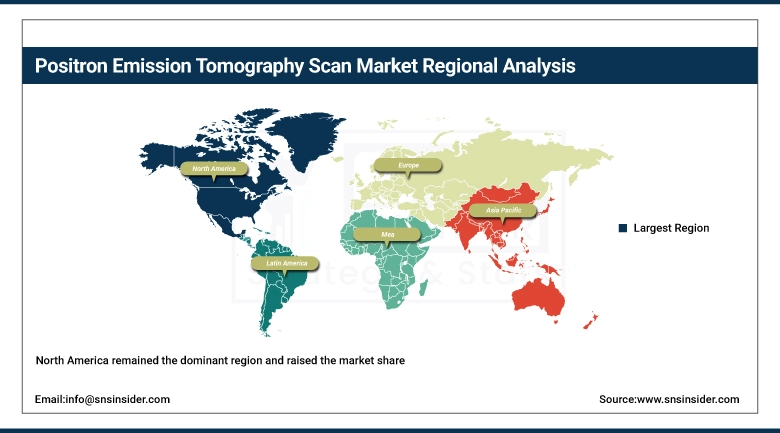
North America remained the dominant region and raised the market share for Positron Emission Tomography (PET) Scans to its apex of global market revenue generation, owing to well-developed healthcare facilities, increased application of molecular imaging techniques, and rising incidences of cancers, cardiovascular disorders, and neurological diseases. Other factors contributing to the growth include lucrative reimbursement schemes, high healthcare investment, and wide adoption of PET-CT and PET-MRI devices in various hospitals and diagnostic centers. Rising demands for early disease diagnosis and precision medicine also bolster market growth.
The best regional performance was exhibited by the United States, backed by robust healthcare spending, availability of advanced diagnostic imaging facilities, and growing use of PET scans for cancer and neurology purposes.
The U.S. National Cancer Institute (NCI) highlights the increasing incidence of cancer and chronic diseases across the country, supporting sustained demand for PET imaging technologies for disease diagnosis, staging, and treatment monitoring.
Get Customized Report as per Your Business Requirement - Enquiry Now
Asia Pacific Positron Emission Tomography Scan Market Insights
The Asia Pacific region will show the fastest growth rate during the forecast period owing to rising healthcare spending, increasing cases of cancer, and increased availability of high-tech diagnostic imaging solutions. Some of the countries contributing to the growth of the market include China, India, Japan, South Korea, and Australia, wherein the contribution from China will be significant. Increasing healthcare infrastructure, rising awareness about early diagnosis of diseases, and growing use of hybrid imaging systems will be key drivers for the market.
Government efforts to improve healthcare through the implementation of various programs, along with initiatives towards screening for cancers, are fueling market growth. The NMPA of China is encouraging the adoption of advanced medical imaging solutions, while the MHLW of Japan is supporting the integration of advanced imaging technologies for precision diagnostics.
Europe Positron Emission Tomography Scan Market Insights
Europe held a significant revenue share in the global Positron Emission Tomography Scan Market, driven by strong healthcare systems, increasing aging population, and rising adoption of advanced diagnostic imaging technologies. Countries such as Germany, the United Kingdom, France, Italy, and Spain are major contributors, with Germany accounting for a substantial portion of regional demand due to high utilization of PET imaging in oncology and neurological diagnostics.
Growth in cases of cancers and neurodegenerative disorders, rising spending on the healthcare sector, and investments in precision medicine solutions are some of the important factors driving market growth. The European Commission remains active in its efforts towards healthcare innovations, and the regional healthcare policies encourage the usage of advanced imaging technologies.
Middle East & Africa and Latin America Positron Emission Tomography Scan Market Insights
The Middle East & Africa (MEA) region is witnessing steady growth in the Positron Emission Tomography Scan Market, driven by improving healthcare infrastructure, rising awareness regarding early disease diagnosis, and increasing investments in advanced imaging technologies. Countries such as the UAE, Saudi Arabia, and South Africa are leading adoption due to healthcare modernization initiatives and growing establishment of specialized diagnostic centers. Saudi Arabia’s Vision 2030 program is further supporting healthcare expansion and advanced medical imaging integration.
Latin America region is experiencing steady growth in the market with Brazil leading demand within the region. The main factors behind growth in the market include prevalence of cancers, expanding access to health care, and adoption of advanced imaging technology. Other factors contributing towards growth in the market are improved healthcare infrastructures and awareness of precision diagnostic and early disease detection among urban populations.
Positron Emission Tomography Scan Market Growth Drivers
-
Rising Global Cancer Burden and Increasing Demand for Early Disease Detection Are Accelerating PET Imaging Adoption Across Healthcare Facilities
Increasing incidence of cancer, cardiovascular conditions, and neurodegenerative diseases is fueling the global growth of the Positron Emission Tomography (PET) scanner market. The use of PET scanning technology is vital in disease diagnosis, staging of tumors, and treatment management. The rising knowledge concerning preventive medicine and the increasing preference for molecular imaging are expected to propel the growth of the market. Additionally, the rising number of elderly patients coupled with the increasing spending on health care will boost the uptake of PET-CT and PET-MRI machines.
In February 2026, expanded deployment of its Biograph Vision Quadra PET/CT system across leading oncology centers to improve early cancer detection and therapy monitoring. The initiative reflects growing global demand for advanced PET imaging technologies driven by rising cancer prevalence and increasing focus on precision diagnostics.
Positron Emission Tomography Scan Market Restraints
-
High Installation and Operational Costs of Advanced PET Imaging Systems Are Limiting Adoption Across Cost-Sensitive Healthcare Markets
High acquisition costs associated with PET-CT/PET-MRI technology is one of the major problems for medical providers, especially in less-developed countries. The introduction of PET imaging systems necessitates heavy investment in building a radio pharmacy, purchasing shielding materials and equipment, maintenance, as well as hiring specialized personnel; thus, resulting in higher costs. Small clinics may encounter financial difficulties due to lack of funding when implementing PET imaging technologies because of tight budget allocation and limited insurance coverage. Moreover, additional costs involved in cyclotron infrastructure and tracer transport hinder the wide commercialization of the PET technology.
Positron Emission Tomography Scan Market Opportunities
-
Expanding Adoption of Precision Medicine and Personalized Oncology Is Creating Significant Growth Potential for Advanced PET Imaging Technologies
Increasing focus on precision medicine and personalized treatment approaches is creating strong growth opportunities for the Positron Emission Tomography Scan Market. PET imaging enables accurate molecular-level analysis, supporting targeted therapies and individualized treatment planning in oncology and neurology applications. Growing demand for companion diagnostics and real-time disease monitoring is encouraging healthcare providers to invest in advanced PET technologies. Pharmaceutical companies are also increasingly utilizing PET imaging in clinical trials and drug development processes. Rising awareness regarding early diagnosis and treatment optimization is expected to further strengthen demand for PET-based precision diagnostic solutions globally over the coming years.
In April 2026, it was announced that there will be a collaboration with some of the prominent research centers in order to develop the technology of PET imaging in the field of precision oncology and monitoring of personalization therapy.
Recent Developments
-
2026: Siemens Healthineers received FDA clearance for its Biograph One PET/MR scanner featuring AI-powered image reconstruction and advanced theranostics applications for oncology and neurological imaging.
-
2025: Canon Medical Systems unveiled its next-generation Alphenix 4D CT integrated with Aquilion ONE / INSIGHT Edition at CIRSE 2025, supporting advanced hybrid imaging applications across healthcare facilities.
-
2024: GE HealthCare announced a USD 960 million investment in India to expand manufacturing and R&D capabilities for PET-CT diagnostic imaging systems and related medical devices.
Positron Emission Tomography Scan Market Key Players
-
Canon Medical Systems
-
United Imaging Healthcare
-
Shimadzu Corporation
-
Mediso Ltd.
-
Neusoft Medical Systems
-
MinFound Medical Systems
-
IBA Radiopharma Solutions
-
Eckert & Ziegler
-
Cubresa Inc.
-
Positron Corporation
-
SOFIE Biosciences
-
PerkinElmer
-
Bruker Corporation
-
Cardinal Health
-
Lantheus Medical Imaging
-
Blue Earth Diagnostics
-
FluoroPharma Medical
Positron Emission Tomography Scan Market Report Scope:
| Report Attributes | Details |
|---|---|
| Market Size in 2025 | USD 1.86 Billion |
| Market Size by 2035 | USD 2.81 Billion |
| CAGR | CAGR of 4.26% From 2026 to 2035 |
| Base Year | 2025 |
| Forecast Period | 2026-2035 |
| Historical Data | 2022-2024 |
| Report Scope & Coverage | Market Size, Segments Analysis, Competitive Landscape, Regional Analysis, DROC & SWOT Analysis, Forecast Outlook |
| Key Segments | • By Product (PET-CT Systems (Hybrid), PET-MRI Systems, Standalone PET Systems) • By Modality (Fixed PET Scanners, Portable / Mobile PET Scanners) • By Application (Oncology, Cardiology, Neurology, Orthopedics & Others) • By End User (Hospitals & Surgical Centers, Diagnostic & Imaging Centers, Academic & Research Institutes, Ambulatory Care Centers & Others) |
| Regional Analysis/Coverage | North America (US, Canada), Europe (Germany, UK, France, Italy, Spain, Russia, Poland, Rest of Europe), Asia Pacific (China, India, Japan, South Korea, Australia, ASEAN Countries, Rest of Asia Pacific), Middle East & Africa (UAE, Saudi Arabia, Qatar, South Africa, Rest of Middle East & Africa), Latin America (Brazil, Argentina, Mexico, Colombia, Rest of Latin America). |
| Company Profiles | GE HealthCare Technologies Inc., Siemens Healthineers AG, Philips Healthcare, Canon Medical Systems Corporation, United Imaging Healthcare Co., Ltd., Shimadzu Corporation, Mediso Ltd., Neusoft Medical Systems Co., Ltd., MinFound Medical Systems Co., Ltd., IBA Radiopharma Solutions, Eckert & Ziegler SE, Cubresa Inc., Positron Corporation, SOFIE Biosciences LLC, PerkinElmer Inc., Bruker Corporation, Cardinal Health Inc., Lantheus Medical Imaging, Inc., Blue Earth Diagnostics Ltd., FluoroPharma Medical, Inc. |

Frequently Asked Questions
North America dominated the Positron Emission Tomography Scan Market in 2025.
The PET-CT Systems (Hybrid) segment dominated the Positron Emission Tomography Scan Market in 2025.
Rising prevalence of cancer and neurological disorders, increasing demand for early disease diagnosis, and growing adoption of hybrid PET imaging systems are the key growth drivers.
The Positron Emission Tomography Scan Market was valued at USD 1.86 billion in 2025.
The Positron Emission Tomography Scan Market is expected to grow at a CAGR of 4.26% from 2026 to 2035.
