
Preimplantation Genetic Testing Market Report Scope & Overview:
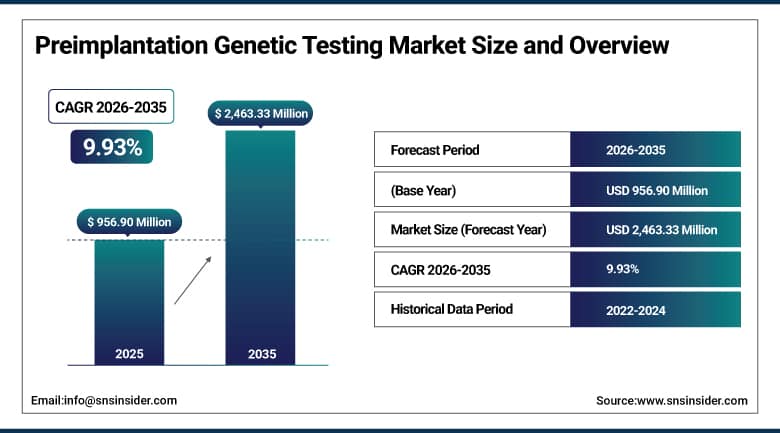
The Preimplantation Genetic Testing Market was valued at USD 956.90 Million in 2025 and is expected to reach USD 2,463.33 Million by 2035, growing at a CAGR of 9.93% from 2026 to 2035.
The international market for preimplantation genetic testing is witnessing substantial growth, owing to the high incidence rate of infertility among couples, increased use of assisted reproductive technologies, increased awareness about the risk of genetic diseases and disorders, and continuous advancements in genetic screening techniques. The continents that dominate the use of PGTs include North America and Europe, primarily driven by the growing incidence rate of infertility due to lifestyle changes, delay in starting a family, and health problems like PCOS and endometriosis. The market is being driven by Next Generation Sequencing (NGS) which provides better results than the FISH and aCGH tests, assisted embryo selection through AI, and fertility treatment coverage in some places.
In July 2023, Thermo Fisher Scientific introduced the Ion ReproSeq PGT-A Kit and Ion AmpliSeq Polyploidy Kit, advancing reproductive health research and genetic defect screening in IVF cycles. The products provide comprehensive whole genome amplification and aneuploidy detection from single embryo biopsy cells with enhanced sensitivity for low-level mosaicism detection.
Preimplantation Genetic Testing Market Size and Forecast
-
Market Size in 2026E: USD 1,051.89 Million
-
Market Size by 2035: USD 2,463.33 Million
-
CAGR: 9.93% from 2026 to 2035
-
Fastest Growing Region: Asia Pacific
-
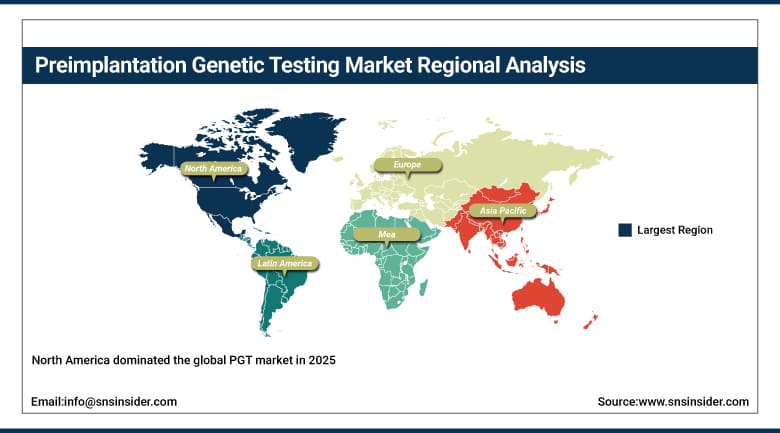
Largest Region: North America
To Get More Information On Preimplantation Genetic Testing Market - Request Free Sample Report
Preimplantation Genetic Testing Market Trends
-
Non-invasive PGT methods using embryo culture media DNA are advancing, reducing the need for embryo biopsy.
-
AI-assisted embryo selection combines imaging and genetic data to improve implantation success prediction and outcomes.
-
Polygenic risk assessment is expanding PGT applications beyond single-gene disorders to complex disease risk evaluation.
-
Expanded carrier screening integration helps identify inherited disease risks before IVF and embryo testing procedures.
-
Reference laboratory testing models are reducing costs and increasing PGT accessibility for smaller fertility clinics.
The U.S. Preimplantation Genetic Testing Market Outlook
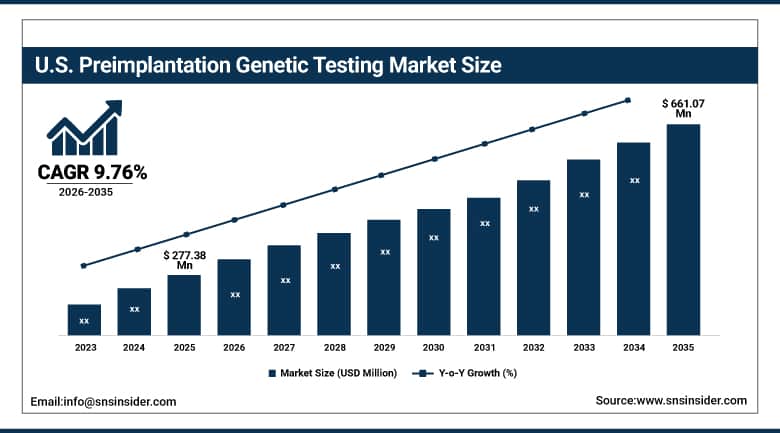
The U.S. preimplantation genetic testing market was valued at approximately USD 277.38 Million in 2025 and is expected to reach approximately USD 661.07 Million by 2035, growing at a CAGR of approximately 9.76%.
The U.S. is the world's most commercially significant PGT market, driven by increasing demand for IVF procedures, growing awareness of genetic disorders among family planning populations, advancements in NGS and PCR screening technologies improving embryo selection accuracy, rising maternal age creating above-average aneuploidy risk in IVF cycles, and expanding fertility clinic infrastructure across major metropolitan markets. CooperSurgical, Natera, Illumina, Foundation Medicine, and major academic medical centre IVF programmes collectively define the domestic PGT commercial landscape. The U.S. genetic testing regulatory environment, whose CLIA laboratory certification and FDA oversight create quality-assured PGT service infrastructure, sustains clinical confidence in domestic laboratory-based PGT results whose accuracy directly influences embryo transfer decision-making.
In 2024, Natera launched Anora Enhanced Carrier Screening integration with its Spectrum PGT-A platform, enabling fertility clinics to provide comprehensive carrier status identification alongside aneuploidy screening within a unified reproductive genetic testing programme that reduces patient management complexity and provides complete reproductive genetic risk picture before embryo transfer selection decisions.
Preimplantation Genetic Testing Market Segment Analysis
-
By Procedure, the preimplantation genetic diagnosis (PGD) segment dominated the market with approximately 78.41% share in 2025, while the preimplantation genetic screening (PGS) segment is the fastest growing.
-
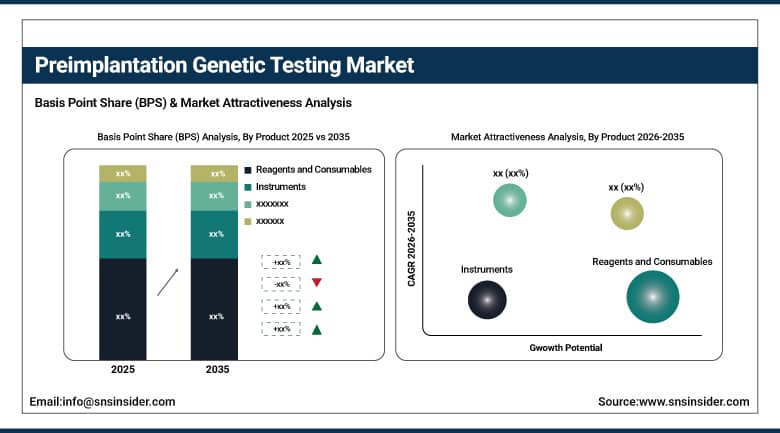
By Product, the reagents and consumables segment dominated the market with the largest share in 2025, while the instruments segment is the fastest growing.
-
By Technology, the next generation sequencing segment dominated the market with the largest share in 2025, while the polymerase chain reaction segment is the fastest growing.
-
By Application, the aneuploidy screening segment dominated the market with the largest share in 2025, while the chromosomal abnormalities segment is the fastest growing.
-
By End-Use, the fertility centers segment dominated the market with the largest share in 2025, while the research centers and academic labs segment is the fastest growing.
By Product, reagents and consumables dominates, instruments grows fastest
The Reagents and Consumables segment dominated the Preimplantation Genetic Testing Market with the largest revenue share in 2025. The segment’s dominance is attributed to the recurring demand for reagents, assay kits, sequencing chemicals, and laboratory consumables used in every genetic testing procedure. The growing volume of IVF cycles, increasing adoption of advanced genetic screening techniques, and the need for high testing accuracy continue to drive consistent consumption of these products across fertility clinics and diagnostic laboratories.
The Instruments segment is expected to witness the fastest growth during the forecast period. This growth is driven by rising investments in technologically advanced sequencing platforms, PCR systems, imaging equipment, and automated laboratory workflows that enhance testing efficiency and accuracy. Expanding fertility centers, increasing adoption of next-generation sequencing (NGS)-based preimplantation genetic testing, and continuous innovation in molecular diagnostic technologies are further accelerating demand for advanced testing instruments.
By Procedure, PGD dominates, PGS grows fastest
Preimplantation genetic diagnosis retained the dominant procedure position with approximately 78.41% of the PGT market in 2025. PGD's commercial primacy reflects its established clinical indication whose couples with documented hereditary disease carrier status create a defined patient population whose genetic testing need is clinically validated and in some health systems partially reimbursed. Each couple with a known BRCA pathogenic variant whose family planning decision creates PGD for hereditary breast and ovarian cancer risk reduction, each cystic fibrosis carrier couple whose biopsy-based CFTR variant detection enables unaffected embryo selection, and each chromosomal translocation carrier whose PGD prevents chromosomally unbalanced offspring collectively create PGD procurement.
PGS is the fastest growing procedure because the growing proportion of IVF cycles incorporating routine aneuploidy screening creates above-PGD growth momentum from the expanding clinical recommendation for PGT-A in advanced maternal age, repeated implantation failure, and recurrent pregnancy loss IVF patient populations. Each fertility clinic that adopts PGT-A as standard practice for patients above 35 creates testing procurement proportional to its IVF cycle volume. The clinical evidence demonstrating PGT-A's improvement in live birth rate per transfer in appropriate patient populations sustains clinical society guideline support that drives practice standard adoption.
By Technology, NGS dominates, PCR grows fastest
Next generation sequencing retained the dominant technology position in the PGT market in 2025. NGS’s commercial primacy reflects its comprehensive chromosomal analysis capability that examines all 24 chromosome pairs simultaneously from a single biopsy specimen, detecting the full spectrum of numeric and structural chromosomal abnormalities including mosaicism whose clinical significance is incompletely evaluated by earlier platform technologies. The extraordinary sensitivity and specificity of NGS-based aneuploidy detection, combined with its adaptability to simultaneous single gene disorder and chromosomal analysis in combined PGT-A plus PGT-M cycles, creates a platform versatility that sustains specification preference across the most clinically demanding fertility laboratory applications.
PCR is the fastest growing technology because the established clinical validity of real-time PCR for specific single gene variant detection in known PGD indication couples, its lower per-cycle reagent cost relative to NGS for single-variant targeted testing, and the established laboratory workflow integration in fertility laboratories that adopted PCR-based PGD before NGS alternatives became commercially available create an enduring clinical application base whose adoption grows with PGD indication population expansion.
Regional Analysis
|
Region |
Major Country |
Share within Region, 2025 (%) |
|---|---|---|
|
North America |
United States |
87.4% |
|
Europe |
Germany |
22.3% |
|
Asia Pacific |
China |
44.8% |
|
Middle East & Africa |
Israel |
31.2% |
|
Latin America |
Brazil |
44.2% |
North America Preimplantation Genetic Testing Market Insights
North America dominated the global PGT market in 2025, driven by the highest per-cycle IVF utilization of any region, the most developed fertility clinic infrastructure, expanding insurance coverage of fertility treatments in some U.S. states, and the commercial presence of Natera, CooperSurgical, and Illumina. The United States accounts for approximately 87.4% of North American revenues through its CLIA-certified PGT laboratory network and the extraordinary scale of domestic IVF programme adoption among advanced maternal age populations.
Canada contributes approximately 12.6% of North American revenues through its publicly funded fertility treatment programmes in Ontario and Quebec, the academic fertility medicine programme at McGill and University of Toronto, and the growing private fertility clinic sector's PGT adoption.
Get Customized Report as Per Your Business Requirement - Enquiry Now
Europe Preimplantation Genetic Testing Market Insights
Europe is a technically sophisticated PGT market where national regulatory frameworks vary substantially from Germany's restrictive Embryonenschutzgesetz to the UK's HFEA-regulated comprehensive PGT programme and Spain's IVF-permissive environment. Germany accounts for approximately 22.3% of European revenues through its limited PGT clinical indication, the academic reproductive genetics research community, and the fertility clinic network's PGT programme investment within regulatory constraints.
Spain, the United Kingdom, and Belgium are the most commercially significant European PGT markets where permissive regulatory environments, established IVF center networks, and medical tourism from restrictive-regulation countries create above-average PGT adoption rates that sustain commercial volume beyond domestic patient populations alone.
Asia Pacific Preimplantation Genetic Testing Market Insights
Asia Pacific is the fastest growing regional PGT market, driven by China's extraordinary IVF volume growth following ART regulation relaxation, India's growing private fertility clinic sector, Japan's advanced reproductive medicine programme, South Korea's above-average IVF utilization, and the region's growing awareness of PGT clinical benefits. China accounts for approximately 44.8% of Asia Pacific revenues through its extraordinary ART programme scale following two-child and three-child policy implementation creating above-average IVF demand and the government's reproductive health infrastructure investment.
India represents the most commercially dynamic emerging market within Asia Pacific where the growing private fertility clinic network, the government's reproductive health awareness investment, and the above-average prevalence of recessive genetic disorders in consanguineous marriage populations create structured PGT clinical demand.
MEA & Latin America Preimplantation Genetic Testing Market Insights
Israel leads MEA revenues through its world-leading per-capita IVF utilization rate, comprehensive government-funded unlimited IVF cycles for women below age 45, and the Weizmann Institute's reproductive genetics research. Saudi Arabia's and UAE's growing private fertility clinic investment adds Gulf demand.
Brazil leads Latin American revenues through its growing private fertility clinic sector, the SBRA reproductive medicine society's clinical programme development, and the above-average prevalence of sickle cell disease creating PGD clinical indication. Mexico's fertility tourism market and Argentina's academic fertility programme collectively sustain regional growth through 2035.
Market Dynamics
Growth Drivers: IVF adoption creating PGT demand and NGS technology improving aneuploidy detection performance
Rising global infertility prevalence, whose WHO 2023 estimate of 1 in 6 individuals worldwide affected by infertility creates extraordinary aggregate demand for ART and the PGT that enhances IVF cycle success rates, is the PGT market's most commercially significant structural growth driver. Each IVF cycle whose aneuploidy screening creates above-non-tested cycle implantation rate per transfer creates a clinical ROI case for PGT-A adoption that sustains fertility clinic test ordering as a quality metric independent of individual patient cost concerns. The progressive increase in average maternal age at first IVF cycle creates growing aneuploidy screening clinical justification that sustains PGT-A market growth proportional to average IVF patient age increase.
NGS technology advancement creating comprehensive, accurate, and cost-declining chromosomal analysis from single embryo biopsy specimens sustains above-market commercial growth through the progressive cost reduction whose per-cycle test pricing trajectory creates expanding accessible market beyond the most financially able patient populations. Each percentage point reduction in NGS per-cycle test cost creates an additional patient population whose willingness to pay for PGT-A crosses the cost-benefit threshold, sustaining commercial volume growth above pure IVF cycle count growth.
Restraints: High cost and limited insurance coverage excluding patient populations
PGT-A cost of USD 3,000 to USD 6,000 per cycle added to IVF cycle cost of USD 12,000 to USD 20,000 creates a total per-cycle financial burden that substantially limits access in markets where insurance coverage of PGT is unavailable or restricted to specific clinical indications. Each patient whose financial constraint prevents PGT-A addition to an otherwise-indicated IVF cycle creates a missed commercial opportunity whose aggregate across the cost-constrained IVF patient population represents the most commercially significant market constraint. The absence of universal insurance reimbursement for PGT-A sustains out-of-pocket payment dependency that restricts adoption to financially able patient populations in most national markets.
Regulatory variation across national jurisdictions creates commercial complexity for PGT service providers whose geographic market access depends on navigating legal frameworks ranging from permissive IVF and PGT regulation to restrictive embryo testing limitations that prohibit specific PGT indications. Germany's embryo protection law limiting PGD to specific clinical circumstances, Italy's historical PGT restrictions, and various Asian regulatory frameworks that limit ART applications create market fragmentation that sustains above-domestic-single-market cost for PGT service expansion across regulatory boundaries.
Opportunities: Non-invasive PGT development and emerging market fertility clinic expansion
Non-invasive PGT development represents the most technically transformative near-term market opportunity whose elimination of embryo biopsy requirement through cell-free DNA analysis from spent blastocyst culture medium creates a testing approach that avoids the procedural risk, cost, and laboratory complexity of trophectoderm biopsy. Each validation study that demonstrates niPGT clinical performance equivalent to conventional biopsy-based PGT creates regulatory pathway momentum whose approval enables above-current-PGT-eligible-population market expansion to fertility clinics and patient populations where embryo biopsy technical expertise limitation currently constrains PGT adoption.
Emerging market fertility clinic expansion, particularly in China following ART regulation relaxation, India's growing private fertility sector, and Southeast Asia's rising IVF adoption, creates above-average PGT market growth opportunity in patient populations with above-global-average prevalence of specific genetic conditions whose PGD clinical indication creates structured testing demand.
Recent Developments:
-
2025: CooperSurgical expanded its PGT service portfolio through enhanced IGENOMIX genetic testing workflows, supporting improved embryo screening accuracy and IVF outcomes.
-
2025: Illumina advanced reproductive health sequencing capabilities by strengthening adoption of NGS-based PGT solutions for chromosomal abnormality detection.
-
2025: Juno Genetics enhanced its AI-driven embryo assessment platform, integrating genetic and embryology data to support embryo selection decisions.
-
2025: Thermo Fisher Scientific introduced workflow improvements for reproductive genetics laboratories, enabling faster and more scalable preimplantation genetic testing analysis.
Preimplantation Genetic Testing Market key players are:
-
CooperSurgical Inc.
-
Natera Inc.
-
Illumina Inc.
-
Thermo Fisher Scientific Inc.
-
Invitae Corporation
-
Agilent Technologies Inc.
-
Pacific Biosciences of California, Inc.
-
Juno Genetics Ltd.
-
Reprogenomics LLC
-
Genea Limited
-
GeneDx, Inc.
-
Reproductive Genetics Institute
-
Praxis Genomics LLC
-
Fulgent Genetics, Inc.
-
Vitrolife AB
-
Progenesis, Inc.
-
GENOMA Group
-
Ovation Fertility
-
Eurofins Scientific SE
-
Yikon Genomics Co., Ltd.
Preimplantation Genetic Testing Market Report Scope:
| Report Attributes | Details |
|---|---|
| Market Size in 2025 | USD 956.90 Million |
| Market Size by 2035 | USD 2,463.33 Million |
| CAGR | CAGR of 9.93% From 2026 to 2035 |
| Base Year | 2025 |
| Forecast Period | 2026-2035 |
| Historical Data | 2022-2024 |
| Report Scope & Coverage | Market Size, Segments Analysis, Competitive Landscape, Regional Analysis, DROC & SWOT Analysis, Forecast Outlook |
| Key Segments | • By Procedure (Preimplantation Genetic Screening, Preimplantation Genetic Diagnosis) • By Product (Reagents and Consumables, Instruments, Software) • By Technology (Next Generation Sequencing, Polymerase Chain Reaction, Fluorescent In-Situ Hybridization, Others) • By Application (Chromosomal Abnormalities, X-linked Diseases, Embryo Testing, Aneuploidy Screening, HLA Typing, Others) • By End-Use (Fertility Centers, Hospitals, Diagnostic Centers, Research Centers and Academic Labs) |
| Regional Analysis/Coverage | North America (US, Canada), Europe (Germany, UK, France, Italy, Spain, Russia, Poland, Rest of Europe), Asia Pacific (China, India, Japan, South Korea, Australia, ASEAN Countries, Rest of Asia Pacific), Middle East & Africa (UAE, Saudi Arabia, Qatar, South Africa, Rest of Middle East & Africa), Latin America (Brazil, Argentina, Mexico, Colombia, Rest of Latin America). |
| Company Profiles | CooperSurgical Inc., Natera Inc., Illumina Inc., Thermo Fisher Scientific Inc., Invitae Corporation, Agilent Technologies Inc., Pacific Biosciences of California, Inc., Juno Genetics Ltd., Reprogenomics LLC, Genea Limited, GeneDx, Inc., Reproductive Genetics Institute, Praxis Genomics LLC, Fulgent Genetics, Inc., Vitrolife AB, Progenesis, Inc., GENOMA Group, Ovation Fertility, Eurofins Scientific SE, Yikon Genomics Co., Ltd. |
Frequently Asked Questions
Preimplantation Genetic Diagnosis (PGD) dominated with approximately 78.41% share in 2025.
North America dominated the Preimplantation Genetic Testing Market.
The Preimplantation Genetic Testing Market is expected to grow at a CAGR of 9.93% from 2026 to 2035.
The Preimplantation Genetic Testing Market was valued at USD 956.90 Million in 2025.
Rising global infertility prevalence creating above-average ART and IVF adoption and NGS technology advancing comprehensive aneuploidy detection.
