
PROFINET Managed Switch Market Report Scope and Overview:
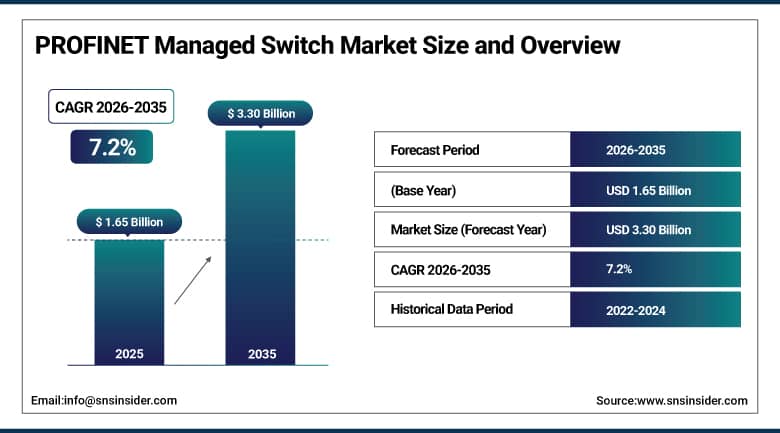
The PROFINET Managed Switch Market size was valued at USD 1.65 Billion in 2025 and is projected to reach USD 3.30 Billion by 2035, registering a CAGR of 7.2% from 2026 to 2035.
The PROFINET Managed Switch Market is transforming industrial connectivity through advancements in managed Ethernet switches, deterministic data transmission, and real-time diagnostics used across automated production lines and process facilities. This market is characterized by increasing investments in Industry 4.0 infrastructure by manufacturers, growing adoption of Layer 3 and advanced routing-capable switches, increased integration of managed switches with SCADA and PLC-based control systems, rising deployment of PoE+-enabled industrial Ethernet infrastructure, and growing utilization of PROFINET managed switches in manufacturing, communication, and energy & power applications.
The trend towards smart factory adoption, cybersecurity-compliant networking requirements, and expansion of industrial IoT devices is an outcome of the massive investments undertaken by automation vendors, system integrators, and manufacturing enterprises in order to enhance network reliability due to increasing demands.
To Get More Information On PROFINET Managed Switch Market - Request Free Sample Report
PROFINET Managed Switch Market Trends
-
Rising Industry 4.0 rollouts across discrete and process manufacturing continues widening the addressable base for PROFINET managed switches.
-
Growing integration of managed switches with cloud-enabled analytics platforms continues accelerating demand for secure edge-to-cloud connectivity.
-
Increasing shift toward Layer 3 and advanced routing-capable switches continues redefining network architecture in large-scale smart factories.
-
Expanding deployment of PROFINET-certified switches in renewable energy and grid infrastructure continues broadening end-use diversification.
-
Rising emphasis on IEC 62443-compliant cybersecurity features continues becoming a standard purchase criterion for industrial network buyers.
U.S. PROFINET Managed Switch Market Size Outlook
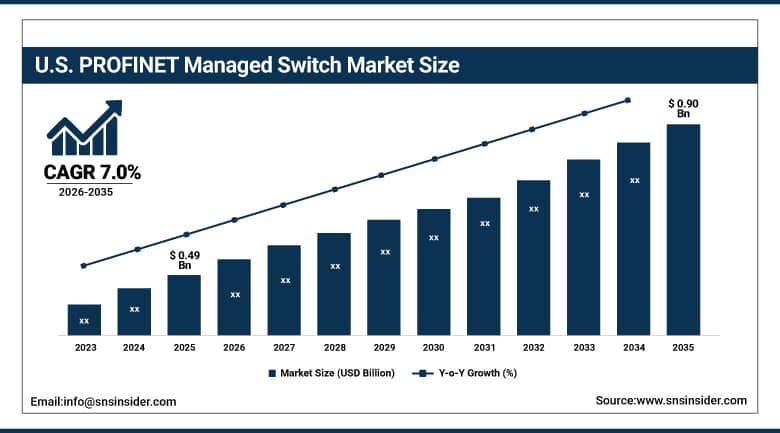
The U.S. PROFINET Managed Switch Market was valued at approximately USD 0.49 Billion in 2025 and is projected to reach approximately USD 0.90 Billion by 2035, registering a CAGR of approximately 7.0% from 2026 to 2035.
Demand for deterministic industrial networking in the US was also fueled by massive investments in smart factory infrastructure, aggressive rollout of Industry 4.0 modernization programs by manufacturers, and strong demand from automation integrators for switches that reduce latency and improve real-time PLC-to-SCADA communication.
The utilization of Layer 3 managed switches and PoE+-enabled industrial Ethernet infrastructure across major manufacturing operations has been crucial in raising the reputation of the United States as the largest buyer of PROFINET managed switch technology in the world. Apart from this, the use of managed switches in digital twin deployment, predictive maintenance, and energy grid modernization has been fueling the high domestic demand for this connectivity-driven technology.
PROFINET Managed Switch Market Segment Analysis
-
By Product Type, Standalone Managed PROFINET Switches led in 2025 with 40% share; Advanced/Layer 3 Managed PROFINET Switches is fastest growing.
-
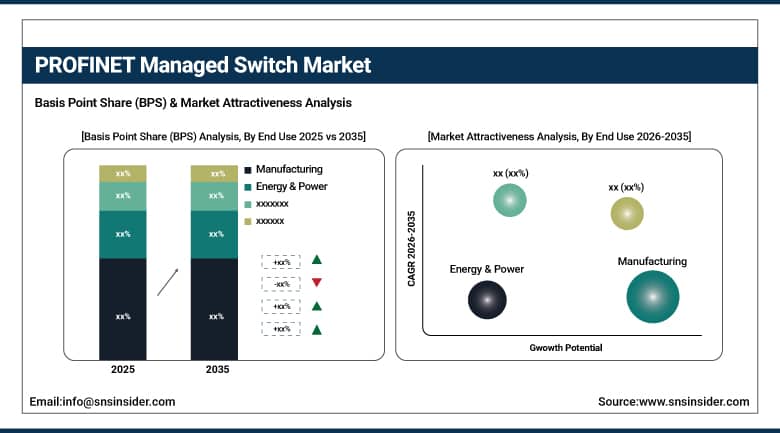
By End Use, Manufacturing led in 2025 with 47% share; Energy & Power is fastest growing.
By End Use: Manufacturing Leads, Energy & Power Grows Fastest
The Manufacturing segment is expected to be the market leader in the PROFINET Managed Switch Market in 2025 because there are many automotive, electronics, and heavy industry manufacturers requiring continuous connectivity between their machines, robots, and automation equipment on their manufacturing lines. This segment can take advantage of using the existing PLC and SCADA systems as well as products provided by vendors like Rockwell Automation's FactoryTalk-enabled switches. In addition, the manufacturing end-use segment is the most capitalized segment among all PROFINET managed switch purchasers around the world.
The Energy & Power vertical has emerged as the most rapidly growing end-user application area for the PROFINET Managed Switch Market. There is substantial interest being shown by energy utilities and renewable energy companies in adopting managed switches which provide real-time monitoring capabilities and secure communication and redundant networks in solar and wind projects, as well as grid modernization projects that cannot be achieved without industrial networking which is deterministic in nature. The efforts made by Siemens AG towards PROFINET Certified switches in substations and renewable asset monitoring projects are a perfect example of this growing trend in energy sector digitalization.
By Product Type: Standalone Switches Lead, Advanced/Layer 3 Switches Grow Fastest
Standalone Managed PROFINET Switches dominated the PROFINET Managed Switch Market in 2025 because these devices deliver essential managed features such as VLAN configuration, port mirroring, and basic network diagnostics at a comparatively lower cost, making them the most bankable route for small to mid-sized industrial network deployments. This product type has seen the longest sustained period of operational deployment among manufacturers and system integrators, thereby becoming the default choice for straightforward plant-floor connectivity. Further advances made by technology companies like Siemens with its SCALANCE switch portfolio and Phoenix Contact with its FL SWITCH series have kept standalone switches dominant over other product types, supported by falling component costs and simplified commissioning that keeps these switches at the center of industrial networking budgets.
The Advanced/Layer 3 Managed PROFINET Switches are anticipated to be the segment recording the highest growth rate in the PROFINET Managed Switch Market due to growing preference for advanced routing features, VLAN segmentation, redundancy protocols, and security management systems required in the large scale smart factories. The emergence of Layer 3 switch platforms from firms such as Cisco Systems, which has added routing capable products to its industrial switch line, exemplifies the commercialization of this segment of products, as also seen through Rockwell Automation and Moxa for IIoT enabled manufacturing facilities.
Regional Analysis:
|
Region |
Major Country |
Share within Region, 2025 (%) |
|---|---|---|
|
North America |
United States |
83.00% |
|
Europe |
Germany |
26.00% |
|
Asia Pacific |
China |
44.00% |
|
Middle East and Africa |
Saudi Arabia |
24.00% |
|
Latin America |
Brazil |
50.00% |
North America PROFINET Managed Switch Market Insights
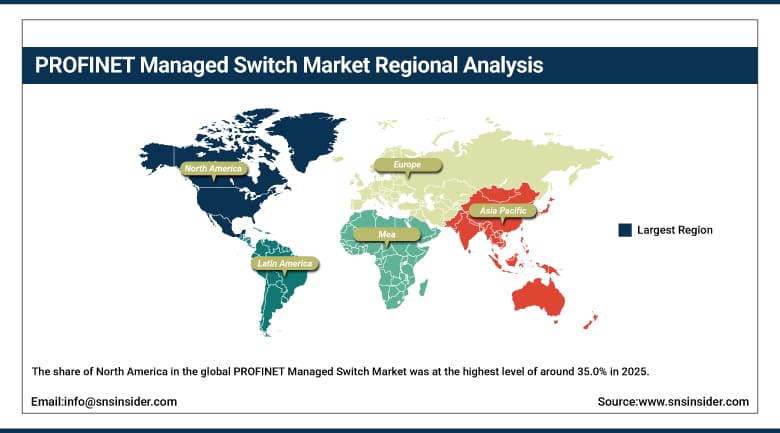
The share of North America in the global PROFINET Managed Switch Market was at the highest level of around 35.0% in 2025. The reasons behind this included high industrial activity and early adoption of automation technology in the region, availability of the best-funded industrial network providers in the world, and continuous investments in modern infrastructure for implementation of smart factories. Moreover, an already developed ecosystem including manufacturers of switches, automation providers, and manufacturing companies which aim to enhance the performance of their communication systems via PROFINET technology was significant as well.
The U.S. made up the biggest proportion of the revenue earned by North America due to the presence and involvement of Cisco Systems, Rockwell Automation, and Emerson Electric, as well as significant investments from other industrial OEMs in digital twins and smart factories. The U.S. Department of Energy released almost USD 13 million for the third round of the USD 50 million State Manufacturing Leadership Program in January 2025 after previously providing funding to 17 projects in 15 states. Greater budget allocation for grid resilience and decarbonization efforts in Canada helped solidify North America's leadership in the market.
Get Customized Report as Per Your Business Requirement - Enquiry Now
Europe PROFINET Managed Switch Market Insights
The Europe PROFINET Managed Switch Market was responsible for a significant part of the world’s revenue from this market, given the high presence of global automation giants like Siemens, Bosch, and ABB, who are actively promoting PROFINET as the most suitable industrial network standard in Europe. The growing implementation of Industry 4.0 policies in both the European Union and individual states of Europe has stimulated manufacturers in the region to focus on high-performance managed switch solutions to boost industrial connectivity and efficiency in automotive, chemical, and heavy machinery manufacturing plants.
The Germany region stood out to be the strictest of all other markets in Europe, contributing a substantial portion of the total revenue earned in Europe because of investments done in the automation clusters, as well as production and engineering factories run by Siemens, Phoenix Contact, and Weidmüller in Germany. The United Kingdom is yet another region that contributes substantially to the demand in the regional market owing to its continuous efforts to build up its smart manufacturing environment through collaboration between automation suppliers and technology integrators for deployment of PROFINET switches.
Asia Pacific PROFINET Managed Switch Market Insights
The Asia Pacific region is witnessing the highest growth rate amongst all the regions considered in the market, with the anticipated CAGR of around 9.0% during 2026-2035, driven by rapid industrialization and increasing investments in smart factories in China and India along with the implementation of policies by governments to boost manufacturing efficiency and industrialization of the region. The overall impact of the above factors has been the reason behind Asia Pacific witnessing the highest growth rate when compared to all other regions discussed in the report.
China was a leading player in this space due to large investments in robotic equipment, IIoT platforms, and automated warehouse systems that assist China in achieving its ambitions of upgrading the manufacturing industry in the country, with robot density standing at 470 units per 10,000 employees, as indicated by the International Federation of Robotics, compared to 402 units last year. Countries that are responsible for this achievement include Japan, which has developed a digital manufacturing industry, and South Korea, which has been making substantial efforts toward smart factory development.
MEA and Latin America PROFINET Managed Switch Market Insights
PROFINET Managed Switch Market demand across the Middle East, Africa, and Latin America exhibited consistent growth due to the growing number of industrial digitalization and manufacturing diversification initiatives gaining momentum, sustained government involvement in industrial modernization and infrastructure development projects, and expanding cooperation between regional manufacturers and international automation technology providers. The early adoption of smart manufacturing practices has increasingly become a strategically vital component of economic diversification programs implemented across these regions. Rising foreign direct investment in industrial parks and free economic zones is also accelerating the deployment of managed networking infrastructure across the region.
In the Middle East and Africa, Saudi Arabia was the largest country market due to its expanding advanced manufacturing investments through sovereign industrial diversification programs, alongside a growing number of automation partnerships tied to its broader economic transformation agenda. Additional contributions came from the implementation of industrial modernization programs within the UAE. Within Latin America, the largest revenue generator was Brazil, driven by its sizable automotive and process manufacturing base. Continued infrastructure spending across both regions is expected to sustain steady adoption of managed industrial networking equipment through 2035.
Market Dynamics:
Growth Drivers: Industry 4.0 Adoption and Real-Time Networking Requirements
The market is being propelled by the increasing trend towards the fourth industrial revolution and smart manufacturing in light of the increasing number of connected machines including robots, sensors and programmable logic controllers that have the need for deterministic and low-latency communication on the factory floor. With the increased use of AI-based network monitoring systems, increased investment in high speed industrial Ethernet infrastructure as well as an increased range of applications such as predictive maintenance, digital twins and process optimization, the market is guaranteed to maintain a high ability to finance within the automation players.
Increasing collaboration among automation vendors, system integrators, and manufacturing enterprises, along with rising commitment from industry bodies to standardize PROFINET compatibility across diverse industrial equipment, constitute additional supporting evidence for this trend. Global industrial robot density reached 162 units per 10,000 workers in 2023, more than double the level seven years prior, according to the International Federation of Robotics, underscoring the accelerating pace of automation worldwide. Capital investment by technology vendors in the development of Layer 3 and cybersecurity-hardened switching platforms is adding to the growing baseline capability supporting demand through the forecast period.
Restraints: High Deployment Costs and Legacy System Integration Challenges
High deployment and integration costs associated with advanced managed switches remain a constraint for further rapid development of the market since small and medium-sized manufacturers often lack the capital budgets required to upgrade legacy network infrastructure to PROFINET-compatible standards before realizing measurable returns on investment. It is owing to this reason that leading-edge industrial switching technology is developed predominantly by well-capitalized companies with established distribution networks, as shown in the case of several vendors scaling cybersecurity-hardened product lines in 2025.
Technical uncertainty around legacy system integration remains a challenge because the complexity of retrofitting aging industrial networks with new PROFINET managed switches continues to require rigorous interoperability engineering, and regulatory compliance requirements have grown more stringent following increased scrutiny of industrial control system security under standards such as IEC 62443. This is a challenge that can be addressed through open, interoperable platform standards, a dynamic process requiring sustained funding from both switch manufacturers and manufacturing enterprise IT departments across the industry.
Opportunities: AI-Driven Monitoring and Emerging Market Industrial Modernization
Increased funding in AI-driven monitoring and self-healing network capabilities integrated with managed switches presents a major opportunity as automation vendors commit to long-term smart factory contracts that include predictive diagnostics, automated fault isolation, and enhanced network resilience. Companies capable of attracting early customers for their advanced switching platforms, such as Moxa with its MX-NOS firmware-based cybersecurity features, will be well positioned to claim a sizable market share as they move from single-site deployments toward fleet-scale industrial networking portfolios across multiple manufacturing facilities.
A further opportunity is presented by the expansion of PROFINET managed switch deployment into emerging markets, because countries across Asia Pacific, Latin America, and the Middle East investing in industrial modernization and manufacturing diversification are actively seeking scalable, cost-effective networking solutions that can enhance production reliability and support digitalization initiatives. Those vendors who can demonstrate credibility on interoperability, affordability, and cybersecurity compliance across rapidly modernizing industrial networks stand to capture a substantial share of future demand.
Recent Developments:
-
2025: Teltonika launched SWM28-series managed switches with PROFINET, EtherNet/IP, MRP, Layer 2/3 features, PoE+, SFP connectivity, TswOS, and remote management.
-
2025: Phoenix Contact’s FL Switch 2000 managed switches received IEC 62443-4-2 certification, strengthening cybersecurity compliance and secure deployment across industrial automation networks.
-
2024: Moxa introduced SDS-3000/G3000 and EDS-4000/G4000 industrial switches with PROFINET support, MX-NOS firmware, simplified integration, and IEC 62443-aligned cybersecurity capabilities.
PROFINET Managed Switch Companies are:
-
Siemens AG
-
ABB Ltd.
-
Rockwell Automation, Inc.
-
Schneider Electric SE
-
Moxa Inc.
-
Eaton Corporation plc
-
Emerson Electric Co.
-
Advantech Co., Ltd.
-
Phoenix Contact GmbH & Co. KG
-
Beijer Electronics Group AB
-
Kyland Technology Co., Ltd.
-
Indu-Sol GmbH
-
TELTONIKA Networks UAB
-
Belden Inc. (Hirschmann)
-
Weidmüller Interface GmbH & Co. KG
-
HARTING Technology Group
-
Red Lion Controls (a Spectris company)
-
Westermo Network Technologies AB
PROFINET Managed Switch Market Report Scope:
| Report Attributes | Details |
|---|---|
| Market Size in 2025 | USD 1.65 Billion |
| Market Size by 2035 | USD 3.30 Billion |
| CAGR | 7.2% from 2026 to 2035 |
| Base Year | 2025 |
| Forecast Period | 2026-2035 |
| Historical Data | 2022-2024 |
| Report Scope & Coverage | Market Size, Segments Analysis, Competitive Landscape, Regional Analysis, DROC & SWOT Analysis, Forecast Outlook |
| Key Segments | • By Product Type (Standalone Managed PROFINET Switches, Advanced/Layer 3 Managed PROFINET Switches, and Industrial Managed PROFINET Switches) • By End Use (Manufacturing, Communication, Energy & Power, and Others) |
| Regional Analysis/Coverage | North America (US, Canada), Europe (Germany, UK, France, Italy, Spain, Russia, Poland, Rest of Europe), Asia Pacific (China, India, Japan, South Korea, Australia, ASEAN Countries, Rest of Asia Pacific), Middle East & Africa (UAE, Saudi Arabia, Qatar, South Africa, Rest of Middle East & Africa), Latin America (Brazil, Argentina, Mexico, Colombia, Rest of Latin America). |
| Company Profiles | Siemens AG, ABB Ltd., Cisco Systems, Inc., Rockwell Automation, Inc., Schneider Electric SE, Moxa Inc., Omron Corporation, Eaton Corporation plc, Emerson Electric Co., Advantech Co., Ltd., Phoenix Contact GmbH & Co. KG, Beijer Electronics Group AB, Kyland Technology Co., Ltd., Indu-Sol GmbH, TELTONIKA Networks UAB, Belden Inc. (Hirschmann), Weidmüller Interface GmbH & Co. KG, HARTING Technology Group, Red Lion Controls (a Spectris company), Westermo Network Technologies AB |

Frequently Asked Questions
Key players in the PROFINET Managed Switch Market include Siemens AG, ABB Ltd., Cisco Systems, Inc., Rockwell Automation, Inc., Schneider Electric SE, and Moxa Inc., among others.
Key opportunities include AI-driven monitoring, self-healing managed switches, industrial modernization in emerging markets, and expanding smart factory deployments.
The market is driven by the growing shift toward Industry 4.0 and smart manufacturing, expansion of industrial automation across key manufacturing sectors, and rising demand for deterministic, real-time data communication on the plant floor.
The Standalone Managed PROFINET Switches segment dominated the PROFINET Managed Switch Market, accounting for approximately 40% market share.
The North America region dominated the PROFINET Managed Switch Market in 2025 with approximately a 35.0% share, driven by a strong industrial base and early adoption of Industry 4.0 and automation technologies.
