
Optical Circuit Switching Market Report Scope & Overview:
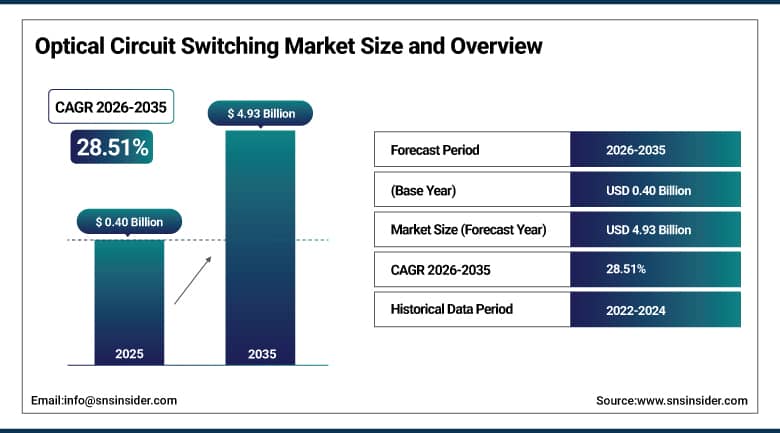
The Optical Circuit Switching Market size was valued at USD 0.40 Billion in 2025 and is expected to reach USD 4.93 Billion by 2035, growing at a CAGR of 28.51% from 2026–2035.
The optical circuit switching market is experiencing consistent growth due to the increasing demand for high-bandwidth, low-latency, and energy-efficient connectivity solutions. The rapid adoption of artificial intelligence, high-performance computing, cloud services, and hyperscale data centers has increased the need for scalable optical interconnect technologies, thereby supporting the growth of the market. Investments in advanced optical networking technologies such as optical circuit switches have increased the deployment of dynamic and reconfigurable optical connectivity across data centers and high-performance computing environments. The focus of companies has been on switching speed, scalability, port density, low insertion loss, energy efficiency, and reliable optical connectivity.
In March 2026, Marvell Technology and Lumentum demonstrated an integrated optical circuit switching solution at OFC 2026 for next-generation AI scale-up infrastructure. The system combined Marvell’s 1.6T optical connectivity technologies with Lumentum’s R300 optical circuit switching platform, demonstrating flexible, high-bandwidth optical paths designed to reduce latency and power consumption in hyperscale AI data centers. The development highlights the growing global adoption of optical circuit switching as AI workloads place greater demands on data-center interconnect capacity, scalability, and energy efficiency.
To Get More Information On Optical Circuit Switching Market - Request Free Sample Report
Optical Circuit Switching Market Trends
-
Growing adoption of AI and high-performance computing is driving demand for advanced optical circuit switching solutions that enable high-bandwidth, low-latency, and efficient data transmission.
-
Rising deployment of hyperscale and AI-focused data centers is increasing the need for scalable optical interconnects, supporting demand for high-port-count optical circuit switching systems.
-
Increasing demand for high-speed connectivity at 400 Gbps, 800 Gbps, and 1.6 Tbps and above is accelerating the adoption of advanced optical switching technologies.
-
Growing focus on network efficiency, switching speed, energy efficiency, scalability, and dynamic traffic management is creating opportunities for optical circuit switching manufacturers.
-
Advancements in MEMS, electro-optic switching, optical networking architectures, high-port-density systems, and software-controlled data-center infrastructure are improving switching performance and supporting market adoption.
U.S. Optical Circuit Switching Market Size Outlook
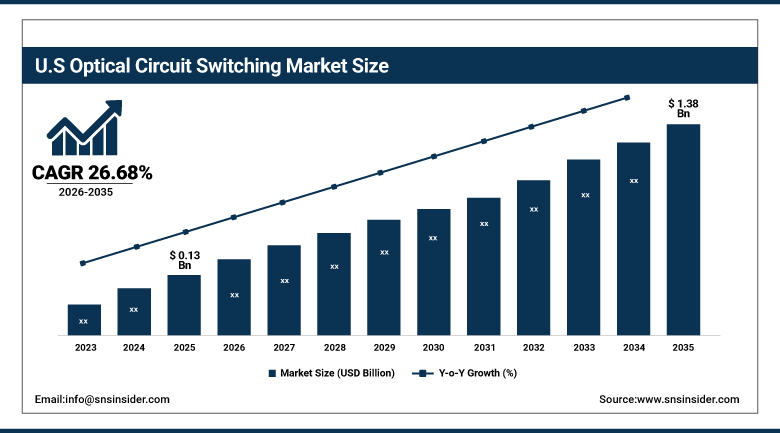
The U.S. Optical Circuit Switching Market was valued at USD 0.13 Billion in 2025 and is expected to reach around USD 1.38 Billion by 2035, growing at a CAGR of 26.68% from 2026–2035.
The U.S. market for optical circuit switching is growing at a strong rate due to increasing demand for high-speed, low-latency, and energy-efficient optical connectivity across data centers and advanced computing infrastructure. The rapid adoption of artificial intelligence, high-performance computing, cloud services, and hyperscale data centers is increasing the need for scalable optical switching solutions. More investments are being made in advanced data-center networking technologies and optical interconnect architectures that improve bandwidth utilization, switching efficiency, and network flexibility. The expansion of AI infrastructure and high-speed data-center connectivity in the country is expected to drive demand for optical circuit switching systems. Manufacturers are focusing on advanced MEMS and electro-optic switching technologies, higher port densities, faster data rates, lower insertion loss, energy efficiency, and software-controlled optical network management.
In March 2026, Marvell Technology and Lumentum announced a live demonstration of an integrated optical circuit switching solution for next-generation AI scale-up infrastructure at OFC 2026 in Los Angeles. The demonstration combined Marvell’s optical connectivity solutions with Lumentum’s optical circuit switching platform to support higher bandwidth, lower latency, flexible network configurations, and improved energy efficiency for hyperscale AI data centers. The development highlights growing U.S. investment in optical circuit switching technologies as AI workloads increase demand for scalable and efficient data-center networking infrastructure.
Optical Circuit Switching Market Segment Analysis
-
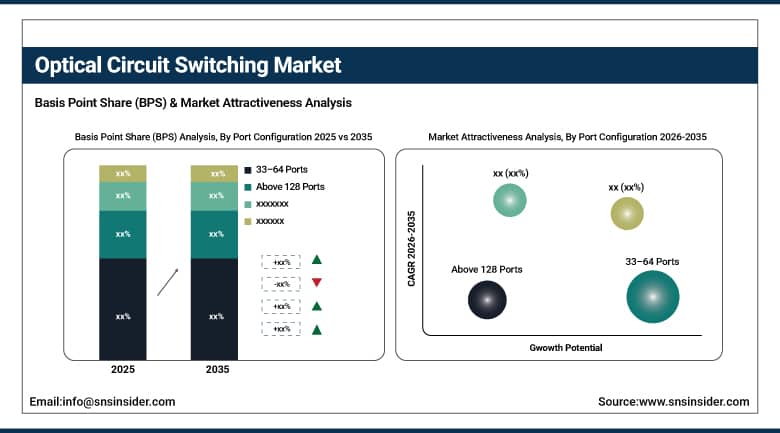
By Port Configuration, 33–64 ports dominated the optical circuit switching market with a 31.68% share in 2025, while above 128 ports are projected to be the fastest-growing segment, registering a 39.44% CAGR during 2026–2035.
-
By Switching Type, 2D MEMS optical circuit switches dominated the optical circuit switching market with a 34.62% share in 2025, while electro-optic optical switches are projected to be the fastest-growing segment, registering a 36.99% CAGR during 2026–2035.
-
By Data Rate, 400 Gbps dominated the optical circuit switching market with a 34.86% share in 2025, while 1.6 Tbps and above are projected to be the fastest-growing segment, registering a 42.93% CAGR during 2026–2035.
-
By Application, AI & high-performance computing dominated the optical circuit switching market with a 34.26% share in 2025, while data center interconnect is projected to be the fastest-growing segment, registering a 33.25% CAGR during 2026–2035.
-
By End User, hyperscale data centers dominated the optical circuit switching market with a 35.48% share in 2025, while cloud service providers are projected to be the fastest-growing segment, registering a 34.01% CAGR during 2026–2035.
By port configuration, 33–64 ports dominated the optical circuit switching market, while above 128 ports are expected to grow fastest.
33–64 ports are expected to maintain a dominant position in the market during 2025 due to their balance of scalability, connectivity density, and deployment flexibility across data centers and network infrastructure. Growing demand for efficient optical interconnects and increasing requirements for flexible traffic management are supporting adoption of medium-to-high port-count optical circuit switches.
Above 128 ports are projected to exhibit the highest growth rate during the forecast period from 2026 to 2035. The rapid expansion of hyperscale data centers, AI clusters, and high-performance computing infrastructure is increasing the need for high-density optical connectivity. Advances in optical switching architectures and scalable network designs are further supporting the adoption of optical circuit switches with higher port counts.
⮞In March 2026, Eoptolink demonstrated its NX200 and NX300 optical circuit switching systems at OFC 2026, featuring 140-port and 320-port configurations, respectively, addressing scalable optical connectivity requirements for AI clusters and large-scale data-center networks.
By switching type, 2D MEMS optical circuit switches dominated the optical circuit switching market, while electro-optic optical switches are expected to grow fastest.
2D MEMS optical circuit switches are expected to maintain a leading position in the market during 2025 due to their established use in scalable optical switching architectures and their ability to provide reliable, low-latency optical connectivity. Increasing deployment of AI infrastructure, hyperscale data centers, and high-performance computing systems is supporting demand for MEMS-based optical circuit switching solutions. Continued improvements in switching reliability, port density, insertion loss, and energy efficiency are further strengthening their adoption across data-center and optical networking environments.
Electro-optic optical switches are anticipated to record the highest growth rate during the forecast period from 2026 to 2035. Increasing requirements for faster switching, dynamic optical network reconfiguration, and high-bandwidth connectivity are encouraging the development and deployment of electro-optic switching technologies. The growing use of AI workloads and high-speed data-center architectures is expected to create additional opportunities for advanced electro-optic optical circuit switching solutions.
⮞In September 2025, Lumentum introduced its R64 optical circuit switch, a MEMS-based platform supporting 64 × 64 ports and scalable to 72 × 72 ports, extending optical circuit switching to lower-port-count AI data-center applications.
By data rate, 400 Gbps dominated the optical circuit switching market, while 1.6 Tbps and above are expected to grow fastest.
400 Gbps is expected to maintain a leading position in the market during 2025 due to its broad suitability for high-bandwidth data-center connectivity and optical network applications. Increasing AI and cloud workloads are driving demand for higher-capacity interconnects, while the established deployment ecosystem for 400 Gbps technology supports its continued market presence.
1.6 Tbps and above are projected to record the highest growth rate during the forecast period from 2026 to 2035. The rapid increase in AI-generated traffic, accelerated computing workloads, and next-generation data-center architectures is creating demand for extremely high-capacity optical connectivity. Continued advancements in optical transceivers, photonic integration, and high-speed switching technologies are expected to accelerate adoption of these data rates.
⮞In April 2025, Jabil launched its 1.6T OSFP optical transceiver, supporting dual 800G Ethernet or InfiniBand connections or a single 1.6T connection over parallel single-mode fiber, targeting high-bandwidth AI, HPC, and data-center interconnect applications.
Regional Analysis
|
Region |
Major Country |
Share within Region, 2025(%) |
|---|---|---|
|
North America |
United States |
82.40% |
|
Europe |
Germany |
34.30% |
|
Asia Pacific |
China |
48.54% |
|
Middle East & Africa |
Saudi Arabia |
23.50% |
|
Latin America |
Brazil |
23.00% |
North America optical circuit switching market insights
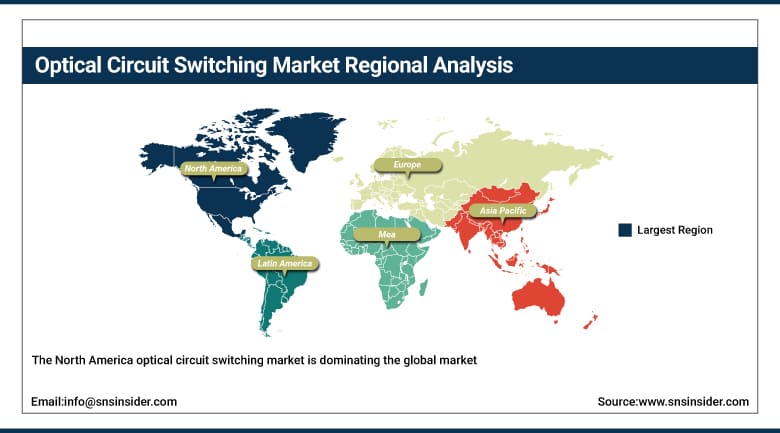
The North America optical circuit switching market is dominating the global market and is expected to maintain its leading position during 2026–2035, driven by increasing demand for high-bandwidth, low-latency connectivity across AI infrastructure, hyperscale data centers, cloud computing, and high-performance computing environments. North America dominated the optical circuit switching market in 2025, accounting for a 38.64% market share, and is expected to retain its leading position throughout the forecast period. The region is benefiting from substantial investments in AI data centers, advanced optical networking, high-speed interconnects, and energy-efficient data-center infrastructure that support increasing data traffic and computing requirements.
The United States is expected to dominate the regional market share in North America in 2025. The country's dominance is supported by its extensive hyperscale data-center infrastructure, strong presence of cloud service providers, rapid AI adoption, advanced telecommunications networks, and continued investments in next-generation optical connectivity. Canada is also expected to contribute to regional growth, supported by expanding data-center infrastructure, cloud adoption, AI development, and investments in high-performance computing and optical networking technologies.
⮞In August 2025, Lumentum announced an expansion of its U.S. semiconductor manufacturing capacity to support rising demand for high-power lasers used in co-packaged optics, strengthening domestic photonics manufacturing for next-generation AI and data-center connectivity.
Get Customized Report as Per Your Business Requirement - Enquiry Now
Europe optical circuit switching market insights
The Europe optical circuit switching market is expected to experience steady growth over the forecast period due to increasing investments in cloud infrastructure, data centers, artificial intelligence, high-performance computing, and next-generation optical networking technologies. Growing demand for high-capacity and energy-efficient data transmission is driving the adoption of optical circuit switching solutions across data centers, telecommunications networks, and enterprise infrastructure. Increasing investments in digital transformation and advanced computing infrastructure are also supporting regional demand for scalable optical connectivity.
Germany is anticipated to continue being one of the key national markets in Europe, fueled by its strong industrial base, expanding data-center infrastructure, cloud computing adoption, telecommunications capabilities, and investments in advanced digital technologies. In addition, countries such as the UK, France, Italy, and the Netherlands are contributing to regional demand through investments in cloud infrastructure, hyperscale facilities, AI computing, and high-speed optical networks.
⮞In November 2025, DE-CIX Frankfurt connected Deutsche Glasfaser through Europe's first 800-gigabit Ethernet internet-exchange port, using Nokia's 800G ZR+ single-lambda optics to expand high-capacity network interconnection in Germany.
Asia Pacific optical circuit switching market insights
The Asia Pacific optical circuit switching market is the fastest-growing region with CAGR 32.08% during 2026–2035, supported by rapid data-center expansion, increasing AI adoption, cloud computing growth, high-performance computing requirements, and rising demand for high-speed optical connectivity. The region is also benefiting from significant investments in hyperscale data centers, telecommunications infrastructure, semiconductor and photonics technologies, and next-generation networking architectures. Increasing data traffic generated by AI workloads and digital services is further accelerating demand for scalable and energy-efficient optical switching solutions.
China will continue to be a major market in the Asia Pacific region due to its large digital infrastructure ecosystem, expanding data-center capacity, growing AI deployment, and significant investments in telecommunications and optical networking technologies. Japan and South Korea will continue to play significant roles due to their established electronics, telecommunications, semiconductor, and advanced technology industries, while India is expected to witness increasing demand with the expansion of AI infrastructure, cloud services, data centers, digital platforms, and enterprise technology investments.
⮞In July 2025, Universal Scientific Industrial announced plans to launch a next-generation 1.6T optical module for AI and high-performance computing data centers, targeting increased transmission capacity and improved network-topology efficiency as computing workloads expand.
Middle East & Africa and Latin America optical circuit switching market insights
There will be consistent growth within the optical circuit switching markets in the Middle East & Africa and Latin America from 2026 to 2035, driven by the expansion of data centers, cloud computing, telecommunications infrastructure, AI adoption, and digital transformation initiatives. Increasing investments in high-capacity connectivity and modern network infrastructure are creating opportunities for optical circuit switching technologies as organizations seek improved bandwidth utilization, lower latency, scalability, and energy efficiency.
Saudi Arabia will continue to be an important market in the Middle East & Africa, supported by investments in digital infrastructure, cloud computing, AI initiatives, smart-city projects, data centers, and economic diversification programs. In Latin America, Brazil will continue to be an important country-level market due to its large telecommunications sector, expanding data-center infrastructure, cloud adoption, digital transformation, and growing demand for high-speed connectivity. Other Latin American countries will also contribute to regional growth through investments in telecommunications modernization, cloud services, enterprise networking, and data-center infrastructure.
⮞In January 2026, Saudi Arabia's National Infrastructure Fund and HUMAIN announced a financing framework of up to USD 1.2 billion to support AI and digital infrastructure, including plans for up to 250 MW of hyperscale AI data-center capacity.
⮞In May 2026, Brazil's BNDES approved BRL 50 million in financing for Eletronet to modernize and expand its optical-fiber network and edge data-center infrastructure, supporting broader connectivity coverage and rising demand from cloud and digital services.
Market Dynamics
Growth Driver: Increasing demand for high-bandwidth and low-latency connectivity is driving market growth
One of the key driving forces behind the growth of the global optical circuit switching market is the increasing demand for high-bandwidth, low-latency, and energy-efficient connectivity across data centers and advanced computing environments. The rapid expansion of artificial intelligence, high-performance computing, cloud services, and hyperscale data centers is generating significant increases in data traffic and interconnect requirements. Optical circuit switching enables efficient optical connectivity between computing and networking resources, supporting higher bandwidth utilization and flexible network configurations.
In addition, advancements in MEMS, electro-optic switching, photonic integration, high-port-density architectures, and software-controlled optical networking are supporting market growth. Investments in AI infrastructure, next-generation data centers, and high-speed optical interconnect technologies are encouraging the deployment of advanced optical circuit switching solutions.
⮞In March 2025, NVIDIA unveiled its Spectrum-X and Quantum-X silicon photonics networking switches, featuring 1.6 Tbps-per-port connectivity and integrated optical technologies designed to scale AI infrastructure across large GPU clusters while improving energy efficiency and network resilience.
Restraint: High deployment complexity and integration challenges can limit market adoption
The complexity associated with integrating optical circuit switching systems into existing data-center and network architectures poses a significant challenge to market adoption. Compatibility requirements across optical components, switching platforms, transceivers, network controllers, and software-defined networking environments can increase deployment complexity. Differences in network architectures and performance requirements may also require customized optical switching configurations.
Moreover, optical circuit switching systems can involve significant initial investment, specialized infrastructure, and technical expertise for installation, configuration, and maintenance. Managing switching reliability, insertion loss, optical signal integrity, port scalability, and network control can create additional challenges, particularly for organizations with limited technical resources. Integration with established electrical switching and networking systems may further increase implementation requirements and costs.
Opportunity: Growing AI data-center expansion and high-speed optical networking creates new market opportunities
The rapid proliferation of artificial intelligence and accelerated computing presents substantial opportunities for optical circuit switching manufacturers. As AI clusters and hyperscale data centers generate increasing volumes of east-west traffic, demand is growing for high-capacity and low-latency optical interconnect solutions capable of efficiently connecting large numbers of computing resources. Advanced optical circuit switching can support flexible network reconfiguration while helping data centers manage bandwidth and energy consumption more efficiently.
Further, the expansion of cloud computing, distributed data centers, high-performance computing facilities, and next-generation telecommunications infrastructure presents opportunities for advanced optical switching technologies. Increasing investments in 800 Gbps and 1.6 Tbps and above optical connectivity, high-port-density switches, photonic integration, and software-controlled networking are expected to create additional opportunities for optical circuit switching solutions and technology providers.
⮞In February 2026, Salience Labs and Tower Semiconductor announced a manufacturing partnership for photonic integrated circuit-based optical circuit switches, combining silicon-photonics manufacturing platforms to support scalable, low-latency, high-bandwidth, and lower-power connectivity for next-generation AI data centers.
Recent Developments
-
2026: Lumentum and Marvell advanced optical circuit switching solutions for next-generation AI scale-up infrastructure, combining optical switching and connectivity technologies to support high-bandwidth, low-latency, and energy-efficient data-center networks.
-
2026: Lightmatter advanced its photonic interconnect portfolio for AI infrastructure, including optical technologies designed to address increasing bandwidth, power-efficiency, and network-density requirements in next-generation AI data centers.
-
2026: Ayar Labs secured $500 million in Series E funding to accelerate high-volume production of co-packaged optics, supporting the broader adoption of optical connectivity for AI scale-up and high-performance computing infrastructure.
-
2026: Ciena expanded its optical networking portfolio for AI-era infrastructure, focusing on high-density, low-power optical technologies and 1.6 Tbps-capable connectivity for data centers and high-performance networks.
-
2026: Nokia expanded its optical networking solutions for AI-era networks, including 1.6T-capable optical connectivity designed to support data center interconnect, hyperscale networks, and high-capacity optical infrastructure.
Optical Circuit Switching Companies are:
-
Lumentum Holdings Inc.
-
DiCon Fiberoptics Inc.
-
Accelink Technologies Co. Ltd.
-
HUBER+SUHNER AG
-
Cisco Systems Inc.
-
Nokia Corporation
-
Huawei Technologies Co. Ltd.
-
Fujitsu Ltd.
-
NTT Advanced Technology Corporation
-
Broadcom Inc.
-
Juniper Networks Inc.
-
Infinera Corporation
-
Agiltron Inc.
-
Sercalo Microtechnology Ltd.
-
Calient Technologies Inc.
-
Thorlabs Inc.
-
Keysight Technologies Inc.
-
HYC Co. Ltd.
Optical Circuit Switching Market Report Scope:
| Report Attributes | Details |
|---|---|
| Market Size in 2025 | USD 0.40 Billion |
| Market Size by 2035 | USD 4.93 Billion |
| CAGR | CAGR of 28.57% From 2026 to 2035 |
| Base Year | 2025 |
| Forecast Period | 2026-2035 |
| Historical Data | 2022-2024 |
| Report Scope & Coverage | Market Size, Segments Analysis, Competitive Landscape, Regional Analysis, DROC & SWOT Analysis, Forecast Outlook |
| Key Segments | • By Switching Type (2D MEMS Optical Circuit Switches, 3D MEMS Optical Circuit Switches, Liquid Crystal Optical Switches, Electro-Optic Optical Switches, Acousto-Optic Optical Switches, Others) • By Port Configuration (8–16 Ports, 17–32 Ports, 33–64 Ports, 65–128 Ports, Above 128 Ports) • By Data Rate (Up to 100 Gbps, 200 Gbps, 400 Gbps, 800 Gbps, 1.6 Tbps and Above) • By Application (Data Center Interconnect, AI & High-Performance Computing, Telecom & Network Infrastructure, Cloud Computing, Enterprise Networking, Others) • By End User (Hyperscale Data Centers, Cloud Service Providers, Telecom Operators, Enterprises, Research & High-Performance Computing Institutions, Government & Defense) |
| Regional Analysis/Coverage | North America (US, Canada), Europe (Germany, UK, France, Italy, Spain, Russia, Poland, Rest of Europe), Asia Pacific (China, India, Japan, South Korea, Australia, ASEAN Countries, Rest of Asia Pacific), Middle East & Africa (UAE, Saudi Arabia, Qatar, South Africa, Rest of Middle East & Africa), Latin America (Brazil, Argentina, Mexico, Colombia, Rest of Latin America) |
| Company Profiles | Lumentum Holdings Inc., Coherent Corp., DiCon Fiberoptics Inc., Accelink Technologies Co. Ltd., HUBER+SUHNER AG, Cisco Systems Inc., Ciena Corporation, Nokia Corporation, Huawei Technologies Co. Ltd., Fujitsu Ltd., NTT Advanced Technology Corporation, Broadcom Inc., Juniper Networks Inc., Infinera Corporation, Agiltron Inc., Sercalo Microtechnology Ltd., Calient Technologies Inc., Thorlabs Inc., Keysight Technologies Inc., HYC Co. Ltd. |

Frequently Asked Questions
The Optical Circuit Switching Market is expected to grow at a CAGR of 28.57% from 2026 to 2035.
The Optical Circuit Switching Market was valued at approximately USD 0.40 billion in 2025.
The market is primarily driven by the increasing adoption of AI and high-performance computing, expansion of hyperscale data centers, rising demand for high-bandwidth and low-latency connectivity, growth in data center interconnect infrastructure, and increasing deployment of advanced optical switching technologies.
2D MEMS Optical Circuit Switches dominated the Optical Circuit Switching Market in 2025, accounting for a 34.62% share.
North America dominated the Optical Circuit Switching Market in 2025, accounting for a 38.64% share.
