
Satellite-to-Cellular Network Integration Market Report Scope & Overview:
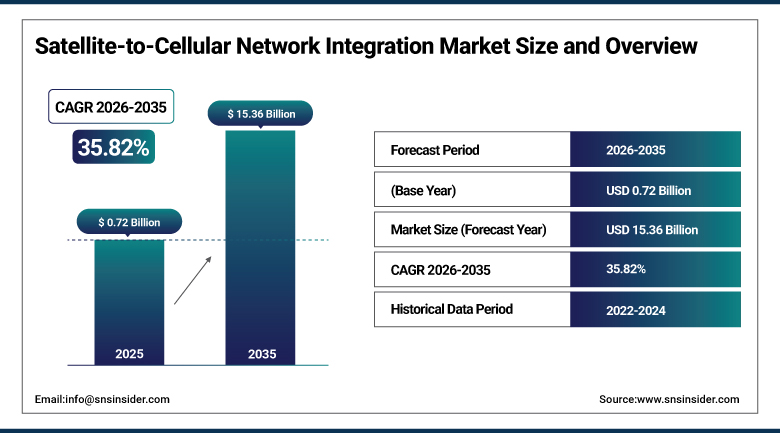
The Satellite-to-Cellular Network Integration Market was valued at USD 0.72 Billion in 2025 and is expected to reach USD 15.36 Billion by 2035, growing at a CAGR of 35.82% from 2026–2035.
The satellite-to-cellular network integration market is experiencing consistent growth due to increasing demand for reliable, ubiquitous, and low-latency connectivity beyond traditional terrestrial networks. The expansion of direct-to-cell services, 3GPP NTN technologies, 5G networks, IoT applications, emergency communications, and connected mobility is driving demand for integrated satellite and cellular infrastructure. Investments in satellite constellations, ground infrastructure, network integration platforms, user equipment, and advanced communication technologies are enhancing network coverage, capacity, interoperability, scalability, and service reliability. Companies are focusing on seamless satellite-to-cellular integration, improved spectrum efficiency, lower latency, device compatibility, and network flexibility.
In August 2026, SES expanded its strategic investment and collaboration with Elveo Mobile, formed through the merger of Lynk Global and Omnispace, to accelerate direct-to-device connectivity. The initiative is focused on delivering mobile connectivity from satellites directly to phones, devices, and machines worldwide, supporting the broader integration of satellite networks with terrestrial cellular infrastructure. The development is expected to strengthen the global satellite-to-cellular ecosystem by expanding coverage, improving connectivity resilience, and supporting the deployment of direct-to-device services across consumer, enterprise, and IoT applications.
To Get more information Satellite-to-Cellular Network Integration Market - Request Free Sample Report
Satellite-to-Cellular Network Integration Market Trends
-
Growing demand for reliable satellite-based cellular connectivity is driving direct-to-cell and satellite-to-cellular integration.
-
Rising deployment of 5G, IoT, connected vehicles, and emergency communications is expanding satellite-enabled cellular connectivity in remote and underserved areas.
-
Increasing adoption of 3GPP NTN, LEO satellites, and hybrid satellite-terrestrial networks is supporting scalable connectivity solutions.
-
Growing focus on coverage, reliability, spectrum efficiency, low latency, device compatibility, and seamless handover is creating opportunities for satellite-to-cellular integration providers.
-
Advancements in LEO satellites, satellite payloads, user equipment, and 3GPP-compliant technologies are improving connectivity performance and accelerating market adoption.
The U.S. Satellite-to-Cellular Network Integration Market Outlook
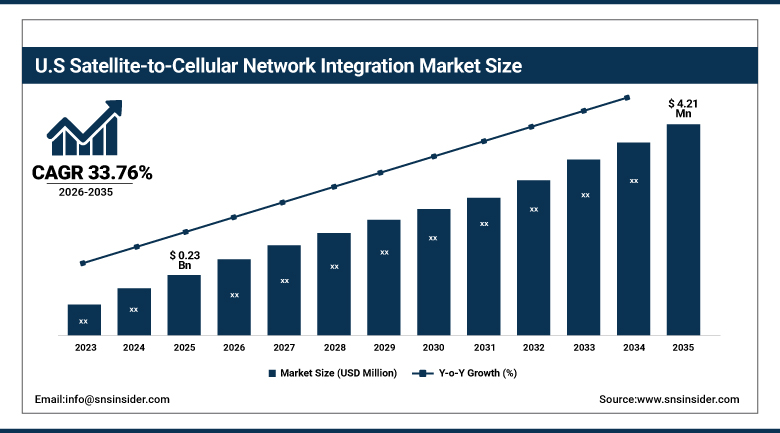
The U.S. Satellite-to-Cellular Network Integration Market was valued at USD 0.23 Billion in 2025 and is expected to reach around USD 4.21 Billion by 2035, growing at a CAGR of 33.76% from 2026–2035.
The U.S. satellite-to-cellular network integration market is growing steadily due to rising demand for reliable mobile connectivity beyond traditional terrestrial networks. The expansion of 5G networks, direct-to-cell services, connected devices, IoT applications, emergency communications, and coverage requirements in remote and underserved areas is driving demand for satellite-enabled cellular connectivity. Investments in LEO satellite constellations, ground infrastructure, network integration platforms, and 3GPP NTN technologies are improving coverage, network scalability, interoperability, and connectivity reliability. Growing collaboration between U.S. mobile network operators and satellite providers is supporting the integration of satellite networks with existing cellular infrastructure. Companies are focusing on direct-to-cell architectures, 3GPP NTN standards, hybrid terrestrial-satellite networks, satellite payload technologies, and compatible user equipment to enhance network coverage and service performance
In August 2026, AST SpaceMobile received temporary authorization to conduct testing of its satellite-to-smartphone connectivity solution in the United States. The testing supports AST SpaceMobile’s development of direct-to-cell 4G and 5G broadband services using its BlueBird satellite network and represents another step toward integrating satellite connectivity with conventional mobile networks. The development is expected to support the expansion of satellite-based cellular coverage in underserved areas while advancing commercial direct-to-device services in the U.S. market.
Satellite-to-Cellular Network Integration Market Segment Analysis
-
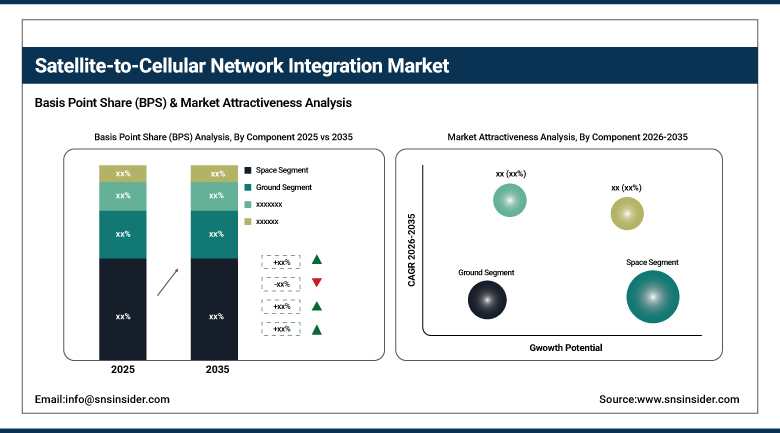
By Component, space segment dominated the satellite-to-cellular network integration market with a 35.80% share in 2025, while network integration platform is projected to be the fastest-growing segment, registering approximately a 44.03% CAGR during 2026–2035.
-
By Network Architecture, direct-to-cell dominated the satellite-to-cellular network integration market with a 38.60% share in 2025, while 3GPP NTN is projected to be the fastest-growing segment, registering approximately a 39.90% CAGR during 2026–2035.
-
By Connectivity Type, data connectivity dominated the satellite-to-cellular network integration market with a 34.60% share in 2025, while IoT/M2M connectivity is projected to be the fastest-growing segment, registering approximately a 43.96% CAGR during 2026–2035.
-
By Orbit Type, LEO dominated the satellite-to-cellular network integration market with a 65.80% share in 2025, while LEO connectivity is projected to be the fastest-growing segment, registering approximately a 37.76% CAGR during 2026–2035.
-
By Application, consumer connectivity dominated the satellite-to-cellular network integration market with a 33.80% share in 2025, while IoT & M2M is projected to be the fastest-growing segment, registering approximately a 42.82% CAGR during 2026–2035.
-
By End User, mobile network operators dominated the satellite-to-cellular network integration market with a 32.40% share in 2025, while enterprises are projected to be the fastest-growing segment, registering approximately a 44.96% CAGR during 2026–2035.
By Component, space segment dominated the satellite-to-cellular network integration market, while network integration platform is expected to grow fastest.
Space segment held the leading position in the satellite-to-cellular network integration market in 2025, supported by its critical role in enabling satellite-based communication links, direct-to-cell connectivity, and integration with terrestrial cellular infrastructure. Increasing deployment of low-earth-orbit satellite constellations, growing investment in satellite communication infrastructure, and rising demand for ubiquitous connectivity are driving the expansion of the space segment.
Network integration platforms are anticipated to register the highest CAGR during the forecast period from 2026 to 2035. Increasing integration between satellite networks, mobile network operators, terrestrial cellular infrastructure, and 3GPP NTN architectures is creating strong demand for advanced network integration capabilities.
By Connectivity Type, data connectivity dominated the satellite-to-cellular network integration market, while IoT/M2M connectivity is expected to grow fastest.
Data connectivity accounted for the dominant share of the satellite-to-cellular network integration market in 2025, driven by increasing demand for reliable broadband communication, mobile data services, connected applications, and high-capacity connectivity in areas with limited terrestrial network coverage. The expansion of direct-to-cell services and integration between satellite and cellular networks are increasing demand for satellite-enabled data transmission.
IoT/M2M connectivity is projected to exhibit the highest growth rate during 2026–2035. The increasing deployment of connected sensors, industrial equipment, asset-tracking devices, vehicles, and remote monitoring systems is creating strong demand for ubiquitous satellite-enabled connectivity. Satellite-to-cellular integration enables IoT and M2M devices to maintain communication across geographically dispersed and underserved locations.
By Application, consumer connectivity dominated the satellite-to-cellular network integration market, while IoT & M2M is expected to grow fastest.
Consumer connectivity held the dominant position in the satellite-to-cellular network integration market in 2025, supported by increasing demand for smartphone-based satellite communication, messaging, emergency connectivity, and network access in areas beyond conventional terrestrial coverage. Growing adoption of direct-to-cell services, increasing smartphone compatibility, and partnerships between satellite operators and mobile network operators are supporting the expansion of consumer connectivity applications.
IoT & M2M is expected to register the highest CAGR during the forecast period from 2026 to 2035. The rapid expansion of connected devices, remote monitoring applications, asset tracking, industrial automation, and machine-to-machine communication is increasing demand for continuous connectivity across locations where terrestrial networks may be unavailable or unreliable. Satellite-to-cellular network integration provides an effective connectivity layer for geographically dispersed IoT applications, supporting transportation, logistics, agriculture, utilities, industrial infrastructure, and remote operations.
Regional Analysis
|
Region |
Major Country |
Share within Region, 2025(%) |
|---|---|---|
|
North America |
United States |
82.40% |
|
Europe |
Germany |
34.30% |
|
Asia Pacific |
China |
48.54% |
|
Middle East & Africa |
Saudi Arabia |
23.50% |
|
Latin America |
Brazil |
23.00% |
North America satellite-to-cellular network integration market insights
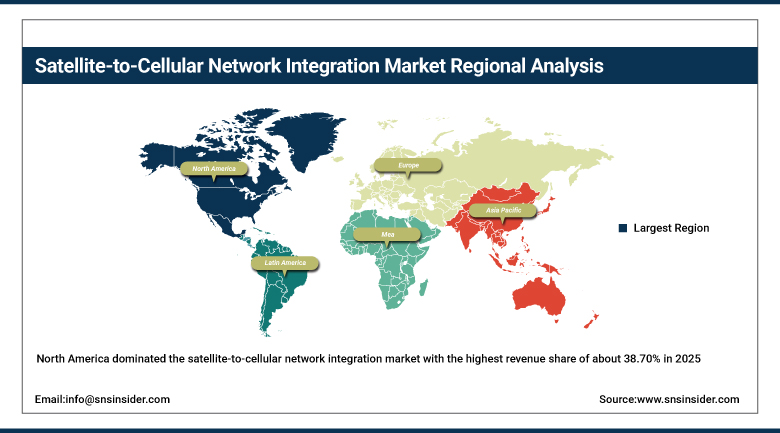
North America dominated the satellite-to-cellular network integration market with the highest revenue share of about 38.70% in 2025, supported by its advanced telecommunications infrastructure, established mobile network ecosystem, satellite communication capabilities, and strong presence of major technology and network operators. Growing deployment of direct-to-cell connectivity, 3GPP NTN technologies, and satellite-terrestrial network integration is increasing demand for advanced connectivity infrastructure across the region. Rising requirements for reliable communication in remote areas, emergency connectivity, transportation, and enterprise applications are further supporting market expansion. The U.S. represents the largest country-level market in the region, accounting for approximately 82.15% of the North American market in 2025.
Get Customized Report as per Your Business Requirement - Enquiry Now
Europe satellite-to-cellular network integration market insights
The satellite-to-cellular network integration market in Europe is expected to witness strong growth over the forecast period, supported by increasing deployment of advanced mobile networks, satellite communication infrastructure, 3GPP NTN technologies, and integrated terrestrial-satellite connectivity solutions. Growing demand for reliable connectivity across rural, remote, maritime, transportation, and emergency applications is encouraging network operators and satellite companies to expand integrated connectivity capabilities. Germany is anticipated to remain an important national market, supported by advanced telecommunications infrastructure, industrial digitalization, enterprise connectivity requirements, and increasing adoption of satellite-enabled communication technologies.
Asia Pacific satellite-to-cellular network integration market insights
Asia Pacific is expected to witness rapid growth in the satellite-to-cellular network integration market, supported by expanding telecommunications infrastructure, rising smartphone and connected-device adoption, 5G deployment, and increasing demand for connectivity across remote and underserved areas. The region accounted for approximately 40.10% CAGR of the global market in 2025 and is projected to increase its share substantially through 2035. Countries including China, Japan, South Korea, India, Singapore, and other Southeast Asian economies are investing in advanced mobile networks, satellite communication systems, IoT infrastructure, and digital connectivity initiatives. Increasing deployment of direct-to-cell services, satellite-enabled IoT and M2M connectivity, and hybrid terrestrial-satellite networks is creating additional growth opportunities.
Middle East & Africa and Latin America satellite-to-cellular network integration market insights
The satellite-to-cellular network integration market in the Middle East & Africa and Latin America is expected to experience consistent growth from 2026 to 2035, supported by expanding mobile networks, increasing digital connectivity requirements, satellite communication deployment, IoT adoption, and efforts to improve coverage in geographically remote areas. Saudi Arabia is expected to remain an important market in the Middle East & Africa, supported by investments in digital infrastructure, advanced telecommunications, satellite connectivity, and national technology initiatives.
In Latin America, Brazil is anticipated to remain a key country-level market due to its large telecommunications sector, expanding connectivity infrastructure, and demand for reliable communication across remote and rural areas. Increasing adoption of direct-to-cell connectivity, satellite-enabled IoT, emergency communications, and transportation connectivity is expected to support regional market expansion through 2035.
Market Dynamics
Growth Driver: Increasing demand for ubiquitous and reliable cellular connectivity is driving market growth
One of the key factors driving the growth of the global Satellite-to-Cellular Network Integration Market is the increasing need to extend mobile connectivity beyond conventional terrestrial networks. The expansion of 5G networks, smartphones, IoT devices, connected vehicles, emergency communication services, and connectivity requirements in rural and remote areas is creating substantial demand for satellite-enabled cellular connectivity. As terrestrial infrastructure remains limited or unavailable in certain locations, mobile network operators and satellite providers are increasingly integrating satellite networks with existing cellular infrastructure to improve coverage, connectivity resilience, and service availability. In addition, advancements in direct-to-cell technologies, 3GPP NTN standards, LEO satellite constellations, satellite payloads, and network integration platforms are improving interoperability, coverage, capacity, and service reliability.
Restraint: High infrastructure costs and network integration complexity can limit market adoption
The high capital requirements and technical complexity associated with integrating satellite networks with terrestrial cellular infrastructure can restrict market adoption, particularly among smaller operators and service providers. Satellite constellations, ground stations, network integration platforms, spectrum resources, user equipment, and supporting infrastructure require substantial investments. Deploying and maintaining satellite-based cellular services can also involve considerable operational and technological costs. Moreover, integrating satellite connectivity with existing 4G and 5G networks requires interoperability across satellite systems, mobile network infrastructure, spectrum management platforms, and compatible devices. Regulatory requirements, spectrum allocation challenges, latency considerations, network handover complexities, and differences in technology standards can further increase deployment complexity.
Opportunity: Expansion of direct-to-cell services and 3GPP NTN creates new market opportunities
The rapid development of direct-to-cell services and 3GPP NTN technologies presents significant opportunities for satellite-to-cellular network integration providers. Increasing demand for continuous connectivity across rural, remote, maritime, aviation, and disaster-affected areas is encouraging mobile network operators and satellite companies to develop integrated connectivity solutions. Direct-to-cell technologies can enable compatible smartphones and connected devices to access satellite networks without requiring specialized satellite terminals, creating opportunities for broader service adoption. Furthermore, the expansion of LEO satellite constellations, 5G NTN deployments, IoT connectivity, emergency communications, and connected mobility is creating new opportunities across consumer, enterprise, government, public safety, and defense applications. Investments in network integration platforms, satellite ground infrastructure, compatible user equipment, and 3GPP-compliant solutions are expected to support market expansion.
Recent Developments
-
2026: SpaceX continued expanding Starlink direct-to-cell services, supporting satellite connectivity for compatible smartphones and mobile networks.
-
2026: AST SpaceMobile continued advancing its BlueBird satellite constellation to provide broadband connectivity directly to standard smartphones through mobile network partnerships.
-
2026: Lynk Global continued developing direct-to-device satellite connectivity solutions, supporting messaging, voice, data, and IoT applications.
-
2026: Skylo Technologies continued expanding its 3GPP NTN connectivity platform, enabling satellite-based messaging, IoT, and emergency connectivity through compatible devices.
-
2026: Globalstar continued strengthening satellite-to-cellular connectivity through satellite infrastructure, spectrum resources, and partnerships supporting direct-to-device services.
Satellite-to-Cellular Network Integration Market key players are:
-
SpaceX (Starlink)
-
AST SpaceMobile
-
Lynk Global
-
Skylo Technologies
-
Globalstar
-
Iridium Communications
-
Viasat
-
Amazon Leo
-
Eutelsat Group
-
Omnispace
-
Sateliot
-
Telesat
-
Thuraya (Al Yah Satellite Communications)
-
SES
-
Qualcomm
-
MediaTek
-
Samsung Electronics
-
Apple
-
Nokia
-
Ericsson.
Satellite-to-Cellular Network Integration Market Report Scope:
| Report Attributes | Details |
|---|---|
| Market Size in 2025 | USD 0.72 Billion |
| Market Size by 2035 | USD 15.36 Billion |
| CAGR | CAGR of 35.82% From 2026 to 2035 |
| Base Year | 2025 |
| Forecast Period | 2026-2035 |
| Historical Data | 2022-2024 |
| Report Scope & Coverage | Market Size, Segments Analysis, Competitive Landscape, Regional Analysis, DROC & SWOT Analysis, Forecast Outlook |
| Key Segments | • By Component (Space Segment, Ground Segment, Network Integration Platform, User Equipment & Devices, Software & Services) • By Network Architecture (Direct-to-Cell, 3GPP NTN, Hybrid Terrestrial-Satellite Network, Satellite-Native Network) • By Connectivity Type (Messaging, Voice, Data Connectivity, IoT/M2M Connectivity, Emergency & Safety Connectivity) • By Orbit Type (LEO, MEO, GEO) • By Application (Consumer Connectivity, Enterprise Connectivity, IoT & M2M, Government & Public Safety, Defense & Security, Transportation & Mobility) • By End User (Consumers, Mobile Network Operators, Satellite Operators, Enterprises, Government & Public Safety Agencies, Defense Organizations) |
| Regional Analysis/Coverage | North America (US, Canada), Europe (Germany, UK, France, Italy, Spain, Russia, Poland, Rest of Europe), Asia Pacific (China, India, Japan, South Korea, Australia, ASEAN Countries, Rest of Asia Pacific), Middle East & Africa (UAE, Saudi Arabia, Qatar, South Africa, Rest of Middle East & Africa), Latin America (Brazil, Argentina, Mexico, Colombia, Rest of Latin America) |
| Company Profiles | SpaceX (Starlink), AST SpaceMobile, Lynk Global, Skylo Technologies, Globalstar, Iridium Communications, Viasat, Amazon Leo, Eutelsat Group, Omnispace, Sateliot, Telesat, Thuraya (Al Yah Satellite Communications), SES, Qualcomm, MediaTek, Samsung Electronics, Apple, Nokia, Ericsson |

Frequently Asked Questions
Key players include SpaceX, AST SpaceMobile, Lynk Global, Skylo Technologies, Globalstar, Iridium Communications, Viasat, SES, Eutelsat Group, Amazon Leo, Nokia, Ericsson, Qualcomm, and MediaTek, among others.
Key opportunities include direct-to-cell services, 3GPP NTN adoption, LEO satellite deployment, IoT connectivity, emergency communications, rural coverage, connected mobility, and hybrid satellite-terrestrial networks.
The market is primarily driven by rising demand for ubiquitous mobile connectivity, expansion of 5G networks, direct-to-cell services, IoT adoption, and connectivity requirements in remote and underserved areas.
The Direct-to-Cell segment dominated the market in 2025, supported by its ability to extend cellular connectivity directly to compatible smartphones and connected devices through satellite networks.
North America dominated the market in 2025 with a 38.60% share.
