
Direct-to-Device Satellite Connectivity Market Report Scope & Overview:
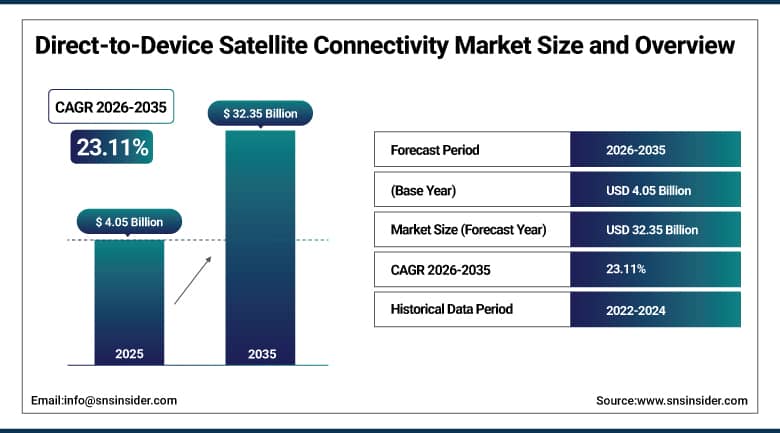
The Direct-to-Device Satellite Connectivity Market was valued at USD 4.05 Billion in 2025 and is expected to reach USD 32.35 Billion by 2035, growing at a CAGR of 23.11% from 2026–2035.
The direct-to-device satellite connectivity market is experiencing consistent growth due to increasing demand for reliable, ubiquitous, and seamless satellite-enabled connectivity for smartphones, IoT devices, wearables, connected vehicles, and other devices beyond the reach of traditional terrestrial networks. The expansion of direct-to-device services is being driven by the growing need for messaging, voice, data, IoT connectivity, and emergency services in remote, rural, maritime, aviation, and disaster-prone areas. Investments in L-band, S-band, Ku-band, and Ka-band satellite communication technologies are enhancing coverage, capacity, network efficiency, and service reliability. Companies are focusing on improving satellite-to-device connectivity, reducing latency, expanding coverage, increasing data transmission capabilities, and enabling seamless integration between satellite and terrestrial networks.
In August 2026, AST SpaceMobile reported that its satellite network had reached 13 satellites in orbit and reaffirmed plans to begin beta direct-to-device services with selected mobile network partners during 2026. The company said its commercial and government backlog had reached approximately $1.3 billion, while partnerships with more than 60 mobile network operators cover over 3 billion subscribers. The expansion is expected to strengthen global adoption of satellite-to-smartphone connectivity by extending cellular services, emergency communications, and broadband access to areas with limited terrestrial coverage.
To Get More Information On Direct-to-Device Satellite Connectivity Market - Request Free Sample Report
Direct-to-Device Satellite Connectivity Market Trends
-
Growing demand for reliable and ubiquitous connectivity is driving the adoption of direct-to-device satellite services to provide seamless communication in areas with limited or no terrestrial network coverage.
-
Rising adoption of smartphones, IoT devices and sensors, wearables, connected vehicles, and other connected devices is increasing demand for satellite-enabled messaging, voice, data, IoT, and emergency services.
-
Increasing deployment of L-Band, S-Band, Ku-Band, and Ka-Band satellite communication technologies is supporting expanded coverage, higher capacity, improved connectivity reliability, and enhanced network performance.
-
Growing focus on reducing connectivity gaps, improving network availability, lowering latency, and enabling seamless integration between satellite and terrestrial networks is creating opportunities for direct-to-device satellite connectivity providers.
-
Advancements in satellite constellations, satellite-to-device communication, antenna technologies, spectrum utilization, network interoperability, and hybrid satellite-terrestrial architectures are improving connectivity performance and supporting the adoption of direct-to-device satellite connectivity solutions.
U.S. Direct-to-Device Satellite Connectivity Market Outlook
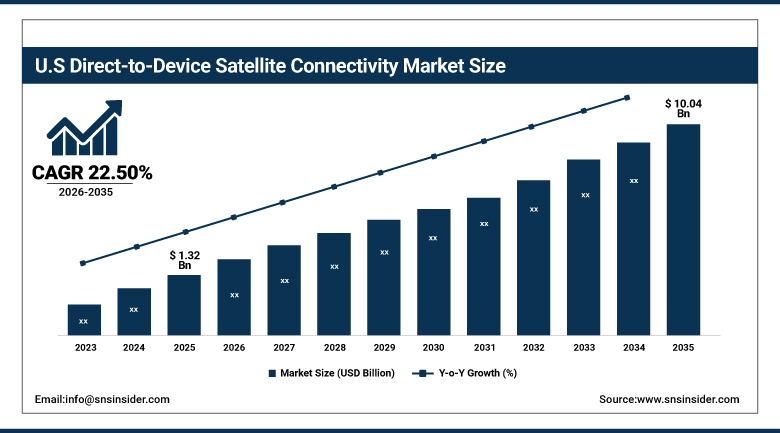
The U.S. Direct-to-Device Satellite Connectivity Market was valued at USD 1.32 Billion in 2025 and is expected to reach around USD 10.04 Billion by 2035, growing at a CAGR of 22.50% from 2026–2035.
The U.S. direct-to-device satellite connectivity market is growing steadily due to rising demand for reliable, ubiquitous, and seamless connectivity across areas with limited or no terrestrial network coverage. Increasing adoption of satellite-enabled messaging, voice, data, IoT, and emergency services is supporting market expansion across consumer, government and defense, enterprise, maritime, aviation, and automotive applications. Investments in next-generation satellite constellations, satellite-to-device communication technologies, and hybrid satellite-terrestrial networks are improving coverage, connectivity reliability, network capacity, and service availability. Growing demand for smartphone connectivity, IoT applications, wearable devices, connected vehicles, and emergency communications is further supporting market development in the U.S. Companies are focusing on improving satellite network integration, reducing latency, enhancing data transmission capabilities, expanding geographic coverage, and optimizing spectrum utilization.
In August 2026, AST SpaceMobile received temporary authorization to test its satellite-to-smartphone connectivity solution in the U.S., supporting further development and validation of direct-to-device communications. The company is developing its BlueBird satellite constellation to provide cellular connectivity directly to standard smartphones, while expanding commercial and government applications. The regulatory approval is expected to support continued testing of satellite-enabled connectivity, emergency communications, and coverage extension in areas underserved by terrestrial networks, strengthening the development of the U.S. direct-to-device satellite connectivity market.
Direct-to-Device Satellite Connectivity Market Segment Analysis
-
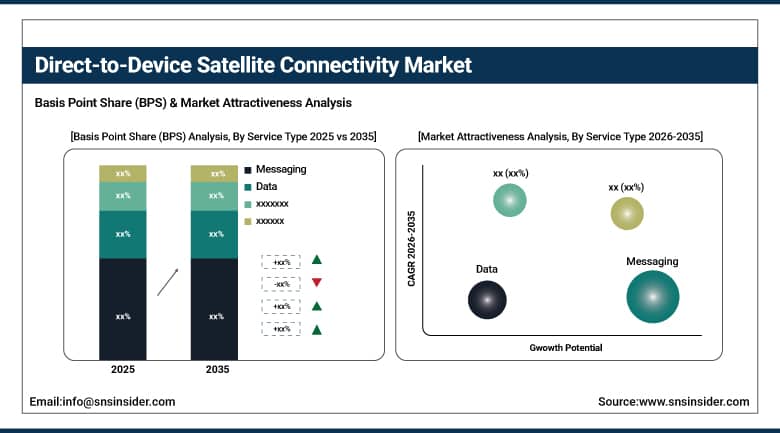
By Service Type, messaging the direct-to-device satellite connectivity market with a 24.36% share in 2025, while data is projected to be the fastest-growing segment, registering a 27.77% CAGR during 2026–2035.
-
By Frequency Band, L-Band dominated the direct-to-device satellite connectivity market with a 41.53% share in 2025, while Ka-Band is projected to be the fastest-growing segment, registering a 27.90% CAGR during 2026–2035.
-
By Device Type, smartphones dominated the direct-to-device satellite connectivity market with a 47.23% share in 2025, while wearables are projected to be the fastest-growing segment, registering a 27.11% CAGR during 2026–2035.
-
By End User, consumer dominated the direct-to-device satellite connectivity market with a 37.62% share in 2025, while government and defense is projected to be the fastest-growing segment, registering a 27.20% CAGR during 2026–2035.
-
By Region, North America dominated the direct-to-device satellite connectivity market with a 38.70% share in 2025, while Asia-Pacific is projected to be the fastest-growing region, registering a 26.17% CAGR during 2026–2035.
By Service Type, messaging dominated the direct-to-device satellite connectivity market, while data is expected to grow fastest.
Messaging held the leading position in the direct-to-device satellite connectivity market in 2025, supported by strong demand for satellite-enabled text communication, emergency messaging, location sharing, and basic connectivity in areas with limited or no terrestrial coverage. The growing integration of satellite messaging capabilities into smartphones, along with expanding collaborations between mobile network operators and satellite connectivity providers, is strengthening adoption. Increasing demand for reliable communication during emergencies, remote travel, maritime activities, and disaster situations is further supporting messaging services.
Data is anticipated to register the highest growth during the forecast period from 2026 to 2035. Rising demand for satellite-enabled internet access, higher-bandwidth connectivity, application support, and seamless integration between satellite and terrestrial networks is creating strong growth opportunities for data services. Increasing smartphone data usage, expansion of satellite capacity, improvements in network performance, and growing availability of direct-to-device broadband services are expected to further accelerate demand for satellite-enabled data connectivity.
By Device Type, smartphones dominated the direct-to-device satellite connectivity market, while wearables are expected to grow fastest.
Smartphones held the leading position in the direct-to-device satellite connectivity market in 2025, supported by the increasing integration of satellite connectivity capabilities into mainstream mobile devices. Growing demand for messaging, emergency communications, location sharing, and connectivity in areas without terrestrial network coverage is encouraging smartphone manufacturers and mobile network operators to expand satellite-enabled services. The increasing availability of satellite-to-smartphone connectivity is further strengthening smartphone adoption across remote and underserved locations.
Wearables are anticipated to register the highest growth during the forecast period from 2026 to 2035. Increasing adoption of connected watches, personal safety devices, fitness devices, and other portable electronics is creating demand for reliable connectivity beyond terrestrial networks. The growing need for continuous communication, location tracking, emergency services, and safety applications is expected to encourage the integration of satellite connectivity into next-generation wearable devices.
By End User, consumer dominated the direct-to-device satellite connectivity market, while government and defense is expected to grow fastest.
Consumer held the leading position in the direct-to-device satellite connectivity market in 2025, supported by rising demand for smartphone-based messaging, emergency services, location sharing, and connectivity in remote areas. The expansion of satellite-to-smartphone services through mobile network operators and satellite connectivity providers is improving consumer access to satellite-enabled communication. Growing consumer awareness of satellite connectivity and increasing demand for uninterrupted communication are further supporting market development.
Government and defense is anticipated to register the highest growth during the forecast period from 2026 to 2035. Increasing requirements for resilient communications, disaster response, remote operations, public safety, surveillance, and secure connectivity are driving adoption across government and defense applications. Growing deployment of satellite-enabled communication systems for emergency response, border operations, disaster management, and mission-critical communications is expected to further strengthen demand.
Regional Analysis
|
Region |
Major Country |
Share within Region, 2025(%) |
|---|---|---|
|
North America |
United States |
84.22% |
|
Europe |
Germany |
34.30% |
|
Asia Pacific |
China |
48.54% |
|
Middle East & Africa |
Saudi Arabia |
23.50% |
|
Latin America |
Brazil |
23.00% |
North America Direct-to-Device Satellite Connectivity Market Insights
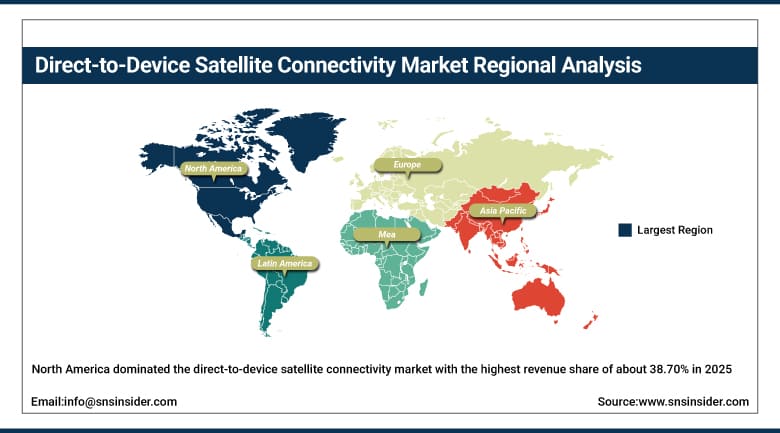
North America dominated the direct-to-device satellite connectivity market with the highest revenue share of about 38.70% in 2025, supported by its advanced telecommunications infrastructure, strong mobile network coverage, established satellite communication ecosystem, and presence of leading satellite connectivity providers and mobile network operators. The region has been an early adopter of satellite-to-smartphone connectivity, 5G networks, direct-to-device communication technologies, and next-generation satellite constellations. Increasing investments in satellite infrastructure, spectrum resources, network integration, and advanced connectivity solutions are strengthening North America's market position
Growing demand for reliable connectivity across remote, rural, maritime, and disaster-prone areas is encouraging the deployment of direct-to-device satellite services throughout North America. Increasing adoption of satellite-enabled smartphones, IoT devices and sensors, wearables, connected vehicles, and emergency communication solutions is further driving demand. The expansion of partnerships between satellite operators and mobile network operators, along with investments in satellite constellations, network interoperability, spectrum utilization, and satellite-to-device technologies, is expected to support sustained regional growth.
Get Customized Report as Per Your Business Requirement - Enquiry Now
Europe Direct-to-Device Satellite Connectivity Market Insights
The direct-to-device satellite connectivity market in Europe is expected to witness steady growth over the forecast period, supported by increasing demand for ubiquitous mobile connectivity, expanding satellite communication infrastructure, 5G deployment, and growing adoption of satellite-enabled messaging and emergency communication services. Rising demand for connectivity across remote and rural areas, maritime routes, aviation networks, and disaster-prone locations is encouraging network operators and satellite companies to expand direct-to-device capabilities. Investments in satellite constellations, network interoperability, spectrum utilization, and hybrid satellite-terrestrial connectivity are further supporting regional market development.
Asia Pacific Direct-to-Device Satellite Connectivity Market Insights
Asia Pacific is expected to grow at the fastest CAGR of about 26.17% from 2026–2035, driven by rapid digital transformation, expanding telecommunications infrastructure, increasing smartphone adoption, and accelerating deployment of satellite-enabled connectivity services. Countries including China, Japan, South Korea, India, Singapore, and other Southeast Asian economies are investing in satellite communication infrastructure and next-generation mobile networks to address connectivity requirements across remote and underserved locations. The expansion of IoT, connected devices, emergency communication services, maritime connectivity, aviation applications, and connected vehicles is creating substantial demand for direct-to-device satellite connectivity. Governments, telecommunications companies, satellite operators, and technology providers are also increasing investments in satellite constellations, spectrum resources, network interoperability, and hybrid satellite-terrestrial architectures.
Middle East & Africa and Latin America Direct-to-Device Satellite Connectivity Market Insights
The direct-to-device satellite connectivity market in the Middle East & Africa and Latin America is expected to witness consistent growth from 2026 to 2035, supported by expanding telecommunications infrastructure, increasing smartphone adoption, growing demand for reliable connectivity, 5G deployment, and investments in satellite communication networks. Large remote and underserved areas across both regions are creating demand for satellite-enabled messaging, data, IoT, and emergency services. Increasing adoption of connected devices, development of mobile networks, expansion of satellite constellations, and investments in hybrid satellite-terrestrial connectivity are further supporting opportunities for direct-to-device satellite connectivity solutions.
In Latin America, Brazil is anticipated to remain a key country-level market due to its large telecommunications sector, extensive geographic coverage requirements, expanding mobile networks, and growing demand for connectivity across remote and rural areas. Other Latin American countries are also expected to contribute to regional growth through investments in broadband expansion, 5G deployment, satellite communication infrastructure, emergency services, IoT connectivity, and direct-to-device satellite technologies.
Growth Driver: Increasing demand for reliable and ubiquitous satellite connectivity is driving market growth
One of the key factors driving the growth of the global direct-to-device satellite connectivity market is the increasing demand for reliable and seamless connectivity in areas with limited or no terrestrial network coverage. The expansion of smartphone connectivity, IoT devices and sensors, wearables, connected vehicles, maritime communications, aviation connectivity, and emergency communication services is creating substantial demand for satellite-enabled messaging, voice, data, IoT, and emergency services. As terrestrial networks face coverage limitations across remote, rural, maritime, and disaster-prone areas, mobile network operators and satellite connectivity providers are increasingly adopting direct-to-device technologies capable of extending connectivity directly to compatible devices. In addition, advancements in satellite constellations, satellite-to-device communication technologies, spectrum utilization, satellite antennas, network interoperability, and hybrid satellite-terrestrial architectures are improving coverage, connectivity reliability, network capacity, and service availability.
Restraint: High deployment costs and technological complexity can limit market adoption
The high cost and technical complexity associated with deploying direct-to-device satellite connectivity infrastructure can restrict market adoption, particularly among smaller operators and service providers. Satellite constellation deployment, ground infrastructure, spectrum acquisition, satellite antennas, network integration, and device compatibility require significant capital investment and specialized technical capabilities. Upgrading existing mobile networks to support satellite-to-device connectivity may also require substantial changes to network architecture, spectrum management systems, user equipment, and supporting infrastructure. Moreover, maintaining reliable satellite connectivity requires sophisticated network management, satellite tracking, spectrum coordination, and interoperability capabilities. Compatibility challenges between satellite systems, mobile network operators, device manufacturers, and network equipment providers can further increase deployment complexity.
Opportunity: Rapid expansion of satellite-enabled mobile services and IoT connectivity create new market opportunities
The rapid expansion of satellite-enabled mobile communication and IoT connectivity present significant opportunities for direct-to-device satellite connectivity providers. Increasing demand for continuous connectivity across remote regions, maritime environments, aviation networks, emergency situations, connected vehicles, and industrial IoT applications is generating substantial demand for satellite-based communication services. As users and enterprises require connectivity beyond the reach of terrestrial networks, direct-to-device technologies are becoming increasingly important for extending network coverage and supporting seamless communication.
Furthermore, the growing adoption of satellite-enabled messaging, voice, data, IoT, and emergency services creates opportunities for service providers to expand their offerings across consumer, government and defense, enterprise, maritime, aviation, and automotive applications. Advancements in L-Band, S-Band, Ku-Band, and Ka-Band technologies, along with improvements in satellite constellations, antennas, spectrum efficiency, and network interoperability, are creating additional growth opportunities.
Recent Developments
-
2026: AST SpaceMobile, Inc. continued advancing its direct-to-device satellite connectivity network, expanding satellite deployment and partnerships with mobile network operators to support broadband connectivity directly to compatible smartphones and other devices.
-
2026: SpaceX continued expanding Starlink’s direct-to-device satellite connectivity capabilities, supporting messaging and other satellite-enabled services through partnerships with mobile network operators and extending connectivity to areas beyond conventional terrestrial coverage.
-
2026: Lynk Global, Inc. continued developing its direct-to-device satellite network, focusing on satellite-enabled mobile connectivity that allows compatible phones to connect directly to satellites without requiring specialized satellite hardware.
-
2026: Globalstar, Inc. continued strengthening its satellite connectivity capabilities and mobile partnerships, supporting direct-to-device communication services and expanding satellite-enabled connectivity for messaging, emergency communications, and other mobile applications.
-
2026: Iridium Communications Inc. continued advancing satellite-based mobile connectivity solutions, supporting reliable communication services across remote, maritime, aviation, government, enterprise, and other applications where terrestrial network coverage is limited.
Direct-to-Device Satellite Connectivity Market Key Players are:
-
AST SpaceMobile, Inc.
-
Globalstar, Inc.
-
Iridium Communications Inc.
-
Lynk Global, Inc.
-
Skylo Technologies, Inc.
-
Omnispace, LLC
-
Viasat, Inc.
-
Sateliot
-
Eutelsat Group
-
Space42
-
SES S.A.
-
EchoStar Corporation
-
Telesat
-
Qualcomm Incorporated
-
MediaTek Inc.
-
Apple Inc.
-
Ericsson AB
-
Samsung Electronics Co., Ltd.
Direct-to-Device Satellite Connectivity Market Report Scope:
| Report Attributes | Details |
|---|---|
| Market Size in 2025 | USD 4.05 Billion |
| Market Size by 2035 | USD 32.35 Billion |
| CAGR | CAGR of 23.11% From 2026 to 2035 |
| Base Year | 2025 |
| Forecast Period | 2026-2035 |
| Historical Data | 2022-2024 |
| Report Scope & Coverage | Market Size, Segments Analysis, Competitive Landscape, Regional Analysis, DROC & SWOT Analysis, Forecast Outlook |
| Key Segments | • By Service Type (Messaging, Voice, Data, IoT, Emergency Services, Others) • By Frequency Band (L-Band, S-Band, Ku-Band, Ka-Band, Others) • By Device Type (Smartphones, IoT Devices and Sensors, Wearables, Laptops and Tablets, Connected Vehicles, Others) • By End User (Consumer, Government and Defense, Enterprise, Maritime, Aviation, Automotive) |
| Regional Analysis/Coverage | North America (US, Canada), Europe (Germany, UK, France, Italy, Spain, Russia, Poland, Rest of Europe), Asia Pacific (China, India, Japan, South Korea, Australia, ASEAN Countries, Rest of Asia Pacific), Middle East & Africa (UAE, Saudi Arabia, Qatar, South Africa, Rest of Middle East & Africa), Latin America (Brazil, Argentina, Mexico, Colombia, Rest of Latin America) |
| Company Profiles | SpaceX, AST SpaceMobile, Inc., Globalstar, Inc., Iridium Communications Inc., Lynk Global, Inc., Skylo Technologies, Inc., Omnispace, LLC, Viasat, Inc., Sateliot, Eutelsat Group, Amazon Leo, Space42, SES S.A., EchoStar Corporation, Telesat, Qualcomm Incorporated, MediaTek Inc., Apple Inc., Ericsson AB, Samsung Electronics Co., Ltd. |

Frequently Asked Questions
Key players in the direct-to-device satellite connectivity market include AST SpaceMobile, Inc., SpaceX, Lynk Global, Inc., Globalstar, Inc., and Iridium Communications Inc., among others.
Key opportunities in the direct-to-device satellite connectivity market include expansion of satellite-enabled smartphone connectivity and increasing integration of satellite networks with terrestrial mobile infrastructure.
The market is driven by increasing demand for reliable and ubiquitous connectivity in areas with limited or no terrestrial network coverage, along with rising adoption of satellite-enabled messaging, voice, data, IoT, and emergency services.
The North America region dominated the direct-to-device satellite connectivity market in 2025 with a 38.70% share.
