
Silicon as a Platform Market Report Scope & Overview:
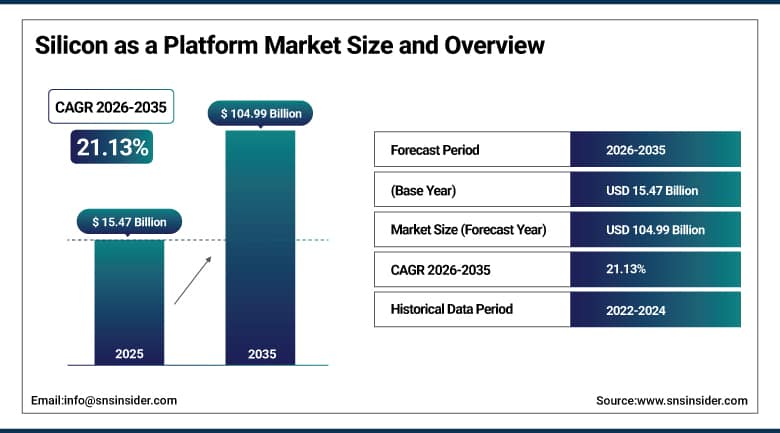
The Silicon as a Platform Market size was valued at USD 15.47 billion in 2025 and is expected to reach USD 104.99 billion by 2035, growing at a CAGR of 21.13% from 2026–2035.
The global silicon as a platform market is witnessing strong growth in the global market owing to increasing demand for advanced semiconductor technologies and high-performance computing solutions. Rising adoption of CMOS silicon platforms, silicon photonics, heterogeneous integration, and chiplet-based architectures is accelerating market expansion. Foundries and semiconductor companies are focusing on advanced packaging, AI-driven chip design, sub-7 nm technology nodes, and high-density integration platforms. Growing investments in data center processors, automotive electronics, edge computing, and next-generation communication infrastructure are supporting technology advancement. Increasing demand for energy-efficient chips, AI accelerators, cloud computing, and intelligent connected devices is further driving market adoption.
The European Union’s share of manufacturing logic silicon platforms below 22 nanometers was 0% while targeting 20% global market share by 2030, according to the European Court of Auditors 2025 Special Report on microchip strategic autonomy. Additional benchmark statistics from the U.S. Geological Survey’s 2025 Mineral Commodity Summaries showed that China produced about 85% of the world’s raw silicon feedstock, but overall net import reliance was 74% domestically.
To Get More Information On Silicon as a Platform Market - Request Free Sample Report
Silicon as a Platform Market Trends
-
The increasing adoption of silicon photonics is revolutionising high-speed optical communication across cloud and enterprise networking infrastructure worldwide.
-
Worldwide demand for advanced CMOS, chiplet and heterogeneous integration technologies has been growing in response to AI-driven semiconductor platform development.
-
The continuing expansion of hyperscale data centres is driving investments in energy-efficient silicon platforms and advanced packaging solutions.
-
The growing adoption of edge computing devices is spurring demand for scalable, high-performance silicon platform architectures globally.
-
Strategic alliances between semiconductor vendors and cloud providers are accelerating commercialisation of next-gen silicon photonics platforms.
-
Advances in fabrication technologies are enabling lower power consumption, higher performance, and improved semiconductor scalability.
U.S. Silicon as a Platform Market Size Outlook
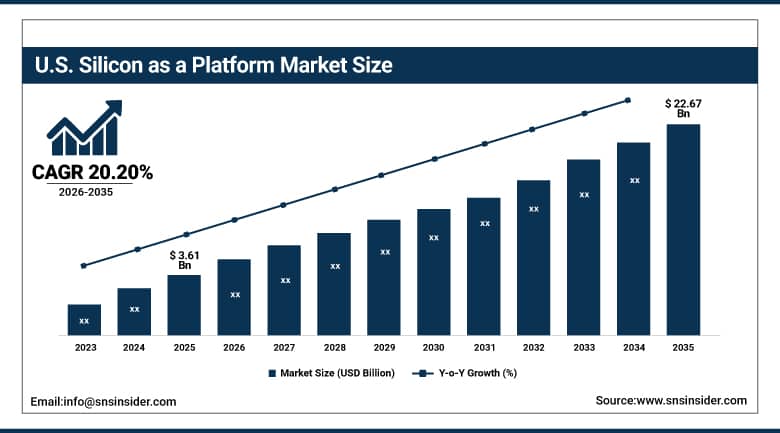
The U.S. Silicon as a Platform Market was valued at USD 3.61 billion in 2025 and is expected to reach around USD 22.67 billion by 2035, growing at a CAGR of 20.20% from 2026–2035.
The U.S. silicon as a platform market is expanding rapidly owing to rising development of advanced semiconductor technologies across high-performance computing and communication applications. Increasing adoption by foundries, fabless semiconductor companies, hyperscalers, automotive manufacturers, and industrial equipment producers is supporting market growth nationwide. Rising investments in silicon photonics, advanced packaging, heterogeneous integration, AI chip development, and next-generation fabrication technologies are driving manufacturing efficiency and platform innovation. Growth in cloud infrastructure, edge computing, and automotive electronics is further accelerating silicon platform adoption across industries. Technology providers are focusing on chiplet architectures, low-power silicon design, electronic design automation, and advanced process nodes across diverse application segments.
The U.S. Department of Commerce January 2025 updates show federal CHIPS for America initiatives funded advanced semiconductor packaging and silicon core substrate research facilities that cut chip development timelines by 40% through digital twin optimisation. Policy benchmarks are to increase domestic fabrication capacity for 300 mm silicon wafers from an initial 8% share of global to 20% of global leading edge logic production under active federal strategic national implementation framework goals.
Silicon as a Platform Market Segment Analysis
-
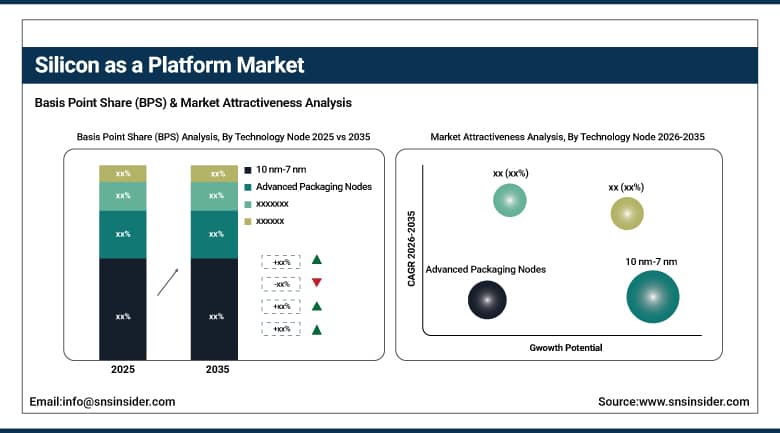
By Technology Node, 10 nm-7 nm dominated the market with 33.39% share in 2025; while advanced packaging nodes are the fastest growing segment with CAGR of 32.39% during 2026 to 2035.
-
By Platform Type, CMOS silicon platforms dominated the market with 43.79% share in 2025; while heterogeneous silicon integration/chiplets are the fastest growing segment with CAGR of 25.71% during 2026 to 2035.
-
By Application, computing & data centers dominated the market with 34.99% share in 2025; while automotive electronic are the fastest growing segment with CAGR of 27.11% during 2026 to 2035.
-
By Integration Type, system-on-chip dominated the market with 41.39% share in 2025; while chiplet-based architectures are the fastest growing segment with CAGR of 29.24% during 2026 to 2035.
-
By End User, foundries & IDMs dominated the market with 38.59% share in 2025; while hyperscalers & data center operators are the fastest growing segment with CAGR of 27.97% during 2026 to 2035.
By Technology Node, 10 nm-7 nm dominated the silicon as a platform market, while advanced packaging nodes are the fastest growing segment.
The 10 nm-7 nm segment held the dominated revenue share in the silicon as a platform market in 2025. Its leadership was backed by broad traction in AI processors, data-center chips, networking gear and sophisticated consumer electronics. This technology node was preferred by premier foundries and integrated device manufacturers for the balance of performance, power efficiency, manufacturing maturity, and production scalability. Strong demand in cloud computing, automotive electronics and high-performance computing further fortified its dominant market position.
The advanced packaging nodes segment is expected to grow at the fastest CAGR during 2026-2035. The growth is fueled by increasing adoption of chiplet architectures, heterogeneous integration and high bandwidth memory technologies across advanced semiconductor platforms. The growing demand for AI accelerators, next-gen data centre processors and small form-factor high performance devices is driving investments in advanced packaging innovations. The market is growing rapidly, powered by continuous innovations in 2.5D, 3D packaging and System-in-Package technologies.
By Platform Type, CMOS silicon platforms dominated the silicon as a platform market, while heterogeneous silicon integration/chiplets are the fastest growing segment.
CMOS silicon platforms segment accounted for the dominated share of the market in 2025. This dominance was reinforced by adoption of the product in processors, memory devices, consumer electronics, automotive semiconductors and industrial applications worldwide. Mature manufacturing ecosystems, proven fabrication processes, high production yields, and cost-effective scalability enabled widespread commercial deployment across a wide range of end-use industries. CMOS Silicon Platforms’ leadership in the global semiconductor industry was further strengthened by ongoing enhancements to performance, power efficiency and support for advanced technology nodes.
Heterogeneous silicon integration/chiplets segment is expected to witness the fastest CAGR during the forecast period 2026-2035. Rising demand for modular chip architectures that provide higher performance, flexibility and manufacturing efficiency for advanced computing applications are fueling the rapid growth. Growing adoption of AI accelerators, data centres, high-performance computing and next-generation communication systems is creating massive market opportunities worldwide. More investment in advanced packaging technologies, chiplet ecosystems and scalable semiconductor designs are further accelerating adoption in multiple industries.
By Application, computing & data centers dominated the silicon as a platform market, while automotive electronic are the fastest growing segment.
The computing & data centres segment accounted for the dominated share of revenues in the silicon as a platform market in 2025. The increasing demand for cloud computing, artificial intelligence and hyperscale infrastructure had a significant impact on the adoption of advanced silicon platforms globally. High-performance processors, silicon photonics and advanced packaging technologies enabled faster data processing with better energy efficiency. Continued investment by hyperscalers and semiconductor manufacturers has increased production capacity to enable wide deployment across enterprise, cloud and high-performance computing environments.
The automotive electronics segment is projected to witness fastest CAGR between 2026-2035. The growing adoption of electric vehicles, advanced driver assistance systems, and autonomous driving technologies is propelling the global demand for advanced silicon platforms. Car makers are adding more AI processors, high-performance sensors, and heterogeneous chip architectures to next-generation vehicle designs. Furthermore, the rapid expansion of the market is supported by rising investments in connected mobility, vehicle electrification and safety focused semiconductor innovations.
By Integration Type, system-on-chip dominated the silicon as a platform market, while chiplet-based architectures are the fastest growing segment.
The system-on-chip segment accounted for the dominated revenue share in the silicon as a platform market in 2025. Its ubiquity in smartphones, data centres, consumer electronics, automotive systems and industrial devices that needed compact high-performance semiconductor solutions drove its dominance. System-on-Chip platforms integrate processors, memory, connectivity and specialised accelerators on a single chip, which improves power efficiency and reduces manufacturing complexity. Further market leadership was cemented with large investments from leading players and progress on advanced process nodes.
The chiplet-based architectures segment is estimated to register the fastest CAGR during 2026–2035. Demand for scalable computing, artificial intelligence workloads, high-performance processors and cost-effective semiconductor manufacturing is increasing rapidly, driving adoption across multiple industries. Chiplet-Based Architectures enables flexible assembly of heterogeneous components, enhances design efficiency, production yields and performance, and lowers development costs. We expect strong long term market growth supported by increased investment in advanced packaging technologies, heterogeneous integration and next generation data centre processors.
By End User, foundries & IDMs dominated the silicon as a platform market, while hyperscalers & data center operators are the fastest growing segment.
The foundries & IDMs segment dominated the silicon as a platform market in terms of revenue share in 2025. Their leadership was backed by huge wafer fabrication capacity, cutting-edge process technologies and substantial investments in semiconductor manufacturing infrastructure. These companies provided high-volume silicon platforms for computing, automotive, industrial and communication applications to global markets. Their market competitiveness was further improved by long term partnerships with fabless companies, continuous node improvements and integrated production capabilities.
Hyperscalers & data centre operators segment is anticipated to record fastest CAGR from 2026-2035. The rapid growth of cloud computing, artificial intelligence workloads, and HPC infrastructure is creating a huge demand for advanced silicon platforms. Increasing investments in custom processors, silicon photonics, chiplet architectures, and energy-efficient semiconductor technologies are driving the adoption of platforms. Continued deployment of hyperscale facilities and next generation data centres continues to support long term growth across global digital infrastructure markets.
Regional Analysis
|
Region |
Major Country |
Share within Region, 2025(%) |
|---|---|---|
|
North America |
United States |
79.97% |
|
Europe |
Germany |
28.30% |
|
Asia Pacific |
China |
43.20% |
|
Middle East & Africa |
UAE |
18.10% |
|
Latin America |
Brazil |
47.20% |
Asia Pacific Silicon as a Platform Market Insights
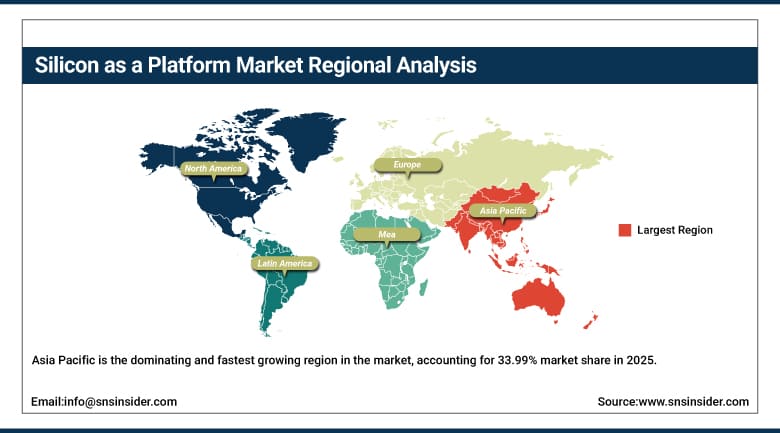
Asia Pacific is the dominating and fastest growing region in the silicon as a platform market, accounting for 33.99% market share in 2025 and registering a CAGR of 22.73% during 2026–2035. Rapid semiconductor manufacturing expansion and increasing electronics production are driving strong market demand across China, Taiwan, Japan, South Korea, and India. Rising investments in advanced fabrication facilities, silicon photonics, and chiplet technologies are accelerating regional market growth. Growing demand for consumer electronics, artificial intelligence, and automotive semiconductors continues supporting widespread silicon platform adoption across manufacturing industries.
According to the OECD Digital Economy Outlook 2025, more than 95% of electronic devices are based on semiconductor components. Asia Pacific leads the way in advanced silicon integration. The United Nations Industrial Development Organization’s indicators show that the Asia Pacific region accounts for more than 60% of global electronics manufacturing volume, with China, South Korea, Japan, and Taiwan leading the way. Moreover, advanced nodes below 10 nanometers comprise more than 20% of global production, further solidifying regional dominance within silicon platform ecosystems.
Get Customized Report as Per Your Business Requirement - Enquiry Now
North America Silicon as a Platform Market Insights
North America silicon as a platform market is witnessing significant growth in 2025, driven by increasing investments in advanced semiconductor manufacturing and silicon platform technologies across computing, automotive, and communication industries. The region benefits from leading semiconductor companies, strong research capabilities, and advanced fabrication facilities. Increasing adoption of silicon photonics, chiplet architectures, and AI processors is strengthening market growth. Expansion of high-performance computing and cloud infrastructure continues supporting semiconductor innovation and broader adoption of advanced silicon platform technologies across multiple end-use industries.
According to the U.S. Geological Survey’s December 2025 report, domestic net shipments of silicon alloys and metal totalled 18,600 metric tonnes, a 6% increase from November 2025. Total ferrosilicon imports, on a silicon content basis, decreased 37% to 4,610 metric tonnes from the previous month. Also, total silicon metal imports reached 12,500 metric tonnes, which was a 15% increase compared with December 2024 volume metrics.
Europe Silicon as a Platform Market Insights
Europe silicon as a platform market is characterized by stable growth in 2025 owing to increasing investments in semiconductor research, automotive electronics, and advanced silicon manufacturing technologies. Key countries include Germany, France, United Kingdom, Italy, and Netherlands. Rising adoption of silicon photonics, power semiconductors, and advanced packaging technologies is supporting market expansion. Increasing focus on semiconductor self-sufficiency and digital transformation is strengthening long-term industry development. Technological advancements continue encouraging efficient chip manufacturing and high-performance electronic system integration across the region.
The European Union aims to increase its share of the global chip market to 20% by 2030, the European Commission said in a 2025 progress assessment of the semiconductor framework. Pillar I foresees the Chips Joint Undertaking running pilot lines in member states and 13 state aid decisions supporting the building of new fabrication facilities. Meanwhile, regional automotive manufacturing accounts for 39% of the total sector demand, followed by industrial applications at 23% and communications at 12%.
Middle East & Africa and Latin America Silicon as a Platform Market Insights
The Middle East & Africa along with Latin America regions are witnessing steady growth due to expanding semiconductor investments and increasing adoption of advanced digital infrastructure across multiple industries. Key contributing countries include Saudi Arabia, UAE, South Africa, Brazil, Mexico, and Argentina. Growing demand for automotive electronics, industrial automation, and communication technologies is supporting market expansion. Continued investments in semiconductor ecosystem development are strengthening long-term regional opportunities.
The International Renewable Energy Agency and United Nations Conference on Trade and Development say global renewable power capacity grew 15.5% in 2025, adding 692 gigawatts to reach 5,149 gigawatts. New solar photovoltaic installations added 510 gigawatts of new capacity. The Middle East added renewable capacity at a rate of 28.9%, while Africa’s growth was at 15.9%. Long-term technology and semiconductor demand continues to be supported by expanding digital infrastructure and industrial modernization across Latin America and Africa.
Market Dynamics
Growth Drivers: AI computing and cloud infrastructure accelerate global Silicon as a Platform Market growth
The demand for silicon technologies is being driven worldwide by increasing artificial intelligence workloads, expansion of cloud computing and high-performance processors. Semiconductor makers are pouring money into CMOS platforms silicon photonics and heterogeneous integration to boost computing efficiency. The platform continues to be a hotbed of innovation as AI accelerators, edge computing devices and sophisticated networking hardware are increasingly deployed. Greater adoption in automotive electronics, industrial automation, healthcare devices and communication systems boosts commercial opportunities. Progress in fabrication technologies, chiplet architectures and advanced packaging solutions is leading to next-generation semiconductor applications with higher performance, lower power consumption and greater scalability.
The International Energy Agency says data centres around the world used 485 terawatt hours of electricity in 2025 — a number powered by increasing cloud infrastructure and specialised silicon workloads. Accelerated servers for artificial intelligence deployment grew 30% annually, and represented nearly 50% of net global data centre electricity growth. Additionally, advanced computing hardware platforms consumed 60% of the total facility power to support demanding generative model training and inference tasks.
Restraints: Supply chain disruptions and fabrication constraints limit Silicon as a Platform growth
The semiconductor industry uses very specialized materials, equipment suppliers and advanced fabrication facilities which are located in more than one country. The availability of semiconductors and their production is often affected by geopolitical uncertainties, trade restrictions and shortages of raw materials. Manufacturing bottlenecks for high performance silicon platforms arise from limited availability of advanced process nodes. Long lead times for equipment and limited wafer fabrication capacity are the cause for extended delivery schedules for customers. Dependence on a small number of global foundries exposes manufacturers to operational risks. These factors still influence the stability of production and the growth of the market as a whole.
Opportunities: Silicon photonics adoption expands long-term digital infrastructure growth opportunities worldwide
Demand for high-speed optical communication technologies is being driven by the rapid growth of cloud computing, artificial intelligence and hyperscale data centres. Silicon photonics enables higher speed data transmission, lower energy consumption and higher system efficiency. Commercial opportunities continue to expand as deployment increases in telecommunications, enterprise networking and advanced computing applications. Ongoing investments in integrated optical chips and advanced packaging technologies further enhance capabilities of products. More collaboration between semiconductor manufacturers and cloud service providers will help commercialize the next-generation silicon photonics platforms in global markets.
The Horizon Europe STARLight project 2025 report from the European Commission underscores the rapid scaling of manufacturing onto 300mm wafer substrates for the adoption of silicon photonics in global digital infrastructure to optimise high performance optical interconnects. The advanced photonic integrated circuits are delivering optical modulation speeds over 200Gbps per lane and are working on 400Gbps per lane demonstrators, which will improve the overall energy efficiency of data centres and increase the data throughput capacity for artificial intelligence processing across modern global telecommunications networks.
Recent Developments
-
2026: Taiwan Semiconductor Manufacturing Company announced an additional $100 billion investment in Arizona to construct four 2-nanometer semiconductor fabrication plants.
-
2025: Samsung Electronics began mass production of its 286-layer eighth-generation vertical NAND flash memory tailored for artificial intelligence data centers.
-
2025: Intel Corporation installed high-numerical-aperture extreme ultraviolet lithography equipment at its Oregon technology development facility to advance 18A node production.
-
2024: NVIDIA Corporation acquired Israeli AI software orchestration startup Run:ai for USD 700 million to optimize enterprise graphics processing unit utilization.
Silicon as a Platform Companies are:
-
Samsung Electronics
-
Intel Corporation
-
GlobalFoundries
-
Advanced Micro Devices
-
Qualcomm
-
Broadcom
-
Texas Instruments
-
STMicroelectronics
-
Infineon Technologies
-
NXP Semiconductors
-
Analog Devices
-
Micron Technology
-
Marvell Technology
-
Arm
-
VeriSilicon
-
Silicon Laboratories
-
Wolfspeed
-
Synopsys
Silicon as a Platform Market Report Scope:
| Report Attributes | Details |
|---|---|
| Market Size in 2025 | USD 15.47 Billion |
| Market Size by 2035 | USD 104.99 Billion |
| CAGR | CAGR of 21.13% From 2026 to 2035 |
| Base Year | 2025 |
| Forecast Period | 2026-2035 |
| Historical Data | 2022-2024 |
| Report Scope & Coverage | Market Size, Segments Analysis, Competitive Landscape, Regional Analysis, DROC & SWOT Analysis, Forecast Outlook |
| Key Segments | • By Platform Type (CMOS Silicon Platforms, Silicon Photonics Platforms, Silicon Power & Analog Platforms, Heterogeneous Silicon Integration/Chiplets) • By Application (Computing & Data Centers, Telecommunication, Automotive Electronic, Industrial Automation & IoT, Healthcare & Medical Devices) • By Technology Node (Above 28 nm, 28 nm-14 nm, 10 nm-7 nm, Below 7 nm, Advanced Packaging Nodes) • By Integration Type (Monolithic Integration, System-on-Chip, System-in-Package, Chiplet-Based Architectures) • By End User (Foundries & IDMs, Fabless Semiconductor Companies, Hyperscalers & Data Center Operators, Automotive OEMs & Tier-1 Suppliers, Industrial & Medical Device Manufacturers) |
| Regional Analysis/Coverage | North America (US, Canada), Europe (Germany, UK, France, Italy, Spain, Russia, Poland, Rest of Europe), Asia Pacific (China, India, Japan, South Korea, Australia, ASEAN Countries, Rest of Asia Pacific), Middle East & Africa (UAE, Saudi Arabia, Qatar, South Africa, Rest of Middle East & Africa), Latin America (Brazil, Argentina, Mexico, Colombia, Rest of Latin America). |
| Company Profiles | Taiwan Semiconductor Manufacturing Company, Samsung Electronics, Intel Corporation, GlobalFoundries, Advanced Micro Devices, NVIDIA Corporation, Qualcomm, Broadcom, Texas Instruments, STMicroelectronics, Infineon Technologies, NXP Semiconductors, Analog Devices, Micron Technology, Marvell Technology, Arm, VeriSilicon, Silicon Laboratories, Wolfspeed, Synopsys |
Frequently Asked Questions
