
Silicon Interposer Market Report Scope & Overview:
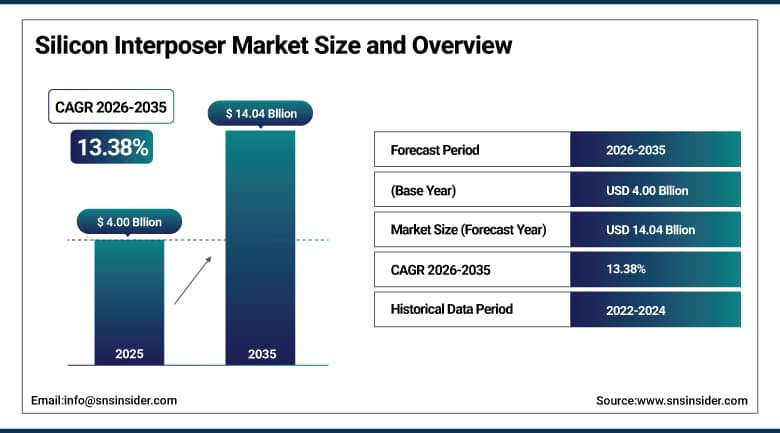
The Silicon Interposer Market was valued at USD 4.00 Billion in 2025 and is projected to reach USD 14.04 Billion by 2035, expanding at a CAGR of 13.38% during the forecast period 2026–2035.
Silicon interposer industry is witnessing healthy growth due to the rising demand for advanced semiconductor packaging technologies that can enable high bandwidth, low latency, and power-efficient design of semiconductors. Silicon interposer is a crucial enabling technology that facilitates the heterogeneous integration of multiple dies in a package with excellent electrical properties over traditional substrate-based technologies.
Artificial Intelligence (AI), High Performance Computing (HPC), Data Centers, Networking devices, Graphics Processing Units (GPUs), and Consumer Electronics have been rapidly proliferating and are expected to boost the adoption of silicon interposer technologies. The silicon interposer is a crucial enabler of the advanced chiplet-based semiconductor architecture that aims to leverage packaging technology to circumvent the scaling problems in the design of transistors. Innovations in 2.5D and 3D semiconductor packaging, Wafer Level Packaging, Advanced Through-Silicon via (TSV) fabrication, and Heterogeneous Integration are adding value to market growth.
During the period from 2025 to 2026, some major semiconductor manufacturers have launched next-generation silicon interposers, which feature chiplets, High Bandwidth Memory (HBM), AI acceleration, and HPC.
To Get More Information On Silicon Interposer Market - Request Free Sample Report
Silicon Interposer Market Trends
-
Increasing adoption of chiplet-based semiconductor architectures for high-performance computing and AI applications.
-
Growing deployment of advanced 2.5D and 3D packaging technologies to improve bandwidth, power efficiency, and system integration.
-
Rising investments in AI accelerators, high-bandwidth memory (HBM), and heterogeneous integration technologies for next-generation computing platforms.
-
Expanding utilization of silicon interposers across data centers, networking equipment, automotive electronics, and advanced consumer devices.
-
Continuous innovations in advanced wafer-level packaging, through-silicon via (TSV) technologies, and semiconductor manufacturing processes supporting higher package density and improved thermal performance.
The U.S. Silicon Interposer Market Size Outlook
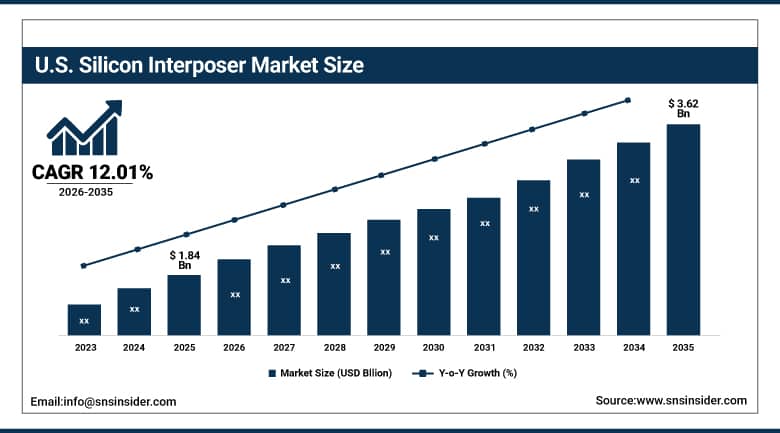
The U.S. Silicon Interposer Market was valued at USD 1.84 billion in 2025 and is expected to reach approximately USD 3.62 billion by 2035, expanding at a CAGR of 12.01% during 2026–2035.
The United States is anticipated to be one of the leading nations that would see increased usage of silicon interposer technology due to the presence of semiconductor chipmakers, advanced packaging firms, hyper scale cloud services, and artificial intelligence hardware producers in the nation. Increased efforts made toward the production of semiconductors domestically, artificial intelligence, defense electronics, high-performance computing devices, and advanced data centers have continued to drive the need for advanced packaging technologies. The rapid adoption of AI accelerators, graphics processing chips, chiplet processors, and high bandwidth memory technologies has also driven the adoption of silicon interposers in the nation. Support from the government towards semiconductor manufacturing and resilient supply chains has also contributed to the growth of the market.
Several U.S. based semiconductor firms during 2025-2026 ramped up their efforts towards the adoption of advanced packaging platforms featuring silicon interposers along with chiplet architectures, HBM technologies, AI processors, and heterogeneous computing systems.
Silicon Interposer Market Segment Analysis
-
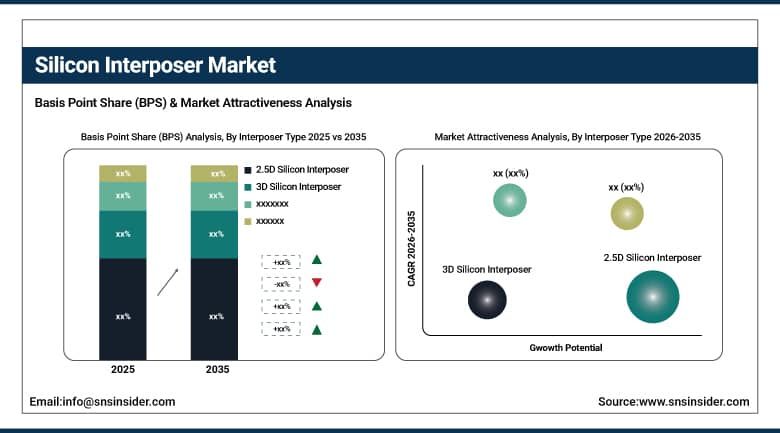
By Interposer Type, 2.5D silicon interposer dominated the market with 58.00% share in 2025 and is projected to witness the fastest growth with a CAGR of 13.75% during the forecast period.
-
By Packaging Technology, 2.5D packaging dominated the market with 54.00% share in 2025, while 3D packaging is projected to witness the fastest growth with a CAGR of 17.86% during the forecast period.
-
By Application, high performance computing (HPC) dominated the market with 29.00% share in 2025, whereas artificial intelligence accelerators are expected to register the fastest CAGR of 17.88% during the forecast period.
-
By End User, semiconductor manufacturers dominated the market with 43.00% share in 2025, while data center companies are projected to witness the fastest growth with a CAGR of 16.26% during the forecast period.
By Interposer Type, 2.5D silicon interposer dominated the market and is also the fastest-growing segment.
The 2.5D silicon interposer segment was valued at 58.00% in 2025 and held the largest market share in the 2.5D Interposer market and it is estimated that it will register the highest CAGR of 13.75%. The dominance of the segment is due to the usage in applications such as high-performance computing (HPC), artificial intelligence (AI) accelerators, GPUs, FPGAs, and HBM applications. Unlike other packaging technologies, 2.5D silicon interposers help in achieving higher signal integrity, reduced power requirements, shorter interconnect distances, and higher input-output density, making it possible to stack different heterogeneous dies in a single package. In addition, with semiconductor scaling becoming more difficult, chiplet architecture with 2.5D interposers is the way forward for better performance and packaging solutions.
In the years 2025 and 2026, many of the semiconductor firms continued with their strategy to offer advanced packaging technology and developed the new version of the 2.5D silicon interposer technology, which was designed to support HBM4 memory, AI accelerators, heterogeneous integration, and high-performance computing processors.
By Packaging Technology, 2.5D packaging dominated the market, while 3D packaging is projected to witness the fastest growth.
In 2025, the 2.5D packaging segment recorded the maximum market share of 54.00%, primarily driven by its maturity, scalability in manufacturing processes, and wide application in AI processors, HPC systems, networking devices, and advanced graphics solutions. In the process, several dies can interact through a silicon interposer with increased bandwidth and low latency at decreased complexity as compared to full 3D stacking. For manufacturing CPUs, GPUs, memory ICs, and customized AI processors, several semiconductor players favor 2.5D packaging as it provides an ideal balance of performance, thermal considerations, high manufacturing yield, and economics. Further, the emerging use of chiplet in processors would help drive growth in the segment over high-performance semiconductors.
Over the forecast period, the 3D packaging segment would grow at the highest CAGR of 17.86%. Increasing need for high-density integration, reduced size, high bandwidth, and increased energy efficiency would be driving investments in 3D packaging technologies. With the increasing complexity of AI workloads, semiconductor companies are working on vertically stacked chip architectures that would provide significantly increased computing performance with minimum energy consumption. Over 2025 to 2026, several players introduced advanced 3D integration platforms enabling the manufacture of next-generation AI processors, HBM memories, and heterogeneous semiconductors.
By Application, high performance computing (HPC) dominated the market, while Artificial Intelligence Accelerators are projected to witness the fastest growth.
High Performance Computing (HPC) was the most prominent end-user application market in 2025 with a leading market share of 29.00%, owing to rising installation rates of advanced processors in supercomputers, cloud infrastructure, scientific research, engineering simulation, financial modeling, and enterprise computing infrastructure. Advanced silicon interposers enable effective and high-bandwidth communication between multiple processor dies and memory modules while ensuring very high signal integrity and thermal performance. Rising demands in the terms of computing power of HPC solutions will drive the need for advanced packaging technologies providing support for heterogeneous integration and high-speed interconnects.
The artificial intelligence accelerators will be the fastest-growing segment in 2025–2030 with a projected CAGR of 17.88%. The fast development of generative AI, large language models, AI inference, autonomous systems, and intelligent edge computing solutions will drive the demand for AI accelerator chips with silicon interposers. Increasing investments from hyper scale cloud and AI infrastructure providers will help further market expansion.
Regional Analysis
|
Region |
Major Country |
Share within Region, 2025 (%) |
|---|---|---|
|
North America |
United States |
94.00% |
|
Europe |
Germany |
14.00% |
|
Asia Pacific |
China |
31.00% |
|
Middle East & Africa |
UAE |
3.00% |
|
Latin America |
Brazil |
3.00% |
North America Silicon Interposer Market Insights
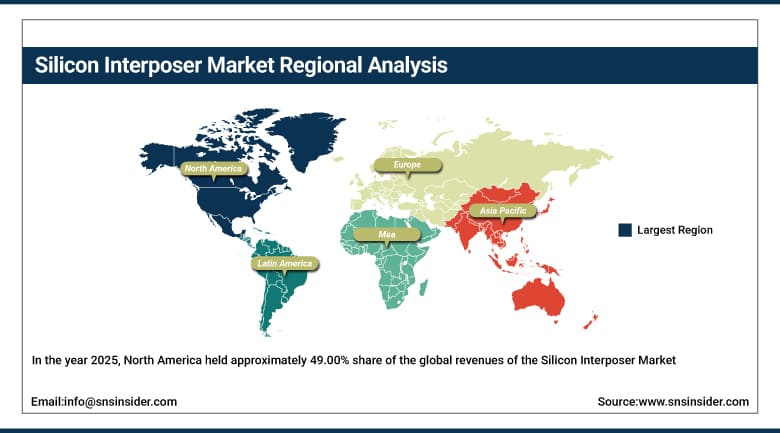
In the year 2025, North America held approximately 49.00% share of the global revenues of the Silicon Interposer Market and it will hold the topmost position during the forecast period. This dominance of North America can be attributed to the presence of major players such as leading semiconductor manufacturers, fabless chip manufacturers, advanced packaging manufacturers, hyper scale cloud service providers, and advanced AI infrastructure providers in the region.
The rise in investment in advanced technologies such as high-performance computing (HPC), artificial intelligence (AI), data centers, defense electronics, and networking devices has been driving the need for silicon interposer solutions. With the commercialization of chiplet processors, AI accelerators, GPUs, and HBM devices, there has been an increase in the deployment of 2.5D and 3D advanced semiconductor packaging technologies. During 2025 and 2026, a number of semiconductor firms from North America invested in advanced packaging technologies by offering advanced silicon interposer solutions for AI accelerators, HPC processors, heterogeneous integration, and HBM-based computing systems.
Get Customized Report as Per Your Business Requirement - Enquiry Now
Europe Silicon Interposer Market Insights
The European region is still seeing an increase in the market growth rate of Silicon Interposer on account of increased investments made in semiconductor fabrication facilities, automotive electronics, automation systems in industry, telecommunication networks, and computing technologies. Countries like Germany, France, the UK, the Netherlands, and Italy have invested in research and advanced packaging to ensure that there is technological competitiveness in their regions. The rise in the number of AI-enabled industrial systems, self-driving vehicles, networking components, and embedded computing systems is leading to the adoption of silicon interposers.
European semiconductor manufacturers are working on heterogeneous integration and chiplets to improve computing efficiency in next-generation electronics systems. Between 2025 and 2026, some European semiconductor manufacturers were conducting research in advanced packaging technology through silicon interposer solutions for use in automotive processors, industrial electronics, networking systems, and high-performance embedded AI systems.
Asia Pacific Silicon Interposer Market Insights
The APAC region is expected to have the highest CAGR of 14.48%, mainly due to the region’s robust ecosystem of semiconductor manufacturing, increased foundry production capacity, rising investments in AI infrastructure and packaging technology, and fast-growing packaging technology. China, Taiwan, South Korea, Japan, and other nations in Asia are still leading the world in terms of semiconductor fabrication, chip packaging, OSAT, and electronic manufacturing, which is why there is high demand for silicon interposers in the region.
The fast-paced development of accelerators for AI, HPC processors, consumer electronics, cloud computing, and networking infrastructure adds further impetus to the regional market growth. Semiconductors self-reliance programs and manufacturing initiatives will drive growth in the region. From 2025 to 2026, several advanced packaging productions in semiconductor foundries and OSAT vendors in the Asia Pacific region have increased the output due to the introduction of next-generation silicon interposer platform for HBM memory, AI processor, and heterogeneous semiconductor architecture.
Middle East & Africa and Latin America Silicon Interposer Market Insights
There is a trend of steady growth in the Middle East & Africa market because of investments in digital infrastructure, telecommunication facilities, and usage of AI technology, smart city programs, and industrial modernization in the UAE, Saudi Arabia, South Africa, and other neighboring nations. Increasing use of high-performance computing systems, coupled with rising investments in cloud infrastructure, is generating new opportunities in the market for advanced packaging solutions for semiconductors. Government-sponsored initiatives to enable digital transformation in the region have helped in making future prospects of the market more robust.
There is an upward trend in the Latin America market because of investments in consumer electronics manufacturing, telecommunication infrastructure, automation of industries, and digital transformation programs in Brazil, Mexico, Argentina, and Chile. Rising use of AI-based computing systems, cloud computing, and networking devices has increased the need for advanced semiconductor packaging solutions. Organizations in the regions of Latin America and Middle East made significant adoption of advanced semiconductor technology for AI computing, networking, cloud infrastructure, and high-performance electronics between 2025 and 2026.
Market Dynamics
Growth Drivers: Increasing use of advanced packaging solutions and chiplets for artificial intelligence (AI) and high-performance computing.
Increased demand for semiconductor packaging technologies in providing higher processing performance, higher bandwidth, lower latency, and greater energy efficiency is one of the important driving forces for the Silicon Interposer market. With the limitations of transistor scaling becoming more pronounced in the current era, semiconductor players have been forced to shift their focus from conventional architectures to chiplet architectures in which several dies get integrated using silicon interposers in order to achieve higher processing performance. This enables the integration of CPUs, GPUs, AI accelerators, FPGAs, and HBM, leading to higher processing performance without increasing the size and power consumption of the chip.
The continued rise in the use of artificial intelligence (AI), high-performance computing (HPC), cloud computing, data center, autonomous vehicle, and networking technology will lead to greater demand for semiconductor packaging technologies. In the year 2025 to 2026, several semiconductor companies introduced new products in the domain of advance packaging technology such as silicon interposer, AI processor, HBM, and heterogeneous computing.
Restraints: The high complexity in manufacturing and high manufacturing cost of advanced silicon interposers.
However, despite all the technological advances that have been achieved recently, the Silicon Interposer market faces some challenges connected with complicated manufacturing, high cost of production, and high production requirements. Advanced silicon interposer production includes highly complicated wafer processing, through-silicon visa (TSV), high precision lithography, micro-bump interconnects, and other advanced technologies requiring large investments. It is difficult to achieve high yields in the manufacturing process when dealing with a number of heterogeneous dies.
Moreover, advanced packaging manufacturing relies heavily on specialized foundries and outsourced semiconductor assembly and testing (OSAT) facilities. As a result, the time of production increases, and there are additional limitations in the supply chain. The high initial investment in the manufacturing process of advanced packaging technologies may discourage small semiconductor companies from implementing them. It is important to continue improving thermal and mechanical reliability and scalability of silicon interposer manufacturing. During 2026, many semiconductor manufacturers increased their investments into advanced packaging automation, wafer level manufacturing, and high density interconnect manufacturing.
Opportunities: Increased use of AI accelerators, high bandwidth memory, and heterogeneous integration technologies.
The fast-growing application of artificial intelligence, cloud computing, hyperscale data centers, autonomous driving and mobility, and next-generation network infrastructure is creating significant growth opportunities for the Silicon Interposer Market. Workloads in AI training and inference require processors that have extremely high bandwidth memory and low latency communication among computing elements. Silicon interposer technology can integrate AI accelerators along with high bandwidth memory (HBM), GPUs, CPUs, and AI-specific custom chips to become the preferred packaging technology for next-generation computing systems.
The rising adoption of the chiplet design provides semiconductor players with scalability, lowers R&D costs, and speeds up innovation in spite of the constraints of monolithic chip designs. In 2025-2026, several semiconductor firms released their next-generation chiplet-based processors on advanced silicon interposer technology equipped with HBM memory and AI accelerators.
Recent Developments
-
2026: Taiwan Semiconductor Manufacturing Company (TSMC) expanded its advanced CoWoS (Chip-on-Wafer-on-Substrate) packaging capacity to address rising demand for silicon interposer-based AI accelerators and high-bandwidth memory integration used in next-generation AI processors.
-
2026: Intel Corporation strengthened its advanced packaging roadmap by expanding EMIB (Embedded Multi-die Interconnect Bridge) and advanced heterogeneous integration technologies for high-performance computing, AI accelerators, and data center processors.
-
2025: Samsung Electronics enhanced its advanced semiconductor packaging portfolio by accelerating development of next-generation 2.5D and 3D packaging technologies supporting AI processors, high-performance memory, and chiplet-based semiconductor architectures.
-
2025: Amkor Technology expanded its advanced packaging capabilities by introducing enhanced silicon interposer manufacturing solutions designed for AI chips, networking processors, high-performance computing systems, and heterogeneous semiconductor integration.
Silicon Interposer Market Key Players are:
-
Taiwan Semiconductor Manufacturing Company (TSMC)
-
Samsung Electronics Co., Ltd.
-
Intel Corporation
-
Advanced Micro Devices, Inc. (AMD)
-
NVIDIA Corporation
-
Broadcom Inc.
-
ASE Technology Holding Co., Ltd.
-
Amkor Technology, Inc.
-
JCET Group Co., Ltd.
-
Powertech Technology Inc. (PTI)
-
Siliconware Precision Industries Co., Ltd. (SPIL)
-
United Microelectronics Corporation (UMC)
-
SK hynix Inc.
-
Micron Technology, Inc.
-
IBM Corporation
-
Qualcomm Technologies, Inc.
-
Marvell Technology, Inc.
-
Cadence Design Systems, Inc.
-
Siemens EDA
-
Fujitsu Limited
Silicon Interposer Market Report Scope:
| Report Attributes | Details |
|---|---|
| Market Size in 2025 | USD 4.00 Billion |
| Market Size by 2035 | USD 14.04 Billion |
| CAGR | CAGR of 13.38% From 2026 to 2035 |
| Base Year | 2025 |
| Forecast Period | 2026-2035 |
| Historical Data | 2022-2024 |
| Report Scope & Coverage | Market Size, Segments Analysis, Competitive Landscape, Regional Analysis, DROC & SWOT Analysis, Forecast Outlook |
| Key Segments | • By Interposer Type (2.5D Silicon Interposer, 3D Silicon Interposer, Active Silicon Interposer, Passive Silicon Interposer) • By Packaging Technology (2.5D Packaging, 3D Packaging, Chiplet Integration, Fan-Out Packaging) • By Application (High Performance Computing (HPC), Artificial Intelligence Accelerators, Networking & Telecom, Consumer Electronics, Others) • By End User (Semiconductor Manufacturers, Foundries & OSATs, Data Center Companies, Consumer Electronics OEMs, Others) |
| Regional Analysis/Coverage | North America (US, Canada), Europe (Germany, UK, France, Italy, Spain, Russia, Poland, Rest of Europe), Asia Pacific (China, India, Japan, South Korea, Australia, ASEAN Countries, Rest of Asia Pacific), Middle East & Africa (UAE, Saudi Arabia, Qatar, South Africa, Rest of Middle East & Africa), Latin America (Brazil, Argentina, Mexico, Colombia, Rest of Latin America). |
| Company Profiles | Taiwan Semiconductor Manufacturing Company (TSMC), Samsung Electronics Co., Ltd., Intel Corporation, Advanced Micro Devices, Inc. (AMD), NVIDIA Corporation, Broadcom Inc., ASE Technology Holding Co., Ltd., Amkor Technology, Inc., JCET Group Co., Ltd., Powertech Technology Inc. (PTI), Siliconware Precision Industries Co., Ltd. (SPIL), United Microelectronics Corporation (UMC), SK hynix Inc., Micron Technology, Inc., IBM Corporation, Qualcomm Technologies, Inc., Marvell Technology, Inc., Cadence Design Systems, Inc., Siemens EDA, Fujitsu Limited |
Frequently Asked Questions
The market is projected to reach USD 14.04 Billion by 2035.
The Silicon Interposer Market was valued at USD 4.00 Billion in 2025.
The market is expected to expand at a CAGR of 13.38% during the forecast period.
North America dominated the global market in 2025 with approximately 49.00% revenue share.
Asia Pacific is projected to register the fastest CAGR of 14.48% during 2026–2035.
