
Single Loop Controller Market Report Scope & Overview:
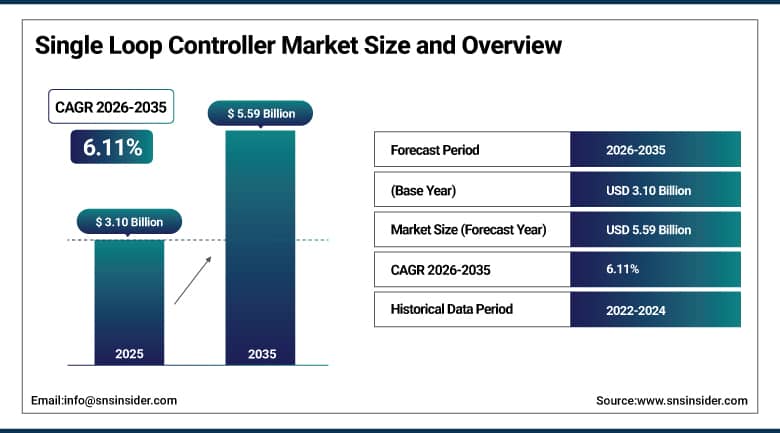
The Single Loop Controller Market was valued at USD 3.10 billion in 2025 and is expected to reach USD 5.59 billion by 2035, growing at a CAGR of 6.11% from 2026–2035.
The single loop controller market is witnessing steady growth in the global market owing to increasing industrial automation adoption. Rising demand for accurate process control across manufacturing industries is supporting market expansion. Manufacturers are focusing on smart controllers with advanced communication capabilities. Growing investments in process optimization and energy efficiency are driving innovation. Increasing deployment across chemical processing, oil and gas, and water treatment facilities is further accelerating market adoption.
As per IFR World Robotics 2025, the global industrial robot installation is at 542,000 units, of which Asia represents 74% of new installations. In addition to that, IEA recorded global improvement in energy efficiency at 1.8% in 2025. As motor drives consume almost 45% of global electricity, the rise in automation and energy efficiency efforts is driving the market for single-loop controllers in the process industry application segment.
To Get More Information On Single Loop Controller Market - Request Free Sample Report
Single Loop Controller Market Trends
-
There has been an increasing trend among industries to substitute traditional controllers with intelligent single loop controllers to increase accuracy, efficiency, and energy efficiency of the processes.
-
Increased usage of industrial internet of things applications has led to intelligent controllers which monitor, diagnose and enable predictive maintenance.
-
There has been an increased integration of communication protocols within single loop controllers to enable easy communication with PLC, SCADA and other industrial automation systems.
-
Increased investments in smart manufacturing plants have been fuelling demand for intelligent process control technologies.
-
With more and more environmental laws being enacted, there has been an increasing tendency among industries to use energy efficient control systems without compromising on the stability of the processes.
-
Increasing upgrades in industrial facilities have also contributed to the growing adoption of automated single loop controllers.
The U.S. Single Loop Controller Market Outlook
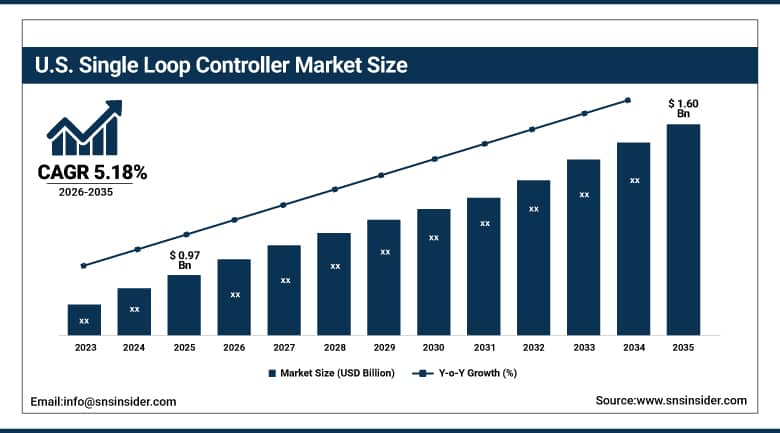
The U.S. Single Loop Controller Market was valued at USD 0.97 billion in 2025 and is expected to reach around USD 1.60 billion by 2035, growing at a CAGR of 5.18% from 2026–2035.
The U.S. single loop controller market is expanding steadily owing to increasing investments in industrial automation and modernization. Strong demand from process manufacturing industries is supporting market growth. Rising focus on operational efficiency and precise process control is driving adoption across industrial facilities. Growing implementation of smart manufacturing technologies is further accelerating demand. Manufacturers are focusing on intelligent controllers with advanced communication and diagnostic capabilities. Increasing deployment across chemical processing, oil and gas, and water treatment plants is strengthening market penetration.
As per the information provided by the U.S. Census Bureau and the Industrial Decarbonization Roadmap of the U.S. Department of Energy, the manufacturing industry utilizes about 24% of the overall energy consumed in the United States. As per data provided by the Bureau of Labor Statistics, there are around 12.9 million workers employed in the manufacturing industry in the United States. As per the report released by the DOE, process heating consumes up to a third of the energy used by industries in their operations. Due to the huge thermal load, there is an extensive use of single loop controllers in the industrial sector.
Single Loop Controller Market Segment Analysis
-
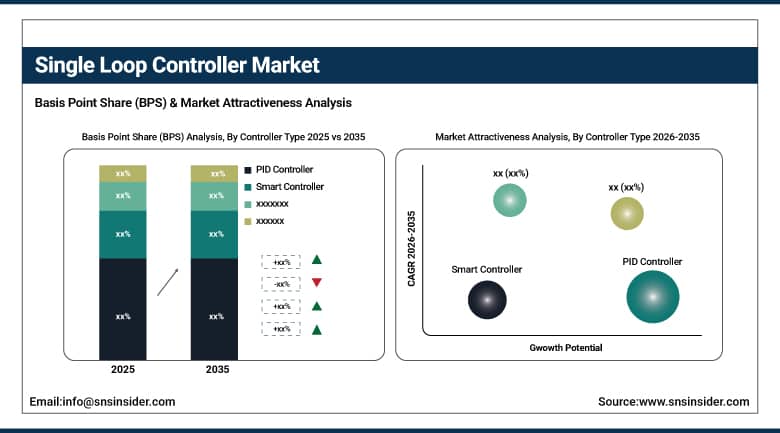
By Controller Type, PID controller dominated the market with 46.85% share in 2025; while smart controller is the fastest growing segment with CAGR of 9.72% during 2026 to 2035.
-
By Installation Type, panel mounted dominated the market with 52.60% share in 2025; while DIN rail mounted is the fastest growing segment with CAGR of 8.39% during 2026 to 2035.
-
By Application, temperature control dominated the market with 38.70% share in 2025; while flow control is the fastest growing segment with CAGR of 8.76% during 2026 to 2035.
-
By End Use Industry, chemical processing dominated the market with 36.40% share in 2025; while water and wastewater treatment is the fastest growing segment with CAGR of 9.64% during 2026 to 2035.
By Controller Type, PID controller dominated the market, while smart controller is the fastest-growing segment.
PID controller segment held the dominated market share among the single loop controller market segments based on type in 2025 owing to the extensive usage of the same in various end-use sectors such as manufacturing industry, chemical processing, food & beverages, and pharmaceuticals. The PID controller offers accurate process control, stability, and economical functioning of the process involving temperature, pressure, and flow. The proven reliability, easy configuration, and compatibility with industrial automation system led to its consistent adoption.
The smart controller segment is anticipated to grow at a faster CAGR during the forecast period. The growing implementation of Industry 4.0 technologies, connected manufacturing, and intelligent process automation in different end-user industries is driving the growth of this market segment. This controller offers remote monitoring, predictive diagnosis, data logging, and industrial internet of things compatibility. Increased spending on digital factory, energy efficient manufacturing, and process optimization is making industries switch from their traditional controllers to smart controllers.
By Installation Type, panel mounted dominated the market, while DIN rail mounted is the fastest-growing segment.
Panel mounted segment was the most dominant in the single loop controller market, accounting for maximum market share in terms of revenue generation in 2025. This segment led due to its wide use in industrial control panels in manufacturing plants. The controllers offer user-friendly features such as easy accessibility to the operator, high visibility of the display, and ease of maintenance during operation. Their ease of integration with existing automation systems, along with reliability, cost-effectiveness, and wide applicability in process industries.
The DIN rail mounted segment is anticipated to register a fastest CAGR between 2026 and 2035. This is on account of the rising use of modular automation systems in modern industrial plants. The controllers offer fast installation, space-saving integration, and scalability in electrical cabinets. Increased investments in smart factories and space-saving automation systems have fueled demand.
By Application, temperature control dominated the market, while flow control is the fastest-growing segment.
The temperature control segment had the dominated revenue share in the single loop controller market in 2025 due to its wide range of applications in chemical processing, food & beverages, pharmaceuticals, plastics, and industrial manufacturing. Precise control of temperature is necessary to ensure product quality, safety, and energy efficiency. Increasing demand for efficient temperature process control, coupled with automation in manufacturing plants, helped increase the adoption of single-loop temperature controllers in various industries.
The flow control segment is likely to experience the fastest CAGR between 2026-2035. Increasing investment in water & wastewater treatment, oil & gas, power generation, and process industries is fueling the demand. There is an increasing need for flow measurement in order to optimize resource use, reduce operating losses, and comply with environmental laws. Increasing adoption of process control systems. Coupled with modernization of industrial processes, is expected to drive the growth of flow control applications.
By End Use Industry, chemical processing dominated the market, while water and wastewater treatment is the fastest-growing segment.
Chemical processing segment has been leading the market for Single Loop Controller with the dominated share of revenue generation in 2025. The reason behind such leadership position is their wide usage in achieving process control in reactors, distillation towers, heat exchangers, and mixing operations. Single Loop Controllers deliver accurate control of temperature, pressure, flow, and level control in the process. The high accuracy, continuous functioning, easy integration with industrial automation systems, and maintenance of product quality with improved efficiency has led to their extensive adoption.
Water & wastewater treatment segment is estimated to have the fastest growth rate from 2026 to 2035. The main reason behind the rapid growth is increased investment in modern treatment plants and environmental regulations around the world. The wide adoption of Single Loop Controllers is because of the monitoring of flow, pressure, chemical dosing, and filtration processes. The increasing need for automation, efficient operations of the treatment plants, and process optimization will boost the adoption rate in the forecasted period.
Regional Analysis
|
Region |
Major Country |
Share within Region, 2025(%) |
|---|---|---|
|
North America |
United States |
84.72% |
|
Europe |
Germany |
24.80% |
|
Asia Pacific |
China |
38.60% |
|
Middle East & Africa |
UAE |
16.20% |
|
Latin America |
Brazil |
43.10% |
North America Single Loop Controller Market Insights.
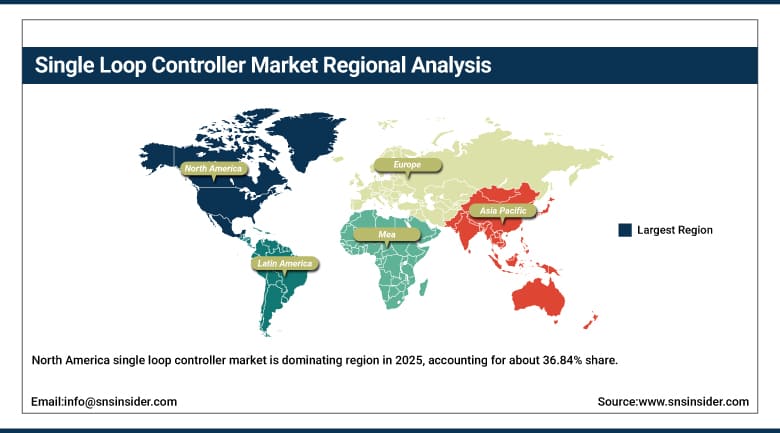
North America single loop controller market is dominating region in 2025, accounting for about 36.84% share, driven by widespread industrial automation adoption across manufacturing industries. The region benefits from advanced process control infrastructure and early technology implementation. Increasing investments in smart factories are significantly strengthening controller deployment. Strong demand from chemical processing, oil and gas, and power industries is accelerating adoption. Continuous focus on operational efficiency and digital industrial transformation further reinforces the region's dominant position in the market.
The U.S. Bureau of Economic Analysis and the U.S. Census Bureau state that the manufacturing industry provides about 10.2% of GDP of the United States by means of more than 346,000 manufacturing plants. The Natural Resources Canada says that the industrial sector uses about 23% of the final energy in Canada. The widespread use of ISA-95 and ISA-88 automation standards leads to increased use of single loop controllers.
Get Customized Report as Per Your Business Requirement - Enquiry Now
Europe Single Loop Controller Market Insights.
Europe single loop controller market is characterized by stable growth in 2025 owing to strong industrial automation adoption and energy efficiency initiatives. Key countries include Germany, France, United Kingdom, and Italy. Rising investments in smart manufacturing technologies are driving controller adoption. Increasing emphasis on process safety and operational reliability is boosting demand. Growth across chemical, pharmaceutical, and food processing industries is further supporting market expansion. Strict industrial efficiency regulations are encouraging innovation in advanced process control technologies.
As per the statistics by the European Commission and Eurostat, the share of manufacturing sector in Gross Value Added in terms of almost 2.2 million enterprises is approximately 15% in the European Union. According to the IFR World Robotics 2025 report, Europe represented 16% of the total number of installations of industrial robots in the world, which totaled 85,000 units.
Asia Pacific Single Loop Controller Market Insights.
Asia Pacific is the fastest growing region in the single loop controller market, registering a CAGR of about 7.38% during 2026–2035. Rapid industrialization and expanding manufacturing investments are driving strong demand across China, India, Japan, South Korea, and Southeast Asia. Increasing automation across production facilities is boosting market growth. Rising investments in chemical processing and water treatment infrastructure are further accelerating adoption. Expansion of electronics and automotive manufacturing hubs is supporting large scale controller deployment.
According to the IFR World Robotics 2025 Report, Asia has led all others in terms of deployment of industrial robots, representing 74% of total worldwide industrial robot deployment. The trend is further emphasized by the China National Bureau of Statistics in that equipment manufacturing grew by 9.2% along with an impressive 28% growth in industrial robot manufacturing. The region-wide expansion in electricity generation and chemical manufacturing according to IEA data is resulting in the deployment of sophisticated single loop control systems.
Middle East & Africa and Latin America Single Loop Controller Market Insights.
The Middle East & Africa along with Latin America regions are witnessing steady growth due to expanding industrial infrastructure and modernization initiatives. Key contributing countries include Brazil, Mexico, UAE, Saudi Arabia, and South Africa. Increasing investments in oil and gas processing facilities are driving controller adoption. Growth in water treatment and food processing industries is further supporting market expansion. Rising industrial automation investments are boosting regional demand for reliable process control solutions.
In accordance with the findings from the IEA World Energy Investment 2025 report, the Middle East represents about 31% of the world’s upstream investments in oil and gas, and Latin America represents about 6% of these investments. Additionally, UNIDO indicates that there is consistent growth in manufacturing within developing countries. The development of industry infrastructure results in an increased use of single-loop controllers.
Market Dynamics
Growth Drivers: Growing emphasis on energy efficiency and process optimization is increasing deployment of advanced control technologies globally.
The sectors are emphasizing energy savings while ensuring consistency in product quality. The single-loop controllers tune process parameters by continuously monitoring them and making necessary automatic adjustments. This helps in increasing the efficiency of machines and saves energy that is not required during manufacturing operations. With growing environmental laws, there is an urge among industries to upgrade their process control systems. The old control devices are being replaced by intelligent controllers in order to improve the performance. Growing investments in sustainable manufacturing technology are enabling market growth.
According to the International Energy Agency, the industrial sector accounts for approximately 37% of global final energy consumption. The United Nations Industrial Development Organization states electric motor-driven systems consume up to 70% of industrial electricity worldwide. Rising adoption of digital infrastructure, advanced control loops, and factory automation is accelerating deployment of single-loop controllers to reduce process variability, improve energy efficiency, and support industrial decarbonization goals.
Restraints: Multifunction automation platforms reduce demand for standalone control systems in advanced industrial environments and applications.
Industrial units have been moving towards distributed control systems and automation platforms in favor of centralized control of their processes. Such systems integrate various process loops by having common control system architectures with advanced analytics capabilities. Single loop controllers become unattractive in the case where more complex automation needs are encountered in production processes. The increased use of IoT platforms in industry adds to the demand for integrated control systems as well. The end users look forward to automation solutions that can grow with their processes in the future.
Opportunities: Rapid smart manufacturing expansion increases demand for intelligent connected industrial process control technologies worldwide.
A major focus on digital manufacturing is being made by manufacturers due to the need to enhance efficiency and transparency of processes. Single-loop controllers that feature communication protocol technology are able to integrate smoothly with industrial automation systems. The ability to monitor in real time facilitates predictive maintenance and helps in quicker decision making at the production facility. The increasing usage of the Industrial Internet of Things platform creates numerous applications. Intelligent control solutions that can enhance productivity and minimize downtime are highly sought after.
In its IFR World Robotics 2025 report, the International Federation of Robotics estimated that 542,000 robots were installed worldwide and Asia accounted for 74%. At the same time, the Organization for Economic Co-operation and Development monitor a fast transition in industry towards the data-driven Industry 4.0 environment. The number of smart manufacturing plants spurs the global use of intelligent single-loop controllers for process regulation.
Recent Developments
-
2026: Siemens expanded its partnership with NVIDIA to build the Industrial AI Operating System for end-to-end industrial value chains.
-
2025: Honeywell completed the strategic acquisition of Sundyne to strengthen its process automation and technology business segment portfolio.
-
2025: ABB restructured its organization by pushing strategic mandates down to the business line level to increase operational transparency.
-
2024: Schneider Electric launched its digital twin software integrations to reduce engineering design time for automated packaging systems.
Single Loop Controller Market Key Players are:
-
Honeywell International Inc.
-
Siemens AG
-
ABB Ltd.
-
Schneider Electric SE
-
Yokogawa Electric Corporation
-
Omron Corporation
-
Emerson Electric Co.
-
Rockwell Automation, Inc.
-
Watlow Electric Manufacturing Company
-
Fuji Electric Co., Ltd.
-
Azbil Corporation
-
Gefran S.p.A.
-
Delta Electronics, Inc.
-
Red Lion Controls, Inc.
-
Mitsubishi Electric Corporation
-
WIKA Alexander Wiegand SE & Co. KG
-
Danaher Corporation
-
Danfoss A/S
-
Keysight Technologies, Inc.
-
National Instruments Corporation
Single Loop Controller Market Report Scope:
| Report Attributes | Details |
|---|---|
| Market Size in 2025 | USD 3.10 Billion |
| Market Size by 2035 | USD 5.59 Billion |
| CAGR | CAGR of 6.11% From 2026 to 2035 |
| Base Year | 2025 |
| Forecast Period | 2026-2035 |
| Historical Data | 2022-2024 |
| Report Scope & Coverage | Market Size, Segments Analysis, Competitive Landscape, Regional Analysis, DROC & SWOT Analysis, Forecast Outlook |
| Key Segments | • By Controller Type (PID Controller, On/Off Controller, Programmable Controller, Smart Controller) • By Installation Type (Panel Mounted, DIN Rail Mounted, Field Mounted) • By Application (Temperature Control, Pressure Control, Flow Control, Level Control) • By End Use Industry (Oil and Gas, Chemical Processing, Water and Wastewater Treatment, Food and Beverage) |
| Regional Analysis/Coverage | North America (US, Canada), Europe (Germany, UK, France, Italy, Spain, Russia, Poland, Rest of Europe), Asia Pacific (China, India, Japan, South Korea, Australia, ASEAN Countries, Rest of Asia Pacific), Middle East & Africa (UAE, Saudi Arabia, Qatar, South Africa, Rest of Middle East & Africa), Latin America (Brazil, Argentina, Mexico, Colombia, Rest of Latin America). |
| Company Profiles | Honeywell International Inc., Siemens AG, ABB Ltd., Schneider Electric SE, Yokogawa Electric Corporation, Omron Corporation, Emerson Electric Co., Rockwell Automation, Inc., Watlow Electric Manufacturing Company, Fuji Electric Co., Ltd., Azbil Corporation, Gefran S.p.A., Delta Electronics, Inc., Red Lion Controls, Inc., Mitsubishi Electric Corporation, WIKA Alexander Wiegand SE & Co. KG, Danaher Corporation, Danfoss A/S, Keysight Technologies, Inc., National Instruments Corporation |

Frequently Asked Questions
The PID Controller dominated the market in 2025 due to precise process control, operational stability, cost-effectiveness, and broad industrial automation adoption.
North America dominated the single loop controller market in 2025.
The major growth factors include industrial automation, process control demand, energy efficiency, smart manufacturing, Industrial IoT integration, and intelligent controllers in processing industries.
