
Spices and Seasonings Market Report Scope & Overview:
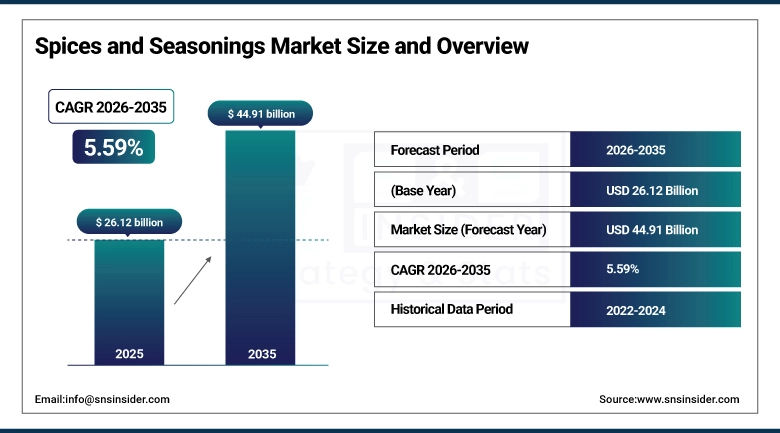
The Spices and Seasonings Market size was valued at USD 26.12 billion in 2025 and is expected to reach USD 44.91 billion by 2035, growing at a CAGR of 5.59% from 2026–2035.
The Spices and Seasonings Market is witnessing robust global growth due to increasing demand for savory ethnic foods, convenience foods, and growing foodservice sectors. Heightened consumer awareness about natural products is aiding the market’s development in both developed and developing countries. Moreover, developments in clean label recipes, organic and non-GMO foods, innovative preservation methods, and tailor-made seasonings are driving market growth. The collaboration between spices producers, food manufacturers, and supermarket chains is improving the consistency and quality of spices and facilitating the standardization of flavors globally.
In 2026, adoption of advanced food processing technologies such as AI-based flavor formulation, automated blending systems, and precision fermentation in seasoning development is expected to rise globally due to increasing consumer preference for healthier, customized, and convenience-oriented food products.
Spices and Seasonings Market and Forecast
-
Market Size in 2025: USD 26.12 Billion
-
Market Size by 2035: USD 44.91 Billion
-
CAGR: 5.59% from 2026 to 2035
-
Base Year: 2025
-
Forecast Period: 2026–2035
-
Historical Data: 2022–2024
To Get more information on Spices and Seasonings Market - Request Free Sample Report
Spices and Seasonings Market Trends
-
Growing demand for clean-label, natural, and chemical-free spices is reshaping product formulations across global food industries, driven by rising health consciousness and safety concerns.
-
Increasing adoption of organic and sustainably sourced spices is strengthening traceability systems and encouraging ethical sourcing practices in major producing regions.
-
Rising popularity of seasoning blends and ready-to-use spice mixes is transforming consumer cooking habits, especially in urban households with preference for convenience foods.
-
Expanding use of functional spices such as turmeric, ginger, garlic, and cinnamon is driving integration of spices into nutraceuticals and immunity-boosting food products.
-
Rapid growth of e-commerce and quick-commerce platforms is enhancing accessibility to premium, regional, and specialty spice products with faster delivery models.
-
Increasing globalization of cuisines is boosting demand for ethnic and fusion flavor profiles, encouraging innovation in multi-regional seasoning formulations.
U.S. Spices and Seasonings Market Size Outlook
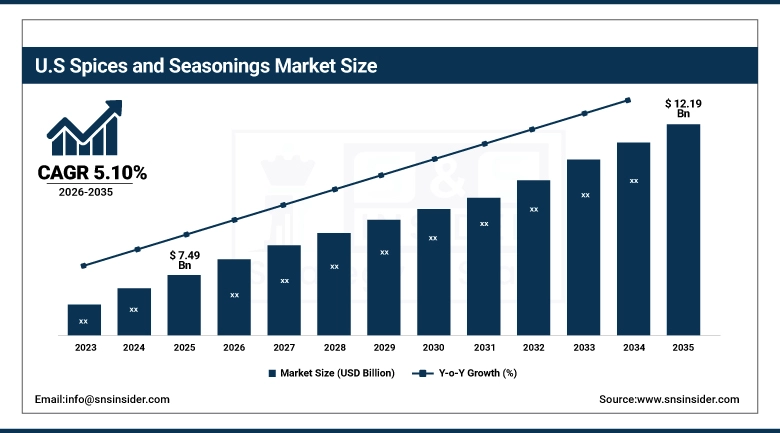
The U.S. Spices and Seasonings Market was valued at USD 7.49 billion in 2025 and is expected to reach around USD 12.19 billion by 2035, growing at a CAGR of 5.10% from 2026–2035.
U.S. Spices and Seasonings Market is considered the biggest and most established market in the world, backed up by the very developed food processing sector, extensive use of packaged foods and convenience foods, and ethnic and international foods. The leading companies like McCormick & Company, Kerry Group, Sensient Technologies, and Ajinomoto consistently improve their product innovations and seasoning ranges.
The U.S. Food and Drug Administration (FDA) has been instrumental in ensuring food safety standards, product labeling, and quality control in imported spices and seasonings. This ensures a high level of consumer satisfaction and consistency.
As per the U.S. Centers for Disease Control and Prevention (CDC), there has been a growing consumer interest in healthy eating habits with a lower consumption of sodium, which is resulting in higher demand for organic and clean-label seasoning products.
Spices and Seasonings Market Segment Analysis
-
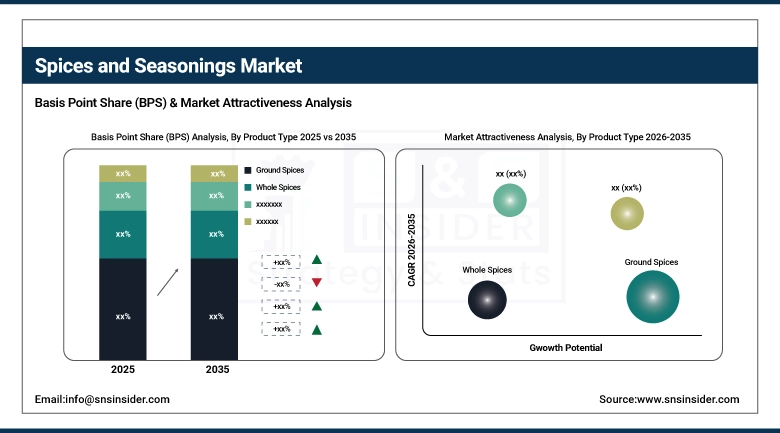
By Product Type, Ground Spices dominated the Spices and Seasonings Market with 33.84% share in 2025; Seasoning Blends fastest growing (CAGR).
-
By Application, Food Industry dominated the Spices and Seasonings Market with 39.68% share in 2025; Food Service fastest growing (CAGR).
-
By Distribution Channel, Supermarkets/Hypermarkets dominated the Spices and Seasonings Market with 44.73% share in 2025; Online Retail fastest growing (CAGR).
-
By Form, Powdered dominated the Spices and Seasonings Market with 41.92% share in 2025; Liquid fastest growing (CAGR).
By Product Type, Ground Spices dominate the Spices and Seasonings Market, while Seasoning Blends are the fastest-growing segment.
Ground spices segment accounted for the largest market share in the Spices and Seasonings Market in 2025 owing to the wide-ranging applications in household food preparation and food processing industry. Ground spices' affordable nature, greater shelf life, and the crucial part played by them in different regional cuisines ensure demand remains high in both developing and developed countries.
Seasoning blends segment is anticipated to experience the fastest CAGR during the forecast period of 2026-2035 owing to increasing preference for ready-to-eat foods in households across the world. Rising urbanization and people leading hectic lives coupled with preference for flavors of other cultures have compelled companies to develop convenient seasonings.
By Application, Food Industry dominates the Spices and Seasonings Market, while Food Service is the fastest-growing segment.
Food Industry segment has held the maximum share of revenues in the Spices and Seasonings Market in 2025 due to the widespread use of spices in processed foods, packaged foods, snacks, sauces, and ready-to-eat foods. The steady growth of large scale food processing and demand for flavoring and preservation purposes contribute to the growth.
Food Services segment is anticipated to witness the maximum Compound Annual Growth Rate (CAGR) between 2026-2035 due to the rapid growth in restaurants, quick service restaurants (QSR), cloud kitchens, and catering services. Increased urbanization and changing food trends are resulting in increased demand for customized seasoning blends and bulk spices consumption.
By Distribution Channel, Supermarkets/Hypermarkets dominate the Spices and Seasonings Market, while Online Retail is the fastest-growing segment.
Supermarkets/Hypermarkets segment had the largest market share in terms of revenues because customers had high preferences for verifying the quality of goods physically, extensive product range, price reductions, and the available infrastructure in the retail stores. In addition, practices of purchasing in bulk and the use of packaged brands also boosted the offline channel's growth.
Online retail channel is anticipated to experience the fastest growth rate during 2026 - 2035 because of increasing trends towards e-commerce, rising smartphone penetration, and convenience-driven consumer trends. Availability of luxury, organic, and regional versions and the option of home delivery through subscriptions is contributing to the growth of the online retail channel.
By Form, Powdered dominates the Spices and Seasonings Market, while Liquid is the fastest-growing segment.
Powdered segment was leading in the global Spices and Seasonings Market owing to the high revenue share held by this form of spices during 2025 owing to its greater shelf-life, easy storage, and wide usage in home-cooking and food processing. This product form provides better cost-effectiveness, uniform distribution of flavoring agents, and high compatibility with packaged food production systems.
Liquid segment is anticipated to exhibit the fastest CAGR between 2026 and 2035, as there is rising demand for seasonings which could be used instantly without any further preparation in food service and processed foods. It provides better mixing efficiency, higher consistency, and fast blending.
Regional Analysis
|
Region |
Major Country |
Share (%) |
|---|---|---|
|
North America |
United States |
82.30% |
|
Europe |
Germany |
31.50% |
|
Asia Pacific |
China |
26.20% |
|
Middle East & Africa |
UAE |
32.00% |
|
Latin America |
Brazil |
55.00% |
North America Spices and Seasonings Market Insights
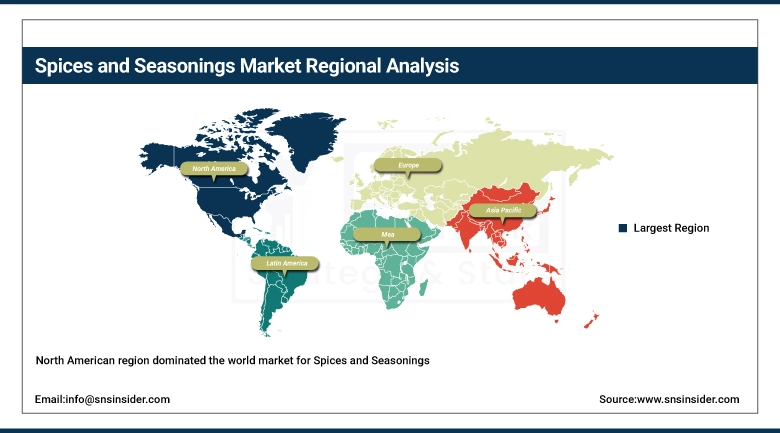
The North American region dominated the world market for Spices and Seasonings with its well-established food processing industry and extensive consumption of ethnic cuisines. The region is blessed with superior retail networks, brand presence of international seasoning companies, and high consumer awareness about clean-label and organic foods. The United States is the top performer within the region with a leading share among all countries of the region with huge demand coming from domestic consumption and foodservice industries.
Further backing this dominance is the FDA, which regulates the food safety and labeling standards for spices and seasonings. There is continuous product development by major players like McCormick & Company, Kerry Group, and Sensient Technologies, who are increasing their seasoning product lines according to health and convenience demands of consumers.
Get Customized Report as per Your Business Requirement - Enquiry Now
Asia Pacific Spices and Seasonings Market Insights
Asia-Pacific Region holds the highest rate of development amongst all other regions across the Global Spices and Seasonings Market through the forecasted period, owing to factors like the presence of rich culinary heritage, rising population, high rate of urbanization, and higher consumption of processed food products. Some of the important countries contributing to growth include China, India, Japan, and nations from Southeast Asia, with China becoming an important contributor owing to its highly developed food processing industry and retail market.
In support of these factors, developments such as government initiatives towards modernizing food safety, along with agricultural industrialization, are aiding spice production and distribution infrastructure. Several Asian markets are witnessing increasing domestic consumption owing to strong production and export capabilities in spices. In Japan and South Korea, the demand for premium quality seasonings, compatible with the changing tastes of people consuming convenience foods, is increasing.
Europe Spices and Seasonings Market Insights
Europe is of great importance in the Spices and Seasonings Market worldwide, due to the increased preference for premium and organic products in the food ingredients market. Germany, the UK, France, and Italy play a vital role in this respect as they consume large amounts of processed foods and bakery products in addition to adopting ethnicity.
Supporting this position, the EFSA (European Food Safety Authority) acts as an important body in setting food safety standards within the continent and ensures the compliance of these foods with respect to their standards. In addition to that, stringent guidelines laid down by the European Union concerning additives has forced manufacturers to concentrate on producing natural spice blends.
The region is also witnessing increasing demand for organic herbs, spice blends, and gourmet seasoning products, driven by health-conscious consumers and the growing popularity of home cooking trends. Expansion of retail chains and private-label brands is further strengthening market penetration across both Western and Eastern Europe.
Middle East & Africa and Latin America Spices and Seasonings Market Insights
The Middle East & Africa regions are observing consistent growth in the Spices and Seasonings Market owing to well-established culinary heritage, urbanization, and increasing consumer preference for ready-to-eat food items. In the Middle East, important countries such as the UAE, Saudi Arabia, and South Africa are driving demand, largely fueled by a large expatriate population and rich regional cuisine traditions.
In Latin America, some significant countries include Brazil and Mexico, where an increasing consumption of spices is being observed due to the expansion of the food service industry and growing preference for convenient food products.
Spices and Seasonings Market Growth Drivers:
-
Expansion of Ethnic Cuisines and Foodservice Industry Fueling Strong Market Consumption
The Globalization of food culture and the rising trend of eating ethnic food are creating a huge rise in demand for spices. People are trying out different tastes from India, Asia, Middle East, and Latin America, which is fueling up spice consumption at households and restaurants. The growing number of hotels, restaurants, catering businesses, and fast food chains is also contributing to increasing consumption. Standardized flavor mixes play a vital role in ensuring quality food across various restaurants. Moreover, tourism and urbanization with multicultural populations are fueling up the quest for flavors by consumers.
In 2026, foodservice operators are increasingly adopting customized and standardized spice formulations to ensure consistency across multiple outlets, supported by growing partnerships with seasoning manufacturers and global food ingredient suppliers.
Spices and Seasonings Market Restraints:
-
Quality Concerns and Adulteration Issues Restricting Growth of Organized Spice Market
Inconsistencies in the quality of the raw materials, along with a lack of any standard procedures adopted in production, are major concerns for the growth of the international industry. The quality of the spices and its inconsistent taste cause loss of consumer confidence in the products. There are many risks associated with spices in the developing markets due to the lack of regulations regarding their safety and purity. They adversely affect the reputation of branded spices and hinder the expansion of premium spices. Furthermore, compliance with food safety guidelines results in higher costs for the exporters.
Spices and Seasonings Market Opportunities:
-
Growth of Organic, Clean-Label, and Functional Spices Creating High Value Expansion Potential
Increasing consumer consciousness towards health, wellness, and natural ingredients is providing excellent prospects for the production of organic and clean-label spices. There is a growing demand for non-GMO, chemical-free, and sustainable spices in the developed world, especially in North America and Europe. Spices such as turmeric, ginger, garlic, and cinnamon that possess functional qualities are becoming popular among food and health supplements. This trend is prompting companies to invest in making premium lines of spices that can add value from the perspective of health benefits. The expansion in organic and sustainable agriculture provides excellent prospects for exports of developing nations.
In 2026, the organic spices market is witnessing robust momentum owing to the development of certified organic farming methods and rising global trade in sustainable spice ingredients.
Recent Developments
-
2026: The McCormick & Company expanded their portfolio of seasonings by introducing clean-label and low-sodium products globally, thus meeting the demands in North America and Europe. Some of the key focuses included flavor innovation and artificial intelligence (AI)-enabled product development.
-
2025: Unilever stepped up efforts to transform its food and seasoning business by incorporating culinary brands like Knorr into its growth strategies. The emphasis was put on instant seasoning mixes and premium culinary offerings in emerging countries.
-
2024: International Flavors & Fragrances (IFF) enhanced its platform for seasoning innovations with additional investments in flavor creation technology and natural ingredients. Improved collaboration with food manufacturers in creating customized seasonings was among IFF’s priorities.
Spices and Seasonings Companies are:
-
Unilever
-
Nestlé
-
Ajinomoto Co., Inc.
-
Kerry Group plc
-
Sensient Technologies Corporation
-
Ariake Japan Co., Ltd.
-
International Flavors & Fragrances (IFF)
-
Givaudan
-
MDH Spices
-
Everest Spices
-
DS Group (Catch)
-
Kikkoman Corporation
-
Haitian Flavoring & Food Co.
-
Zhumadian Wang Shouyi Thirteen Spices Group
-
Anhui Jinhe Industrial
-
Brucefoods
-
Döhler GmbH
-
Fuchs Group
Spices and Seasonings Market Report Scope:
| Report Attributes | Details |
|---|---|
| Market Size in 2025 | USD 26.12 Billion |
| Market Size by 2035 | USD 44.91 Billion |
| CAGR | CAGR of 5.59% From 2026 to 2035 |
| Base Year | 2025 |
| Forecast Period | 2026-2035 |
| Historical Data | 2022-2024 |
| Report Scope & Coverage | Market Size, Segments Analysis, Competitive Landscape, Regional Analysis, DROC & SWOT Analysis, Forecast Outlook |
| Key Segments | • By Product Type (Whole Spices, Ground Spices, Seasoning Blends, Herbs & Salts) • By Application (Food Industry, Food Service, Household, Bakery & Culinary) • By Distribution Channel (Supermarkets/Hypermarkets, Convenience Stores, Specialty Stores, Online Retail) • By Form (Whole, Powdered, Liquid, Paste) |
| Regional Analysis/Coverage | North America (US, Canada), Europe (Germany, UK, France, Italy, Spain, Russia, Poland, Rest of Europe), Asia Pacific (China, India, Japan, South Korea, Australia, ASEAN Countries, Rest of Asia Pacific), Middle East & Africa (UAE, Saudi Arabia, Qatar, South Africa, Rest of Middle East & Africa), Latin America (Brazil, Argentina, Mexico, Colombia, Rest of Latin America). |
| Company Profiles | McCormick & Company, Unilever, Nestlé, Ajinomoto Co., Inc., Kerry Group plc, Olam International, Sensient Technologies Corporation, Ariake Japan Co., Ltd., International Flavors & Fragrances (IFF), Givaudan, MDH Spices, Everest Spices, DS Group (Catch), Kikkoman Corporation, Haitian Flavoring & Food Co., Zhumadian Wang Shouyi Thirteen Spices Group, Anhui Jinhe Industrial, Brucefoods, Döhler GmbH, Fuchs Group. |

Frequently Asked Questions
North America dominated the Spices and Seasonings Market in 2025.
The Ground Spices segment dominated the Spices and Seasonings Market in 2025.
Rising demand for ethnic cuisines, growth of processed and convenience foods, expansion of the foodservice industry, and increasing consumer preference for natural and clean-label ingredients are the major growth drivers.
The Spices and Seasonings Market was valued at USD 26.12 billion in 2025.
The Spices and Seasonings Market is expected to grow at a CAGR of 5.59% from 2026 to 2035.
