
Spray Polyurethane Foam Market Report Scope & Overview:
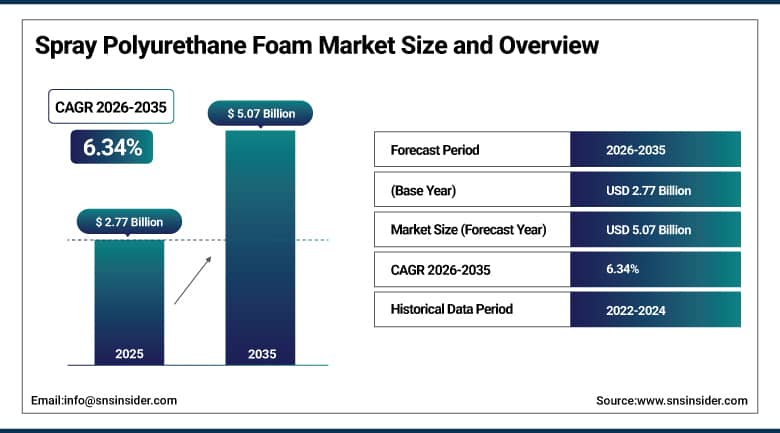
The Spray Polyurethane Foam (SPF) Market is valued at approximately USD 2.77 Billion in 2025 and is projected to reach around USD 5.07 billion by 2035, growing at a CAGR of 6.34% during the forecast period 2026–2035.
According to the Spray Polyurethane Foam (SPF) Market research report analysis, some of the key highlights include the growing use of advanced thermal insulation technology, rising demand for energy-efficient and environmentally friendly building products, and widening applications from residential refurbishments to commercial roofs and industrial insulation systems.
Spray polyurethane foam insulation is being used in billions of square meters per year by 2025, owing to extensive insulation in buildings and widespread adoption in mature construction markets.
Market Size and Forecast:
-
Market Size in 2025: USD 2.77 Billion
-
Market Size by 2035: USD 5.07 Billion
-
CAGR: 6.34 % from 2026 to 2035
-
Base Year: 2025
-
Forecast Period: 2026–2035
-
Historical Data: 2022–2024
To Get More Information On Spray Polyurethane Foam Market - Request Free Sample Report
Spray Polyurethane Foam Market Trends:
-
Rising demand for energy-efficient building envelopes and low-carbon construction materials is driving strong adoption of spray polyurethane foam for superior thermal insulation and air-sealing performance in residential and commercial projects.
-
Expanding use of retrofit insulation and building renovation activities is significantly increasing SPF demand, especially in aging infrastructure markets where energy efficiency upgrades are prioritized.
-
Growing emphasis on green building certifications and net-zero energy targets is accelerating adoption of low-GWP and environmentally compliant spray foam systems across construction sectors.
-
Increasing shift toward high-performance roofing and waterproofing applications is boosting SPF utilization due to its seamless application, durability, and moisture resistance advantages.
-
Advancements in low-emission blowing agents and bio-based polyurethane formulations are improving environmental compliance while maintaining insulation efficiency and structural integrity.
U.S. Spray Polyurethane Foam Market Insights:
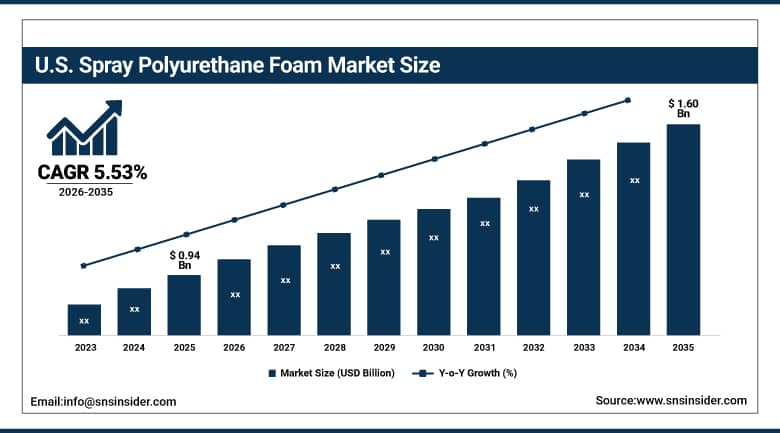
The U.S. Spray Polyurethane Foam (SPF) Market is projected to grow from USD 0.94 Billion in 2025 to around USD 1.60 Billion by 2035, at a CAGR of 5.53%. Growth will be spurred by an increasing demand for energy-efficient insulation solutions, widespread utilization of environmentally friendly building products, rising renovations due to existing stock of aging buildings and structures, and an increased number of high performances roofings and air-sealing installations.
Spray Polyurethane Foam Market Growth Drivers:
-
Rising demand for energy-efficient, airtight, and high-performance insulation systems is driving strong adoption of spray polyurethane foam (SPF) across residential, commercial, and industrial construction sectors.
There is growing importance in minimizing the use of energy in buildings along with better insulation performance, which has become one of the driving factors behind the growth of the SPF market. The trend in construction towards more carbon-efficient and insulated building envelopes has made SPF a favorable choice due to its excellent sealing properties and higher R-value per inch along with thermal bridging elimination compared to conventional insulation materials.
In developed construction markets, over 35% of energy-efficient retrofit insulation projects in 2025 utilized spray polyurethane foam solutions or equivalent high-performance foam systems.
Spray Polyurethane Foam Market Restraints:
-
The relatively high initial cost of spray polyurethane foam (SPF) systems and the need for skilled application expertise act as key restraints limiting wider adoption across price-sensitive construction markets.
One of the reasons behind the slow growth of the market for spray polyurethane foam is the comparatively high initial price of materials compared to traditional methods of insulation including fiberglass and mineral wool, along with the need for specific machinery and qualified operators. Any incorrect execution may affect efficiency, thus increasing the reliance on professional workforce. Apart from that, there are legal issues concerning chemical management, emissions, and fire safety regulations that further complicate the process.
Spray Polyurethane Foam Market Opportunities:
-
Rapid expansion of building energy retrofitting programs and deep-energy renovation initiatives is creating significant growth opportunities for the spray polyurethane foam (SPF) market.
As the world becomes more aware of the need to reduce carbon emissions from existing buildings and increase the energy efficiency of old buildings, there is a surge of investments into insulation improvement projects, in which spray polyurethane foam (SPF) is increasingly preferred owing to its air-sealing capability, improved insulation quality, and enhanced efficiency without structural changes. Governments around the globe are encouraging energy retrofits, carbon emission reduction targets, and zero-net buildings, thus boosting the demand for new insulation products.
In developed nations, over 45% of insulation retrofits in 2025 will employ SPF or other high-performance insulations.
Spray Polyurethane Foam Market Segmentation Analysis:
-
By Application, Residential Construction accounted for the largest share of 38.05% in 2025, while Industrial Insulation is expected to grow at the fastest CAGR of 8.55% during 2026–2035.
-
By Type, Closed-Cell Spray Polyurethane Foam held the largest market share of 48.45% in 2025, while High-Density SPF is expected to grow at the fastest CAGR of 7.39% during 2026–2035.
-
By End-Use Industry, Construction & Infrastructure held the dominant share of 55.15% in 2025, while Automotive & Transportation is expected to grow at the fastest CAGR of 6.45% during 2026–2035.
-
By Raw Material / Component, Polyol Resin accounted for the largest market share of 32.84% in 2025, while MDI (Methylene Diphenyl Diisocyanate) is expected to grow at the fastest CAGR of 7.17% during 2026–2035.
-
By Density, Medium-Density SPF held the largest market share of 40.23% in 2025, while High-Density SPF is expected to grow at the fastest CAGR of 6.34% during 2026–2035.
By Application, Residential Construction Dominates While Industrial Insulation Grows Rapidly:
Residential Construction segment dominated the market owing to the high need for energy-efficient residential construction, insulation of existing buildings, and advanced building enclosure systems. Spray polyurethane foam systems get a boost due to the growing preference for spray foam for walls, roofing, and air sealing purposes.
Industrial Insulation is the fastest-growing segment during the forecast period, primarily due to the increasing need for efficient temperature management, energy conservation, and insulation in industrial applications such as manufacturing plants and cold storages.
By Type, Closed-Cell Spray Polyurethane Foam Dominates While High-Density SPF Grows Rapidly:
Closed-Cell Spray Polyurethane Foam segment dominated the market due to the higher use of this material in insulation applications in residential, commercial, and industrial applications due to its better heat resistance capacity and high R-value, moisture resistance and strength.
High-Density SPF is the fastest-growing segment, High demand for better-performing insulation in construction, industrial and infrastructure applications is propelling the growth of this segment. Increasing awareness about durable and load-bearing insulation materials and their fire-resistant performance is driving the growth of this segment.
By End-Use Industry, Construction & Infrastructure Dominates While Automotive & Transportation Grows Rapidly:
The Construction & Infrastructure segment accounted for the highest share of the market due to the widespread use of spray polyurethane foam in residential, commercial, and mega infrastructure constructions. The market for this segment will be driven by increased construction activities and the need for energy-efficient buildings.
Automotive & Transportation is the fastest-growing segment due to the rising usage of spray foam in the insulating material and thermal management systems of vehicles. The focus of manufacturers on lightweight, efficient, and passenger-friendly vehicles is driving the market.
By Raw Material / Component, MDI (Methylene Diphenyl Diisocyanate) Dominates While Blowing Agents Grow Rapidly:
MDI (Methylene Diphenyl Diisocyanate) was the dominant segment owing to its importance as a key isocyanate ingredient in the composition of spray polyurethane foam. This was attributed to MDI’s high reactivity potential, ability to produce rigid foam structure, and extensive use in SPF systems for insulation purposes.
Blowing agents segment is the fastest growing one owing to the increasing trend towards adopting low emission and eco-friendly insulation systems. Increasing adoption of advanced low-GWP blowing agents along with the rising need for improving foam expansion capabilities and thermal performance is driving the trend towards adoption of sustainable SPF products.
By Density, Medium-Density SPF Dominates While High-Density SPF Grows Rapidly:
Medium-Density SPF segment dominated the market due to its effective performance properties that include thermal insulation, rigidity, and flexibility in application in residential and non-residential constructions. The use of medium-density foam in various constructions proves its prevalence in the market.
High-Density SPF is the fastest-growing segment due to growing demand for highly durable insulating materials for industries, infrastructure, and specialty construction. High requirements for increased strength and reliability of insulation products are fueling the growth of high-density foams.
Spray Polyurethane Foam Market Regional Analysis:
North America Spray Polyurethane Foam Market Insights:
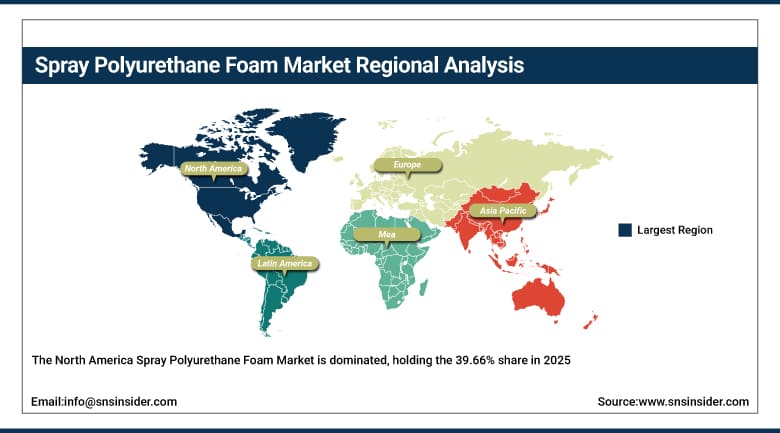
The North America Spray Polyurethane Foam Market is dominated, holding the 39.66% share in 2025, powered by an extremely well-developed construction sector, highly efficient building standards regarding energy consumption, and the extensive use of modern insulation material. The area enjoys high levels of building retrofit initiatives, solid regulatory policies promoting energy conservation, and increasing demand for premium-grade roof insulation and air-sealing. Existence of leading chemical producers, innovative spray techniques, and established contractor networks are some other factors that make this area dominant in the region. Increasing improvements in building energy codes and increasing focus on minimizing building energy consumption are adding to the region’s dominance.
Get Customized Report as Per Your Business Requirement - Enquiry Now
United States Spray Polyurethane Foam Market Insights:
The United States Spray Polyurethane Foam Market is driven by growing demand for building insulation improvement, increasing residential and commercial renovation projects, and growing demand for energy efficiency improvements in aged facilities. Growing demand for superior quality roof and air-sealing systems and wall cavity insulation has played a critical role in boosting the growth of this market.
Asia-Pacific Spray Polyurethane Foam Market Insights:
The Asia-Pacific Spray Polyurethane Foam Market is the fastest-growing region, projected to expand at a CAGR of 7.30% during 2026–2035. This trend is attributed to urbanization, increased construction activities, and the rise in demand for energy-efficient insulation products in emerging economies. Increased investments in infrastructure, escalating residential housing requirements, and the use of innovative construction practices are fueling the application of SPF solutions. The region is undergoing a transition towards sustainable building materials fueled by improved regulations and environmental consciousness.
China Spray Polyurethane Foam Market Insights:
The China Spray Polyurethane Foam Market is experiencing substantial growth driven by the urbanization process, the rapid growth in construction activity, and the emphasis on efficient building systems. The increase in demand for high-end insulation material for new constructions is contributing substantially to market growth. Robust production capacities, the development of local chemical production facilities, and investment in green buildings are other factors fueling the market.
Europe Spray Polyurethane Foam Market Insights:
The Europe Spray Polyurethane Foam market is primarily driven by strict requirements concerning energy efficiency, increased sustainability initiatives, and the well-established building environment with efforts to reduce building emissions. The growing renovation activities along with retrofitting of existing structures, growing demands for highly effective insulating materials, and high penetration of thermal insulation technologies have been positively impacting the growth of the market. Rising investments into green constructions, low-energy building projects, and highly efficient insulations will fuel the market development. Constant government regulations aimed at improving the efficiency of buildings are expected to support further growth.
Germany Spray Polyurethane Foam Market Insights:
Germany plays an important role in the Europe market due to its high engineering skills, high level of building technology, and its focus on building energy efficiency improvement. Growing use of spray polyurethane foam in residential construction renovation, commercial construction, and industrial insulation projects contributes significantly to the growth of the market. High attention to reducing energy consumption related to heating buildings, improving airtightness, and meeting all environmental standards is a positive driver for this sector.
Latin America Spray Polyurethane Foam Market Insights:
The Latin America Spray Polyurethane Foam Market has been growing steadily with the increase in construction activity, demand for insulation at affordable rates, and changing trends towards modern construction techniques. The Latin American countries such as Brazil, Mexico, and Chile have played a key role in this growth with the help of increased residential, commercial, and infrastructural developments. Need for energy-efficient structures in hot climates is encouraging the adoption of spray foam insulation systems. Development in industrial and logistical infrastructure, along with awareness about energy savings, is driving market penetration.
Middle East & Africa Spray Polyurethane Foam Market Insights:
The Middle East & Africa Spray Polyurethane Foam Market has been growing steadily with the development of infrastructure on a large scale, investment in construction, and increasing demand for high-end insulation under extreme climatic conditions. The Middle Eastern countries such as the United Arab Emirates, Saudi Arabia, and South Africa have played a vital role in this growth by means of large construction projects, commercial and industrial infrastructural development.
Spray Polyurethane Foam Market Competitive Landscape:
BASF SE is one of the leading players in the Spray Polyurethane Foam (SPF) Market, with a strong position in polyurethane systems, construction chemicals, and low-emission insulation technologies. The company is widely recognized for its advanced MDI-based formulations and energy-efficient building solutions used across residential, commercial, and industrial applications. Its strengths lie in strong R&D capabilities, integrated chemical value chain, and continuous innovation in sustainable insulation materials. BASF’s focus on low-GWP and high-performance foam systems reinforces its leadership in the SPF market.
-
In February 2025, BASF introduced a new low-GWP two-component polyurethane foam system designed for commercial building insulation, aimed at improving energy efficiency and reducing environmental impact in modern construction applications.
Dow Inc. is a major player in the Spray Polyurethane Foam (SPF) Market, supplying critical raw materials such as polyols and isocyanates used in high-performance insulation systems. The company plays a central role in enabling energy-efficient construction through advanced polyurethane chemistries that improve thermal insulation, air sealing, and durability. Its strong supply chain, innovation in building materials, and focus on sustainable chemistry position it as a key enabler of SPF adoption.
-
In February 2025, Dow advanced its next-generation low-GWP polyurethane insulation systems, focusing on improving energy efficiency while reducing emissions and expanding sustainable building envelope solutions for construction markets.
Huntsman Corporation is a leading participant in the Spray Polyurethane Foam (SPF) Market, specializing in MDI-based polyurethane systems used in insulation, construction, and industrial applications. The company is known for high-performance foam formulations that deliver strong thermal resistance, structural durability, and long-term energy efficiency. Its strengths include advanced chemical engineering capabilities, distribution strength, and strong presence in rigid and spray foam systems. Huntsman continues to focus on sustainable insulation innovations aligned with energy efficiency trends.
-
In April 2025, Huntsman launched a next-generation polyurethane formulation with enhanced fire resistance and improved adhesion performance, targeting cold chain logistics and appliance insulation applications with higher durability and efficiency.
Spray Polyurethane Foam Market Key Players:
Some of The Spray Polyurethane Foam Market Companies are:
-
BASF SE
-
Dow Inc.
-
Huntsman Corporation
-
Covestro AG
-
Bayer AG
-
Johns Manville (Berkshire Hathaway)
-
Icynene-Lapolla (now part of Huntsman)
-
Soprema Group
-
Henry Company (Carlisle Companies)
-
Carlisle Companies Inc.
-
Saint-Gobain
-
Kingspan Group plc
-
BASF Construction Chemicals (Master Builders Solutions)
-
CertainTeed (Saint-Gobain)
-
Gaco Western (Holcim Group)
-
PPG Industries Inc.
-
Sika AG
-
Lapolla Industries
-
NCFI Polyurethanes
-
RMAX Operating LLC
| Report Attributes | Details |
|---|---|
| Market Size in 2025 | USD 2.77 Billion |
| Market Size by 2035 | USD 5.07 Billion |
| CAGR | CAGR of 6.34% From 2026 to 2035 |
| Base Year | 2025 |
| Forecast Period | 2026-2035 |
| Historical Data | 2022-2024 |
| Report Scope & Coverage | Market Size, Segments Analysis, Competitive Landscape, Regional Analysis, DROC & SWOT Analysis, Forecast Outlook |
| Key Segments | • By Type ( Closed-Cell Spray Polyurethane Foam,Open-Cell Spray Polyurethane Foam, High-Density SPF, Low-Density SPF, Others) • By Application (Residential Construction, Commercial Construction, Industrial Insulation, Roofing Systems, HVAC & Air Sealing, Others) • By End-Use Industry (Construction & Infrastructure, Industrial & Manufacturing, Oil & Gas, Automotive & Transportation, Agriculture & Cold Storage, Others) • By Raw Material / Component (Polyol Resin, MDI (Methylene Diphenyl Diisocyanate), Blowing Agents, Additives (Catalysts, Flame Retardants, Surfactants), Others) • By Density ( Medium-Density SPF,Low-Density SPF, High-Density SPF, Others) |
| Regional Analysis/Coverage | North America (US, Canada), Europe (Germany, UK, France, Italy, Spain, Russia, Poland, Rest of Europe), Asia Pacific (China, India, Japan, South Korea, Australia, ASEAN Countries, Rest of Asia Pacific), Middle East & Africa (UAE, Saudi Arabia, Qatar, South Africa, Rest of Middle East & Africa), Latin America (Brazil, Argentina, Mexico, Colombia, Rest of Latin America). |
| Company Profiles | BASF SE, Dow Inc., Huntsman Corporation, Covestro AG, Bayer AG, Johns Manville (Berkshire Hathaway), Icynene-Lapolla (now part of Huntsman), Soprema Group, Henry Company (Carlisle Companies), Carlisle Companies Inc., Saint-Gobain, Kingspan Group plc, BASF Construction Chemicals (Master Builders Solutions), CertainTeed (Saint-Gobain), Gaco Western (Holcim Group), PPG Industries Inc., Sika AG, Lapolla Industries, NCFI Polyurethanes, RMAX Operating LLC |
Frequently Asked Questions
North America dominated with a 39.66% share in 2025, while Asia-Pacific is the fastest-growing region, expected to expand at a CAGR of 7.30% during 2026–2035.
Closed-Cell Spray Polyurethane Foam dominated with a 48.45 % share in 2025, while High-Density SPF Foam are projected to grow at the fastest CAGR of 7.39% during 2026–2035.
Growth is driven by rising demand for energy-efficient insulation systems and expanding building retrofit activities, along with increasing adoption of sustainable, high-performance construction materials that improve thermal efficiency and reduce long-term energy consumption.
The market is valued at USD 2.77 Billion in 2025 and is projected to reach USD 5.07 Billion by 2035.
The Spray Polyurethane Foam Market is projected to grow at a CAGR of 6.34% during 2026–2035.
