
Traction Transformer Market Report Scope & Overview:
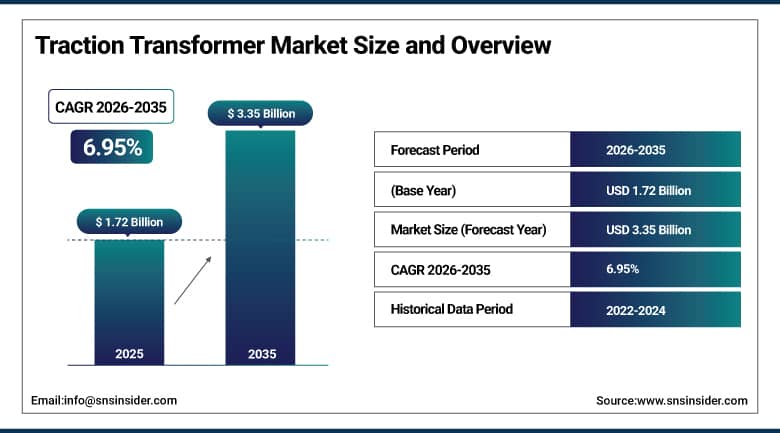
The Traction Transformer Market size was valued at USD 1.72 Billion in 2025 and is expected to reach USD 3.35 Billion by 2035, growing at a CAGR of 6.95% from 2026 to 2035.
The Traction Transformers Market is witnessing a continuous growth due to the electrification of the railways, growth in the number of high speed rail lines and metros, as well as the replacement of the old rolling stocks with efficient traction transformers. Traction transformers are essential components in electric locomotives, metros, trams, and high speed trains for converting high-voltage power from the overhead lines into suitable voltages used in the train. The traction transformer market is witnessing an increased demand as the governments worldwide are making more investments in sustainable and energy-efficient transport systems.
The China State Railway Group and CRRC Corporation are continuously working on electrifying freight corridors and high speed rail lines of China's mid to long term railway network planning scheme, which requires the installation of traction transformers with better thermal efficiency and lower onboard weight.
Market Size and Forecast:
-
Market Size in 2026E: USD 1.84 Billion
-
Market Size by 2035: USD 3.35 Billion
-
CAGR: 6.95% from 2026 to 2035
-
Fastest Growing Region: Europe
-
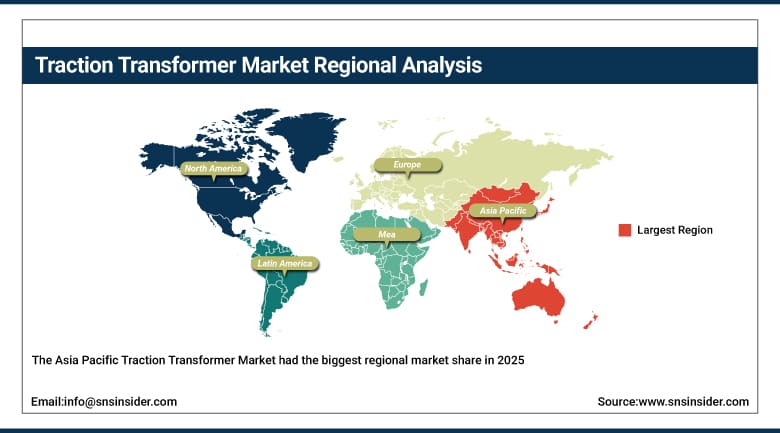
Largest Region: Asia Pacific
To Get More Information On Traction Transformer Market - Request Free Sample Report
Traction Transformer Market Trends:
-
Rising electrification of railway networks and expansion of high-speed rail corridors are increasing demand for compact, energy-efficient traction transformers.
-
Growing investments in metro and urban transit infrastructure across emerging economies are accelerating deployment of onboard and roof-mounted traction transformer systems.
-
Increasing preference for dry-type and cast-resin traction transformers is being driven by stricter fire-safety norms and reduced maintenance requirements in passenger rolling stock.
-
Integration of IoT-enabled condition monitoring and predictive maintenance technologies is helping railway operators reduce transformer downtime and lifecycle costs.
-
Strategic collaborations among transformer manufacturers, rolling stock OEMs, and railway operators are supporting the development of modular, lightweight traction transformer platforms.
U.S. Traction Transformer Market Size Outlook:
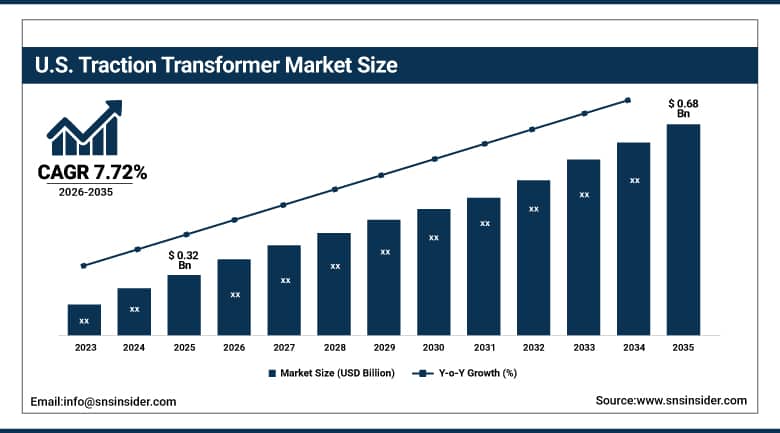
The U.S. Traction Transformer Market held a value of USD 0.32 Billion in 2025 and is projected to reach USD 0.68 Billion by 2035, growing at a CAGR of 7.72% during 2026–2035.
The U.S. Traction Transformer Market is expected to grow steadily due to continuing investments made in the electrification of Amtrak's Northeast Corridor, modernization of freight rail networks, and development of commuter and light-rail networks within key metropolitan areas. Demand for high-efficiency traction transformers is driven by the aging fleet of locomotives within the country and rising government funding as part of rail infrastructure modernization initiatives. Moreover, growing cooperation between manufacturers of rolling stock and transformer companies in the development of light-weight dry-type transformers will fuel growth in the market.
Amtrak in 2026 advanced procurement talks regarding next-generation electric locomotives under its fleet replacement initiative, with suppliers such as Siemens Mobility and Alstom developing traction transformer solutions offering greater thermal efficiency and maintenance intervals on the Northeast Corridor.
Traction Transformer Market Segment Analysis:
-
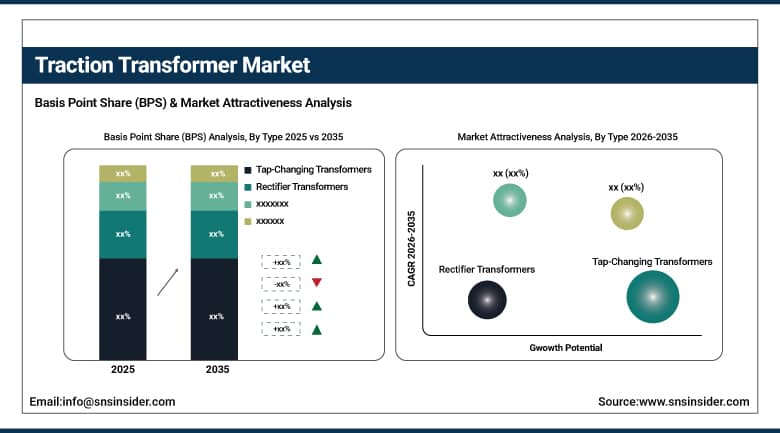
By Type, Tap-Changing Transformers dominated the Traction Transformer Market with a 54.20% share in 2025, while Rectifier Transformers is the fastest-growing type segment with a CAGR of 8.10% from 2026–2035.
-
By Cooling Type, Oil-Cooled Transformers dominated the Traction Transformer Market with a 68.50% share in 2025, while Dry-Type Transformers is the fastest-growing cooling type segment with a CAGR of 8.95% from 2026–2035.
-
By Mounting Position, Underframe-Mounted dominated the Traction Transformer Market with a 56.30% share in 2025, while Roof-Mounted is the fastest-growing mounting position segment with a CAGR of 8.40% from 2026–2035.
-
By Voltage System, AC System dominated the Traction Transformer Market with a 61.70% share in 2025, while Multi-System is the fastest-growing voltage system segment with a CAGR of 8.70% from 2026–2035.
-
By Rolling Stock, Electric Locomotives dominated the Traction Transformer Market with a 58.60% share in 2025, while High-Speed Trains is the fastest-growing rolling stock segment with a CAGR of 8.60% from 2026–2035.
-
By End User, OEMs dominated the Traction Transformer Market with a 71.40% share in 2025, while Aftermarket is the fastest-growing end user segment with a CAGR of 8.30% from 2026–2035.
By Type, Tap-Changing Leads, Rectifier Grows Fastest
Tap-Changing Transformers held the largest share of 54.20% in the market in 2025. Tap-changing transformers find wide-ranging applications across AC-powered railroads due to their capacity to control voltage under different operating conditions, including acceleration and braking modes, where the power requirement changes. These transformers find significant application owing to their reliable performance in high-speed and freight locomotives and are capable of operating within an existing network of overhead lines. Further, manufacturers are focusing on on-load tap changing transformers with improved switching capability and lower arcing, which is expected to fuel the popularity of this segment.
Rectifier Transformers Segment is expected to record the fastest CAGR of 8.10%. Increasing installations of DC-powered metro railways are driving the growth of rectifier transformers, as these are designed to transform AC power into DC output power needed by the traction motors in third rail and low voltage overhead lines used in urban railroads. Additionally, the rapid metro rail investments in Asia Pacific and the Middle East region coupled with the conversion of older DC networks with compact and semiconductor-based rectifiers will drive the adoption of rectifier-based traction transformers in the coming years.
By Cooling, Oil-Cooled Dominates, Dry-Type Accelerates
Oil-Cooled Transformers occupied the largest revenue share of 68.50% in the Traction Transformer Market in 2025. The oil-cooled transformers continue to be favored in high-power locomotive and freight segments, mainly because of their heat dissipation ability, compact structure, and established efficiency in rail applications characterized by constant heavy loads and fluctuations in operating temperatures. Their efficient cost in relation to the energy supplied, along with long-term experience of operation in tough rail conditions and the history of use in freight routes, are ensuring the popularity of oil-cooled transformers among the railway companies and producers of rolling stock.
Dry-Type Transformers are expected to have the highest CAGR of 8.95% throughout the forecast period of 2026-2035. Increasing requirements of fire-safety measures in passenger rolling stock used in metros, trams, and other forms of enclosed transport increase the demand for dry-type and cast resin transformers which do not present the risk of oil leakage and spontaneous combustion in the underground environment. Low maintenance requirements, light weight, and easy disposal at the end of the life cycle of the equipment become additional factors of their growing popularity in the development of new electric multiple units.
By Mounting, Underframe Leads, Roof-Mounted Rises Fast
The Underframe-Mounted segment dominated the Traction Transformer Market with a revenue share of 56.30% in 2025. Underframe mounting remains the standard configuration for high-speed trains and mainline electric locomotives owing to better weight distribution, a lower center of gravity, and improved vehicle stability at higher operating speeds, which is critical for maintaining ride comfort and track adhesion on high-speed corridors. Its widespread use across freight and passenger locomotives, coupled with well-established engineering standards for underframe transformer integration among major rolling stock builders, continues to reinforce this configuration's dominance across new-build and refurbished fleets alike.
The Roof-Mounted segment is expected to grow at the fastest CAGR of 8.40% during the forecast period 2026-2035. Increasing adoption of roof-mounted transformer configurations in metro and light-rail vehicles is being driven by the need to maximize underframe space for propulsion inverters, braking equipment, and auxiliary systems in increasingly space-constrained low-floor transit vehicle designs. Growing metro rail expansion projects across Asia Pacific, along with a rising number of light-rail and tram procurement programs in Europe that favor compact roof-mounted equipment layouts, are expected to support faster growth of this segment through 2035.
By Voltage, AC System Leads, Multi-System Expands Rapidly
AC System accounted for the leading position in the Traction Transformer Market by generating a share of 61.70% in terms of revenue in 2025. The use of AC electrification continues to be the standard choice in new high-speed and mainline rail infrastructure because of reduced transmission losses, fewer substation installations, and compatibility with higher power supply that is required to run trains at high speeds and hauls of heavy cargo. The construction of new electrified rail routes based on AC system along with the replacement of aging DC network in some matured markets will contribute towards the dominance of this segment in the coming years.
Multi-System is likely to experience the highest CAGR of 8.70% in the forecast period 2026-2035. The need to enhance the interoperability among railways having different systems is expected to drive the demand for multi-system traction transformer as these transformers are designed to operate in multiple voltage systems and signals. The development of rail corridors in Europe and Asia Pacific on the lines of Single European Railway Area concept along with the increase in freight traffic between nations will drive the growth of this segment.
By Rolling Stock, Locomotives Lead, High-Speed Trains Surge
The Electric Locomotives segment dominated the Traction Transformer Market with a revenue share of 58.60% in 2025. Electric locomotives, spanning both freight and passenger applications, remain the largest consumers of traction transformers owing to the sheer scale of electrified mainline networks worldwide, the long operating life of freight locomotive fleets, and ongoing replacement programs in mature rail markets seeking improved energy efficiency and reduced lifecycle maintenance costs. Continued freight electrification in North America and Europe, alongside government-backed decarbonization targets for the rail sector, supports sustained segment demand through the coming decade.
The High-Speed Trains segment is expected to register the fastest CAGR of 8.60% during the forecast period 2026-2035. Rapid expansion of high-speed rail networks across China, Europe, and Southeast Asia is driving demand for compact, lightweight traction transformers capable of supporting higher operating speeds, tighter weight budgets, and improved energy efficiency without compromising onboard power reliability. Growing government investments in new high-speed corridors, including several under-construction projects in India and Southeast Asia, are expected to sustain this segment's rapid growth well beyond 2030.
By End User, OEMs Dominate, Aftermarket Grows Fastest
The OEMs segment held a revenue share of 71.40% in the Traction Transformer Market. The OEMs continue to contribute to the majority of traction transformer market demand due to the inclusion of the transformers in the manufacturing process of locomotive, metro, and high-speed trains, where the transformers will be part of the propulsion system. In addition, long-term supply agreements have been established between the transformer manufacturers and the major OEMs of rolling stocks, where the suppliers supply transformers to the manufacturers over several models of locomotives, for a period of several years.
The Aftermarket segment is expected to grow at a CAGR of 8.30% from 2026-2035. Rail fleets in North America and Europe are aging and many have reached or exceeded their intended design service life. As a result, there is a growing need for replacement, refurbishment, and retrofitting of transformers in order to increase the service life of the locomotives at a fraction of their new-build cost. The increasing focus by railways on improving locomotive service life through component replacements and an increasing availability of drop-in replacement transformers is expected to drive the growth of the aftermarket segment over 2035.
Regional Analysis:
Asia Pacific Traction Transformer Market Insights
The Asia Pacific Traction Transformer Market had the biggest regional market share in 2025 due to the fast development of the high-speed rail system, large metro construction projects across various countries in the region, and electrification of freight lines where the traction previously used diesel fuel. The domestic manufacturing capability of the region in terms of rolling stock and transformers, coupled with modernization projects for railways being supported by the governments, helps in maintaining the leading position of the region as well as the forecasted dominance up to 2035.
The major contributor of the Asia Pacific Traction Transformer Market is China because of its rapidly growing high-speed rail system, electrification projects of freight lines according to national railway development plans, and the domestic production by CRRC and TBEA which supplies transformers to both the domestic and international markets. Other countries in the region such as India, Japan, and South Korea are supporting the growth by developing metro rail systems, electrification projects along dedicated freight corridors, and rolling stock modernization projects.
Get Customized Report as Per Your Business Requirement - Enquiry Now
North America Traction Transformer Market Insights
The North America Traction Transformer Market held a significant regional market share in 2025 owing to ongoing freight rail electrification initiatives, modernization of commuter rail networks, and expanding light-rail and metro systems across major metropolitan regions. The region benefits from a well-established rail equipment manufacturing base, a deep bench of engineering and maintenance expertise, and growing federal funding directed toward passenger rail infrastructure upgrades under successive multi-year surface transportation funding programs. Continued collaboration between transformer manufacturers and regional rolling stock builders is further strengthening the domestic supply chain for traction transformer components.
The US was the leading country within the North America Traction Transformer Market in 2025 with a market share of 84.20% of the regional market, driven by Amtrak's Northeast Corridor electrification, commuter rail expansion across California and the Pacific Northwest, and ongoing freight locomotive fleet renewal programs among Class I railroads. Canada is contributing to regional growth through investments in urban transit electrification in Toronto and Montreal, along with cross-border freight corridor upgrades that are gradually extending electrified operation beyond traditional diesel-dominated routes.
Europe Traction Transformer Market Insights
The Europe region was one of the prominent contributors to the Traction Transformer Market in 2025 and is anticipated to hold the fastest regional CAGR in the forecast period. This can be credited to the well-developed and longstanding electrified rail system of the region, along with the efforts being made to develop interoperable cross-border rail corridors within the Single European Railway Area and ambitious carbon reduction targets set out in the European Green Deal favoring rail against roads and air travel for both passengers and freight. The cycles of replacing rolling stocks through national fleet renewal initiatives are contributing to the regional demand as well.
Germany is among the prominent markets in the Europe region because of the widespread electrified rail network in the country, strong presence of rolling stocks manufacturers domestically, and various fleet modernization and digitization initiatives by Deutsche Bahn for regional and long-distance rolling stocks. In addition, other countries such as France, Italy, and Spain are contributing to the market growth through the initiatives taken for expanding high-speed rail networks, improving cross-border interoperability, and extending the lifetime of existing traction transformers.
Middle East & Africa and Latin America Traction Transformer Market Insights
Middle East & Africa and Latin American regions are gradually adopting advanced traction transformer systems as investments increase in metro rail projects, freight corridor electrification, and urban transit infrastructure designed to reduce reliance on road-based transportation. Growing government focus on reducing dependence on fossil-fuel-based transport and lowering transportation-related emissions is opening meaningful avenues for railway electrification and modern traction system deployment in these regions over the coming decade.
Brazil is set to be a prominent Latin American market, driven by metro expansion in major cities such as São Paulo and Rio de Janeiro and freight rail modernization initiatives tied to the country's mining and agricultural export corridors. The Middle East & Africa region has UAE and Saudi Arabia investing in metro rail networks, high-speed rail corridors, and national logistics rail programs as part of broader economic diversification strategies and ambitious smart-city development plans such as NEOM.
Market Dynamics:
Growth Drivers: Rising rail electrification and expansion of high-speed and metro networks driving market growth
The increase in electrification of rail transport networks, expansion of high-speed rail networks, and growth in investments made in urban transit infrastructures are some of the key factors driving the Traction Transformers Market. Traction transformers serve an important purpose in facilitating voltage transformation for locomotives, high-speed trains, and metro rail systems and are essential components in the transition towards efficient energy consumption through electrified rail transport. Railway companies in established and emerging economies are focusing on electrification over diesel traction as part of their efforts towards decarbonization, resulting in increased traction transformers purchase from the market.
The efficiency of traction transformers has been increased significantly by the introduction of technologies that make use of lightweight cores and insulation materials along with dry-type cooling systems in the development of traction transformers. Growing government investments in railway modernization projects along with the focus on lowering carbon emissions from the transportation industry is another factor that is driving the need for advanced traction transformers in various freight, passenger and urban transit segments. Increased rate of replacements due to aging fleets in North America and Europe along with increased demand from Asia-Pacific are supplementing each other to drive the market forward.
Restraints: High raw material costs and long replacement cycles limiting market expansion
High costs of raw materials such as grain-oriented electrical steel and copper are some of the major issues that limit the market. The variability in prices of raw materials that is brought about partly by limited global capacity of GOES production from few nations in the world may influence production and price strategies of transformer manufacturers in the face of global supply chain uncertainties and high freight cost.
Secondly, traction transformers are used over a period of more than two decades, meaning that replacement of the transformers happens very rarely, hence affecting the flow of orders. Another limiting factor to rapid market development is the difficulty in replacing transformers due to the technical nature of requalifying the electrical architecture of the on-board system as well as approval for the modified rolling stock, and shortage of skilled engineers in some regions.
Opportunities: Expansion of emerging rail markets and digital condition-monitoring technologies creating new growth avenues
The ongoing expansion of railway electrification programs across emerging economies in Asia Pacific, Latin America, and the Middle East & Africa is expected to generate substantial opportunities for the Traction Transformer Market. Growing government investments in metro rail networks, high-speed corridors, and freight electrification in these regions, often backed by multilateral development financing and public-private infrastructure partnerships, are anticipated to support strong future demand for both new-build and retrofit traction transformer solutions over the next decade.
The integration of IoT-enabled condition monitoring and predictive maintenance technologies with traction transformers presents a considerable growth opportunity, enabling railway operators to reduce unplanned downtime, optimize maintenance scheduling, and extend equipment service life well beyond conventional replacement intervals. Furthermore, increasing collaboration between transformer manufacturers and rolling stock OEMs to develop modular, lightweight transformer platforms compatible with multiple locomotive architectures is expected to fuel growth throughout the forecast period, particularly as operators seek to standardize components across mixed fleets.
Recent Developments:
-
2025: Alstom delivered 193 newly upgraded ONIX traction transformer units to Italy's high-speed rail network as part of a diesel-to-electric conversion and fleet modernization program for Trenitalia, enhancing energy efficiency and reducing onboard weight across the country's high-speed rolling stock.
-
2025: Siemens Mobility launched its Sitras TT compact dry-type traction transformer platform and secured a contract to equip a European regional operator's Desiro-series electric multiple unit fleet, incorporating cast-resin cooling technology to meet updated EN 45545 fire-safety standards.
-
2026: CRRC Corporation Limited commissioned a new traction transformer production line at its Zhuzhou manufacturing base in China, expanding capacity to support rising domestic demand from new high-speed rail corridors and metro rail expansion projects across the Asia Pacific region.
-
2026: Hitachi Rail partnered with ABB to integrate ABB's Ability condition-monitoring sensors into onboard traction transformers for the Rock Rail-financed EMU fleets in the United Kingdom, enabling predictive maintenance capabilities for metro and commuter rail operators.
Traction Transformer Companies are:
-
ABB Ltd.
-
Mitsubishi Electric Corporation
-
Hitachi Rail (Hitachi, Ltd.)
-
Alstom SA
-
CRRC Corporation Limited
-
TBEA Co., Ltd.
-
Toshiba Corporation
-
General Electric Company
-
Wabtec Corporation
-
China XD Group
-
Wolong Electric Group Co., Ltd.
-
Sunten Electric Equipment Co., Ltd.
-
Bharat Heavy Electricals Limited (BHEL)
-
CG Power and Industrial Solutions Limited
-
Škoda Transportation a.s.
-
Voith GmbH & Co. KGaA
-
EMS-Werke GmbH
-
Actom (Pty) Ltd.
Traction Transformer Market Report Scope:
| Report Attributes | Details |
|---|---|
| Market Size in 2025 | USD 1.72 Billion |
| Market Size by 2035 | USD 3.35 Billion |
| CAGR | CAGR of 6.95% From 2026 to 2035 |
| Base Year | 2025 |
| Forecast Period | 2026-2035 |
| Historical Data | 2022-2024 |
| Report Scope & Coverage | Market Size, Segments Analysis, Competitive Landscape, Regional Analysis, DROC & SWOT Analysis, Forecast Outlook |
| Key Segments | • by Type (Tap-Changing Transformers, Rectifier Transformers) • by Cooling Type (Oil-Cooled Transformers, Dry-Type Transformers) • by Mounting Position (Underframe-Mounted, Roof-Mounted, Machine Room-Mounted) • by Voltage System (AC System, DC System, Multi-System) • by Rolling Stock (Electric Locomotives, High-Speed Trains, Metros, Trams & Light Rail, EMUs) • by End User (OEMs, Aftermarket) |
| Regional Analysis/Coverage | North America (US, Canada, Mexico), Europe (Eastern Europe [Poland, Romania, Hungary, Turkey, Rest of Eastern Europe] Western Europe] Germany, France, UK, Italy, Spain, Netherlands, Switzerland, Austria, Rest of Western Europe]), Asia Pacific (China, India, Japan, South Korea, Vietnam, Singapore, Australia, Rest of Asia Pacific), Middle East & Africa (Middle East [UAE, Egypt, Saudi Arabia, Qatar, Rest of Middle East], Africa [Nigeria, South Africa, Rest of Africa], Latin America (Brazil, Argentina, Colombia, Rest of Latin America) |
| Company Profiles | ABB Ltd., Siemens Mobility, Mitsubishi Electric Corporation, Hitachi Rail (Hitachi, Ltd.), Alstom SA, CRRC Corporation Limited, TBEA Co., Ltd., Toshiba Corporation, Schneider Electric SE, General Electric Company, Wabtec Corporation, China XD Group, Wolong Electric Group Co., Ltd., Sunten Electric Equipment Co., Ltd., Bharat Heavy Electricals Limited (BHEL), CG Power and Industrial Solutions Limited, Škoda Transportation a.s., Voith GmbH & Co. KGaA, EMS-Werke GmbH, Actom (Pty) Ltd. |
Frequently Asked Questions
The Traction Transformer Market is expected to grow at a CAGR of 6.95% from 2026 to 2035.
The Traction Transformer Market was valued at USD 1.72 Billion in 2025.
The market is driven by increasing electrification of railway networks, expansion of high-speed rail and metro infrastructure, rising investments in sustainable public transportation, and growing replacement of aging locomotive fleets.
The Tap-Changing Transformers segment dominated the Traction Transformer Market in 2025, accounting for approximately 54.20% market share.
The Asia Pacific region dominated the Traction Transformer Market in 2025, driven by rapid high-speed rail expansion and metro infrastructure growth.
