
Vascular Injury Treatment Market Report Scope & Overview:
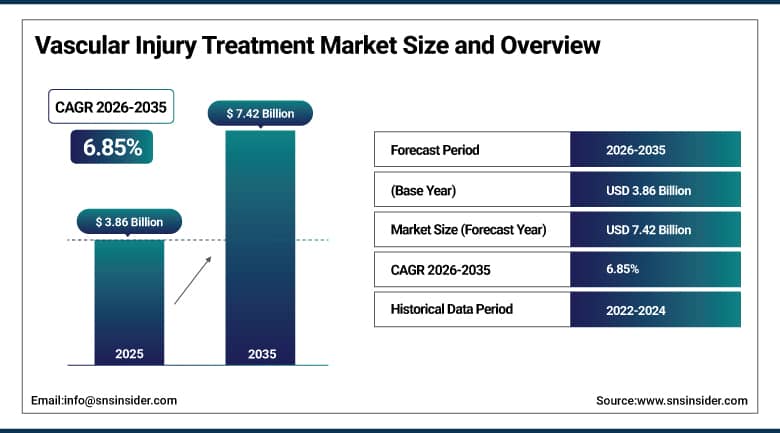
The Vascular Injury Treatment Market was valued at USD 3.86 Billion in 2025 and is expected to reach USD 7.42 Billion by 2035, growing at a CAGR of 6.85% from 2026 to 2035.
The treatment of vascular injury includes the diagnosis and management of arterial and venous trauma resulting from penetrating injuries, blunt-force trauma, complications from medical procedures, and combat injuries. The category of vascular injury treatment covers surgical intervention methods such as bypass surgery, patch angioplasty, and lateral arteriorrhaphy as well as catheter interventions such as thrombectomy and endovascular stent-grafting. Increased road traffic accidents, sports injury cases, and gunshots coupled with trauma center facilities growth and endovascular surgical practices have fueled an increase in the demand for vascular injury treatment devices and surgical options in both advanced and developing healthcare settings.
Medtronic and Teleflex introduced rapid-deployment stent-grafts and catheter-based hemorrhage control devices in 2026 to address the increased demand of trauma centers for quicker and minimally-invasive treatment of vascular injury in light of the growing numbers of road traffic and combat casualties.
To Get More Information On Vascular Injury Treatment Market - Request Free Sample Report
Vascular Injury Treatment Market Trends:
-
Growing adoption of endovascular stent-graft repair over open surgical reconstruction is reducing procedure times and hospital stays.
-
Rising deployment of hybrid trauma operating rooms integrating real-time imaging is improving complex vascular repair precision.
-
Increasing use of bioresorbable and drug-eluting vascular grafts is expanding treatment options for high-risk trauma patients.
-
Expanding combat-casualty care programs are driving demand for portable, rapid-deployment vascular hemorrhage-control devices.
-
Strategic collaborations between device manufacturers and Level I trauma centers are accelerating application-specific repair kits.
U.S. Vascular Injury Treatment Market Outlook:
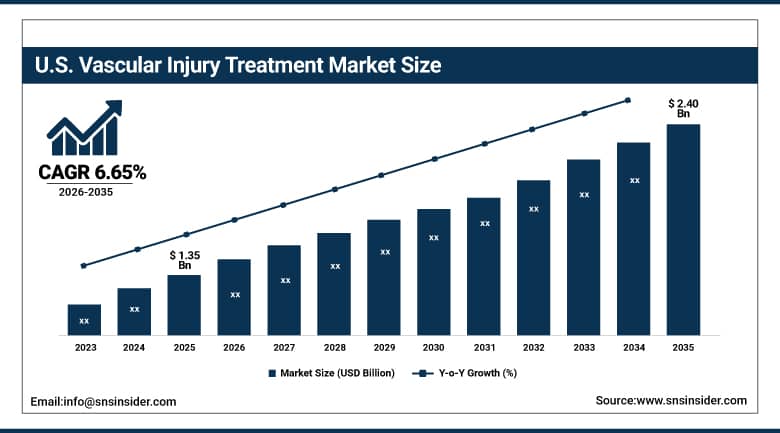
The U.S. Vascular Injury Treatment Market was valued at USD 1.35 Billion in 2025 and is projected to reach USD 2.40 Billion by 2035, growing at a CAGR of 6.65% during 2026-2035.
The most prominent trauma centers and academic medical facilities in the U.S. continue to augment their ability to handle cases involving injuries to blood vessels in light of increasing numbers of patients with vascular injuries caused by penetrating or blunt force trauma. This development is underpinned by solid reimbursement mechanisms and extensive coverage offered by Level I and Level II trauma networks throughout the country. The increasing financial support provided by the government and state authorities in the field of emergency care infrastructure and an increasing number of physicians specializing in vascular and trauma surgery help ensure the availability of advanced treatment methods.
In 2026, Boston Scientific expanded its production capacities in the U.S. for its Mustang balloon angioplasty and stent graft systems.
Vascular Injury Treatment Market Segment Analysis:
-
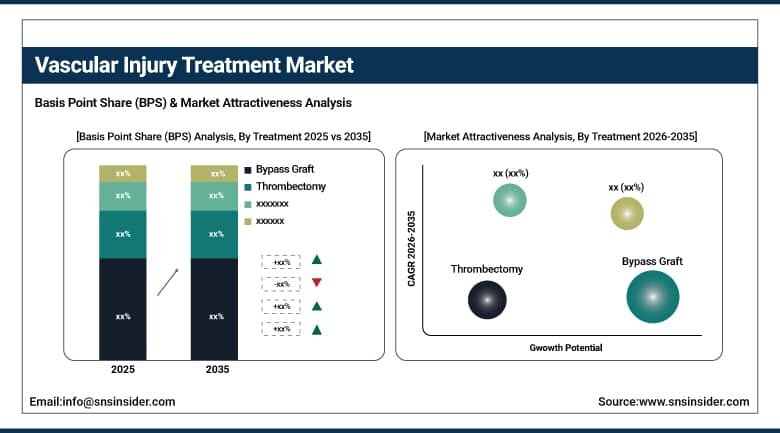
By Treatment, Bypass Graft dominated the Vascular Injury Treatment Market with a 27.60% share in 2025, while Thrombectomy is the fastest-growing treatment segment with a CAGR of 8.40% from 2026-2035.
-
By Injury Type, Thrombosis dominated the Vascular Injury Treatment Market with a 31.20% share in 2025, while Aneurysm & Pseudoaneurysm is the fastest-growing injury segment with a CAGR of 8.60% from 2026-2035.
-
By Product Type, Consumables dominated the Vascular Injury Treatment Market with a 61.40% share in 2025, while Instruments is the fastest-growing product segment with a CAGR of 8.10% from 2026-2035.
-
By End User, Hospitals dominated the Vascular Injury Treatment Market with a 64.50% share in 2025, while Ambulatory Surgical Centers is the fastest-growing end-user segment with a CAGR of 8.90% from 2026-2035.
By Treatment, Bypass Graft Led the Market While Thrombectomy Was the Fastest-Growing Segment.
The Bypass Graft category has been leading the market of Vascular Injury Treatment in terms of contribution to the market in revenue shares in 2025, with 27.60%. In cases where vessel repair is not possible due to extensive tissue loss, contamination, or segmental arterial injury following high-velocity penetrating or blast injuries, the procedure of bypass grafting still remains the most preferred surgical treatment option for severe vascular injury. Surgeons tend to opt for autologous vein grafts and synthetic conduits owing to their good patency rates for many years in major limb and torso trauma surgery due to clinical data accumulated over many years of use.
The Thrombectomy segment will have the fastest growth, at a rate of 8.40% between 2026 and 2035. Traumatic arterial and venous thrombosis, which is prevalent in cases of blunt trauma, has led to an increase in demand for efficient thrombectomy technologies to help remove clots to allow blood flow before tissue is irreversibly damaged. With the advent of thrombectomy technologies such as catheter aspiration and stent retriever thrombectomy, there has been a reduction in the use of open surgery thrombectomy procedures as well as shorter procedural times and improved outcomes of limb salvage in patients with acute traumatic thrombosis.
By Injury Type, Thrombosis Dominated While Aneurysm & Pseudoaneurysm Recorded the Fastest Growth.
The Thrombosis product segment dominated the Vascular Injury Treatment Market in 2025, holding a revenue market share of 31.20%. Thrombosis continues to be the most prevalent complication of vascular injury occurring due to blunt trauma, long-term compression of blood vessels, or late identification of hidden arterial or venous injuries following major accidents or sports injuries. Frequent incidence of the condition in emergency department patients and availability of proven diagnostic procedures such as duplex ultrasonography and CT angiography help maintain its position as one of the focal points of trauma care management programs.
The Aneurysm & Pseudoaneurysm product segment is expected to witness the highest CAGR of 8.60% during the forecast period 2026–2035. Increasing incidence of iatrogenic pseudoaneurysm formation following catheterization procedures and delayed aneurysmal complications after blunt or penetrating vascular injuries are driving the demand for focused solutions for endovascular repairs. More widespread use of ultrasound-guided thrombin injection and covered stent grafting as a less invasive alternative to open surgical repairs improves patient results and reduces the length of hospital stay and recovery periods.
By Product Type, Consumables Led the Market While Instruments Registered the Fastest Growth.
The Consumables segment had a market share of 61.40% in the year 2025. The consumable items include vascular grafts, patches, sutures, catheters, and hemostatic agents that have dominated the market due to their one-time use, making patients purchase them repeatedly in various vascular injury treatments around the world. Hospitals and trauma centers need an uninterrupted supply of these sterile grafts and closure tools to be able to handle unpredictable and changing trauma workloads. The Instruments segment has the highest CAGR between 2026 to 2035 of 8.10%.
The growth is attributed to the increased investments in the latest vascular treatment technology, such as endovascular platforms, robotic-assisted surgical devices, and high-resolution intraoperative imaging machines. The growing preference by hospitals for reusable, precision-made instruments for both minimally invasive and open vascular treatment procedures has triggered their equipment updates.
By End User, Hospitals Dominated While Ambulatory Surgical Centers Recorded the Fastest Growth.
For its part, the Hospitals segment retained the dominant share of 64.50% in terms of revenues in 2025. Hospitals, particularly those functioning as level I or level II trauma centers, are likely to remain the primary sites of care in the case of vascular injury patients due to their round-the-clock capacity to perform surgery and have access to multidisciplinary trauma teams as well as to advanced imaging and interventional radiology suites necessary for conducting complex vascular repair operations. The time-sensitive nature of vascular injuries necessitates immediate hospital-based care. Investments made by leading providers of this type in such features as trauma bays, hybrid operating theaters, and 24/7 vascular surgery coverage ensure the dominance of the segment on the market.
Moreover, the Ambulatory Surgical Centers segment demonstrates the highest projected compound annual growth rate of 8.90% in 2026–2035. The growing number of elective as well as relatively less severe vascular repair cases such as pseudoaneurysm closures and patch angioplasties are shifting toward ambulatory facilities providing a cheaper and faster option than hospitalization. The growing acceptance of the insurance community for vascular interventions performed at an ambulatory level as well as increased portability of imaging systems and repair kits appropriate for use in ambulatory environments enable centers to take up a growing range of vascular injury cases.
Regional Analysis:
|
Region |
Major Country |
Share within Region, 2025 (%) |
|---|---|---|
|
North America |
United States |
83.60% |
|
Europe |
Germany |
24.80% |
|
Asia Pacific |
China |
38.60% |
|
Middle East & Africa |
UAE |
26.40% |
|
Latin America |
Brazil |
39.20% |
North America Vascular Injury Treatment Market Insights
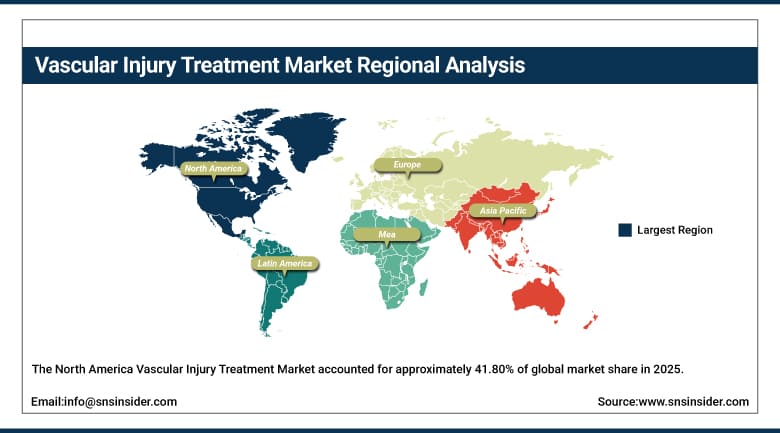
The North America Vascular Injury Treatment Market accounted for approximately 41.80% of global market share in 2025, driven by the region's extensive Level I trauma-center network, high per-capita incidence of road-traffic and firearm-related vascular injuries, and well-established reimbursement frameworks supporting both surgical and endovascular repair procedures. Strong presence of leading vascular device manufacturers headquartered in the region, combined with early adoption of advanced stent-graft and thrombectomy technologies, continues to reinforce North America's leadership position. The region's advanced emergency medical response infrastructure, including rapid air and ground trauma-transport systems, ensures timely patient access to specialized vascular repair facilities across both urban and rural care settings.
United States occupied an overwhelming position in the North America Vascular Injury Treatment Market in 2025, occupying 83.60% of the total regional market share. This domination arises owing to the high density of specialized trauma centers in the country, along with increased surgical procedure volumes and wide-scale application of advanced technology for vascular injuries. In addition, Canada is adding momentum to regional growth due to higher investment in trauma care and increased application of minimally-invasive techniques in the repair of vascular injuries in major hospitals in urban settings. The collaborative efforts between US-based medical devices suppliers and US-based academic trauma centers regarding next-generation technologies are expected to drive their competitive standing.
Get Customized Report as Per Your Business Requirement - Enquiry Now
Europe Vascular Injury Treatment Market Insights
Europe region has emerged as one of the important factors behind the growth of the Vascular Injury Treatment Market during 2025, due to the presence of effective trauma network at the national level, standardization of emergency response system and substantial government investments in infrastructure for vascular surgeries in developed nations. Road traffic accident incidences in some eastern Europe countries, as well as growing adoption of endovascular procedures in western Europe hospital setup have ensured that there is steady demand from this region for treatments of surgical and catheter-based vascular injuries. The harmonization process of medical devices regulations within European Union countries will ensure faster penetration of new vascular injury repair technology by regional as well as foreign companies.
Germany has been identified as an important European country because of its well developed trauma care network, high domestic manufacturing capacity of medical devices and the use of minimally invasive vascular injury repair in leading university hospitals. Countries like UK, France and Italy, which have good network of trauma centers and growing endovascular surgery program are contributing to the growth of the regional market. Further investments in specialized training programs for vascular trauma in European medical institutions will help in driving the regional market during the forecast period.
Asia Pacific Vascular Injury Treatment Market Insights
The Asia Pacific Vascular Injury Treatment Market is expected to witness the fastest growth rate during the forecast period 2026-2035, registering a CAGR of 8.72%. Rapidly rising road-traffic accident volumes, expanding industrial and construction-related trauma incidence, and growing government investment in emergency trauma-care infrastructure across the region's major and emerging economies are driving strong demand for both surgical and endovascular vascular injury treatment solutions. Increasing establishment of dedicated trauma centers and Level I equivalent facilities across major metropolitan areas, supported by rising healthcare expenditure and expanding insurance coverage, is significantly improving patient access to timely, advanced vascular repair interventions across the region.
China is one of the main growth drivers in the Asia Pacific Vascular Injury Treatment Market, owing to its large trauma-patient population, expanding domestic medical device manufacturing capability, and growing adoption of advanced endovascular repair techniques across major hospital systems. India and Japan, both witnessing rising trauma-center investment and growing vascular surgeon training pipelines, are also contributing to regional growth through expanding surgical capacity and increasing adoption of minimally invasive treatment approaches across public and private healthcare networks.
Middle East & Africa and Latin America Vascular Injury Treatment Market Insights
Middle East & Africa and Latin American regions are gradually expanding vascular injury treatment adoption as trauma-care infrastructure investment grows across both regions, supported by rising government focus on emergency medical response capacity and growing establishment of specialized trauma and vascular surgery centers. Increasing incidence of road-traffic and industrial trauma across rapidly urbanizing markets in both regions continues to drive demand for both surgical and endovascular vascular repair solutions, while growing medical tourism activity is supporting adoption of advanced treatment technologies in select regional hub markets.
Brazil is set to be a prominent Latin American market, fueled by its extensive trauma-patient population and growing investment in specialized vascular surgery infrastructure across major metropolitan hospital networks. The Middle East & Africa region has the UAE and Saudi Arabia investing heavily in advanced trauma-care facilities and medical tourism infrastructure, gradually increasing demand for vascular injury treatment technologies across their expanding hospital networks and specialty surgical centers.
Market Dynamics:
Growth Drivers: Rising trauma incidence and expanding minimally invasive repair adoption driving market growth
The rise in occurrence of traffic accidents, firearm injuries, sports injuries, and combat injuries, as well as the rising application of minimally invasive endovascular repair techniques is a key factor driving the global market for treatment of vascular injuries. Injuries to the vascular system comprise a large number of trauma patients and the increasing development of trauma centers is facilitating diagnosis as well as efficient surgeries and endovascular procedures in advanced as well as developing healthcare environments.
Improvements in stent grafts technology, bioabsorbable vascular scaffolds, and catheter based thrombectomy devices have made the procedures more effective, with modern developments leading to shorter procedure time and lower postoperative complications in advanced trauma centers. The increasing adoption of hybrid operating rooms having both surgery as well as interventional radiology facilities, increased reimbursements for endovascular trauma procedures, and continued efforts by medical device vendors on research and development of trauma specific products are also contributing to the market growth.
Restraints: High treatment costs and shortage of skilled trauma surgeons limiting market expansion
One of the most critical obstacles to market growth is the high cost associated with advanced vascular injury treatment, particularly complex endovascular repair procedures requiring specialized stent-graft and thrombectomy devices. Hospitalization costs for severe vascular trauma cases substantially exceed those of standard trauma admissions due to extended intensive-care stays, multiple imaging studies, and the need for highly specialized surgical teams, creating significant financial barriers for both patients and healthcare systems in cost-constrained markets. This cost burden is particularly pronounced in emerging economies, where limited insurance coverage and constrained public healthcare budgets restrict access to advanced treatment technologies, slowing broader market penetration despite rising trauma-case volumes across these regions.
In addition, there is an ongoing shortage of vascular and trauma surgeons that are well trained, particularly in underdeveloped and rural areas, which has continued to hinder access to vascular injury treatments in many markets around the world. The complexity involved in the current state-of-the-art endovascular and reconstructive vascular surgeries requires significant training, and the limited number of skilled surgeons makes it difficult for hospitals to scale up their trauma care capabilities. Moreover, the rigorous approval process and lengthy clinical trials necessary for vascular grafts and trauma-specific devices require significant R&D investment by manufacturers.
Opportunities: Expansion of hybrid trauma care and emerging-market infrastructure investment creating new growth avenues
With the increased use of hybrid ORs that combine surgery and interventional radiology skills, along with increased funding for bioresorbable and drug-eluting vascular grafts as well as government funding for trauma-care facilities in emerging markets, Vascular Injury Treatment Market will witness tremendous growth in the upcoming years. There are going to be a lot of opportunities for the market players due to the rising demand for application-specific vascular repair kits designed for combat casualty care, disaster management and remote or resource-limited trauma situations.
The opportunity for the development of next-generation antimicrobial and bioresorbable vascular graft materials that reduce infections as well as the necessity of repeated intervention while providing improved patency outcomes is enormous. Trauma centers and vascular surgery facilities are going to expand in Asia Pacific and Latin American markets due to increased funding in healthcare and increased interest of governments in the expansion of their emergency care facilities. Collaboration between device companies and academic and military medical institutions in developing new generation trauma repair solutions is expected to contribute to innovations and growth of the addressable market.
Recent Developments:
-
2025: Medtronic launched an enhanced iteration of its Endurant stent-graft platform, engineered for rapid deployment in penetrating and blunt traumatic vascular injuries within emergency and trauma surgery settings.
-
2025: Teleflex introduced a QuikClot-integrated junctional hemorrhage-control catheter system, designed to improve rapid bleeding control for extremity and junctional vascular trauma cases in pre-hospital and emergency settings.
-
2026: Boston Scientific expanded its peripheral vascular portfolio with an enhanced version of its Mustang balloon angioplasty catheter, tailored for traumatic arterial injury repair in narrow or distorted vasculature.
-
2026: Inari Medical received expanded regulatory clearance for its ClotTriever mechanical thrombectomy system to cover acute traumatic vascular thrombosis indications, broadening its use across trauma-center emergency departments.
-
2026: LeMaitre Vascular unveiled an enhanced XenoSure biologic vascular patch designed to reduce infection risk and reintervention rates in penetrating and blast-related arterial repair procedures.
Vascular Injury Treatment Market Key Players are:
-
Terumo Corporation
-
Cook Medical
-
Teleflex Incorporated
-
BD (Becton, Dickinson and Company)
-
Cardinal Health, Inc.
-
W. L. Gore & Associates, Inc.
-
Getinge AB
-
LeMaitre Vascular, Inc.
-
Penumbra, Inc.
-
Stryker Corporation
-
Inari Medical, Inc.
-
Solventum Corporation
-
B. Braun Melsungen AG
-
Baxter International Inc.
-
Merit Medical Systems, Inc.
-
Integra LifeSciences Holdings Corporation
-
Artivion, Inc.
Vascular Injury Treatment Market Report Scope:
| Report Attributes | Details |
|---|---|
| Market Size in 2025 | USD 3.86 Billion |
| Market Size by 2035 | USD 7.42 Billion |
| CAGR | CAGR of 6.85% From 2026 to 2035 |
| Base Year | 2025 |
| Forecast Period | 2026-2035 |
| Historical Data | 2022-2024 |
| Report Scope & Coverage | Market Size, Segments Analysis, Competitive Landscape, Regional Analysis, DROC & SWOT Analysis, Forecast Outlook |
| Key Segments | • By Treatment (Bypass Graft, Patch Angioplasty, Lateral Arteriorrhaphy/Venorrhaphy, Thrombectomy, Extraanatomic Bypass, Others) • By Injury Type (Thrombosis, Laceration/Transection, Contusion/Intimal Flap, Aneurysm & Pseudoaneurysm, Arteriovenous (AV) Fistula, Spasm, Others) • By Product Type (Consumables, Instruments) • By End User (Hospitals, Ambulatory Surgical Centers, Others) |
| Regional Analysis/Coverage | North America (US, Canada), Europe (Germany, UK, France, Italy, Spain, Russia, Poland, Rest of Europe), Asia Pacific (China, India, Japan, South Korea, Australia, ASEAN Countries, Rest of Asia Pacific), Middle East & Africa (UAE, Saudi Arabia, Qatar, South Africa, Rest of Middle East & Africa), Latin America (Brazil, Argentina, Mexico, Colombia, Rest of Latin America). |
| Company Profiles | Medtronic plc, Abbott Laboratories, Boston Scientific Corporation, Terumo Corporation, Cook Medical, Teleflex Incorporated, BD (Becton, Dickinson and Company), Cardinal Health, Inc., W. L. Gore & Associates, Inc., Getinge AB, LeMaitre Vascular, Inc., Penumbra, Inc., Stryker Corporation, Inari Medical, Inc., Solventum Corporation, B. Braun Melsungen AG, Baxter International Inc., Merit Medical Systems, Inc., Integra LifeSciences Holdings Corporation, Artivion, Inc. |

Frequently Asked Questions
Key players in the Vascular Injury Treatment Market include Medtronic plc, Abbott Laboratories, Boston Scientific Corporation, Terumo Corporation, Cook Medical, and Teleflex Incorporated, among others.
Key opportunities in the Vascular Injury Treatment Market include expansion of hybrid trauma care, emerging-market trauma infrastructure investment, and development of next-generation antimicrobial and bioresorbable vascular grafts.
The market is driven by rising incidence of road-traffic accidents, firearm-related injuries, sports trauma, and combat-related casualties, along with growing adoption of minimally invasive endovascular repair techniques.
The Bypass Graft segment dominated the Vascular Injury Treatment Market, accounting for approximately 27.60% market share in 2025.
The North America region dominated the Vascular Injury Treatment Market in 2025 with a 41.80% share, driven by an extensive trauma-center network, high vascular trauma incidence, and strong adoption of advanced vascular repair technologies.
