
Veterinary 3D Printing Market Report Scope & Overview:
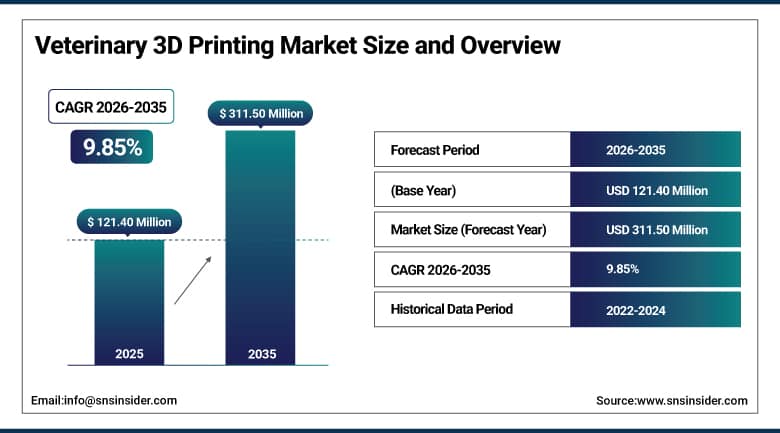
The Veterinary 3D Printing Market was valued at USD 121.40 Million in 2025 and is expected to reach USD 311.50 Million by 2035, growing at a CAGR of 9.85% from 2026 to 2035.
There is constant and steady growth of the Veterinary 3D Printing Market due to increasing adoption of additive manufacturing across companion-animal orthopedic care, rising R&D investment among veterinary teaching hospitals, and continuous refinement of biocompatible metal and polymer printing platforms that shorten surgical planning cycles. Veterinary 3D printing enables clinicians to convert CT and MRI datasets into patient-specific implants, prosthetics, orthotic devices, and anatomical training models, replacing generic off-the-shelf hardware with anatomically matched solutions that improve fit, reduce operating time, and support faster post-operative recovery across dogs, cats, horses, and a growing range of exotic and wildlife species.
In addition, the development of the market is further facilitated by rising pet ownership and veterinary healthcare spending in developed economies, growing incidence of orthopedic trauma and congenital limb deformities in companion animals, and expanding use of 3D-printed surgical guides that allow veterinary surgeons to pre-plan complex procedures before entering the operating theatre. Academic veterinary institutions are increasingly integrating 3D-printed anatomical models into surgical training curricula, reducing dependence on live-animal practice while improving student proficiency, and this educational adoption is running parallel to a steady rise in specialized start-ups offering species-specific implants for horses, birds, and other non-companion animals.
⮞June 2025: WIMBA introduced WIMBA Orthotics Pro, a new generation of custom veterinary orthotic devices designed to provide multiplanar support for pets with moderate to severe orthopedic conditions. The launch reflects continued product innovation in digitally manufactured, patient-specific mobility solutions.
To Get More Information On Veterinary 3D Printing Market - Request Free Sample Report
Veterinary 3D Printing Market Trends:
-
Rising use of 3D-printed surgical guides is improving orthopedic procedure precision in veterinary hospitals.
-
Growing adoption of anatomical training models is reducing veterinary schools' reliance on live-animal surgical practice.
-
Expanding titanium and polymer implant portfolios are strengthening custom prosthetic adoption in companion animals.
-
Broader use of 3D printing beyond dogs and cats is extending demand to horses, birds, and exotic species.
-
Strategic partnerships between orthopedic device makers and veterinary hospital networks are accelerating implant commercialization.
U.S. Veterinary 3D Printing Market Outlook:
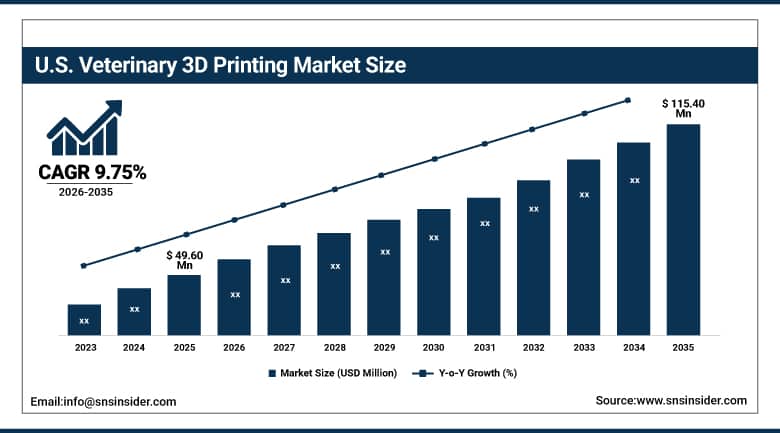
The U.S. Veterinary 3D Printing Market was valued at USD 49.60 Million in 2025 and is projected to reach USD 115.40 Million by 2035, growing at a CAGR of 9.75% during 2026–2035.
Major veterinary hospital chains and universities in the USA are increasingly utilizing additive manufacturing technologies in the creation of orthopedic implants, surgical guides, and models for anatomy education. This trend can be attributed to substantial spending on pet health care, an extensive infrastructure of veterinary teaching hospitals, as well as greater expertise of surgeons in using surgical planning software. An extensive network of specialty and referral veterinary hospitals operating 3D printing facilities either independently or in collaboration with external vendors continues to facilitate the swift implementation of patient-specific implants in cases of orthopedic and soft-tissue conditions.
The increase in the prevalence of orthopedic conditions, such as cruciate ligament rupture, angular limb deformities, and traumatic fractures in dogs, is resulting in growing demand for patient-specific implants and guides among U.S. veterinarians. Combined with investments made by veterinary hospitals in 3D printing infrastructure and further research conducted by universities in developing innovative biomaterials and specialized devices, it confirms the dominant role of the USA as the leading source of global revenues in the field of veterinary 3D printing.
⮞May 2025: Washington State University's Veterinary Teaching Hospital introduced a donated 3D printer into its orthopedic surgery service, enabling surgeons to create patient-specific anatomical models for complex procedures. The equipment supports detailed preoperative planning and more precise treatment of small-animal orthopedic conditions.
Veterinary 3D Printing Market Segment Analysis:
-
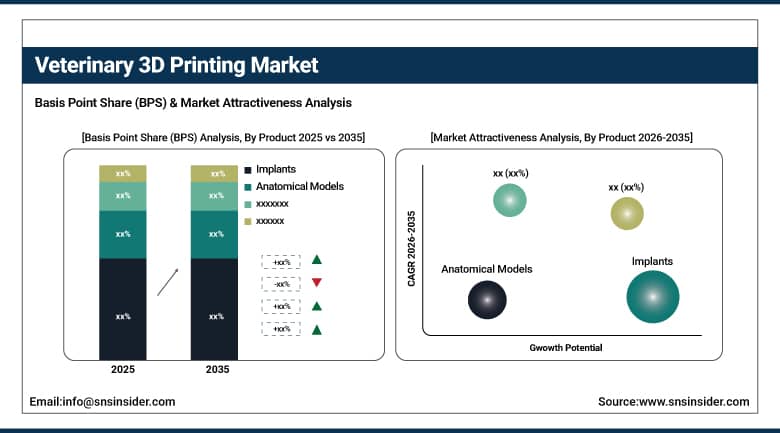
By Product, Implants dominated the Veterinary 3D Printing Market with a 34.20% share in 2025, while Anatomical Models is the fastest-growing product segment with a CAGR of 12.40% from 2026–2035.
-
By Animal, Dogs dominated the Veterinary 3D Printing Market with a 52.60% share in 2025, while Other Animals is the fastest-growing animal segment with a CAGR of 12.70% from 2026–2035.
-
By Application, Orthopedics dominated the Veterinary 3D Printing Market with a 46.90% share in 2025, while Surgical Planning & Training is the fastest-growing application segment with a CAGR of 12.90% from 2026–2035.
-
By Material, Metals dominated the Veterinary 3D Printing Market with a 38.80% share in 2025, while Other Materials is the fastest-growing material segment with a CAGR of 13.40% from 2026–2035.
-
By End Use, Hospitals & Clinics dominated the Veterinary 3D Printing Market with a 58.60% share in 2025, while Academic & Research Institutions is the fastest-growing end-use segment with a CAGR of 11.70% from 2026–2035.
By Product, Implants dominated the Veterinary 3D Printing Market, while Anatomical Models is the fastest-growing segment.
The Implants segment was the leading contributor with a 34.20% revenue share in the Veterinary 3D Printing Market in 2025. Implants such as tibial plateau leveling osteotomy (TPLO) plates, tibial plateau leveling angle (TPLA) devices, spinal fixation hardware, and custom titanium bone plates dominate this category because they directly address the high volume of orthopedic trauma, cruciate ligament disease, and congenital limb deformity cases treated in companion-animal practice. The ability to design implants from a patient's own CT scan allows surgeons to achieve tighter anatomical fit than generic stock hardware, which shortens operating time, reduces the risk of implant rejection, and improves post-surgical mobility outcomes.
Anatomical Models market segment is anticipated to exhibit the highest CAGR of 12.40% in 2026-2035. Growing application of patient-specific and animal-specific anatomical models for surgical planning and practice in pre-surgery training and learning is creating an increasing demand. Veterinary colleges have started to replace the use of live animals in their surgeries with anatomical models through 3D printing technology. With this process, students get accustomed to the complex parts of the animal's anatomy without having to operate on live subjects. Surgeons are using the models of tumor, broken bones, and abnormal joints for surgical practice before the actual procedure to decrease surgery time and risks associated with the operation.
⮞June 2025: Cornell University Hospital for Animals reported using CT-derived 3D-printed anatomical models to support bilateral hip replacement surgery in a young golden retriever with congenital hip abnormalities. The case demonstrates the clinical value of patient-specific models for planning complex veterinary orthopedic procedures.
By Animal, Dogs dominated the Veterinary 3D Printing Market, while Other Animals is the fastest-growing segment.
In the segment of Dogs, there was a market share dominance of 52.60% in terms of revenue contribution towards the overall revenue of the Veterinary 3D Printing Market in 2025. Dogs are the most commonly-owned companion animals throughout the world, and thus, are the largest contributors to expenditure in veterinary healthcare, which automatically makes their surgeons more inclined to adopt innovative surgical tools for treatment purposes. Cranial cruciate ligament tear, hip dysplasia, and other kinds of traumatically caused fractures are common in dogs, particularly large breeds. Consequently, there is a regular demand for customized implants, surgical guides, and prostheses among canine patients. Clinical cases involving 3D printed implants of dogs are the largest contributors towards the database of veterinary hospitals and referral centers.
The Other Animals segment, comprising horses, birds, turtles, livestock, and additional exotic and wildlife species, is projected to expand at the fastest rate of over 12.70% during the forecast period, driven by growing adoption of species-specific 3D-printed devices beyond the traditionally dominant companion-animal base. Specialized companies are increasingly designing custom implants, protective devices, and anatomical models tailored to equine, avian, and aquatic anatomy, addressing conditions that previously had few tailored treatment options. For example, wildlife rehabilitation centers and aquariums have used 3D-printed harnesses and prosthetic devices to treat injured sea turtles and birds of prey, while equine hospitals are adopting printed surgical guides for complex skull and limb procedures, signaling a broadening application base across non-traditional veterinary patients.
⮞April 2025: Oklahoma State University College of Veterinary Medicine introduced a 3D-printed horse skeleton for veterinary education, allowing students to examine equine anatomy and practice procedures using a physical model. The initiative demonstrates the extension of additive manufacturing into large-animal training applications.
By Application, Orthopedics dominated the Veterinary 3D Printing Market, while Surgical Planning & Training is the fastest-growing segment.
Orthopedics emerged as the topmost category within the global Veterinary 3D Printing Market in 2025 by occupying a market share of 46.90%. This is because of the proven success of the technology in the production of custom-made implant, plate, and surgical guide designed for each individual animal, thereby enhancing the precision of alignment during joint replacements, bone fracture repairs, and deformities correction. Veterinarians involved in orthopedic surgery have become heavily reliant on personalized guides to plan the surgical process in terms of where exactly to drill and fix the screws without running into any complications. Besides, the prevalence rate of orthopedic conditions in older and large breed pets coupled with increased interest among pet owners in undergoing complex surgeries has kept orthopedics the largest field within the market.
The Surgical Planning & Training segment is estimated to grow at the highest CAGR of 12.90% during the forecast period 2026-2035. Rising use of patient-specific 3D-printed models to visualize complex fractures, tumors, and congenital deformities before surgery is enabling veterinary teams to rehearse difficult procedures, pre-contour implants, and better estimate operative time. This capability also improves communication between veterinarians and pet owners by providing a tangible physical reference for explaining a planned procedure. Veterinary schools are expanding the use of printed training models to teach surgical technique without relying solely on live-animal practice, and this dual clinical-and-educational demand is expected to keep surgical planning and training among the fastest-growing veterinary 3D printing applications through the forecast period.
⮞July 2026: Researchers from the University of São Paulo published a study describing a dynamic 3D-printed canine stifle model developed for tibial plateau leveling osteotomy training. The model reproduced relevant anatomical structures and provided a repeatable alternative to cadaver-based practice for teaching orthopedic surgical techniques.
By Material, Metals dominated the Veterinary 3D Printing Market, while Other Materials is the fastest-growing segment.
In the year 2025, Metals had a market share of 38.80% in the Veterinary 3D Printing Market. The choice of Titanium, cobalt chromium, and stainless steel continues to be popular material selection for load-bearing veterinary implants and orthopedic implants because of their biocompatibility, anti-corrosive nature, and good mechanical properties to handle stress from a mobile animal body. With metal 3D printing technology, manufacturers can create complex lattice structures which facilitate osseointegration as well as provide strength for long term implant in an active companion animal. Advancements in powder bed technologies for metal 3D printing have improved surface finish as well as decreased production costs.
Other Materials category – bone cement and other biological/biowaste materials – is set to experience the highest growth rate, i.e., CAGR of 13.40%. Rising scientific focus on biocompatible, resorbable and regenerative material formulas is creating possibilities for newer applications beyond metals and polymers in the case of orthopedic defects of small dimensions. Biowaste-based materials – bone/shell-derived hydroxyapatite – are gaining attention owing to their possible help in bone regeneration along with reduction in production expenses and environmental degradation. With continued evaluation of such novel materials by the research facilities associated with veterinary science, adoption will gradually increase.
⮞June 2026: Researchers affiliated with Universidad Complutense de Madrid published research on a 3D-printed polyetheretherketone (PEEK) exo-endoprosthesis for limb salvage in dogs and cats. The study highlights continued investigation of high-performance polymers for patient-specific veterinary reconstructive applications beyond conventional metallic implants.
By End Use, Hospitals & Clinics dominated the Veterinary 3D Printing Market, while Academic & Research Institutions is the fastest-growing segment.
The Hospitals & Clinics segment remained the dominant force in the Veterinary 3D Printing Market, having garnered a market revenue share of 58.60% in 2025. Hospitals and specialized veterinary clinics possess all the required facilities and surgical workload along with financial ability to acquire 3D printing facilities either internally or through collaborations. They are able to manufacture customized implants and surgical guides on-demand for individual cases. Along with the growth in network of hospitals, many have set up their own 3D printing facilities, which has led to reduced time of device production and reduced dependency on third-party manufacturers. Thus, this segment has maintained its dominance due to capability of fast and easy conversion of imaging to surgical devices.
Academic & Research Institutions are estimated to register the highest CAGR of 11.70% during the forecast period, driven by expanding integration of 3D-printed anatomical models and training aids into veterinary education curricula. These institutions increasingly use printed models to teach students complex anatomy and surgical technique before they work with live patients, improving proficiency while reducing ethical and logistical constraints associated with live-animal training. Universities are also using 3D printing for original research into novel implant designs, biomaterials, and species-specific devices, often in partnership with veterinary hospitals and device manufacturers. This dual role in both education and applied research is expected to sustain above-average growth for academic and research institutions throughout the forecast period.
⮞February 2026: Louisiana State University School of Veterinary Medicine highlighted ongoing research into 3D-printed canine prosthetics and anatomical teaching models, including designs using tensegrity principles to improve device flexibility and functionality. The work illustrates the role of veterinary academic institutions in advancing additive manufacturing for both clinical applications and education.
Regional Analysis:
|
Region |
Major Country |
Share within Region, 2025 (%) |
|
North America |
United States |
84.50% |
|
Europe |
Germany |
24.80% |
|
Asia Pacific |
China |
41.20% |
|
Middle East & Africa |
UAE |
26.40% |
|
Latin America |
Brazil |
39.20% |
North America Veterinary 3D Printing Market Insights
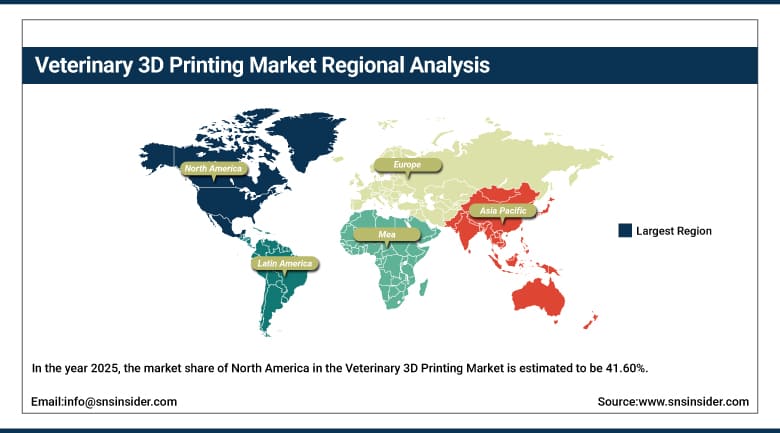
In the year 2025, the market share of North America in the Veterinary 3D Printing Market is estimated to be 41.60%. Factors responsible for such dominance include the presence of an established framework for veterinary health care, higher expenditure on pet health care, and the presence of specialized referral hospitals equipped with 3D printing capability either internally or externally. With increasing adoption of pets and pet owners becoming increasingly inclined towards opting for advanced surgeries, the demand for customized implants, prosthetics, and surgical guides is anticipated to increase significantly in the region.
United States emerged as a dominating player in the North America Veterinary 3D Printing Market for the year 2025 with around 84.5% market share. This has been possible due to an abundance of veterinary specialist hospitals, advanced studies in veterinary medicine along with the development of new 3D printing implants and surgical planning devices. Canada has also been driving the growth in the region through the development of veterinary teaching hospitals and using 3D printed surgical guides for orthopedic surgeries in companion animals. Mexico is also gradually becoming dependent on 3D printed devices, locally produced and imported ones.
⮞September 2026: Auburn University's College of Veterinary Medicine announced the development of a low-cost, camera-equipped 3D-printed laryngoscope through collaboration between its veterinary anesthesia team and engineering students. The device supports large-animal intubation training and demonstrates expanding applications of additive manufacturing in veterinary clinical education.
Get Customized Report as Per Your Business Requirement - Enquiry Now
Europe Veterinary 3D Printing Market Insights
The Europe region was a major contributor to the Veterinary 3D Printing Market in 2025, supported by a strong base of specialized veterinary device manufacturers, established regulatory frameworks for animal healthcare products, and growing veterinary hospital investment in custom orthopedic and orthotic solutions. Several countries across the region are home to companies focused specifically on veterinary additive manufacturing, ranging from titanium implant producers to custom orthotic and prosthetic device makers, which has helped establish Europe as a hub for veterinary 3D printing innovation alongside North America.
Germany is one of the major markets in Europe owing to its strong industrial manufacturing base and presence of veterinary device producers serving both domestic and international customers. The UK and Poland are also significant contributors, home to companies actively developing custom orthotic, prosthetic, and titanium implant solutions for companion animals, while France, Italy, and Spain are contributing to regional growth through expanding veterinary hospital adoption of 3D-printed surgical guides and growing academic research into novel implant materials and designs.
⮞February 2026: Researchers from Clinique Vétérinaire de Grosbois in France and Freie Universität Berlin published an experimental study evaluating a 3D-printed titanium aiming device for equine proximal interphalangeal joint arthrodesis. The research examined the device's potential to support accurate transarticular screw placement in complex equine orthopedic procedures.
Asia Pacific Veterinary 3D Printing Market Insights
The Asia Pacific Veterinary 3D Printing Market is expected to witness the fastest growth rate of 12.60% during the forecast period 2026-2035. Market growth is driven by rapidly expanding veterinary hospital infrastructure, growing pet ownership across major economies, and increasing awareness among veterinary institutions of the clinical benefits offered by patient-specific implants and anatomical training models. Leading veterinary hospital chains across the region are beginning to invest in dedicated 3D printing capabilities to enhance surgical outcomes and reduce reliance on imported implant hardware.
China is one of the main growth drivers in the Asia Pacific Veterinary 3D Printing Market, owing to its expanding companion-animal healthcare sector and growing domestic manufacturing capability supporting both veterinary hospitals and academic research institutions. India and Australia are also contributing to regional growth, with leading veterinary hospital chains introducing in-house 3D printing capabilities for reconstructive surgery, while Japan and South Korea are advancing research into novel biomaterials and implant designs suited to companion-animal and exotic-species applications.
⮞May 2026: Researchers at Seoul National University published a canine orthopedic case report describing reconstruction of a severely deformed femoral trochlea using a patient-specific 3D-printed titanium implant and surgical guides. The report documented sustained functional improvement during long-term follow-up, supporting continued clinical investigation of customized veterinary implants in South Korea.
Middle East & Africa and Latin America Veterinary 3D Printing Market Insights
Middle East & Africa and Latin American regions are gradually expanding veterinary 3D printing adoption as specialty veterinary care investment grows across both regions, supported by rising pet ownership, increasing government focus on modern veterinary infrastructure, and growing collaboration between veterinary hospitals and technology providers to introduce advanced surgical planning tools.
Brazil has the potential to emerge as one of the top markets in Latin America because of increasing numbers of pets, increasing number of specialty hospitals for companion animals, and increasing need for low-cost, customized implants and prosthetics which can compete with imported products. In the Middle East and Africa, the United Arab Emirates and Saudi Arabia are building state-of-the-art veterinary hospitals and improving their surgical facilities, thereby slowly driving the demand for 3D printed implants, orthotics, and anatomical models.
⮞September 2025: The University of Pretoria reported that surgeons at its Onderstepoort Veterinary Academic Hospital used a 3D-printed skull model to plan reconstructive surgery for a Pomeranian with a severe traumatic skull fracture. The case demonstrates practical adoption of additive manufacturing for complex veterinary surgical planning in South Africa.
Market Dynamics:
Growth Drivers: Rising adoption of patient-specific implants and surgical planning tools driving market growth
The rising adoption of 3D printing across veterinary orthopedic surgery, combined with growing pet ownership and rising veterinary healthcare expenditure in developed economies, is among the primary drivers of the Veterinary 3D Printing Market. Patient-specific implants, surgical guides, and prosthetics allow veterinary surgeons to achieve tighter anatomical fit than generic stock hardware, improving surgical outcomes while reducing operating time and post-operative complications across a growing range of orthopedic and soft-tissue procedures in companion animals.
Technological advancements in metal and polymer printing platforms have significantly improved implant precision and biocompatibility, while growing veterinary surgeon familiarity with digital surgical planning workflows continues to expand clinical adoption. Rising R&D investment from veterinary teaching hospitals and device manufacturers, increasing incidence of orthopedic trauma and congenital limb deformities in aging and larger-breed companion animals, and expanding use of 3D-printed anatomical models in veterinary education are further supporting demand across the forecast period.
⮞July 2026: WIMBA published a technical comparison of digitally manufactured 3D-printed canine orthotics and traditional cast-based devices, detailing differences in patient measurement, customization, fabrication and fitting. The publication illustrates the growing importance of repeatable digital workflows in the development of patient-specific veterinary mobility devices.
Restraints: High device costs and limited regulatory clarity restraining broader market adoption
High cost of custom 3D-printed implantations and devices as compared to the standard generic veterinary hardware available in the market is one of the major barriers in the development of the market. This increased cost barrier will prevent small-scale general clinics from adopting these technologies and will also discourage pet owners who want to save money. Equipping their facilities with 3D printing technology will require investment in dedicated equipment, material and skilled staff.
Another problem with the veterinary market is the lack of uniformity of 3D-printed medical devices regulation in some regions as compared to human medical devices regulation. The lack of knowledge about the 3D-printing possibilities on the part of general practitioners, as well as the difficulty in transforming the data from diagnostic imaging into suitable design for a medical device, requires special training.
Opportunities: Expansion into non-companion species and novel biomaterials creating new growth avenues
The growing application of 3D printing beyond dogs and cats into horses, birds, livestock, and exotic and wildlife species presents significant opportunities for specialized device manufacturers to address previously underserved veterinary segments. Continued innovation in biocompatible and resorbable materials, including biowaste-derived formulations, is expected to expand the range of clinical applications suited to 3D-printed veterinary devices, from bone regeneration support to soft-tissue repair.
There is considerable potential for growth in academic and research partnerships that combine veterinary hospital clinical case data with device manufacturer design expertise to develop next-generation implants and training tools. The increasing establishment of dedicated veterinary 3D printing laboratories within hospital networks, alongside rising investment in veterinary healthcare infrastructure across emerging markets in Asia Pacific and Latin America, is expected to create sustained demand for both established and next-generation veterinary 3D printing solutions.
⮞October 2025: Researchers at Freie Universität Berlin published a veterinary case report describing reconstruction of an orbital fracture in a mare using a patient-specific 3D-printed implant. The case highlights opportunities for customized additive manufacturing in equine reconstructive surgery beyond conventional companion-animal applications.
Recent Developments:
-
2025: Bio3Dvet became the exclusive distributor of 3D Metal Tech's titanium implant systems across Europe and North America, expanding veterinary surgeon access to patient-specific orthopedic hardware.
-
2025: Vimian's Movora expanded its portfolio of 3D-printed titanium orthopedic implants, broadening case coverage across canine and equine limb-reconstruction procedures.
-
2026: Spark Spine and Invictos Orthopedics partnered to bring Spark Spine's Electro-Mechanical Polymer (EMP) implant technology into veterinary spinal and orthopedic applications.
-
2026: ExoPets launched a dedicated veterinary orthotics and prosthetics service line, offering specialized clinical case support for companion-animal mobility devices.
Veterinary 3D Printing Market Key Players are:
-
3D Pets (DiveDesign LLC)
-
3D Systems, Inc.
-
OrthoDesigns
-
Ortho Vet 3D
-
r3volutionD AG
-
Novus Life Sciences
-
WhiteClouds
-
Med Dimensions LLC
-
CABIOMEDE Vet
-
OrthoPets
-
Animal Ortho Care
-
KeriCure
-
Fusion Implants
-
Formlabs Inc.
-
VET 3D
-
M3D ILAB Ltd.
-
Protosthetics, Inc.
Veterinary 3D Printing Market Report Scope:
| Report Attributes | Details |
|---|---|
| Market Size in 2025 | USD 121.40 Million |
| Market Size by 2035 | USD 311.50 Million |
| CAGR | CAGR of 9.85% From 2026 to 2035 |
| Base Year | 2025 |
| Forecast Period | 2026-2035 |
| Historical Data | 2022-2024 |
| Report Scope & Coverage | Market Size, Segments Analysis, Competitive Landscape, Regional Analysis, DROC & SWOT Analysis, Forecast Outlook |
| Key Segments | • By Product (Implants, Prosthetics & Orthotics, Anatomical Models, Masks) • By Animal (Dogs, Cats, Other Animals) • By Application (Orthopedics, Surgical Planning & Training, Other Applications) • By Material (Metals, Ceramics, Polymers, Other Materials) • By End Use (Hospitals & Clinics, Academic & Research Institutions, Other End Use) |
| Regional Analysis/Coverage | North America (US, Canada), Europe (Germany, UK, France, Italy, Spain, Russia, Poland, Rest of Europe), Asia Pacific (China, India, Japan, South Korea, Australia, ASEAN Countries, Rest of Asia Pacific), Middle East & Africa (UAE, Saudi Arabia, Qatar, South Africa, Rest of Middle East & Africa), Latin America (Brazil, Argentina, Mexico, Colombia, Rest of Latin America). |
| Company Profiles | bio3Dvet (Bio3Dtech), WIMBA, Vimian Group (Movora), 3D Pets (DiveDesign LLC), 3D Systems, Inc., OrthoDesigns, Ortho Vet 3D, r3volutionD AG, Novus Life Sciences, WhiteClouds, Med Dimensions LLC, CABIOMEDE Vet, OrthoPets, Animal Ortho Care, KeriCure, Fusion Implants, Formlabs Inc., VET 3D, M3D ILAB Ltd., Protosthetics, Inc. |

Frequently Asked Questions
Key players in the Veterinary 3D Printing Market include bio3Dvet (Bio3Dtech), WIMBA, Vimian Group (Movora), 3D Pets (DiveDesign LLC), and 3D Systems, Inc., among others.
Key opportunities in the Veterinary 3D Printing Market include expansion into non-companion animal applications, development of novel biomaterials, growth of academic and research partnerships, and increasing establishment of dedicated veterinary 3D printing laboratories.
The market is driven by rising adoption of patient-specific implants and surgical planning tools, increasing pet healthcare expenditure, growing incidence of orthopedic conditions, and technological advancements in metal and polymer 3D printing.
The Implants segment dominated the Veterinary 3D Printing Market, accounting for approximately 34.20% market share in 2025.
The North America region dominated the Veterinary 3D Printing Market in 2025 with a 41.60% share, supported by established veterinary healthcare infrastructure, high pet healthcare expenditure, and strong adoption of specialty veterinary 3D printing solutions.
