
Veterinary X-Ray Market Report Scope & Overview:
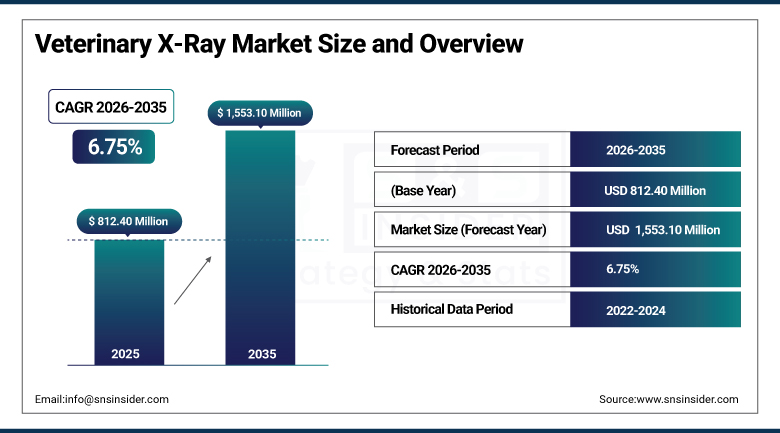
The Veterinary X-Ray Market was valued at USD 812.40 Million in 2025 and is expected to reach USD 1,553.10 Million by 2035, growing at a CAGR of 6.75% from 2026 to 2035.
Market Growth for Veterinary X-Rays is driven by growing pet ownership, increasing adoption of pet insurance coverage which pays the cost of diagnostic imaging studies, growing veterinary hospital and clinics facilities, and continuous migration towards digital radiography systems in clinical applications. Veterinary x-ray equipment continue to be the preferred non-invasive diagnostic tool in use by veterinarians for bone fractures, joint problems, internal organs issues, dental disease, or any other suspected tumor in companion animals, equines, or livestock, hence, making them an essential part of veterinary medicine and emergency medicine.
In January 2026, IDEXX Laboratories launched the ImageVue DR50 Plus, a next-generation digital radiography system delivering approximately 25% lower radiation dose than its predecessor, reinforcing manufacturer focus on safety-driven equipment upgrades across veterinary hospitals and clinics worldwide.
To Get more information On Veterinary X-Ray Market - Request Free Sample Report
Veterinary X-Ray Market Trends:
-
Rapid clinical migration from computed radiography to direct radiography is accelerating as sub-5-second image acquisition and superior resolution shorten examination times.
-
Growing integration of artificial intelligence-based image interpretation software is helping practices flag fractures, tumors, and joint abnormalities faster amid a persistent shortage of veterinary radiologists.
-
Rising demand for portable and handheld X-ray units is expanding on-site diagnostic access for equine, farm, and mobile veterinary services.
-
Increasing adoption of cloud-based PACS and teleradiology platforms is enabling remote second-opinion reads and multi-location image sharing across corporate veterinary hospital chains.
-
Expanding veterinary insurance penetration and rising per-visit diagnostic spending are encouraging clinics to upgrade toward premium, AI-compatible digital radiography systems.
U.S. Veterinary X-Ray Market Outlook:
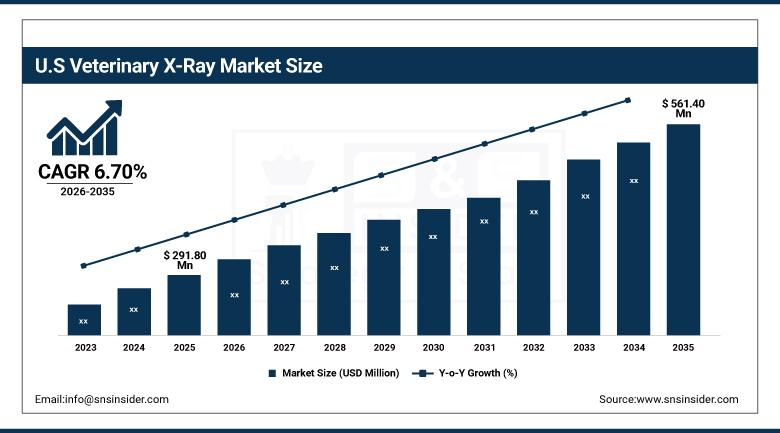
The U.S. Veterinary X-Ray Market was valued at USD 291.80 Million in 2025 and is projected to reach USD 561.40 Million by 2035, growing at a CAGR of 6.70% during 2026–2035.
The US market will continue to grow owing to the high prevalence of companion animals, increasing expenditure on veterinary treatment and availability of highly advanced diagnostic facilities. The increased specialty treatment of various conditions including orthopedics, oncology, dentistry and emergency cases is leading to high demand for repeated imaging, which is causing the increased utilization of digital and portable radiography systems. The academic and referral hospitals of the veterinary sector are also increasingly adopting advanced imaging technology for clinical purposes and for educating future radiologists.
In May 2025, Cornell University Hospital for Animals installed a linear accelerator alongside a photon-counting CT scanner to complement its digital radiography suite, enhancing diagnostic and therapeutic imaging precision for both companion and referral large-animal cases.
Veterinary X-Ray Market Segment Analysis:
-
By Technology, Computed Radiography Systems dominated the Veterinary X-Ray Market with a 53.40% share in 2025, while Direct Radiography Systems is the fastest-growing technology segment with a CAGR of 7.60% from 2026–2035.
-
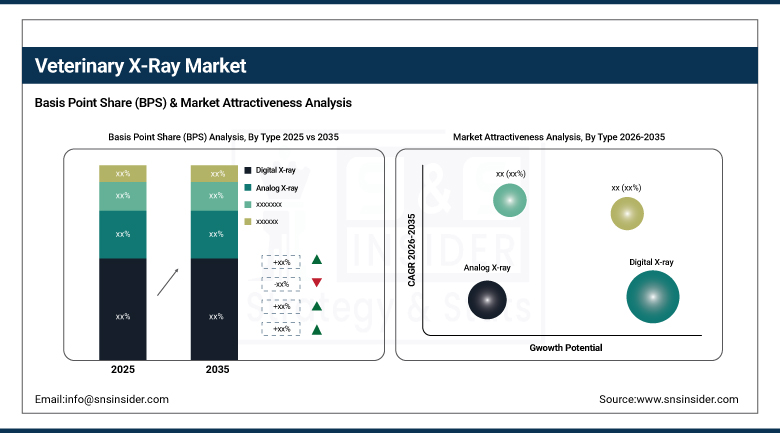
By Type, Digital X-ray dominated the Veterinary X-Ray Market with a 73.80% share in 2025, and also remains the fastest-growing type segment with a CAGR of 7.35% from 2026–2035.
-
By Mobility, Stationary systems dominated the Veterinary X-Ray Market with a 55.60% share in 2025, while Portable systems is the fastest-growing mobility segment with a CAGR of 7.20% from 2026–2035.
-
By Animal Type, Small Companion Animals dominated the Veterinary X-Ray Market with a 66.50% share in 2025, and also remains the fastest-growing animal type segment with a CAGR of 7.65% from 2026–2035.
-
By Application, Orthopedics & Trauma dominated the Veterinary X-Ray Market with a 33.80% share in 2025, while Dental is the fastest-growing application segment with a CAGR of 7.75% from 2026–2035.
-
By End User, Veterinary Hospitals & Clinics dominated the Veterinary X-Ray Market with a 47.20% share in 2025, while Diagnostic Imaging Centers is the fastest-growing end-user segment with a CAGR of 7.30% from 2026–2035.
By Technology, Computed Radiography Systems dominated the Veterinary X-Ray Market, while Direct Radiography Systems is the fastest-growing segment.
The Computed Radiography Systems segment was the leading contributor in the Veterinary X-Ray Market in 2025. Computed radiography continues to dominate because its reusable imaging plates and cassette-based scanners let clinics upgrade from legacy film-based equipment at a comparatively modest capital outlay, without requiring a full replacement of existing X-ray generators and tube housings. Small and mid-sized companion animal practices, which make up the bulk of the installed veterinary equipment base globally, favor computed radiography for its lower maintenance costs, longer field service life, and compatibility with existing bucky tables, allowing multi-species practices to standardize imaging workflows across companion, exotic, and small farm-animal caseloads without incurring the higher upfront cost associated with direct capture detector panels.
The Direct Radiography Systems segment is expected to witness the highest growth during the forecast period 2026–2035. Growth is being driven by sub-five-second image acquisition, elimination of intermediate cassette processing, and markedly superior spatial resolution, all of which shorten patient handling time and reduce the need for repeat exposures in anxious or sedated animals. Corporate veterinary hospital chains and referral centers are increasingly standardizing new-build and renovation projects around direct radiography to support integration with cloud-based PACS, AI-assisted lesion-flagging software, and teleradiology overreads, while declining flat-panel detector costs and expanding retrofit-kit availability are gradually narrowing the price gap with computed radiography, further accelerating the segment's above-average growth trajectory.
By Type, Digital X-ray dominated the Veterinary X-Ray Market, and also remains the fastest-growing segment.
The Digital X-ray category held a market share of the Veterinary X-Ray Market in 2025. Digital systems, encompassing both computed and direct radiography, continue to displace analog and film-based equipment because they eliminate darkroom chemical processing, enable near-instant image review at the point of care, and integrate seamlessly with practice management and PACS software for storage, retrieval, and remote sharing among specialists. Reduced radiation exposure per study, lower long-term operating costs once chemical and film consumables are removed from the workflow, and compatibility with AI-based diagnostic overlays have collectively cemented digital radiography as the default specification for new equipment purchases across general practice, referral hospital, and diagnostic imaging center settings worldwide.
The Digital X-ray segment is also anticipated to grow at the fastest rate during the forecast period 2026–2035. Continued price compression on flat-panel detectors, expanding availability of financing and lease-to-own purchase models for single-doctor practices, and the growing bundling of cloud storage and AI-assisted interpretation subscriptions with hardware sales are together widening digital radiography's addressable base among cost-sensitive clinics in emerging markets. As manufacturers phase out legacy analog product lines and regulatory bodies tighten radiation-safety and record-keeping expectations, digital adoption is expected to further consolidate its lead over the remainder of the forecast period.
By Mobility, Stationary systems dominated the Veterinary X-Ray Market, while Portable systems is the fastest-growing segment.
The Stationary systems segment dominated the Veterinary X-Ray Market. Fixed-room installations remain the preferred configuration for high-volume veterinary hospitals and referral centers because they deliver superior image stability, higher power output, and larger imaging fields suited to both small companion animals and larger-bodied patients requiring precise, high-resolution radiographs for orthopedic planning, oncologic staging, or complex trauma evaluation. Their durability, longer usable lifespan, and integration with dedicated shielding and radiation-safety infrastructure make stationary systems a cost-effective long-term investment for practices with consistent, high case-throughput imaging requirements across multiple examination rooms.
The Portable systems segment is expected to grow at the fastest rate during the forecast period 2026–2035. Growth is being driven by rising demand for on-site imaging in equine, bovine, and field-based large-animal practice, where transporting patients to a fixed facility is often impractical, costly, or clinically risky. Advances in lightweight detector panels, extended battery-operated imaging sessions, and wireless connectivity to cloud PACS are enabling practitioners to capture and transmit diagnostic-quality images directly from farms, stables, shelters, and disaster-response settings, further widening the addressable use cases for portable veterinary radiography equipment.
By Animal Type, Small Companion Animals dominated the Veterinary X-Ray Market, and also remains the fastest-growing segment.
The Small Companion Animals segment dominated the Veterinary X-Ray Market. Rising global pet ownership, particularly among dogs and cats, combined with owners' growing willingness to pursue advanced, human-grade diagnostic care for their animals, continues to anchor this segment's leading position. Increasing longevity in companion animals resulting from improved nutrition and preventive care has raised the prevalence of age-related orthopedic, dental, and oncologic conditions that require serial radiographic monitoring, while breed-specific screening protocols for conditions such as hip dysplasia and cranial cruciate ligament injury further sustain consistent imaging volumes across general practice and specialty referral settings.
The Small Companion Animals segment is also projected to register the fastest CAGR during the forecast period 2026–2035. Continued growth in multi-pet households, expanding pet insurance enrollment that reduces the out-of-pocket burden of diagnostic imaging, and manufacturer focus on companion-animal-specific AI algorithms for early cancer and joint-disease detection are together reinforcing above-average growth for this segment relative to large-animal and exotic imaging categories, which face longer equipment replacement cycles and comparatively lower per-visit imaging frequency.
By Application, Orthopedics & Trauma dominated the Veterinary X-Ray Market, while Dental is the fastest-growing segment.
The Orthopedics & Trauma segment dominated the Veterinary X-Ray Market in 2025. X-ray imaging remains the diagnostic gold standard for evaluating bone fractures, joint dysplasia, ligament injuries, and degenerative musculoskeletal disease in companion and large animals, and is routinely used for both pre-surgical planning and post-operative implant assessment. Rising incidence of traumatic injury from vehicular accidents and falls, combined with an aging pet population increasingly affected by osteoarthritis and hip or elbow dysplasia, continues to sustain high radiographic case volumes across general practice, emergency, and orthopedic referral settings worldwide.
The Dental segment is expected to register the fastest growth during the forecast period 2026–2035. Growing owner awareness of the link between periodontal disease and broader systemic health in pets, combined with expanding preventive dental-care packages offered by veterinary hospital chains, is driving rapid uptake of intraoral and panoramic dental radiography units capable of visualizing subgingival tooth root pathology and hidden bone loss that cannot be detected through visual examination alone, positioning dental imaging as one of the fastest-expanding application niches within the broader veterinary radiography market.
By End User, Veterinary Hospitals & Clinics dominated the Veterinary X-Ray Market, while Diagnostic Imaging Centers is the fastest-growing segment.
The Veterinary Hospitals & Clinics segment dominated the Veterinary X-Ray Market. As the first point of contact for the vast majority of pet owners, these facilities handle the highest volume of routine, emergency, and specialty radiographic examinations, and continue to invest heavily in digital radiography, PACS integration, and AI-assisted interpretation tools to support growing caseloads, improve diagnostic turnaround, and differentiate service quality amid intensifying competition from corporate hospital chains and urgent-care veterinary networks.
The Diagnostic Imaging Centers segment is expected to grow at the fastest CAGR during the forecast period 2026–2035. Standalone diagnostic imaging centers are increasingly positioned as referral hubs offering advanced radiographic, and in some cases hybrid CT and MRI, capabilities to general practices lacking in-house equipment, enabling shared access to high-end systems and specialist radiologist overreads. Growing referral partnerships between general practices and dedicated imaging centers, particularly in urban markets with dense practice networks, are expected to sustain above-average growth for this segment through the forecast period.
Regional Analysis:
|
Region |
Major Country |
Share within Region, 2025 (%) |
|---|---|---|
|
North America |
United States |
83.20% |
|
Europe |
Germany |
24.60% |
|
Asia Pacific |
China |
32.40% |
|
Middle East & Africa |
South Africa |
26.80% |
|
Latin America |
Brazil |
41.50% |
North America Veterinary X-Ray Market Insights
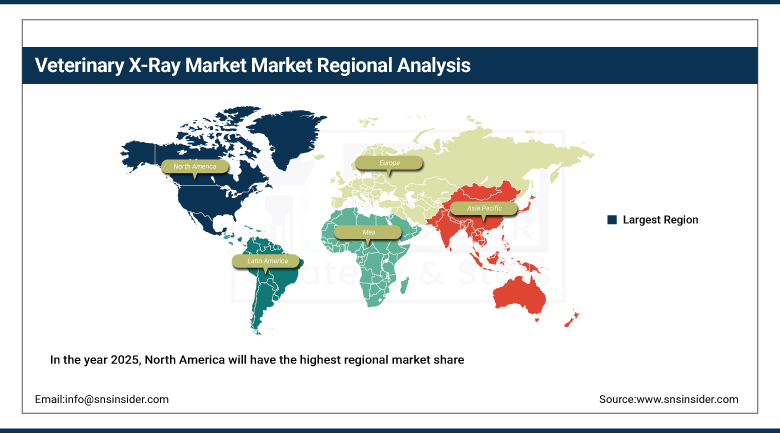
In the year 2025, North America will have the highest regional market share of the global North America Veterinary X-Ray Market with an estimated 38.50%, owing to extremely high pet ownership rates, presence of well-developed and equipped veterinary hospital and clinic infrastructures, as well as popularity of pet health insurance services which minimize costs of using advanced diagnostic imaging techniques. The region is characterized by a well-established base of digital radiography technologies, significant presence of equipment manufacturing industry leaders, as well as early and consistent use of software for assisting AI in interpreting images in independent veterinary clinics and hospitals owned by corporate organizations.
In 2025, the country with the largest market share of the North America Veterinary X-Ray Market is the US, which holds 83.20% of the total market of the region, due to the development of the network of specialty and referral hospitals, high veterinary spending per visit, and introduction of AI-enabled and portable digital radiography systems in veterinary practices. In North America, Canada also contributes to the development of the market, as there is consistent expansion of corporate veterinary clinic chains as well as cloud-based PACS systems used in geographically spread veterinary practices.
Get Customized Report as per Your Business Requirement - Enquiry Now
Europe Veterinary X-Ray Market Insights
Europe held a meaningful share of global revenue, supported by Veterinary X-Ray Market in 2025, supported by stringent animal-welfare regulations, a well-established network of referral and university veterinary hospitals, and steadily rising companion-animal healthcare expenditure across the region's major economies. Ongoing transition from analog to digital radiography, combined with growing demand for portable field-imaging units among equine and livestock practitioners, continues to underpin consistent regional growth throughout the forecast period.
Germany represents one of the biggest markets in Europe due to the country's strong manufacturing sector for veterinary radiographic equipment, well-developed network of referral hospitals, as well as strict national regulations concerning the protection from ionizing radiation which foster the introduction of modern digital radiographic devices in compliance with these regulations. The UK, France, and Italy also represent big players in the development of regional market due to expanding referral hospitals, increased demand for high resolution and 3D imaging as well as artificial intelligence diagnostic software.
Asia Pacific Veterinary X-Ray Market Insights
The Asia Pacific Veterinary X-Ray Market is expected to register the fastest CAGR of 7.85% during the forecast period 2026–2035, driven by rapidly rising companion-animal ownership in urban centers, expanding veterinary college and clinic infrastructure, and growing government and private investment in modern animal-healthcare delivery across the region's major and emerging economies. Increasing disposable income, growing awareness of preventive pet healthcare, and rapid urbanization are collectively accelerating the shift from basic film-based imaging toward digital and AI-integrated radiography systems across both companion and livestock veterinary practice.
China is one of the main growth drivers in the Asia Pacific Veterinary X-Ray Market, supported by its expanding companion-animal population, growing base of domestic radiography equipment manufacturers, and increasing investment in livestock health monitoring infrastructure. India and Japan are also contributing significantly to regional growth, with India benefiting from expanding veterinary college capacity and rural clinic networks, and Japan continuing to invest in AI-assisted imaging upgrades and dose-tracking software across its comparatively mature veterinary hospital base.
Latin America Veterinary X-Ray Market Insights
The Latin America Veterinary X-Ray market is expected to grow consistently due to factors such as increased disposable income, increased expenditure on pets' care, and increased governmental attention towards health monitoring of the livestock. The increased usage of digital and mobile radiology equipment in referral and specialty veterinary practices in urban areas is likely to drive the market in the coming years.
Brazil is projected to continue to lead the Latin America market because of the high population of companion animals, large livestock and cattle industry, and growing number of veterinary specialty and referral practices. In addition, Argentina and Mexico are contributing to growth in the region due to increased investments in the veterinary infrastructure and increased use of artificial intelligence-based imaging technology in urban veterinary practices.
Middle East & Africa Veterinary X-Ray Market Insights
The Middle East & Africa Veterinary X-Ray Market is witnessing steady growth, supported by rising pet ownership in urban centers, expanding veterinary infrastructure investment, and growing demand for preventive and diagnostic animal healthcare across the region's key markets. Adoption of digital radiography and portable imaging units continues to accelerate, particularly across countries investing heavily in modern veterinary hospital and clinic networks.
As for South Africa, it had the maximum market share in the Middle East & Africa Veterinary X-Ray Market in 2025 due to the presence of an existing livestock and equine healthcare market in South Africa along with increasing pet care facilities among the urban population. UAE and Saudi Arabia are also helping in regional market growth owing to increased disposable incomes and government initiatives in favor of animals.
Market Dynamics:
Growth Drivers: Rising companion animal ownership and pet insurance penetration driving market growth
Rising global companion-animal ownership, growing willingness among pet owners to pursue advanced diagnostic and preventive healthcare, and expanding pet insurance penetration that reduces the out-of-pocket cost of imaging procedures are among the primary drivers of the Veterinary X-Ray Market. Veterinary X-ray systems remain the frontline, non-invasive diagnostic modality for detecting fractures, joint disease, internal organ abnormalities, dental pathology, and suspected tumors, making them indispensable across general practice, emergency, and specialty referral care for companion, equine, and livestock species alike.
Technological advancement in digital and direct radiography, together with the integration of AI-assisted image interpretation tools, has significantly improved diagnostic speed and accuracy, helping practices manage rising caseloads amid a persistent shortage of trained veterinary radiologists. Growing corporatization of veterinary hospital chains across North America and Europe is standardizing procurement toward advanced, cloud-connected digital radiography platforms, while continued expansion of veterinary college infrastructure and rural clinic networks across Asia Pacific and Latin America is generating incremental first-time installation demand, further supporting sustained market expansion across the forecast period.
Restraints: High equipment costs and shortage of trained veterinary radiologists limiting market expansion
One of the most crucial constraints affecting the growth potential of the Veterinary X-Ray Market is the exorbitant cost of top-end digital and direct radiography technology due to the high capital expense associated with detectors, image acquisition software, and radiation safety technology, discouraging the upgrade from traditional computed radiography or analog technology among sole proprietorship or small veterinary clinics. The absence of reimbursement in developing countries due to insurance coverage also makes it difficult to adopt this technology as pet owners in such places are very price-sensitive in terms of diagnostics.
Another constraint affecting the adoption and implementation of new technology in radiography and image analysis software is the lack of veterinary radiologists as well as lower enrollment in some veterinary technicians and imaging courses. The continued use of rare earth metals in the manufacture of flat panel detectors is another constraint faced by equipment manufacturers, affecting their buying decisions and replacement cycles for old technologies.
Opportunities: AI integration and expansion of portable imaging systems creating new growth avenues
The growing integration of artificial intelligence into veterinary diagnostic imaging, offering automated lesion flagging, faster interpretation, and reduced retake rates, presents a significant growth opportunity for the Veterinary X-Ray Market. As workforce shortages deepen across the veterinary radiology profession, AI-assisted workflows are increasingly viewed by practice owners as a practical means of managing rising caseloads without proportionally expanding specialist headcount, creating durable demand for AI-compatible hardware and subscription-based diagnostic software across both mature and emerging markets.
Expansion of portable and handheld radiography systems into farm, equine, shelter, and mobile veterinary service settings, together with rising demand for cloud-based teleradiology platforms that connect general practices to remote specialist overreads, offers further avenues for growth. Increasing investment in veterinary healthcare infrastructure across emerging economies in Asia Pacific, Latin America, and the Middle East & Africa, combined with government-backed livestock health initiatives, is expected to create substantial first-time equipment installation opportunities for vendors over the coming decade.
Recent Developments:
-
2025: Adaptix Ltd received U.S. FDA 510(k) clearance for its Ortho350 system, a compact, mobile, low-dose 3D Digital Tomosynthesis device designed for rapid, affordable orthopedic imaging of the extremities in companion animals.
-
2025: OR Technology Group completed the acquisition of Ireland-based VetEquip Ltd., expanding its veterinary equipment and service footprint across Europe and advancing its strategy in instant diagnostic imaging solutions.
-
2026: Zoetis announced an agreement to acquire VitalRADS, a cloud-based veterinary teleradiology platform, with plans to integrate the service into its ZoetisDx diagnostics portal to strengthen closed-loop imaging workflows.
-
2025: GE HealthCare and NVIDIA unveiled a joint roadmap to develop autonomous imaging workflow engines for X-ray and ultrasound consoles, aimed at easing workload pressure in radiologist-short veterinary practices.
-
2025: GIERTH X-Ray installed its combiVet S system, featuring the HF 400M generator paired with a Canon CXDI-702C digital detector, at the Grüne Aue small-animal practice in Germany to enhance diagnostic throughput.
Veterinary X-Ray Market Key Players Are:
-
IDEXX Laboratories, Inc.
-
GE HealthCare
-
Canon Medical Systems Corporation
-
Fujifilm Holdings Corporation
-
Siemens Healthineers AG
-
Agfa-Gevaert Group
-
SEDECAL
-
Mindray Bio-Medical Electronics Co., Ltd.
-
Carestream Health
-
Midmark Corporation
-
Heska Corporation (an Antech Company)
-
Konica Minolta, Inc.
-
MinXray, Inc.
-
Examion GmbH
-
Narang Medical Limited
-
-
DRE Veterinary (Ganim Medical LLC)
-
Control-X Medical S.A.
-
SignalPET
-
Adaptix Ltd.
-
Varex Imaging Corporation
Veterinary X-Ray Market Report Scope:
| Report Attributes | Details |
|---|---|
| Market Size in 2025 | USD 812.40 Million |
| Market Size by 2035 | USD 1,553.10 Million |
| CAGR | CAGR of 6.75% From 2026 to 2035 |
| Base Year | 2025 |
| Forecast Period | 2026-2035 |
| Historical Data | 2022-2024 |
| Report Scope & Coverage | Market Size, Segments Analysis, Competitive Landscape, Regional Analysis, DROC & SWOT Analysis, Forecast Outlook |
| Key Segments | • By Technology (Computed Radiography Systems, Direct Radiography Systems, Film-based Radiography Systems) • By Type (Digital X-ray, Analog X-ray) • By Mobility (Stationary, Portable) • By Animal Type (Small Companion Animals, Large Animals, Other Animals) • By Application (Orthopedics & Trauma, Dental, Oncology, Other Applications) • By End User (Veterinary Hospitals & Clinics, Diagnostic Imaging Centers, Other End Users) |
| Regional Analysis/Coverage | North America (US, Canada), Europe (Germany, UK, France, Italy, Spain, Russia, Poland, Rest of Europe), Asia Pacific (China, India, Japan, South Korea, Australia, ASEAN Countries, Rest of Asia Pacific), Middle East & Africa (UAE, Saudi Arabia, Qatar, South Africa, Rest of Middle East & Africa), Latin America (Brazil, Argentina, Mexico, Colombia, Rest of Latin America). |
| Company Profiles | IDEXX Laboratories, Inc., GE HealthCare, Canon Medical Systems Corporation, Fujifilm Holdings Corporation, Siemens Healthineers AG, Agfa-Gevaert Group, SEDECAL, Mindray Bio-Medical Electronics Co., Ltd., Carestream Health, Midmark Corporation, Heska Corporation (an Antech Company), Konica Minolta, Inc., MinXray, Inc., Examion GmbH, Narang Medical Limited, DRE Veterinary (Ganim Medical LLC), Control-X Medical S.A., SignalPET, Adaptix Ltd., Varex Imaging Corporation |
Frequently Asked Questions
Key players include IDEXX Laboratories, GE HealthCare, Canon Medical Systems, Fujifilm, Siemens Healthineers, Agfa-Gevaert, Carestream Health, and Midmark.
Key opportunities include AI-assisted imaging, portable radiography expansion, cloud teleradiology adoption, and veterinary healthcare infrastructure development across emerging markets.
The market is driven by rising pet ownership, increasing veterinary healthcare spending, digital radiography adoption, and expanding pet insurance coverage worldwide.
The Computed Radiography Systems segment dominated the Veterinary X-Ray Market, accounting for approximately 53.40% market share in 2025.
North America dominated the Veterinary X-Ray Market in 2025 with a 38.50% share, supported by advanced infrastructure and high pet ownership.
