
Wireless Charging IC Market Report Scope & Overview:
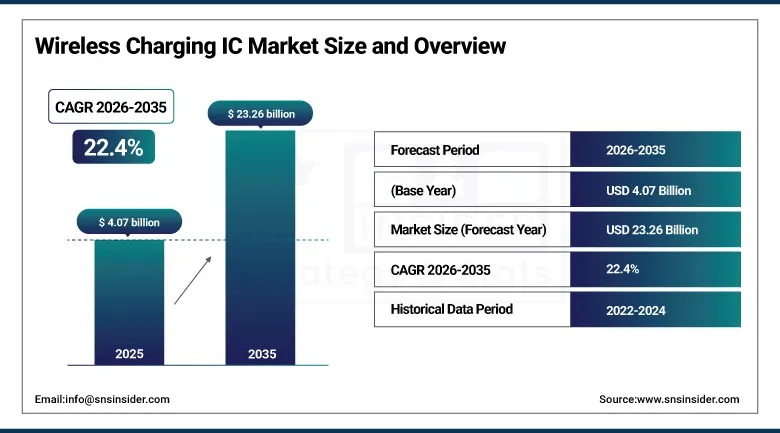
The Wireless Charging IC Market was valued at USD 4.07 Billion in 2025 and is expected to reach USD 23.26 Billion by 2035, growing at a CAGR of 22.4% from 2026 to 2035.
Wireless charging integrated circuits are the semiconductor devices used in transferring energy wirelessly from the charger transmitter to a receiver through the processes of power conversion, coil driving, communication, and safety management. Wireless charging IC comprises a number of specific functions for the transmitter IC which include power amplification, coil current management, Qi/AirFuel communication, and foreign object detection, as well as a number of receiver IC specific functions such as rectification, voltage regulation, thermal management, and back-channel communication which make possible the process of contactless transfer of energy which is necessary to charge a user device in the absence of physical contacts.
The value of the wireless charging IC technology was born when it became part of the electric toothbrush and the medical implant charging but it has evolved into becoming an important part of consumer electronics devices such as smartphones, watches, and wireless earbuds where its use has become a billion-dollar business.
In 2025, Qualcomm announced its next-generation Quick Charge wireless power delivery platform incorporating support for up to 100W wireless charging for flagship Android smartphones and laptops, representing a significant advance in wireless power delivery capability that narrows the performance gap between wireless and wired fast charging to the point where consumer choice between charging methods becomes a convenience rather than speed trade-off.
To Get more information on Wireless Charging IC Market - Request Free Sample Report
Wireless Charging IC Market Trends
-
Integration of gallium nitride (GaN) technology in wireless charging ICs is improving power efficiency and enabling higher-power charging applications.
- Growing adoption of multi-device wireless charging pads is increasing demand for advanced transmitter ICs with enhanced power management capabilities.
- Development of wireless charging receiver ICs for electric vehicles is expanding opportunities in high-value automotive charging applications.
- Advancements in over-the-air wireless power transmission technologies are supporting new consumer and IoT device charging use cases.
- Adoption of the Qi2 standard with magnetic alignment features is accelerating wireless charging ecosystem growth and accessory innovation.
The U.S. Wireless Charging IC Market Outlook
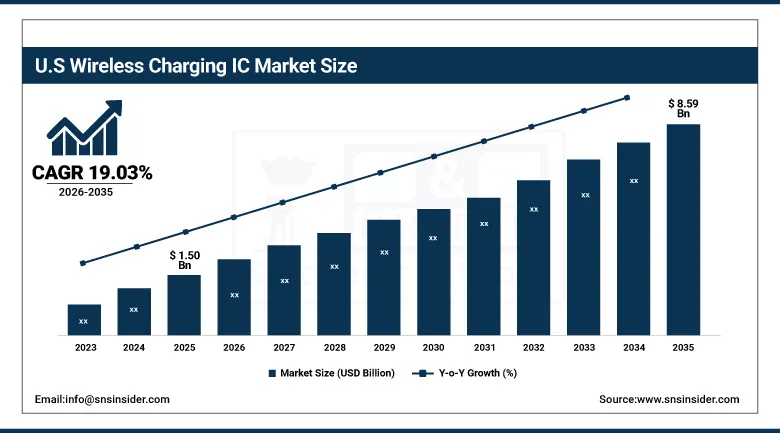
The U.S. Wireless Charging IC Market was valued at approximately USD 1.50 Billion in 2025 and is expected to reach approximately USD 8.59 Billion by 2035, growing at a CAGR of approximately 19.03%.
The United States wireless charging IC market is driven by the commercial concentration of major semiconductor design companies including Qualcomm, Texas Instruments, Broadcom, NXP Semiconductors, and Integrated Device Technology whose wireless charging IC product portfolios define global technical standards, the world's largest Apple iPhone installed base whose Qi-compatible charging accessory ecosystem sustains wireless charging infrastructure investment, and the electric vehicle sector's growing interest in integrated vehicle wireless charging solutions. The U.S. Federal Highway Administration's exploration of electrified roadway wireless EV charging infrastructure and the Department of Energy's wireless power transfer research programme collectively create government-supported technology development that positions U.S. companies at the frontier of next-generation wireless charging capability.
In 2025, Texas Instruments launched its next-generation BQ500 transmitter IC series incorporating advanced foreign object detection using machine learning pattern recognition that substantially reduces false detection rates from metallic objects on the charging surface, improving the consumer experience of Qi wireless charging pads that previously interrupted charging sessions incorrectly when metallic items including keys and coins were placed near charging coils.
Wireless Charging IC Market Segment Analysis
-
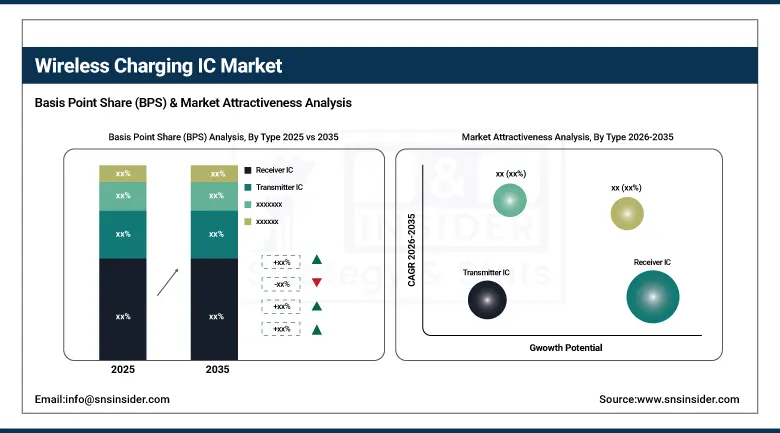
By Type, receiver ICs dominated the wireless charging IC market with 64% share in 2025, while transmitter ICs are growing as multi-coil and high-power pad designs increase per-pad IC content value.
- By Technology, electromagnetic induction dominated the wireless charging IC market with 60% of total revenue in 2025, while magnetic resonance is the fastest growing technology for mid-range power and spatial freedom applications.
- By Power Range, low-range and mid-range wireless charging ICs dominated the market in 2025, while high-range above 51W is the fastest growing power segment with a CAGR of 24.07% driven by EV and laptop charging requirements.
- By Application, consumer electronics dominated the wireless charging IC market in 2025, while the automotive segment is the fastest growing application with a CAGR of 24.52% driven by EV integration and smart vehicle wireless charging adoption.
By Type, receiver ICs dominate, transmitter ICs grow with high-power applications
The market share of receiver ICs contributed 64% of the total wireless charging IC market in 2025 due to their per-unit installation necessity for each Qi-compliant device, where the volume of the product is proportionate to the total number of Qi-compatible smartphones, smartwatches, and earbuds, which account for the biggest source of demand for wireless charging ICs worldwide. The functionality of the receiver IC in terms of AC to DC rectification, voltage regulation to meet battery charging needs, Qi protocol communication, and temperature/over-voltage protection results in significant semiconductor value content in each IC, keeping revenue focus on the receiver despite the seeming equivalence of the two components.
The automotive wireless charging IC segment, whose transmitter pad installation in vehicle centre consoles and passenger compartment charging surfaces creates per-vehicle transmitter IC procurement at automotive reliability and temperature specification grades whose pricing substantially exceeds equivalent consumer electronics components, is growing at 24.52% CAGR as the automotive industry's progressive standard equipment inclusion of wireless charging moves from premium to mainstream vehicle categories across global automotive production.
By Technology, electromagnetic induction dominates, magnetic resonance grows fastest
The contribution from electromagnetic induction towards total revenue earned by wireless charging chips was 60% in 2025 due to the fact that electromagnetic induction technology is the earliest wireless technology with a wide commercial application, where almost all leading smartphone manufacturers implement the Qi standard wireless chargers in their product lines, resulting in a huge user base. Inductive coupling technology works on the principle of proximity where power efficiency is highest when coils separation is under 5 millimetres, which is enabled by a use case where smartphone charging pads are employed.
Magnetic resonance technology is growing fastest as its ability to maintain efficient power transfer across coil separations of several centimetres and with coil misalignment tolerance enables spatial freedom use cases including laptop wireless charging, furniture-integrated charging surfaces, and EV wireless charging whose coil separation and alignment variation requirements exceed inductive coupling's practical operating range.
Regional Analysis
|
Region |
Major Country |
Share within Region, 2025 (%) |
|---|---|---|
|
North America |
United States |
82.47% |
|
Asia Pacific |
China |
42.84% |
|
Europe |
Germany |
28.47% |
|
Middle East & Africa |
UAE |
22.84% |
|
Latin America |
Brazil |
43.84% |
North America Wireless Charging IC Market Insights
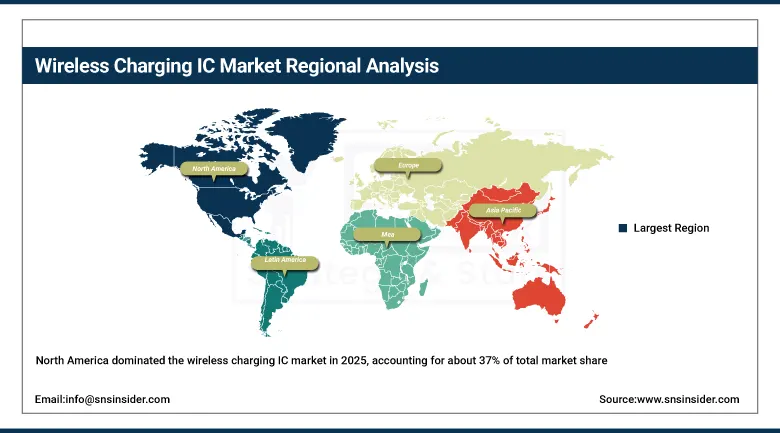
North America dominated the wireless charging IC market in 2025, accounting for about 37% of total market share by way of commercial prominence of prominent wireless charging IC design firms, the largest global installed base of Apple iPhones generating the highest demand for Qi wireless charging accessories, and the earliest uptake of automotive wireless charging technology which has been included by U.S. carmakers like Ford, General Motors, and Tesla in their respective vehicle models. The United States generated nearly 82.47% of total market revenues due to the commercial dominance of Qualcomm, Texas Instruments, NXP Semiconductors, Broadcom, and Integrated Device Technology.
Get Customized Report as per Your Business Requirement - Enquiry Now
Asia Pacific Wireless Charging IC Market Insights
The Asia Pacific region is experiencing the highest growth rate for the wireless charging IC market in the world, owing to its consumer electronics manufacturing base that produces the bulk of global Qi-compliant smartphones and wearables, thereby leading to the procurement of wireless charging ICs from such smartphones and wearables. China is responsible for generating roughly 42.84% of the total Asia Pacific revenues on account of the widespread adoption of wireless charging technology by smartphones manufactured by OEMs like Xiaomi, OPPO, Vivo, and Huawei, which results in massive procurement of wireless charging ICs. On the other hand, South Korea generates high-quality demand in the region due to the flagship wireless charging IC consumption of Samsung.
Europe Wireless Charging IC Market Insights
In 2025, Europe will be responsible for holding a major market share of the global wireless charging IC market revenues owing to the extensive use of wireless charging ICs in automotive applications in the premium automotive manufacturing center that includes Germany, Sweden, and Italy due to their OEM brands like BMW, Mercedes Benz, Volkswagen, Volvo, and Stellantis which are early adaptors of integrated wireless charging technology in vehicles. Around 28.47% of European revenues will be generated from the automotive manufacturing industry due to the presence of the automotive manufacturing industry and increased adoption of industrial wireless charging in smart manufacturing applications.
MEA & Latin America Wireless Charging IC Market Insights
Wireless Charging ICs are witnessing an increase in their usage in Middle East & Latin American countries, owing to the growing number of smartphones in these regions, consumer electronics purchases by the rising middle class population, and growth in the automotive industry. United Arab Emirates tops MEA revenue figures by virtue of its high consumer electronics expenditure per capita, modern consumers in the region's key cities, and rising premium segment of the automotive industry, which is using Qi wireless charging pads for vehicles, resulting in the purchase of wireless charging ICs in this region. Brazil tops Latin America revenue figures with around 43.84% contribution by virtue of its smartphone market, growing automotive production sector that is adopting wireless charging technology for automobiles and increasing consumer electronics retailing market.
Market Dynamics
Growth Driver: Universal adoption of Qi wireless charging standards and expanding wireless charging infrastructure for electric vehicles are driving demand for wireless charging ICs across multiple applications.
The expansion in the market of wireless charger ICs depends on the coming together of two factors: the acceptance of the universal Qi standard across smartphone vendors to form a consumer electronics volume base, and the potential for electric vehicle wireless charging to emerge as the next valuable application front. The adoption of the Qi standard by Apple via its MagSafe implementation along with the Qi2 development, where the Qi standard integrated Apple’s magnetic docking solution into the broader ecosystem, marked the end of the final interoperability divide and set up the environment for the broadest technological standardisation in consumer electronics since Bluetooth.
Restraint: Thermal management issues at higher power levels and higher costs compared to wired charging solutions limit adoption in price-sensitive markets.
Energy is lost through heat during wireless power transfer, which increases with respect to the power being transferred. High-power wireless charging, when the output is over 30 W, produces enough heat to necessitate the need for cooling. Active cooling is costly, heavy, and produces noise, which prevents its use in slim portable devices due to these drawbacks. Wireless power chips, along with the coils used during wireless power transmission, add additional costs per device, thus making wireless power transfer not economically viable in affordable smartphones.
Opportunity: Emerging over-the-air wireless power transmission and multi-device charging technologies are creating new growth opportunities beyond conventional proximity-based charging.
Power transmission through far-field wireless methods using RF energy harvesting, microwave beam, and optical power transfer based on photovoltaic cells would be the technological frontier following near-field inductive and resonant power transmission techniques which would allow wireless power transmission at greater distances without wires. This technological breakthrough, upon its commercialization, would give rise to an entirely new product line for power transmitter and receiver chips for use at radio frequencies compared to the hundreds of kilohertz used in the case of inductive and resonant wireless power transmission systems. The Energies WattUp far-field wireless power charger technology, along with other wireless far-field power chargers made by companies like ossia, among others, is considered one of the cutting-edge products being deployed commercially in IoT sensors and retail shelf-edge units.
Recent Developments:
-
2025: Qualcomm announced its next-generation Quick Charge wireless power delivery platform supporting up to 100W wireless charging with GaN power amplifier integration, substantially narrowing the speed gap between wireless and wired fast charging for flagship smartphones and laptops.
- 2025: Texas Instruments launched its BQ500 transmitter IC series with AI-powered foreign object detection using machine learning pattern recognition, substantially reducing false detection rates from metallic objects and improving consumer wireless charging pad reliability and satisfaction.
Wireless Charging IC Market Key Players are:
-
Qualcomm Technologies Inc.
- Texas Instruments Incorporated
- NXP Semiconductors NV
- Broadcom Inc.
- STMicroelectronics NV
- Infineon Technologies AG
- ROHM Co. Ltd.
- MediaTek Inc.
- Semtech Corporation
- Analog Devices Inc.
- Cirrus Logic Inc.
- Renesas Electronics Corporation
- Microchip Technology Inc.
- IDT (Integrated Device Technology, Renesas)
- Maxim Integrated (Analog Devices)
- Energizer Holdings Inc.
- indie Semiconductor Inc.
- Chargerlab Ltd.
- Green Solution Technology Co. Ltd.
- EDOM Technology Co. Ltd.
Wireless Charging IC Market Report Scope:
| Report Attributes | Details |
|---|---|
| Market Size in 2025 | USD 4.07 Billion |
| Market Size by 2035 | USD 23.26 Billion |
| CAGR | CAGR of 22.4% From 2026 to 2035 |
| Base Year | 2025 |
| Forecast Period | 2026-2035 |
| Historical Data | 2022-2024 |
| Report Scope & Coverage | Market Size, Segments Analysis, Competitive Landscape, Regional Analysis, DROC & SWOT Analysis, Forecast Outlook |
| Key Segments | • By Type (Receiver IC, Transmitter IC) • By Technology (Electromagnetic Induction, Magnetic Resonance, Radio Frequency) • By Power Range (Low Range Up to 5W, Mid-Range 5W-50W, High Range Above 51W) • By Application (Consumer Electronics, Automotive, Healthcare, Industrial, Telecom & IT, Others) |
| Regional Analysis/Coverage | North America (US, Canada), Europe (Germany, UK, France, Italy, Spain, Russia, Poland, Rest of Europe), Asia Pacific (China, India, Japan, South Korea, Australia, ASEAN Countries, Rest of Asia Pacific), Middle East & Africa (UAE, Saudi Arabia, Qatar, South Africa, Rest of Middle East & Africa), Latin America (Brazil, Argentina, Mexico, Colombia, Rest of Latin America). |
| Company Profiles | Qualcomm Technologies Inc., Texas Instruments Incorporated, NXP Semiconductors NV, Broadcom Inc., STMicroelectronics NV, Infineon Technologies AG, ROHM Co. Ltd., MediaTek Inc., Semtech Corporation, Analog Devices Inc., Cirrus Logic Inc., Renesas Electronics Corporation, Microchip Technology Inc., IDT (Integrated Device Technology, Renesas), Maxim Integrated (Analog Devices), Energizer Holdings Inc., indie Semiconductor Inc., Chargerlab Ltd., Green Solution Technology Co. Ltd., EDOM Technology Co. Ltd. |
Frequently Asked Questions
The Wireless Charging IC Market is expected to grow at a CAGR of 22.4% from 2026 to 2035.
The Wireless Charging IC Market was valued at USD 4.07 Billion in 2025.
Universal Qi standard adoption across the global smartphone ecosystem creating the largest coordinated consumer electronics technology deployment, electric vehicle wireless charging integration creating a new high-value IC application category.
The receiver IC segment dominated the Wireless Charging IC Market with 64% share in 2025.
North America dominated the Wireless Charging IC Market in 2025, holding approximately 37% of global market share.
