According to the latest SNS Insider report on the global MEMS Gyroscopes Market, the industry is experiencing sustained expansion as electronics manufacturers increasingly integrate compact motion sensors into smartphones, vehicles, robotics and navigation equipment.
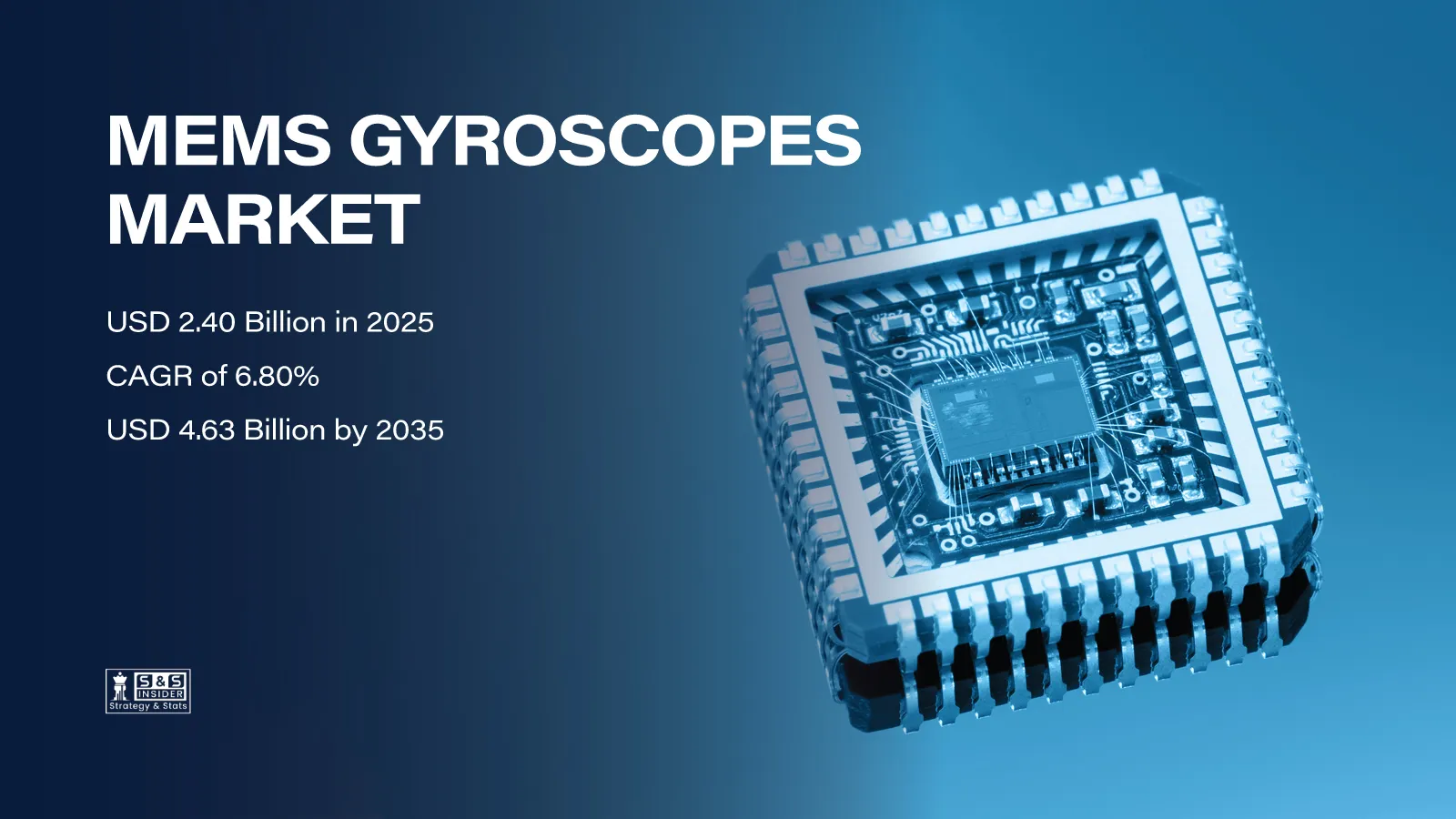
The global MEMS gyroscopes market was valued at USD 2.40 billion in 2025, is estimated to reach USD 2.56 billion in 2026 and is projected to attain USD 4.63 billion by 2035, registering a CAGR of 6.80% during 2026–2035.
Microelectromechanical system gyroscopes measure angular velocity and enable precise movement detection, stabilization and orientation tracking. Their compact construction, low power consumption and compatibility with semiconductor manufacturing make them essential components across consumer and industrial electronics.
Market demand is shifting toward integrated inertial measurement units combining gyroscopes, accelerometers and embedded processing capabilities. These configurations simplify device architecture while improving motion tracking performance.
Consumer electronics remains the largest end-use industry, while automotive applications offer faster expansion through electronic stability control, advanced driver assistance systems and vehicle navigation.
Asia-Pacific leads global demand due to its extensive electronics manufacturing ecosystem and is also projected to record the fastest regional growth.
Through 2035, manufacturers offering improved sensing accuracy, temperature stability, automotive qualification and integrated motion processing are expected to strengthen their competitive positions.
MEMS Gyroscopes Market Size and Forecast
|
Market Indicator |
Value |
|---|---|
|
Market Size, 2025 |
USD 2.40 Billion |
|
Market Size, 2026 |
USD 2.56 Billion |
|
Market Size, 2035 |
USD 4.63 Billion |
|
CAGR, 2026–2035 |
6.80% |
|
Largest Region, 2025 |
Asia-Pacific (39.84%) |
|
Fastest-Growing Region |
Asia-Pacific (8.13% CAGR) |
|
Dominant Axis Type |
Triple-Axis (61.38%) |
|
Dominant End Use |
Consumer Electronics (46.27%) |
Demand Drivers and Constraints
Primary Demand Drivers
-
Smartphone and wearable integration: Expanding use of motion tracking, camera stabilization and gesture recognition sustains gyroscope demand across connected devices.
-
Automotive safety adoption: Electronic stability control, rollover detection and advanced driver assistance systems increase inertial sensor requirements.
-
Drone and robotics expansion: Autonomous machines require accurate orientation sensing, balance control and navigation support.
-
Extended reality applications: AR and VR headsets depend on responsive angular motion tracking for immersive interaction.
-
Advanced sensor integration: Six-axis and nine-axis modules reduce component footprints while improving motion detection capabilities.
-
Defense navigation requirements: Demand for compact inertial sensors is increasing in environments where satellite navigation signals are unreliable.
Potential Growth Constraints
-
Intense pricing competition among consumer electronics sensor manufacturers.
-
Performance limitations involving drift, temperature sensitivity and long-term stability.
-
Dependence on specialized semiconductor fabrication and packaging infrastructure.
-
Lengthy qualification procedures for aerospace, defense and automotive applications.
-
Mature smartphone markets and extended device replacement cycles.
Demand Structure by Axis Type
Triple-Axis MEMS Gyroscopes (2025 Market Share: 61.38%; Forecast CAGR: 7.92%)
Triple-axis gyroscopes dominate the market because they measure rotational movement along three perpendicular axes, enabling comprehensive orientation tracking. Their widespread integration into smartphones, gaming controllers, wearable devices and automotive systems supports substantial production volumes. Compared with multiple single-axis components, integrated triple-axis devices offer packaging efficiency and simplified system design. Demand is expected to accelerate as autonomous robots, drones and extended reality equipment require increasingly accurate multidirectional sensing. The segment is also the fastest-growing axis category through 2035.
Current trend: Growing preference for compact three-axis motion sensors.
Major trends: Six-axis sensor integration, low-power architectures, improved calibration and multidirectional navigation.
Demand Structure by Gyroscope Type
Tuning Fork Gyroscopes (2025 Market Share: 35.46%)
Tuning fork gyroscopes maintain the leading position due to their established manufacturing processes, reliable vibration measurement and cost-effective performance. Their vibrating structures provide resistance to external disturbances, making them suitable for automotive electronics, mobile devices and industrial motion detection. High-volume semiconductor production and mature component designs support competitive pricing. Continued demand from consumer electronics and vehicle safety systems is expected to sustain their commercial importance, although specialized resonator technologies are expanding into higher-precision applications.
Current trend: Stable demand for established, cost-efficient sensing architectures.
Major trends: Miniaturization, vibration resistance, integrated electronics and manufacturing efficiency.
Wine-Glass Resonator Gyroscopes (Forecast CAGR: 9.36%)
Wine-glass resonator gyroscopes represent the fastest-growing technology segment, supported by demand for improved stability and reduced measurement drift. Their resonating structures enable higher-precision angular sensing for navigation equipment, autonomous platforms and defense applications. Manufacturers are developing improved calibration processes and temperature compensation techniques to extend performance reliability. As drones, surveying equipment and specialized navigation systems require smaller inertial components, wine-glass resonators offer opportunities to replace larger sensing technologies in suitable applications.
Current trend: Increasing adoption of precision-oriented resonator designs.
Major trends: Enhanced bias stability, tactical navigation, temperature compensation and compact inertial systems.
Demand Structure by Application
Mobile Devices (2025 Market Share: 41.18%)
Mobile devices account for the largest application share, reflecting the extensive use of gyroscopes in smartphones, tablets and connected electronics. These sensors support camera stabilization, screen orientation, motion-controlled gaming and augmented reality functions. Although smartphone replacement cycles are lengthening, manufacturers continue introducing improved imaging and motion-sensitive features. Premium handsets and connected accessories create opportunities for advanced integrated sensors with lower power consumption and improved accuracy.
Current trend: Sustained demand driven by increasingly sophisticated mobile functionality.
Major trends: Optical image stabilization support, motion-based interfaces, augmented reality and sensor fusion.
Navigation and Stabilization Systems (Forecast CAGR: 8.74%)
Navigation and stabilization systems represent the fastest-growing application category as drones, autonomous vehicles, robotics and industrial equipment require dependable motion information. MEMS gyroscopes provide angular rate measurements essential for maintaining orientation and controlling movement. Their relatively low weight, compact dimensions and energy efficiency support adoption where conventional optical systems are impractical. Improving sensor accuracy is expected to expand deployment in surveying equipment, camera stabilization platforms and positioning systems operating under unreliable satellite reception.
Current trend: Accelerating integration into autonomous navigation platforms.
Major trends: Drone stabilization, robotic navigation, precision positioning and inertial measurement integration.
Demand Structure by End Use
Consumer Electronics (2025 Market Share: 46.27%)
The largest end-use demand is from consumer electronics, due to high production volumes of smart phones, smartwatches, gaming devices, cameras and immersive headsets. Manufacturers are increasingly combining gyroscopes with accelerometers in a small space to provide a high level of motion sensing. Ongoing developments in fields like wearable electronics and augmented reality justify upgrades to components, even as pricing pressure in mature product categories persists. Through 2035, better energy efficiency and built-in motion processing will continue to be major purchase considerations for electronics makers.
Current trend: Continued integration of compact inertial sensors into connected devices.
Major trends: Wearable motion tracking, gesture interfaces, sensor fusion and low-power operation.
Automotive (Forecast CAGR: 9.05%)
Automotive is projected to be the fastest-growing end-use segment as vehicle manufacturers expand electronic safety, stabilization and navigation capabilities. MEMS gyroscopes support electronic stability control, rollover monitoring, dead reckoning and selected advanced driver assistance functions. Electrification and increasingly sophisticated vehicle architectures create additional opportunities for qualified inertial sensing components. Automotive suppliers are emphasizing functional safety, temperature tolerance, long-term reliability and consistent supply availability to meet demanding vehicle development requirements.
Current trend: Rising integration of automotive-grade motion sensors.
Major trends: Vehicle stability control, ADAS integration, navigation assistance and functional-safety qualification.
Regional Market Dynamics
Asia-Pacific (2025 Market Share: 39.84%; Forecast CAGR: 8.13%)
Asia-Pacific dominates the MEMS gyroscopes market and is also expected to register the fastest growth through 2035. China leads regional demand through its extensive smartphone, automotive electronics and consumer device manufacturing industries. Japan brings proven sensor technologies and South Korea and Taiwan are supporting electronics production and semiconductor manufacturing. India and Southeast Asian countries are also developing their electronics assembly and component capabilities. Also, increasing electric vehicle production, industrial automation and robotics investment offer additional growth opportunities across the region.
Direction: Market leadership and accelerated expansion through electronics manufacturing, automotive demand and semiconductor investment.
North America — Second-Largest Regional Market
North America holds the second-largest market position, supported by demand from the United States and Canada. The U.S. market was valued at USD 520.00 million in 2025, with a projected CAGR of 5.70% during 2026–2035. Defense navigation, aerospace electronics, industrial automation and automotive safety systems represent important demand sources. Research investment in high-performance inertial sensors also supports technological development, while semiconductor manufacturing initiatives create opportunities for regional supply diversification.
Direction: Continued growth supported by defense technology, automotive electronics and precision sensing innovation.
Europe — Third-Largest Regional Market
Europe is the third largest regional market with Germany as the leading country. OEMs in the automotive and industrial equipment markets drive demand for sensors used in stability control, motion measurement and navigation. Defense, aerospace and industrial applications are provided by the United Kingdom, France and Italy. European semiconductor initiatives and the growing interest in domestic component production are supporting additional opportunities for specialized MEMS manufacturers.
Direction: Steady expansion through automotive safety, industrial automation and advanced inertial technology.
Latin America — Emerging Automotive and Electronics Demand
MEMS gyroscopes find their major markets in Latin America in Brazil, Mexico, Argentina and Colombia. Smartphone imports and regional electronics assembly provide a ready consumer base, and automotive production offers a direct source of demand for motion sensing components. There are also opportunities in industrial equipment, agricultural machinery, fleet telematics and commercial drones. Market development remains sensitive to currency fluctuations, import costs and investment conditions.
Direction: Gradual growth supported by automotive manufacturing, consumer electronics and industrial applications.
Middle East & Africa — Defense and Smart Infrastructure Opportunities
Middle East & Africa market is driven by growth in consumer electronics, smart infrastructure development, and defense modernization. Saudi Arabia and the United Arab Emirates are backing demand for surveillance systems, unmanned platforms and advanced navigation equipment. Israel offers specialized defense electronics capabilities and South Africa is an important market for industrial and mining equipment. There is very little domestic sensor manufacturing which keeps reinforcing the dependence on imported components.
Direction: Emerging expansion through defense systems, smart infrastructure and connected electronics.
Competitive Landscape
The MEMS gyroscopes market includes major semiconductor manufacturers and specialized inertial sensor developers. Key participants include STMicroelectronics, Bosch Sensortec, TDK Corporation, Analog Devices, Murata Manufacturing, Honeywell, Silicon Sensing Systems, Sensonor, Seiko Epson, Panasonic Industry, ROHM (Kionix) and MEMSIC.
Competitive differentiation increasingly depends on sensing precision, power efficiency, packaging dimensions, manufacturing scale and software integration. Automotive qualification and navigation-grade performance are particularly important for suppliers pursuing higher-value applications. Recent developments highlighted by SNS Insider include Bosch Sensortec's BMI563 inertial measurement unit in June 2026, Silicon Sensing's CRG21 gyroscope introduction in July 2026 and STMicroelectronics' automotive safety combination sensor launch in October 2026.
Market Outlook (2026–2035)
The global MEMS gyroscopes market is projected to hit USD 4.63 billion by 2035, fueled by growing motion sensing applications in consumer electronics, vehicles, robotics and defense equipment. As manufacturers integrate multiple sensing functions into small modules, triple-axis devices are expected to continue to play an important role. Meanwhile, wine-glass resonators and navigation-oriented applications offer opportunities for higher-performance products.
Automotive safety systems, autonomous equipment and advanced navigation technologies will create additional demand beyond mature smartphone applications. However, pricing competition, semiconductor supply dependencies and precision limitations will remain important industry challenges. Asia-Pacific is expected to retain its leadership, while North America and Europe continue supporting innovation in automotive and high-performance inertial sensing.
Overall, market growth through 2035 will increasingly depend on improved sensor accuracy, advanced system integration, manufacturing efficiency and the expansion of motion sensing into higher-value applications.