
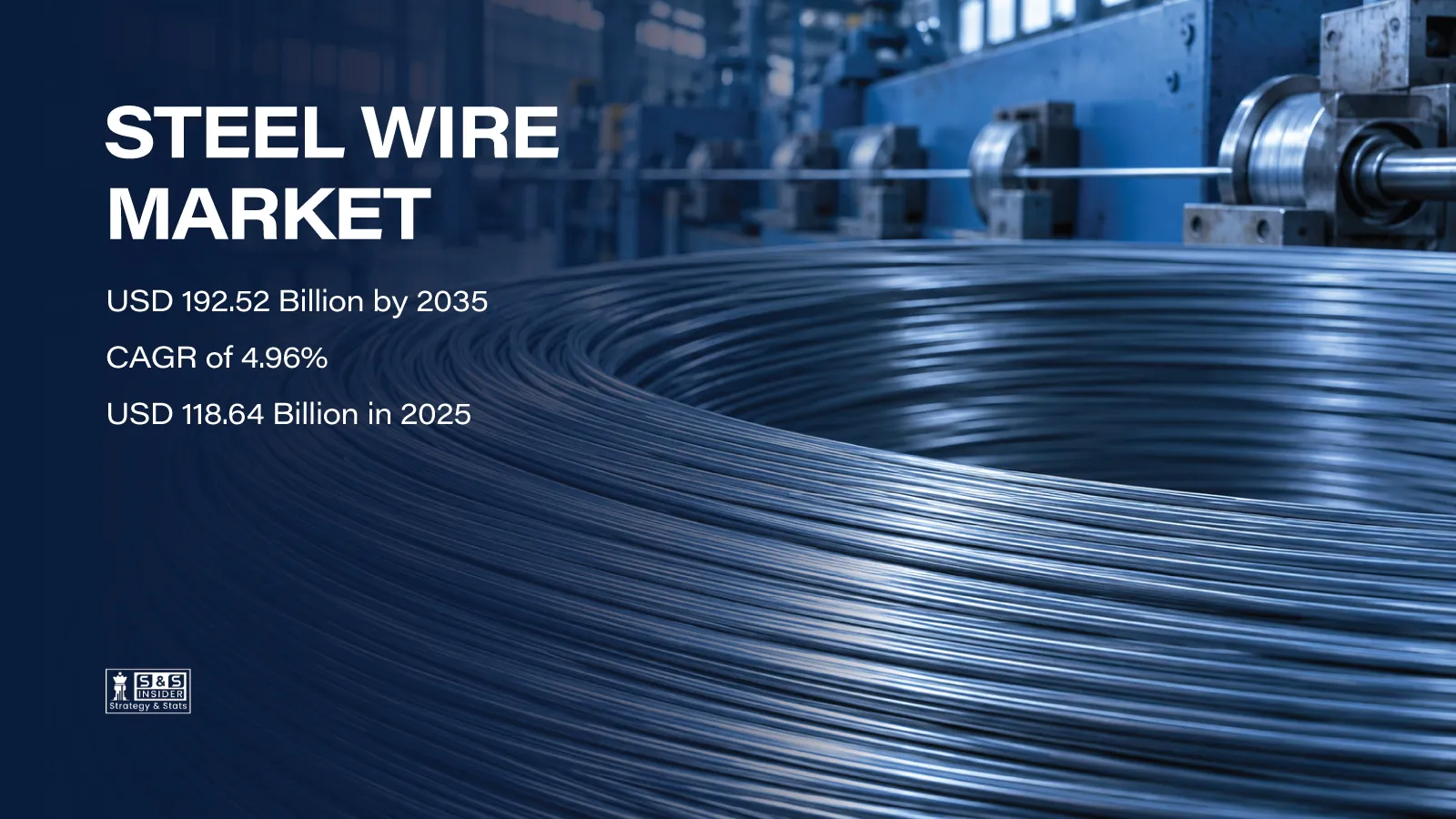
The global steel wire market is entering a new phase of industrial development as infrastructure modernization, automotive production, renewable energy investment and manufacturing expansion strengthen demand for high-performance wire products. Steel wire remains essential for structural reinforcement, mechanical components, transportation equipment, industrial machinery and energy infrastructure because of its tensile strength, durability, versatility and recyclability.
According to the SNS Insider Steel Wire Market, construction and automotive applications represent important demand centers, while carbon steel remains a major material category. The industry includes carbon steel, alloy steel and stainless steel wire used across construction, automotive, industrial, energy and agricultural applications.
Between 2026 and 2035, demand is expected to be influenced by public infrastructure spending, expanding industrial capacity, electrification and growing requirements for durable materials in demanding operating environments. Manufacturers are also focusing on corrosion-resistant coatings, higher-strength wire grades, automated production and improved processing efficiency.
Geographically, Asia-Pacific benefits from extensive steel manufacturing capacity and large construction and automotive industries. North America presents additional opportunities through infrastructure upgrades, industrial investment and energy projects.
The long-term market outlook points toward continued demand for specialized steel wire products, although raw material price volatility, energy costs, international trade restrictions and competition from alternative materials remain important constraints.
Demand Drivers and Constraints
Primary Demand Drivers
-
Infrastructure expansion: Investments in bridges, highways, railway networks, commercial buildings and industrial facilities support demand for steel wire reinforcement, cables and structural applications.
-
Automotive manufacturing: Steel wire is used in tire reinforcement, springs, fasteners, mechanical assemblies and vehicle components requiring strength and durability.
-
Renewable energy investment: Wind power installations, energy infrastructure and industrial lifting applications require specialized wire ropes and high-strength products.
-
Industrial automation: Expanding production facilities and material-handling systems increase demand for wire-based mechanical components and equipment.
-
Advanced material development: High-tensile and corrosion-resistant steel wire products are gaining importance in applications requiring longer service life.
-
Agricultural modernization: Mechanized farming, fencing systems and agricultural equipment support additional demand.
Potential Growth Constraints
-
Fluctuating steel rod prices and manufacturing energy costs.
-
Competition from synthetic ropes, composite materials and alternative reinforcement solutions.
-
International tariffs and regional trade restrictions.
-
Environmental compliance requirements and carbon emissions associated with steel production.
-
Supply chain disruptions affecting raw materials and finished wire products.
Demand Structure by Material Type
Carbon Steel — Leading Material Segment
Carbon steel is the largest material segment in steel wire industry, supported by cost competitiveness, mechanical strength and wide industrial applications. It is flexible and easily formed and is useful for fencing, tying, mesh and general fabrication. High carbon steel wire has higher tensile strength and finds its main use in springs, tire reinforcement, mechanical components and specialty cables.
Construction and automotive manufacturers use carbon steel wire because it can be processed to a variety of diameters, tensile specifications and surface finishes. We expect a supportive demand environment, with infrastructure activity and manufacturing expansion, especially in emerging economies, over the 2026-2035 period.
Current trend: Continued demand for cost-efficient, high-strength carbon steel wire across construction and industrial applications.
Major trends: Improved drawing technology, galvanized finishes, high-tensile grades and energy-efficient wire processing.
Stainless Steel — Corrosion-Resistant Applications Gain Importance
Stainless steel wire is expected to find wider acceptance for industrial applications requiring corrosion resistance, temperature tolerance and longer product service life. Its properties make it suitable for use in marine equipment, industrial springs, medical instruments, food processing equipment, architectural elements and specialized fastening systems.
The industry's demand for lower maintenance and longer equipment life is increasing and this is leading to the greater use of stainless steel wire in applications exposed to moisture, chemicals or harsh environmental conditions. Stainless steel products generally cost more than conventional carbon steel wire, but the performance benefits can justify the cost in critical applications.
Current trend: Increasing demand for corrosion-resistant wire products in specialized industrial environments.
Major trends: Precision manufacturing, advanced stainless steel grades, protective surface finishes and high-performance mechanical applications.
Alloy Steel — Specialized Industrial Requirements
Alloy steel wire is used when tensile strength, wear resistance, fatigue properties and controlled mechanical properties are needed. Industrial machinery, automotive parts, heavy equipment and precision engineering products require special alloy steel formulations.
There is an increasing demand for quality and process technologies enhancing the mechanical properties under repetitive loading conditions. Demand for alloy steel wire will be tied to the purchase of industrial equipment through 2035.
Current trend: Growing emphasis on application-specific alloy wire specifications.
Demand Structure by End-Use Industry
Construction — Major Steel Wire Consumption Center
Construction continues to be among the most significant end-user industries for steel wire products. Steel wire ropes, strands, reinforcement systems, and structural cables are extensively employed in bridges, buildings, transport infrastructure, and industrial construction projects.
Programs for infrastructure improvement have been driving demand for construction materials that are both durable and able to meet high standards. Steel wire is also utilized in prestressed concrete systems where engineers try to increase load-bearing capabilities. In the period from 2026 to 2035, transportation infrastructure, urban construction, and industrial construction will continue to drive demand.
Current trend: Infrastructure investment supporting demand for structural and reinforcement wire.
Major trends: Prestressed concrete applications, galvanized wire, bridge cables and high-strength reinforcement systems.
Automotive — Expanding Component Applications
The automotive industry is yet another notable source of demand for steel wires.
Steel wires find applications in tire bead reinforcement, springs, fasteners, control systems, and mechanical assemblies. The automotive manufacturers need materials that can endure stress, vibrations, and tough operating environments.
Though the rise of electric vehicles is changing the automotive supply chains, the demand for steel wires still depends on the mechanical assemblies, tires, and special vehicle systems and not the electric wiring which requires the use of conductive metals like copper and aluminum. The innovation of tougher and lighter assemblies might present further demand for wire products.
Current trend: Demand for high-performance wire components across passenger and commercial vehicle production.
Major trends: Advanced tire reinforcement, precision springs, component durability and optimized material specifications.
Energy and Industrial Applications
Energy infrastructure and industrial manufacturing increase demand for high-strength steel wire products. Wire ropes, lifting wires, construction wires and reinforcement wires are found in applications such as energy infrastructure, industrial machinery, and wind energy plants.
These machines have to withstand strain and perform efficiently despite mechanical strains. Industrial manufactures are using advanced coating technologies to make machines long lasting.
Current trend: Increasing demand for specialized wire products supporting energy and industrial infrastructure.
Major trends: Renewable energy installations, industrial lifting systems, corrosion protection and high-strength wire rope development.
Regional Market Dynamics
Asia-Pacific — Leading Regional Market
Asia-Pacific remains a leading region in the global steel wire market, backed by large steel making capacity, large manufacturing clusters and significant infrastructure investment. China, India, Japan and South Korea contribute key regional production and consumption.
Steel wire demand continues to be driven by activity in construction, automotive manufacturing, production of industrial machinery, and transportation infrastructure.
Existing steel supply chains and large domestic and international customers also benefit regional manufacturers. Continued investment in manufacturing and industrial development is expected to drive the Asia-Pacific’s importance through 2035.
Direction: Strong market position supported by manufacturing scale and infrastructure development.
North America — Infrastructure and Industrial Investment
North American steel wire producers find openings in the development of transport infrastructure, industrial buildings, and the energy industry.
The USA continues to be an important regional market for such applications as construction, automobile parts, machinery manufacturing, and other industrial products. Procurement needs and production possibilities could be a factor in the search for dependable supply agreements.
Direction: Demand supported by infrastructure upgrades, industrial activity and specialized manufacturing.
Europe — Advanced Manufacturing and Sustainability
Europe's steel wire market is influenced by automotive manufacturing, industrial machinery, construction and environmental performance requirements. The demand for high quality wire products and precision engineered wire products is from Germany, Italy, France and other industrialized economies.
European manufacturers are putting more emphasis on production efficiency, material traceability, recycling and emissions reductions. Demand for specialty steel grades and corrosion-resistant products supports differentiation in higher value applications.
Direction: Market opportunities centered on advanced materials, efficient production and industrial sustainability.
Latin America and Middle East & Africa
Steel wire producers have opportunities to develop in Latin America and Middle East & Africa. Demand in the region is driven by infrastructure construction, agricultural modernization, mining, energy projects and industrial investment.
Key industrial markets in the region include Brazil and Mexico. Saudi Arabia, UAE and South Africa offer opportunities for construction and industrial development. Manufacturing investment, infrastructure investment and regional economic conditions will set the pace of expansion into new markets.
Direction: Gradual expansion associated with construction, energy and industrial development.
Competitive Landscape
The global steel wire industry includes integrated steel producers, specialized wire manufacturers and companies supplying engineered wire products. Representative participants identified by SNS Insider include ArcelorMittal, Bekaert, JFE Steel, Nippon Steel, Tianjin Huayuan Metal Wire Products, Van Merksteijn International, Tata Steel, Kobe Steel, Insteel Industries and WireCo.
Competition is influenced by product quality, tensile strength, pricing, production efficiency, supply reliability and customer-specific technical requirements. Manufacturers are also focusing on specialty wire development, improved coatings, automated drawing operations and production processes that reduce energy consumption and material waste.
Market Outlook (2026–2035)
The global steel wire market is anticipated to continue development through 2035 as construction, transportation, manufacturing and energy industries continue to require durable metal products. Infrastructure investment remains an important driver, notably for structural cables, prestressed concrete applications and reinforcement materials.
Automotive demand will continue to benefit consumption of engineered steel wire, while modernization of industry and investment in renewable energy are opening the door to specialized products.
Manufacturers able to supply consistent quality of materials, corrosion resistance and performance for specific applications are likely to enhance their competitive positions.
However, changes in raw material prices, environmental standards and competition from substitute materials may affect profitability and purchasing decisions. The Asia-Pacific region will likely maintain its strategic importance due to its manufacturing scale, while North America and Europe will provide opportunities for higher-performance products and industrial upgrades.
Overall, the steel wire market outlook through 2035 remains supported by infrastructure modernization, industrial manufacturing demand, material innovation and the continuing need for reliable high-strength engineering products.



