As per the latest SNS Insider IoT Device Market report, connected consumer electronics, industrial automation systems and intelligent healthcare devices are increasingly being integrated into everyday operations, and the global market is entering a period of substantial expansion.
The global IoT device market is structurally shifting from stand-alone connected products to smart ecosystems that can process data in real-time, make automated decisions and interoperate across multiple platforms. Advancements in edge artificial intelligence, low-power wireless connectivity and semiconductor miniaturization are expanding the commercial applications of connected devices.
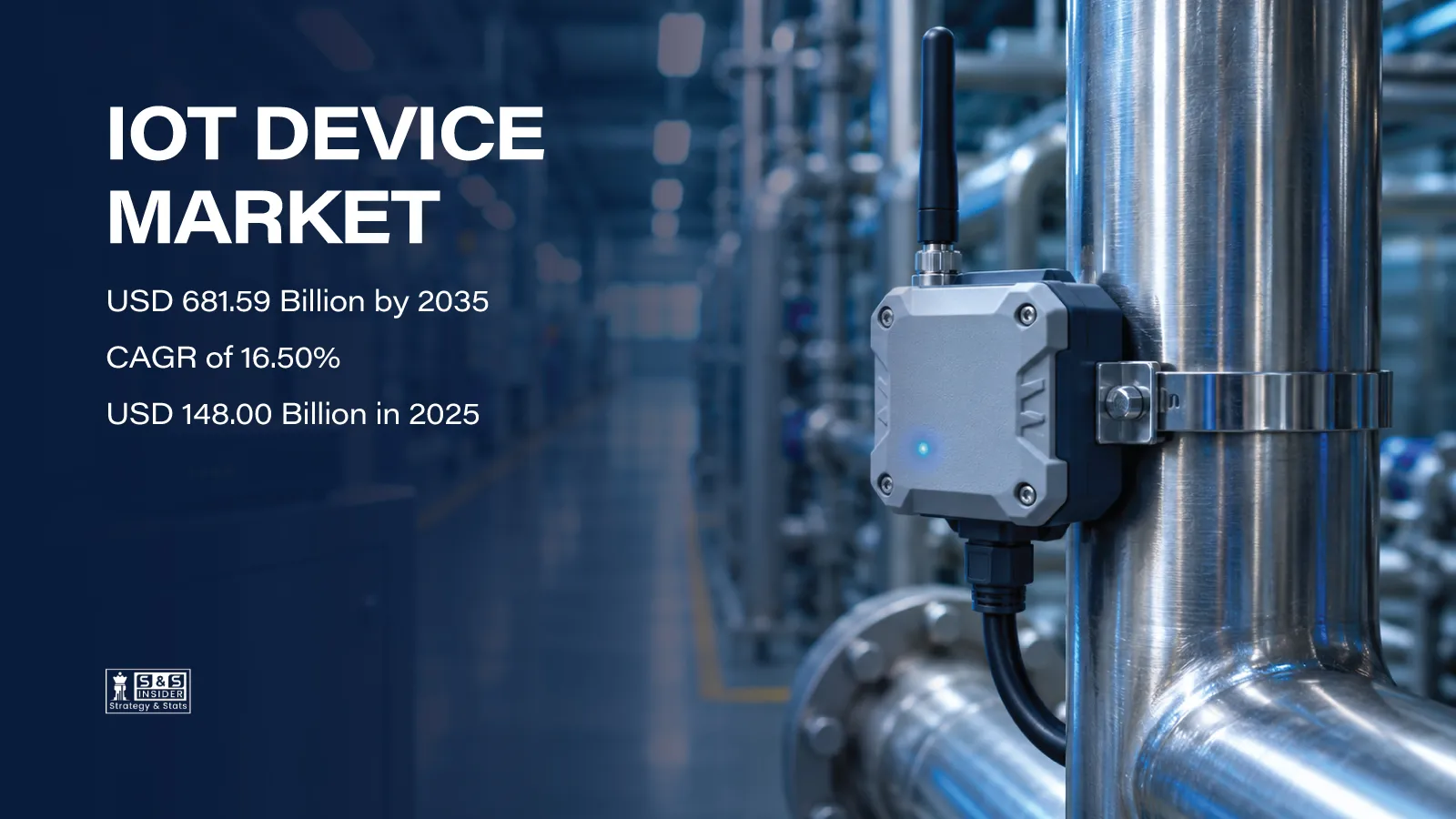
The global IoT Device Market was valued at USD 148.00 Billion in 2025, is estimated to reach USD 172.42 Billion in 2026 and is forecast to expand to USD 681.59 Billion by 2035, registering a CAGR of 16.50% during 2026–2035.
Demand is being supported by smart home adoption, industrial digitalization, connected healthcare infrastructure, and decreasing costs for sensor and wireless modules. More and more manufacturers are integrating advanced connectivity into appliances, wearables, monitoring equipment and industrial machinery.
The competitive landscape is also changing, with semiconductor companies, electronics manufacturers and technology platforms investing in edge processing, device security and integrated software ecosystems.
To Get Detailed Insights on the IoT Device Market – Request a Sample Report
In terms of geography, the Asia-Pacific is the biggest and quickest growing regional market, due to long established electronics manufacturing capabilities and a rising need for connected infrastructure. Through 2035, industry growth will increasingly depend on device interoperability, cybersecurity compliance, connectivity efficiency and affordable intelligent hardware.
Market Size and Forecast
|
Market Indicator |
Value |
|---|---|
|
Market Size, 2025 |
USD 148.00 Billion |
|
Market Size, 2026 |
USD 172.42 Billion |
|
Market Forecast, 2035 |
USD 681.59 Billion |
|
CAGR, 2026–2035 |
16.50% |
|
U.S. Market Size, 2025 |
USD 36.48 Billion |
|
Leading Region |
Asia-Pacific (40.00%) |
|
Fastest-Growing Region |
Asia-Pacific (18.40% CAGR) |
Demand Drivers and Constraints
Primary Demand Drivers
-
Growing smart home adoption: Increasing demand for connected appliances, smart speakers, security cameras and automated household systems supports device sales.
-
Industrial digitalization: Manufacturing facilities are deploying connected sensors and monitoring equipment for predictive maintenance, equipment tracking and operational efficiency.
-
Edge AI integration: On-device intelligence reduces dependence on cloud processing and enables faster responses in industrial, automotive and consumer applications.
-
Expanding healthcare connectivity: Remote patient monitoring, connected medical equipment and wearable health devices are creating new commercial opportunities.
-
Declining component costs: Affordable microcontrollers, sensors and wireless modules are making connectivity economically viable across additional product categories.
-
Advanced wireless networks: 5G, low-power wide-area networks and satellite connectivity are extending IoT applications across remote and mobile environments.
Potential Growth Constraints
-
Cybersecurity vulnerabilities and increasingly demanding product security requirements.
-
Fragmented communication standards and compatibility challenges.
-
Semiconductor supply chain disruptions and international trade restrictions.
-
High deployment and maintenance costs for enterprise IoT systems.
-
Device obsolescence, battery limitations and long-term software support requirements.
Demand Structure by Device Type
Smart Speakers and Displays (2025 Market Share: 26.40%)
Smart speakers and displays were the leading segment by device type, contributing approximately 26.40% to the global revenue of IoT devices in 2025. The products are the main interface for the connected home, allowing consumers to control lighting, security systems, entertainment equipment and appliances via voice commands or interactive displays.
Household automation, affordable products, and the integration of artificial intelligence assistants underpin demand. Matter and Thread are also helping to drive broader adoption by improving communication between connected ecosystems. Replacement purchases and advanced AI capabilities will likely help fuel ongoing demand through 2035.
Current trend: Expanding adoption of AI-enabled smart home control devices.
Major trends: Voice assistants, Matter interoperability, personalized automation and integrated home security.
Connected Consumer Appliances (Forecast CAGR: 17.80%)
With a CAGR of 17.80% from 2026 to 2035, the connected consumer appliances are expected to witness the fastest growth among all device type segments. Smart refrigerators, washing machines, air conditioners, ovens and robotic vacuum cleaners are increasingly equipped with sensors and connectivity modules for remote operation, energy management and equipment diagnostics.
Manufacturers are creating connected appliance ecosystems that allow for software updates, predictive maintenance alerts and integration with residential energy systems. Emerging markets also offer opportunities with growing household incomes and appliance replacement cycles.
Current trend: Increasing integration of wireless connectivity into household appliances.
Major trends: Energy optimization, remote diagnostics, smart appliance ecosystems and predictive maintenance.
Demand Structure by Connectivity Technology
Short-Range Wireless (2025 Market Share: 34.70%)
Short-range wireless had the largest share of the IoT device market in 2025 at 34.70% among all connectivity technologies. Bluetooth, Zigbee, Thread and related technologies allow nearby connected products, including wearables, sensors, smart locks and home automation equipment, to talk to each other.
Their low power consumption, low cost of implementation and compatibility with popular consumer devices make them suitable for high volume applications. The continued adoption is expected to be supported by the expansion of ultra-wideband positioning capabilities, which are interoperable with smart home platforms.
Current trend: Strong demand for energy-efficient, interoperable short-range connectivity.
Major trends: Bluetooth Low Energy, Thread networking, Matter-enabled products and ultra-wideband positioning.
Cellular Connectivity (Forecast CAGR: 19.50%)
Cellular connectivity is estimated to be the fastest growing technology segment with a CAGR of 19.50% during the forecast period (2026-2035). Increased demand is being seen in vehicle tracking, smart metering, connected transportation, industrial asset monitoring and wearable technologies that require extensive network coverage.
The new 5G technologies with lower capability and low power cellular technologies are improving the connectivity options for the devices with limited energy and processing requirements. Further growth opportunities are expected from network modernization and wider deployment of connected infrastructure.
Current trend: Accelerating adoption of cellular connectivity for wide-area IoT applications.
Major trends: 5G RedCap, low-power cellular modules, fleet tracking and connected infrastructure.
Demand Structure by Application
Connected and Smart Home (2025 Market Share: 30.80%)
Connected and smart home applications represented 30.80% of the global IoT device market in 2025. Demand includes connected cameras, thermostats, lighting systems, doorbells, appliances and home monitoring equipment. Consumers are looking for more convenience, home security, remote access and energy efficiency when they buy connected products.
Interoperable device ecosystems encourage households to cluster several connected products, rather than buying stand-alone devices. Residential automation and smart energy management will keep driving market growth through 2035.
Current trend: Growing adoption of integrated residential automation ecosystems.
Major trends: Smart security, automated lighting, connected appliances and energy monitoring.
Healthcare (Forecast CAGR: 19.00%)
The healthcare application segment is expected to be the fastest growing at a CAGR of 19.00% during 2026–2035. Remote patient monitoring systems, wearable medical sensors, blood pressure devices and connected glucose monitors enable clinicians to track chosen patient indicators outside of standard clinical settings.
An aging population, the need to manage chronic diseases and growing interest in home-based healthcare services support demand. For medical device makers, reliable connectivity, data security, longer battery life and clinical performance are key priorities.
Current trend: Rapid expansion of connected patient monitoring technologies.
Major trends: Remote monitoring, wearable medical sensors, connected hospital equipment and secure healthcare data transmission.
Demand Structure by Power Source
Battery-Powered Devices (2025 Market Share: 61.50%)
Battery-powered devices dominated the global market with a 61.50% revenue share in 2025. Batteries are essential for wearables, wireless trackers, connected locks, monitoring sensors and portable medical equipment to work without being plugged into a power source.
Progress in energy-efficient microcontrollers, low-power communication modules and battery management systems is improving device life and functionality. The installation of wireless also reduces the requirements for infrastructure, which makes it easier to adopt in commercial buildings and industrial facilities.
Current trend: Increasing demand for portable, low-power connected hardware.
Major trends: Energy-efficient processors, rechargeable batteries, wireless sensors and extended operating life.
Energy-Harvested Devices (Forecast CAGR: 18.60%)
Energy-harvested IoT devices are expected to grow at a CAGR of 18.60% from 2026 to 2035. These products harvest small amounts of energy from light, motion, temperature gradients or radio frequency signals, reducing the need for conventional battery replacement.
Applications include building monitoring, industrial sensing, logistics tracking and infrastructure management, where maintenance access can be difficult or expensive. Improvements in ultra-low-power electronics are gradually expanding the commercial viability of energy-harvesting technologies.
Current trend: Increasing interest in maintenance-efficient, battery-free sensing solutions.
Major trends: Ambient energy harvesting, ultra-low-power electronics, wireless monitoring and long-life sensors.
Regional Market Dynamics
Asia-Pacific (2025 Market Share: 40.00%; Forecast CAGR: 18.40%)
In 2025, Asia Pacific region held the maximum share of 40.00% in the global IoT device revenue and will continue to be the fastest growing regional market with a CAGR of 18.40% through 2035. China is the lead regional demand, supported by extensive electronics manufacturing, semiconductor supply chains and connected consumer products. Japan and South Korea provide advanced sensor technology, industrial robotics and smart appliances. India presents growing opportunities in smart metering, connected transportation, industrial monitoring and digital infrastructure. Southeast Asian economies are also stepping up investments in smart manufacturing and connected utilities.
Direction: Continued market leadership driven by manufacturing scale, technology adoption and infrastructure modernization.
North America (2025 Market Share: 29.00%)
North America will hold 29.00% of the global IoT device market in 2025. Regional demand is led by the United States, driven by established smart home platforms, semiconductor innovation, cloud infrastructure and adoption of enterprise automation. Canada offers opportunities in energy monitoring, agriculture, mining and connected industrial equipment. The need for secure consumer devices and sophisticated industrial connectivity is fueling investment in device authentication, software updates and smart edge processing.
Direction: Sustained expansion supported by technological innovation, industrial connectivity and cybersecurity investment.
Europe (2025 Market Share: 20.00%)
Europe’s share of global market revenue in 2025 was 20.00%, driven by industrial automation, connected transportation, and building management and energy efficiency initiatives. Germany is the biggest regional market, followed by other important markets like the United Kingdom, France, Italy and Spain. With European cybersecurity and product data requirements becoming more challenging, manufacturers are increasingly focused on secure device design and regulatory compliance. Smart meters, industrial sensors and intelligent building systems are providing significant growth opportunities.
Direction: Steady expansion supported by industrial digitalization, energy efficiency and regulatory modernization.
Latin America
Latin America is an emerging market for IoT devices, with Brazil leading regional demand, followed by Mexico, Argentina and Colombia. Applications include smart metering, fleet management, connected security systems and agricultural monitoring. Mexico’s electronics manufacturing capabilities and Brazil’s growing connected infrastructure support commercial opportunities, while import costs and affordability remain key considerations.
Direction: Gradual expansion driven by industrial connectivity, utility modernization and logistics applications.
Middle East & Africa (2025 Market Share: 5.50%)
Middle East & Africa contributed about 5.50% of the global revenue generated by IoT devices in 2025. Saudi Arabia and the UAE are investing in smart cities, connected utilities, smart transport and digital infrastructure. Mining and industrial automation in South Africa and opportunities for affordable monitoring and tracking technologies in other African markets support demand.
Direction: Emerging growth supported by smart infrastructure investment and expanding wireless connectivity.
Competitive Landscape
The global IoT device market includes major consumer electronics manufacturers, semiconductor suppliers, industrial automation companies and wireless connectivity specialists.
Key participants identified by SNS Insider include Apple, Samsung Electronics, Amazon, Google, Huawei, Xiaomi, Siemens, Bosch, Honeywell, Quectel and u-blox.
Competition increasingly focuses on connectivity reliability, ecosystem compatibility, device security, energy efficiency and product affordability. Companies offering interoperable hardware, reliable software support and integrated edge intelligence are positioned to address expanding demand across consumer and industrial applications.
Market Outlook (2026–2035)
SNS Insider’s baseline forecast predicts that the Global IoT Device Market will reach USD 681.59 Billion by 2035 at a CAGR of 16.50%.
Growth will be increasingly shaped by the integration of artificial intelligence, advanced wireless connectivity and low-power computing into everyday consumer products and industrial equipment. Smart homes will continue to be an important demand driver while connected healthcare, cellular IoT and energy-harvesting technologies are expected to provide attractive growth prospects.
Asia-Pacific is well positioned to continue its leadership of the region, thanks to its manufacturing capabilities, growing consumer markets and investments in industrial technology. But cybersecurity requirements, interoperability challenges, supply chain exposure and device lifecycle management will continue to be important competitive factors. Through 2035, long-term competitiveness in the IoT device market will be driven by intelligent hardware innovation, secure connectivity, ecosystem integration, and scalable manufacturing capabilities, with significant growth anticipated.
About the Author

Get in touch