
Retail Clinics Market Report Scope & Overview:
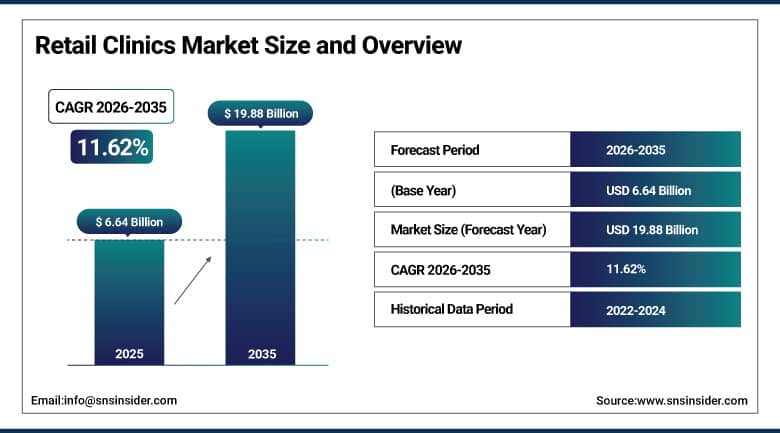
The Retail Clinics Market was estimated at USD 6.64 Billion in 2025 and is expected to reach USD 19.88 Billion by 2035 and grow at a CAGR of 11.62% over the forecast period of 2026-2035.
Retail Clinics Market is experiencing steady Global growth owing to increasing demand for convenient, affordable, and walk-in primary healthcare services, rising prevalence of minor illnesses and chronic disease management needs, along with growing consumer preference for quick medical access outside traditional hospitals. Expanding pharmacy-based healthcare ecosystems, retail chain participation in healthcare delivery, and increasing adoption of preventive care services such as vaccinations and health screenings are further supporting market growth.
The implementation of modern digital health ecosystems, telemedicine-integrated retail clinic networks, electronic health record (EHR) systems, AI-based patient triage tools, and point-of-care diagnostic technologies is expected to see widespread uptake until 2026.
Some of the drivers of market growth include increasing healthcare cost optimization, rising demand for convenient walk-in primary care services, growing expansion of pharmacy-led healthcare clinics, reduced patient waiting time compared to traditional hospitals, and ongoing developments in omnichannel healthcare delivery models and preventive care adoption.
To Get More Information On Retail Clinics Market - Request Free Sample Report
Retail Clinics Market Trends
-
Rising adoption of telehealth-enabled retail clinics is enhancing hybrid care delivery by combining in-person consultations with virtual healthcare services, improving accessibility and patient convenience across urban and semi-urban regions.
-
Increasing focus on preventive healthcare services such as vaccinations, health screenings, and wellness check-ups is expanding the role of retail clinics beyond basic primary care treatment globally.
-
Growing integration of AI-based patient triage systems and electronic health record (EHR) platforms is improving operational efficiency, reducing waiting time, and enhancing clinical decision-making accuracy in retail clinics.
-
Expansion of pharmacy-led healthcare ecosystems and retail chain-operated clinics is accelerating global market penetration by leveraging high customer footfall and established retail infrastructure.
-
Rising adoption of point-of-care diagnostic testing and rapid screening technologies is enabling faster diagnosis and treatment decisions directly at retail clinic locations.
-
Increasing demand for affordable, convenient, and walk-in healthcare services is driving patient shift from traditional hospitals to retail clinics for minor illnesses and primary care needs.
U.S. Retail Clinics Market Outlook:
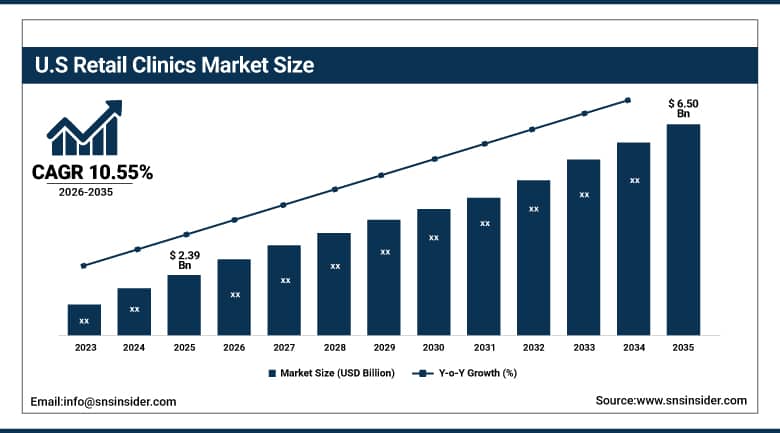
The U.S. Retail Clinics Market was valued at USD 2.39 Billion in 2025 and is expected to reach around USD 6.50 Billion by 2035, growing at a CAGR of 10.55% from 2026–2035.
U.S. Retail Clinics Market is considered one of the most advanced outpatient care markets globally owing to strong healthcare infrastructure, high adoption of pharmacy-led clinic models, and rising demand for convenient walk-in primary care, preventive services, and chronic disease management. Major players such as CVS Health, Walgreens Boots Alliance, Walmart Health, and Kroger Health are actively expanding retail clinic networks and integrated digital healthcare platforms.
Support from U.S. healthcare reforms, insurance coverage expansion for outpatient services, and increasing telehealth integration has accelerated adoption of retail clinics across pharmacies, supermarkets, and retail stores. Rising demand for cost-effective and quick healthcare access and growing investments in AI-enabled triage systems, electronic health records, and point-of-care diagnostics are further increasing retail clinic penetration across the U.S.
Retail Clinics Market Segment Analysis
-
By Service Type, Primary Care and General Consultation Services dominated the Retail Clinics Market with 32.50% share in 2025; Preventive Care Services fastest growing (CAGR).
-
By Ownership Type, Pharmacy Chain-Owned Clinics dominated the Retail Clinics Market with 45.80% share in 2025; Hospital-Affiliated Retail Clinics fastest growing (CAGR).
-
By Facility Location, Pharmacy-Based Clinics dominated the Retail Clinics Market with 38.90% share in 2025; Workplace and Corporate Clinics fastest growing (CAGR).
-
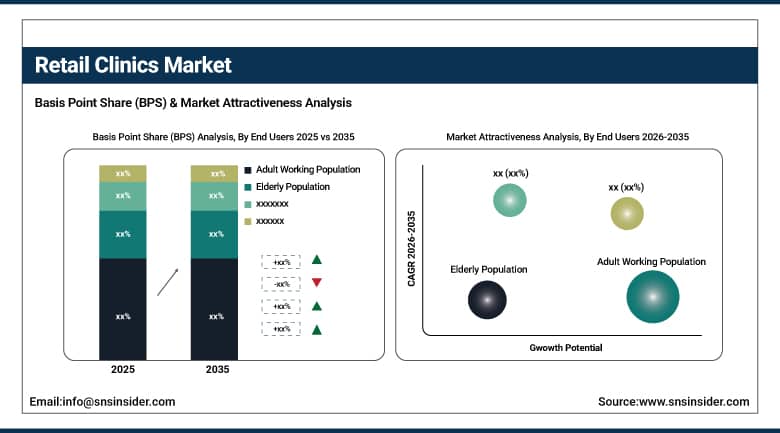
By End Users, Adult Working Population dominated the Retail Clinics Market with 34.80% share in 2025; Elderly Population fastest growing (CAGR).
By End Users, Adult Working Population dominates the Retail Clinics Market, while Elderly Population is the fastest-growing segment.
Adult Working Population was the leading segment within the Retail Clinics Market owing to the high demand for fast and easy access to health care services among working adults. Time constraints and a desire for minimal wait times contribute to the usage of retail clinics.
Elderly Population segment will experience the highest CAGR from 2026 to 2035 because of increasing cases of aging and chronic illnesses. The demand for routine checkups, preventative care, and access to retail facilities within proximity will fuel the market's expansion. Moreover, affordability and lesser reliance on hospitals will fast-track acceptance by elderly consumers.
By Service Type, Primary Care and General Consultation Services dominate the Retail Clinics Market, while Preventive Care Services are the fastest-growing segment.
Primary Care and General Consultation Services dominated the Retail Clinics Market due to high patient dependency on retail clinics for immediate treatment of minor illnesses, infections, and routine consultations. Strong pharmacy networks and walk-in accessibility further drive consistent demand across urban populations.
Preventive Care Services are expected to grow at the fastest CAGR from 2026–2035 due to increasing global focus on early disease detection, vaccination programs, and wellness check-ups. Rising healthcare awareness, insurance coverage expansion, and government-led preventive health initiatives are encouraging consumers to shift toward proactive healthcare, boosting demand for retail clinic preventive services.
By Ownership Type, Pharmacy Chain-Owned Clinics dominate the Retail Clinics Market, while Hospital-Affiliated Retail Clinics are the fastest-growing segment.
Pharmacy Chain-Owned Clinics held a dominant position in the Retail Clinics Market owing to their extensive retail reach, huge footfalls, and pharmacy services. The trustworthiness of the brand, wide geographical coverage, and availability of instant service provision have enabled Pharmacy Chain-Owned Clinics to gain a leadership position in the market.
The Hospital-Affiliated Retail Clinics segment is projected to register the highest CAGR during the forecast period of 2026–2035 owing to the increased convergence between primary care clinics and hospitals. Reasons for such a high growth rate in this segment include the credibility factor, better medical expertise, streamlined referral processes, and their focus on value-based care.
By Facility Location, Pharmacy-Based Clinics dominate the Retail Clinics Market, while Workplace and Corporate Clinics are the fastest-growing segment.
Pharmacy-based clinics were the dominant segments in the retail clinics market owing to their efficient integration with existing pharmacy networks, higher patient traffic, well-established brands, and accessibility to healthcare services. The geographic spread and economical infrastructure of pharmacy-based clinics help them maintain dominance in the market.
Workplace & Corporate Clinics are anticipated to witness the fastest CAGR during the forecast period owing to an increasing need for health care facilities for employees, corporate wellness programs, and minimization of production losses due to health reasons. Growth is being driven by the increasing acceptance of workplace health services.
Regional Insights:
|
Region |
Major Country |
Share (%) |
|---|---|---|
|
North America |
United States |
86.20% |
|
Europe |
Germany |
62.30% |
|
Asia Pacific |
China |
58.40% |
|
Middle East & Africa |
UAE |
44.10% |
|
Latin America |
Brazil |
49.80% |
North America Retail Clinics Market Insights
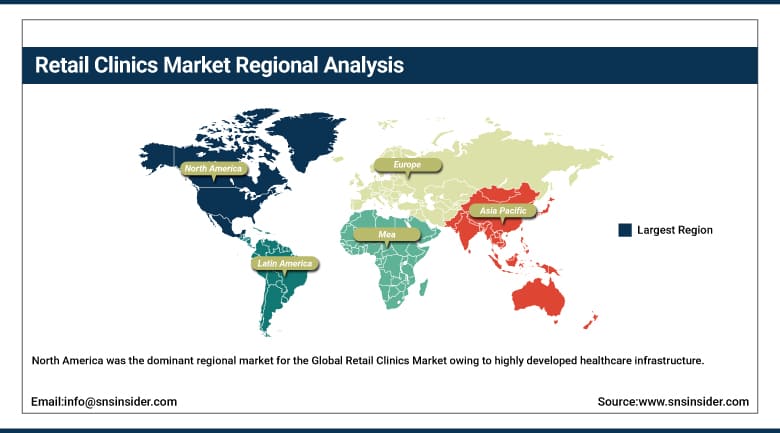
North America was the dominant regional market for the Global Retail Clinics Market owing to highly developed healthcare infrastructure, strong presence of pharmacy-led healthcare chains, and rising demand for convenient walk-in primary care services. The region benefits from increasing healthcare expenditure, widespread insurance coverage for outpatient services, and growing adoption of preventive healthcare and chronic disease management services. The United States remains the leading country due to large-scale expansion of retail clinic networks by major players such as CVS Health, Walgreens Boots Alliance, Walmart Health, and Kroger Health, along with strong consumer preference for quick and affordable healthcare access.
Given this superiority, the U.S. healthcare system and regulatory environment support the expansion of retail clinics through reimbursement policies, telehealth integration, and value-based care models, thus increasing scalability of operations. Strong investments in digital health platforms, AI-based patient triage systems, electronic health records (EHR), and point-of-care diagnostics are further strengthening retail clinic adoption across pharmacies, supermarkets, and retail stores.
Get Customized Report as Per Your Business Requirement - Enquiry Now
Asia Pacific Retail Clinics Market Insights
The Asia-Pacific region is expected to witness the fastest growth rate in the Retail Clinics Market, driven by rising healthcare awareness, increasing demand for affordable primary care services, and rapid expansion of pharmacy and retail healthcare infrastructure. Factors such as growing urban population, increasing healthcare digitization, and rising burden of chronic diseases are driving regional market growth.
China holds a significant share within the Asia Pacific region owing to rapid healthcare modernization, strong expansion of pharmacy chains, and increasing adoption of outpatient care models. India, Japan, South Korea, and Australia are also contributing through rising investments in retail healthcare services, telemedicine integration, and growing demand for accessible and cost-effective primary healthcare solutions.
Europe Retail Clinics Market Insights
The Retail Clinics Market is moderately growing in Europe because of strong public healthcare systems, increasing demand for convenient outpatient services, and growing focus on preventive care and early disease detection. Major countries include Germany, the UK, France, and Italy. Rising healthcare workload on hospitals and demand for faster non-emergency care services are major factors driving regional market growth.
European healthcare authorities and regulatory bodies support outpatient care expansion through structured healthcare frameworks and digital health adoption. Europe is witnessing increasing use of retail clinics for vaccinations, health screenings, minor illness treatment, and chronic disease monitoring, especially within pharmacy-based healthcare networks.
Middle East & Africa and Latin America Retail Clinics Market Insights
The Middle East and Africa region is witnessing steady growth in the Retail Clinics Market owing to increasing investments in healthcare infrastructure, rising adoption of private healthcare services, and improving accessibility of outpatient care in urban areas. UAE, Saudi Arabia, and South Africa are emerging as key regional markets due to growing healthcare modernization and expansion of pharmacy-based healthcare services.
In Latin America, countries such as Brazil and Mexico are contributing to market growth due to rising demand for affordable healthcare access, increasing healthcare burden on hospitals, and growing expansion of retail pharmacy chains. Favorable government initiatives and increasing awareness of preventive healthcare services are further supporting regional market growth.
Market Dynamics:
Growth Drivers: Expansion of pharmacy chains and integration of healthcare services into retail ecosystems
The rapid growth in international chain pharmacies and healthcare retail networks is fast facilitating the development of in-house medical clinics in developed countries. Retailers are taking advantage of high customer traffic in order to combine healthcare provision alongside their existing pharmacy services. This makes provision of prescriptions and consultations much more efficient under one roof. Partnerships between healthcare providers and retail businesses have been playing a big part in facilitating this growth, while a greater emphasis on value-based care programs is contributing to the growth in retail clinics.
Restraints: Regulatory and reimbursement challenges affecting operational scalability across regions
The strict regulatory regime and lack of reimbursement uniformity among various countries poses operational difficulties in the growth of retail clinics. Health care regulations differ widely, influencing issues such as licensing, staffing needs, and the range of services that can be provided within a retail health care facility. The inability of insurance schemes to cover services rendered by retail clinics in particular areas makes access to health care expensive and difficult to adopt. Observance of quality control, privacy laws, and drug regulations increases the complexities of operations. Such conditions limit the speed of market penetration in such environments.
Opportunities: Integration of telehealth and digital health platforms within retail clinic ecosystems
The rapid implementation of telemedicine and digital health technologies presents numerous opportunities for the growth of retail clinics on a global scale. The merging of online consultation capabilities with offline visits helps build hybrid health care models, thus ensuring greater patient involvement. Digital solutions facilitate the diagnosis and follow-up treatments as well as monitor chronic conditions remotely, helping to reduce congestion at the clinics. The adoption of electronic medical records, artificial intelligence triage systems, and mobile apps improves the efficiency of operations. Furthermore, retail clinics can go beyond their physical premises through online consultations connected with pharmacy services.
Recent Developments:
-
2026: CVS Health expanded its MinuteClinic and hybrid care model integration with Aetna insurance platforms, focusing on AI-based patient triage, telehealth consultations, and preventive healthcare services while optimizing underperforming physical clinic locations.
-
2025: Walgreens Boots Alliance accelerated restructuring of its healthcare footprint by expanding digital health services and reducing reliance on standalone VillageMD clinics, while strengthening pharmacy-led walk-in care and virtual consultation models.
-
2024: Walmart Inc. exited several Walmart Health clinic locations as part of a strategic shift toward partnership-based healthcare delivery, focusing more on retail pharmacy services, senior care initiatives, and integrated digital healthcare ecosystems.
Retail Clinics Market Key Players:
-
CVS Health
-
Walgreens Boots Alliance
-
Walmart Inc.
-
The Kroger Co.
-
Target Corporation
-
Rite Aid Corporation
-
NextCare Holdings, Inc.
-
MedExpress Urgent Care
-
Concentra, Inc.
-
American Family Care (AFC)
-
CityMD
-
GoHealth Urgent Care
-
FastMed Urgent Care
-
CareNow Urgent Care
-
Sutter Health (Sutter Walk-In Care)
-
Geisinger Health (ConvenientCare)
-
Aurora Health Care
-
Bellin Health (FastCare)
-
Providence Health & Services (ExpressCare)
-
HealthPartners Clinics
Retail Clinics Market Report Scope:
| Report Attributes | Details |
|---|---|
| Market Size in 2025 | USD 6.64 Billion |
| Market Size by 2035 | USD 19.88 Billion |
| CAGR | CAGR of 11.62% From 2026 to 2035 |
| Base Year | 2025 |
| Forecast Period | 2026-2035 |
| Historical Data | 2022-2024 |
| Report Scope & Coverage | Market Size, Segments Analysis, Competitive Landscape, Regional Analysis, DROC & SWOT Analysis, Forecast Outlook |
| Key Segments | • By Service Type (Primary Care and General Consultation Services, Preventive Care Services, Diagnostic and Screening Services, Chronic Disease Management Services, Wellness and Lifestyle Services) • By Ownership Type (Pharmacy Chain-Owned Clinics, Retail Store-Based Clinics, Hospital-Affiliated Retail Clinics, Independent Retail Clinics) • By Facility Location (Pharmacy-Based Clinics, Supermarket and Hypermarket Clinics, Standalone Retail Clinics, Shopping Mall Clinics, Workplace and Corporate Clinics) • By End Users (Pediatric Patients, Adult Working Population, Elderly Population, Travelers, Low-Income / Price-Sensitive Patients) |
| Regional Analysis/Coverage | North America (US, Canada), Europe (Germany, UK, France, Italy, Spain, Russia, Poland, Rest of Europe), Asia Pacific (China, India, Japan, South Korea, Australia, ASEAN Countries, Rest of Asia Pacific), Middle East & Africa (UAE, Saudi Arabia, Qatar, South Africa, Rest of Middle East & Africa), Latin America (Brazil, Argentina, Mexico, Colombia, Rest of Latin America). |
| Company Profiles | CVS Health, Walgreens Boots Alliance, Walmart Inc., The Kroger Co., Target Corporation, Rite Aid Corporation, NextCare Holdings, Inc., MedExpress Urgent Care, Concentra, Inc., American Family Care (AFC), CityMD, GoHealth Urgent Care, FastMed Urgent Care, CareNow Urgent Care, Sutter Health (Sutter Walk-In Care), Geisinger Health (ConvenientCare), Aurora Health Care, Bellin Health (FastCare), Providence Health & Services (ExpressCare), HealthPartners Clinics. |

Frequently Asked Questions
North America dominated the Retail Clinics Market in 2025.
Primary Care and General Consultation Services segment dominated the Retail Clinics Market in 2025.
Increasing demand for convenient, affordable, and walk-in primary healthcare services, rising preference for quick treatment outside hospitals, expansion of pharmacy-led healthcare networks, and growing adoption of preventive care and digital health technologies are the major growth drivers.
The Retail Clinics Market was valued at USD 6.64 billion in 2025.
The Retail Clinics Market is expected to grow at a CAGR of 11.62% from 2026 to 2035.
