
Transcutaneous Monitors Market Report Scope & Overview:
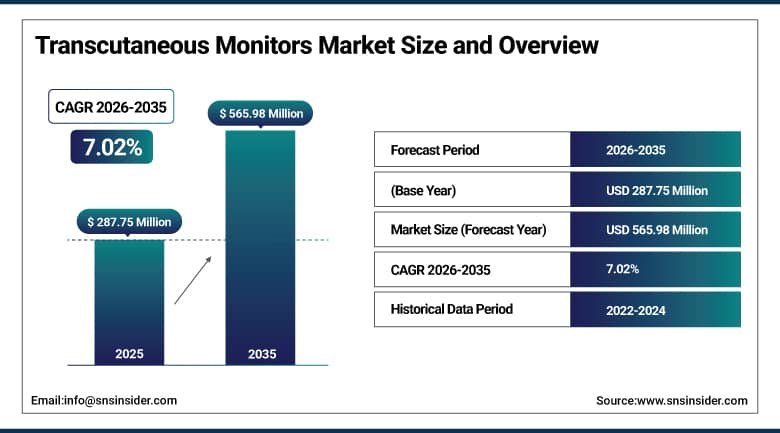
The Transcutaneous Monitors Market was estimated at USD 287.75 Million in 2025 and is expected to reach USD 565.98 Million by 2035 and grow at a CAGR of 7.02% over the forecast period of 2026-2035.
The transcutaneous monitors market is witnessing steady global growth due to rising demand for non-invasive patient monitoring technologies across neonatal care, critical care, respiratory monitoring, sleep diagnostics, and emergency care applications, along with the increasing adoption of advanced monitoring systems integrated with digital sensors, wireless connectivity, AI-enabled analytics, and real-time data tracking capabilities for improved clinical efficiency and patient safety. The expansion of healthcare infrastructure, growing prevalence of respiratory disorders, increasing NICU admissions, and rising demand for continuous oxygen and carbon dioxide monitoring, coupled with growing focus on early diagnosis, remote patient monitoring, and reduction in invasive blood sampling procedures, is also contributing to market growth.
The governmental regulations related to medical device safety standards such as FDA medical device approval requirements in the United States, EU MDR compliance regulations, ISO 80601 standards for respiratory monitoring equipment, and HIPAA data protection guidelines are significantly influencing transcutaneous monitor production and adoption. In addition, the U.S. CMS healthcare reimbursement policies, India’s National Medical Devices Policy and Ayushman Bharat initiative, and China’s healthcare modernization and digital hospital infrastructure programs are further accelerating market adoption.
To Get More Information On Transcutaneous Monitors Market - Request Free Sample Report
Transcutaneous Monitors Market Trends
-
Increasing adoption of non-invasive patient monitoring technologies is driving demand for transcutaneous monitors across neonatal, respiratory, and critical care applications.
-
Growing integration of wireless connectivity and cloud-based monitoring systems is improving real-time patient data management in hospitals and home healthcare settings.
-
Rising prevalence of respiratory disorders and increasing NICU admissions are expanding the use of transcutaneous monitors for continuous oxygen and carbon dioxide monitoring.
-
Increasing development of AI-enabled monitoring systems is enhancing clinical accuracy, alarm management, and patient safety across healthcare facilities.
-
Growing focus on portable and wearable monitoring devices is supporting adoption of compact transcutaneous monitors in ambulatory and remote patient care applications.
-
Rapid expansion of digital healthcare infrastructure and smart hospital systems is accelerating integration of transcutaneous monitors with centralized patient monitoring platforms.
U.S. Transcutaneous Monitors Market Outlook
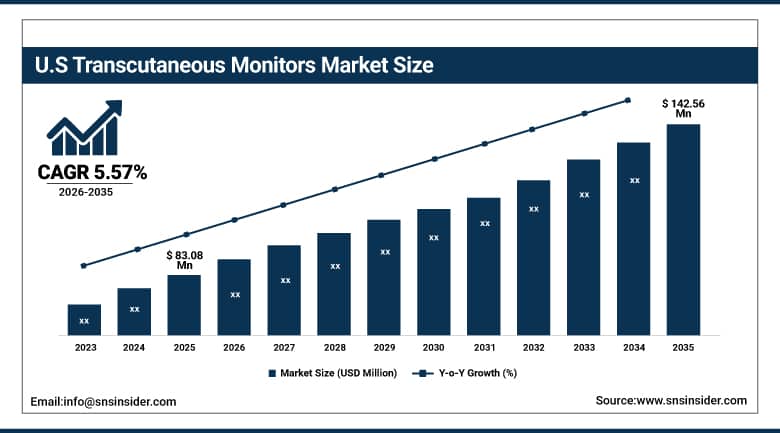
The U.S. Transcutaneous Monitors Market was valued at USD 83.08 Million in 2025 and is expected to reach around USD 142.56 Million by 2035, growing at a CAGR of 5.57% from 2026–2035.
The U.S. transcutaneous monitors market is considered one of the most advanced patient monitoring markets globally owing to strong demand from neonatal care, respiratory monitoring, critical care, emergency medicine, and sleep diagnostics sectors, along with widespread adoption of advanced transcutaneous monitoring systems integrated with digital sensors, wireless connectivity, AI-enabled analytics, and real-time patient monitoring technologies for continuous oxygen and carbon dioxide measurement, along with increasing demand for non-invasive, accurate, portable, and continuous monitoring solutions across hospitals, specialty clinics, and home healthcare settings. Major companies such as Radiometer Medical ApS, SenTec AG, Koninklijke Philips N.V., Medtronic plc, GE HealthCare, Masimo Corporation, Nihon Kohden Corporation, Drägerwerk AG & Co. KGaA, Nonin Medical, Inc., and Smiths Medical are actively focusing on expanding monitoring technology portfolios, strengthening R&D capabilities, and enhancing product accuracy, connectivity, portability, and compliance with advanced healthcare standards.
Governments efforts to enhance patient safety through FDA medical device regulations, healthcare quality improvements through CMS reimbursement policies, data security controls through HIPAA regulations, medical device performance standards through ISO compliance requirements, and support through digital healthcare modernization initiatives are contributing to an increased demand for transcutaneous monitors. Efforts towards minimizing invasive blood sampling procedures, improving respiratory monitoring efficiency, supporting critical care infrastructure, and encouraging the adoption of connected healthcare technologies are also playing a role in the area.
Transcutaneous Monitors Market Segment Analysis
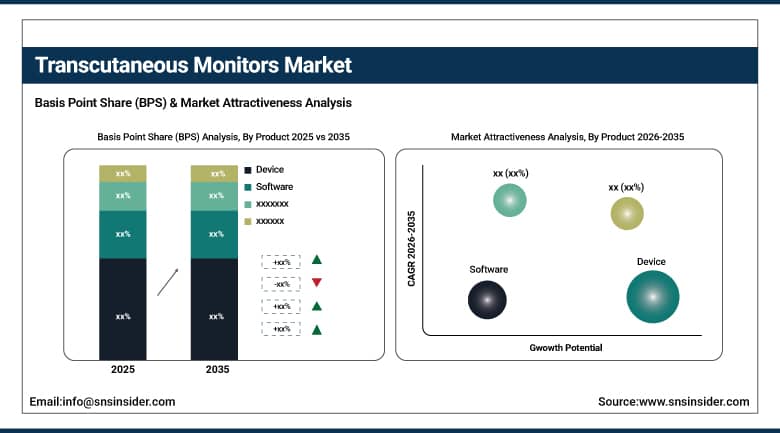
- By Product, device dominated the transcutaneous monitors market with 45.12% share in 2025; while software are the fastest growing segment.
- By Age Group, adult dominated the transcutaneous monitors market with 40.18% share in 2025; while geriatrics are the fastest growing segment.
- By Therapeutic Area, respiratory diseases dominated the transcutaneous monitors market with 45.33% share in 2025; while peripheral artery disease (pad) are the fastest growing segment.
- By End User, hospitals dominated the transcutaneous monitors market with 55.48% share in 2025; while home healthcare are the fastest growing segment.
By Product, device dominated the transcutaneous monitors market, while software is the fastest-growing segment.
Device segment dominated the transcutaneous monitors market in 2025 due to rising demand for continuous non-invasive monitoring systems across neonatal intensive care units, respiratory care, and critical care applications. Hospitals and specialty clinics widely adopted advanced monitoring devices because of their high accuracy, real-time oxygen and carbon dioxide measurement capabilities, improved patient safety, and reduced dependence on repeated invasive blood gas sampling procedures in clinical environments.
Software segment is likely to experience the fastest CAGR between 2026 and 2035 due to the adoption of artificial intelligence (AI) enabled analytics, connectivity through clouds, and central patient monitoring systems in healthcare organizations. The rising trend of digital healthcare architecture, remote patient monitoring, and intelligent hospitals is contributing towards a rise in the demand for effective monitoring software solutions that enhance clinical workflows and improve patient monitoring.
By Age Group, adult dominated the transcutaneous monitors market, while geriatrics is the fastest-growing segment.
Adult segment dominated the transcutaneous monitors market in 2025 owing to the high prevalence rate of respiratory diseases, cardiovascular conditions, sleep apnea, and critical care cases in adults. The growing need for monitoring oxygen and CO2 levels in hospitals, ICUs, and emergencies as well as increasing preference for non-invasive monitoring devices for better patient monitoring and lesser use of invasive sampling processes played a key role in the dominance of the segment.
Growing at the fastest CAGR during 2026-2035, the geriatrics segment is expected to witness strong growth owing to the rapid aging population and rising occurrences of chronic respiratory diseases, neurological disorders, and critical care needs among the geriatric population. Rising need for healthcare services at home and remote patient monitoring services and increased adoption of portable and wireless transcutaneous monitoring devices is expected to accelerate the demand for the devices in the coming years.
By Therapeutic Area, respiratory diseases dominated the transcutaneous monitors market, while peripheral artery disease (PAD) is the fastest-growing segment.
The Respiratory Diseases Segment held a dominant position in the transcutaneous monitors market in 2025 owing to the rise in incidences of chronic respiratory diseases like COPD, asthma, sleep apnea, and respiratory failure where constant monitoring of oxygen and CO2 levels is necessary. The rising number of patients admitted in ICUs and NICUs, increased demand for non-invasive respiratory monitoring, and the growing preference for real-time monitoring systems have driven the segment's dominance in the market.
The Peripheral Artery Disease (PAD) segment is projected to register the fastest CAGR during the forecast period 2026-2035 owing to increased incidences of diabetes, obesity, cardiovascular disease, and aging population. Awareness related to early detection of circulatory disorders, increasing adoption of non-invasive monitoring devices, and growing application of transcutaneous monitors in wound healing applications are expected to boost the segment.
By End User, hospitals dominated the transcutaneous monitors market, while home healthcare is the fastest-growing segment.
Hospital segment occupied the dominated share in the transcutaneous monitors market during 2025 as patients’ continuous monitoring systems are widely adopted in ICUs, NICUs, emergency wards, and respiratory care units. Hospitals feature advanced healthcare facilities, professional healthcare experts, and greater adoption of non-invasive monitoring devices for managing critical care treatments. Moreover, increased hospitalization along with growing need for real-time monitoring of oxygen and carbon dioxide levels contributed significantly to the dominance of the segment.
Home Healthcare segment is expected to witness the fastest growth rate during 2026-2035 driven by the increasing trend of remote monitoring and rise in the number of aged patients and chronic respiratory disorders, which require constant monitoring over a prolonged period. Technological developments in wireless and portable transcutaneous monitors are enhancing patient convenience and allowing patients to monitor their conditions continuously in absence of clinical surroundings.
Regional Analysis:
|
Region |
Major Country |
Share within Region, 2025(%) |
|---|---|---|
|
North America |
United States |
78.35% |
|
Europe |
Germany |
28.94% |
|
Asia Pacific |
China |
41.52% |
|
Middle East & Africa |
UAE |
23.88% |
|
Latin America |
Brazil |
36.47% |
North America Transcutaneous Monitors Market Insights
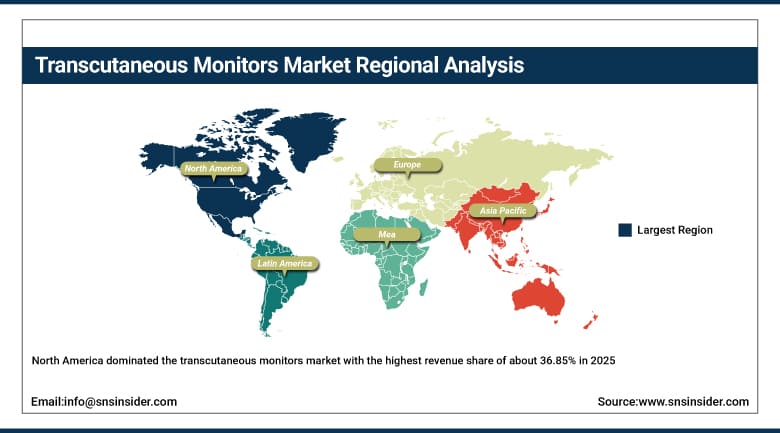
North America dominated the transcutaneous monitors market with the highest revenue share of about 36.85% in 2025 due to its advanced healthcare infrastructure, strong adoption of non-invasive patient monitoring technologies, and increasing demand for continuous respiratory monitoring across hospitals, NICUs, ICUs, and specialty clinics. The region benefits from widespread use of advanced transcutaneous monitoring systems integrated with digital sensors, wireless connectivity, and real-time patient monitoring platforms. Strict regulatory frameworks like FDA medical device regulations, CMS healthcare quality standards, and rising prevalence of respiratory disorders further strengthen market dominance across the United States and Canada.
Consequently, regulations on FDA medical device safety, HIPAA healthcare data protection, ISO respiratory monitoring standards, healthcare modernization programs, and the promotion of advanced patient care technologies have accelerated investments in the transcutaneous monitoring sector. However, the increasing demand arising from critical care expansion, neonatal monitoring, and remote patient monitoring adoption is helping to drive sustained growth in the industry.
Get Customized Report as Per Your Business Requirement - Enquiry Now
Europe Transcutaneous Monitors Market Insights
Europe is considered a highly important region in the transcutaneous monitors market owing to strong emphasis on patient safety, healthcare modernization, and strict medical device and clinical monitoring regulations. Key countries such as Germany, France, the UK, and Italy are contributing significantly through advanced healthcare infrastructure, respiratory care management, and increasing adoption of non-invasive monitoring technologies. The EU MDR regulations, digital healthcare initiatives, and growing focus on early disease diagnosis are supporting increased investment in advanced monitoring systems, connected healthcare devices, and smart patient monitoring solutions across the region.
Asia Pacific Transcutaneous Monitors Market Insights
Asia Pacific segment is expected to grow at the fastest CAGR of about 8.62% from 2026–2035 due to rapid healthcare infrastructure development, expanding hospital networks, and rising prevalence of respiratory and chronic diseases across emerging economies such as China, India, Japan, and Southeast Asia. Rising demand from neonatal care, critical care monitoring, and home healthcare applications is driving strong adoption of transcutaneous monitoring systems. Government initiatives like Ayushman Bharat, China’s healthcare modernization programs, and expansion of digital healthcare services are further accelerating growth. Increasing healthcare investments, improving access to advanced medical technologies, and growing medical device manufacturing are also supporting rapid market expansion in the region.
Middle East & Africa and Latin America Transcutaneous Monitors Market Insights
The Middle East & Africa and Latin America regions, there is an anticipation of growth for the transcutaneous monitors market due to factors including increasing healthcare infrastructure development, growing awareness regarding non-invasive patient monitoring, and rising prevalence of respiratory disorders. The United Arab Emirates, Saudi Arabia, and South Africa in the Middle East & Africa region are working on expanding hospital infrastructure, improving critical care facilities, and enhancing digital healthcare services. Meanwhile, in the Latin America region, the key countries that are propelling demand include Brazil and Mexico, where they are expanding healthcare access, respiratory care services, and hospital modernization initiatives.
Growth Drivers: Rising prevalence of respiratory disorders and increasing demand for continuous non-invasive patient monitoring across critical care and neonatal applications.
Rising instances of respiratory diseases like chronic obstructive pulmonary disease, asthma, sleep apnea, and acute respiratory failure are among key factors boosting demand for transcutaneous monitoring devices. The use of continuous non-invasive monitoring devices in order to ensure better safety of patients, avoid unnecessary invasiveness of blood gas analysis procedures, and streamline clinical processes in ICUs and NICUs is gradually gaining prominence among healthcare professionals. Rising number of infants, aging population, and increasing number of critical care patients are adding momentum to global uptake of transcutaneous monitors. Furthermore, increased awareness about early respiratory evaluation and advances in real-time monitoring technologies are fueling adoption of transcutaneous monitors.
Restraints: Accuracy limitations and sensor-related complications affecting long-term monitoring efficiency in certain critical care and neonatal applications.
The technical constraints related to sensor calibration, skin sensitivity, and accuracy of monitoring under diverse clinical settings are becoming an obstacle to transcutaneous monitoring implementation. The prolonged continuous monitoring can cause irritation of the skin, sensor shifting, and inaccurate readings, especially in the case of infants and critical care patients. Patient skin thickness, body temperature, and blood flow may affect the accuracy of readings and clinical effectiveness of this method. Medical staff may need frequent calibration and validation of results with arterial blood gas analysis.
Opportunities: Increasing investments in digital healthcare infrastructure and AI-enabled patient monitoring systems supporting advanced clinical decision-making capabilities
Healthcare facilities are now increasingly focusing on the adoption of intelligent hospital technology, advanced AI-based healthcare equipment, and connected patient monitoring systems to ensure improved health outcomes and efficiency in operations. The integration of transcutaneous monitors with EHRs, predictive analysis, and monitoring tools has presented substantial growth prospects in the market. With increased emphasis on automation in patient monitoring, early disease diagnosis, and data-driven healthcare management, the market is witnessing an increasing need for advanced monitoring software solutions. Improvements in AI respiratory testing technology, cloud connectivity, and wearables have further enabled the development of next-generation transcutaneous monitoring devices.
Recent Developments
-
2026: SenTec AG expanded development of advanced transcutaneous monitoring systems for neonatal, respiratory, and critical care applications. Focused on improving non-invasive monitoring accuracy, wireless connectivity, and continuous patient monitoring capabilities.
-
2025: GE HealthCare strengthened its connected patient monitoring portfolio through integration of AI-enabled analytics and centralized monitoring technologies. Supported growing demand for smart hospital infrastructure and real-time respiratory monitoring solutions.
-
2025: Masimo Corporation accelerated innovation in wearable and remote patient monitoring technologies through expansion of cloud-connected monitoring platforms. Focused on continuous oxygen saturation monitoring, telehealth integration, and home healthcare applications.
-
2024: Koninklijke Philips N.V. launched advanced patient monitoring solutions integrated with digital healthcare and predictive analytics technologies. Emphasized smart monitoring workflows, remote patient management, and improved clinical decision-making capabilities.
Transcutaneous Monitors Market Key Players are:
-
Radiometer Medical ApS
-
SenTec AG
-
Perimed AB
-
Koninklijke Philips N.V.
-
Medtronic plc
-
GE HealthCare
-
Masimo Corporation
-
Drägerwerk AG & Co. KGaA
-
Nihon Kohden Corporation
-
Smiths Medical
-
Nonin Medical, Inc.
-
Mindray Bio-Medical Electronics Co., Ltd.
-
Edan Instruments, Inc.
-
Bionet Co., Ltd.
-
Fukuda Denshi Co., Ltd.
-
Abbott Laboratories
-
PerkinElmer, Inc.
-
Contec Medical Systems Co., Ltd.
-
OSI Systems, Inc.
-
Edwards Lifesciences Corporation
Transcutaneous Monitors Market Report Scope:
| Report Attributes | Details |
|---|---|
| Market Size in 2025 | USD 287.75 Million |
| Market Size by 2035 | USD 565.98 Million |
| CAGR | CAGR of 7.02% From 2026 to 2035 |
| Base Year | 2025 |
| Forecast Period | 2026-2035 |
| Historical Data | 2022-2024 |
| Report Scope & Coverage | Market Size, Segments Analysis, Competitive Landscape, Regional Analysis, DROC & SWOT Analysis, Forecast Outlook |
| Key Segments | • By Product (Device, Sensors, Accessories, Software) • By Age Group (Adult, Pediatrics, Neonates, Geriatrics) • By Therapeutic Area (Respiratory Diseases, Peripheral Artery Disease (PAD), Diabetic Foot Ulcers, Neuromuscular Disorders, Others) • By End User (Hospitals, Ambulatory Surgical Centers (ASCs), Specialty Clinics, Home Healthcare, Others) |
| Regional Analysis/Coverage | North America (US, Canada), Europe (Germany, UK, France, Italy, Spain, Russia, Poland, Rest of Europe), Asia Pacific (China, India, Japan, South Korea, Australia, ASEAN Countries, Rest of Asia Pacific), Middle East & Africa (UAE, Saudi Arabia, Qatar, South Africa, Rest of Middle East & Africa), Latin America (Brazil, Argentina, Mexico, Colombia, Rest of Latin America). |
| Company Profiles | Radiometer Medical ApS, SenTec AG, Perimed AB, Koninklijke Philips N.V., Medtronic plc, GE HealthCare, Masimo Corporation, Drägerwerk AG & Co. KGaA, Nihon Kohden Corporation, Smiths Medical, Nonin Medical, Inc., Mindray Bio-Medical Electronics Co., Ltd., Edan Instruments, Inc., Bionet Co., Ltd., Fukuda Denshi Co., Ltd., Abbott Laboratories, PerkinElmer, Inc., Contec Medical Systems Co., Ltd., OSI Systems, Inc., Edwards Lifesciences Corporation |

Frequently Asked Questions
The transcutaneous monitors market is expected to grow at a CAGR of 7.02% from 2026 to 2035.
The transcutaneous monitors market was valued at USD 287.75 Million in 2025.
Rising prevalence of respiratory disorders, increasing demand for non-invasive patient monitoring, growing NICU admissions, and expanding adoption of advanced monitoring technologies are driving market growth globally.
The Device segment dominated the transcutaneous monitors market in 2025.
North America dominated the transcutaneous monitors market in 2025.
