
Cloud Workload Protection Platform Market Report Scope & Overview:
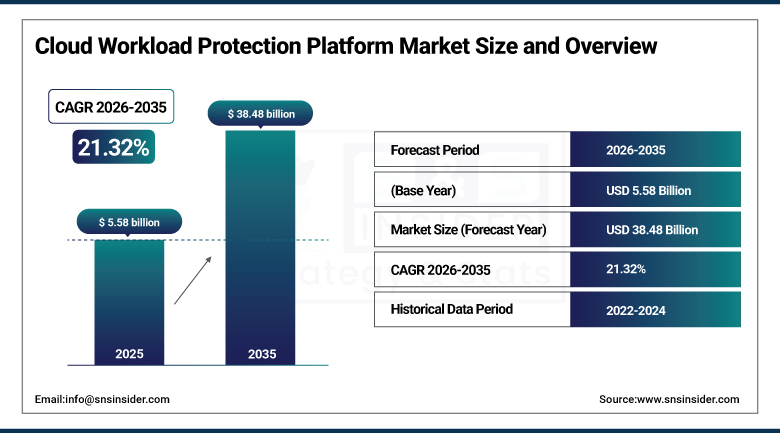
The Cloud Workload Protection Platform Market was valued at USD 5.58 Billion in 2025 and is expected to reach USD 38.48 Billion by 2035, growing at a CAGR of 21.32% from 2026–2035.
The main factors propelling the growth of the global Cloud Workload Protection Platform Market include the fast adoption of cloud computing, migration of enterprise workloads to public, private, and hybrid clouds, and increase in cybersecurity threats from the cloud. Cloud workload protection platforms are deployed by enterprises to secure their virtual machines, containers, serverless workloads, and cloud-native workloads from vulnerabilities, malware, attacks, and misconfigurations. Increasing complexity in multi-cloud and hybrid cloud infrastructures is further driving the demand for centralized visibility and protection of workloads against threats, vulnerabilities, compliance, and more.
Furthermore, there are immense growth opportunities in the market due to the integration of artificial intelligence, machine learning, and automation functionalities in cloud workload protection platforms. Enterprises are opting for cloud security platforms to increase real-time threat detection, automate security, strengthen compliance management, and reduce complexity. Innovations in cloud-native security, container security, zero trust architecture, DevSecOps practices, CSPM, and XDR are expected to drive growth opportunities in the Cloud Workload Protection Platform Market.
In March 2026, ESET launched ESET Cloud Workload Protection as part of its updated ESET PROTECT Platform, extending security capabilities from endpoints and servers to cloud workloads. The solution provides enhanced visibility, detection, and response capabilities for virtual machines running across AWS, Azure, and Google Cloud environments, helping organizations reduce cloud attack surfaces and strengthen workload protection.
To Get more information Cloud Workload Protection Platform Market - Request Free Sample Report
Cloud Workload Protection Platform Market Trends:
-
Increasing adoption of cloud computing and cloud-native applications is driving the Cloud Workload Protection Platform Market.
-
Rising cloud threats, vulnerabilities, and misconfiguration risks are accelerating demand for workload security.
-
Growing use of runtime protection, vulnerability assessment, and compliance management solutions is boosting market growth.
-
Increasing investments in multi-cloud security and zero-trust frameworks are supporting innovation.
-
Expanding deployment across BFSI, IT & telecom, healthcare, and government sectors is strengthening adoption.
U.S. Cloud Workload Protection Platform Market Outlook:
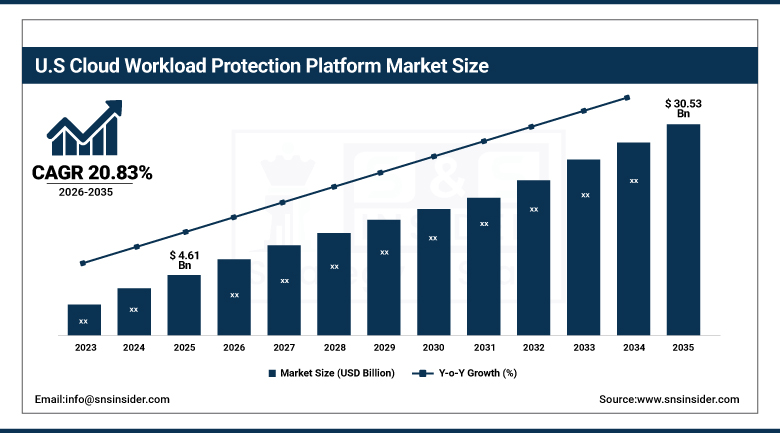
The U.S. Cloud Workload Protection Platform Market was valued at USD 4.61 Billion in 2025 and is expected to reach around USD 30.53 Billion by 2035, growing at a CAGR of 20.83% from 2026–2035.
Growing use of cloud computing, cloud-native applications, and hybrid cloud solutions would play an important role in driving the growth of the cloud workload protection platforms in the US market in the forecast period. Rising need to protect the cloud workloads from various risks, such as vulnerabilities, malware, attacks, misconfiguration, breach of data, etc., is driving the need for cloud workload protection solution. Presence of key cloud services, cybersecurity firms, and enterprise tech companies, coupled with investments made towards digital transformation, would drive market growth.
Moreover, developments in the field of cloud-native security, AI-based threats detection, automated security monitoring, container security, and DevSecOps would enhance the efficiency of cloud workload protection platforms. Investments being made in cloud security solutions, multi-cloud protection, compliance management, and workload risk management solutions would create lucrative opportunities. Growing need for regulation compliances and rising cybersecurity concerns in cloud environment would accelerate the adoption of cloud workload protection platforms in the forecast period.
In May 2026, Qualys achieved FedRAMP High Authorization for its TotalCloud solution, expanding cloud workload protection capabilities for U.S. federal agencies and highly regulated industries. The authorization strengthens Qualys’ cloud security offerings by enabling organizations to improve compliance management, cloud risk assessment, and protection of cloud-native applications and workloads.
Cloud Workload Protection Platform Market Segment Analysis:
-
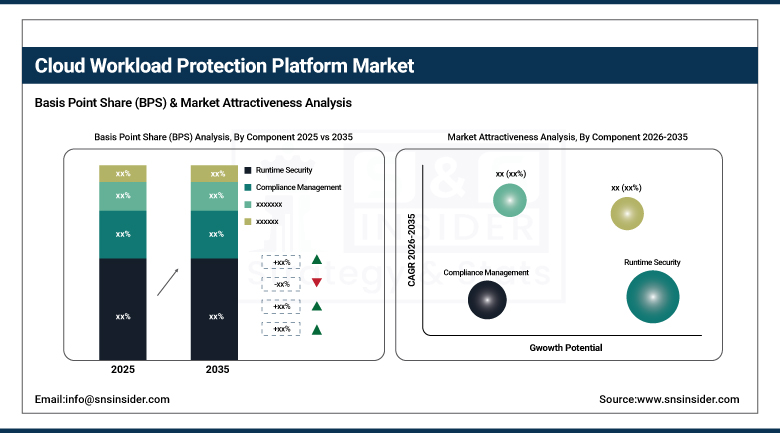
By Component, runtime security dominated the Cloud Workload Protection Platform Market with a 27.35% share in 2025, while vulnerability assessment & management is projected to be the fastest-growing segment, registering a 24.81% CAGR during 2026–2035.
-
By Deployment, public cloud dominated the Cloud Workload Protection Platform Market with a 46.04% share in 2025, while hybrid cloud is projected to be the fastest-growing segment, registering a 23.60% CAGR during 2026–2035.
-
By Application, workload configuration & vulnerability management dominated the Cloud Workload Protection Platform Market with a 32.58% share in 2025, while network segmentation is projected to be the fastest-growing segment, registering a 24.97% CAGR during 2026–2035.
-
By Enterprise Size, large enterprises dominated the Cloud Workload Protection Platform Market with a 68.42% share in 2025, while small & medium enterprises (SMEs) are projected to be the fastest-growing segment, registering a 23.76% CAGR during 2026–2035.
-
By End-User Industry, IT & Telecom dominated the Cloud Workload Protection Platform Market with a 28.64% share in 2025, while BFSI is projected to be the fastest-growing segment, registering a 25.26% CAGR during 2026–2035.
By Component, runtime security dominated the Cloud Workload Protection Platform Market, while vulnerability assessment & management is expected to grow fastest.
Runtime security constituted the biggest market share in the Cloud Workload Protection Platform Market in 2025 owing to the increasing demand for the real-time protection of cloud workloads from advanced cyber threats, malicious activities, malware, and runtime threats. The increasing use of runtime security solutions to monitor the behavior of workloads, detect threats, protect applications, and safeguard dynamic cloud workspaces has driven the need for advanced runtime protection solutions. The increasing adoption of multi-cloud architecture, containerization of applications, and cloud-native workloads has fueled the need for advanced runtime protection solutions.
The vulnerability assessment & management segment is expected to experience the highest growth rate during the forecast period owing to the increasing demand for continuous vulnerability detection, risk assessment, and remediation in the cloud workloads. The focus of enterprises towards proactively safeguarding themselves from cyber-attacks and compliance with security regulations has propelled the market.
By Deployment, public cloud dominated the Cloud Workload Protection Platform Market, while hybrid cloud is expected to grow fastest.
Public cloud constituted the biggest share in the Cloud Workload Protection Platform Market in 2025 owing to increased adoption of public clouds, scalability and cost-efficient security solutions by enterprises. The increasing deployment of cloud workloads in public clouds has led to a growing requirement for cloud workload protection solutions, which offer visibility, threat detection, and security management capabilities.
Hybrid cloud is anticipated to be the fastest-growing segment during the forecast period due to the growing adoption of hybrid IT infrastructures. Enterprises are opting for hybrid cloud workload protection solutions for protecting their distributed workloads, maintaining compliance, and security management in the cloud.
By Application, workload configuration & vulnerability management dominated the Cloud Workload Protection Platform Market, while network segmentation is expected to grow fastest.
The workload configuration and vulnerability management category captured the largest market share in the Cloud Workload Protection Platform Market in 2025 owing to the growing need for detecting misconfiguration, managing vulnerabilities, and ensuring the improvement of security posture in cloud workloads. There is an emphasis by companies on performing continuous security assessments and configuration management to mitigate cloud risks.
The network segmentation category is likely to witness the fastest growth rate during the forecast period because of the rising demand for zero trust security solutions, workload isolation, and protection from lateral movement of cyberattacks. Companies are implementing network segmentation technology in order to secure the cloud environment.
Regional Insights:
|
Region |
Major Country |
Share within Region, 2025(%) |
|---|---|---|
|
North America |
United States |
89.66% |
|
Europe |
Germany |
25.85% |
|
Asia Pacific |
China |
42.92% |
|
Middle East & Africa |
Saudi Arabia |
25.24% |
|
Latin America |
Brazil |
47.58% |
North America Cloud Workload Protection Platform Market Insights
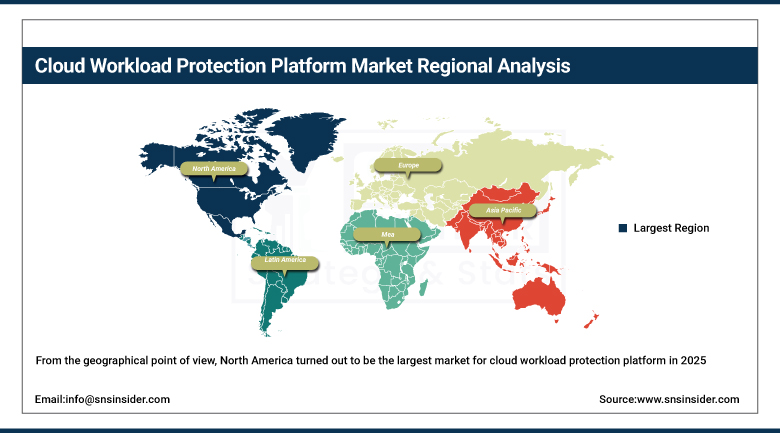
From the geographical point of view, North America turned out to be the largest market for cloud workload protection platform in 2025 owing to the presence of key players offering cybersecurity products, cloud services, and enterprise IT technology ecosystem in this region. Growing spending on the cloud infrastructure, cybersecurity solutions, digital transformation, and multi-cloud environment results in high adoption of the workload protection platform by enterprises.
Cloud workload protection platform solutions are widely deployed by various organizations in the U.S. and Canada in order to secure their cloud-native applications, protect critical workloads, manage vulnerabilities, and detect threats. The rising use of hybrid cloud environment, container applications, and DevSecOps approaches drives demand for workload security solutions. The largest market share belongs to the United States in 2025 because of the presence of key technology vendors, cybersecurity spending, and cloud platform adoption.
Get Customized Report as per Your Business Requirement - Enquiry Now
Europe Cloud Workload Protection Platform Market Insights
The growth of the cloud workload protection platform market in Europe will be attributed to increased adoption of cloud technology, cybersecurity concerns, and regulations on data protection and cloud security. Organizations in different industries such as BFSI, healthcare, manufacturing, automotive, government, and retail are deploying cloud workload protection platforms to enhance the security of cloud environments and protect the organization’s critical business information.
There is growing adoption of hybrid cloud architecture, zero trust security approach, and cloud-native applications, which are driving the demand for advanced workload protection solutions. Regulations related to cybersecurity and data privacy are prompting companies to enhance their cloud security management systems. The largest share of the European Cloud Workload Protection Platform Market in 2025 will be in Germany owing to its industrial presence, digital infrastructure, and increased use of enterprise cybersecurity technology.
Asia Pacific Cloud Workload Protection Platform Market Insights
APAC is expected to show the highest growth rate for the cloud workload protection platform market over the forecast period owing to high rates of cloud adoption, increasing digitization, and increased investment in cybersecurity solutions. Some of the countries that include China, India, Japan, and South Korea are increasing their cloud infrastructure and implementing advanced solutions for ensuring security of their workloads.
Increasing use of cloud-native applications, artificial intelligence, automation, and multi-cloud are the factors that are responsible for increasing the demand for workload protection platforms. Cloud security solutions are being adopted by BFSI, healthcare, manufacturing, telecommunications, and government segments for better threat detection, vulnerability management, and compliance needs. The largest market share in APAC belongs to China in 2025 owing to growing cloud ecosystem, advanced IT sector, and increasing adoption of cybersecurity solutions among enterprises.
Middle East & Africa and Latin America Cloud Workload Protection Platform Market Insights
The cloud workload protection platform market in the Middle East & Africa region is exhibiting steady growth owing to increasing investments in cloud computing, cybersecurity infrastructures, digital transformation programs, and smart cities programs. Workload protection solutions are being implemented by organizations in BFSI, telecom, healthcare, energy, and government industry verticals to secure cloud environments and critical workloads. Increasing threat and cyber regulatory compliance issues are further contributing to the growth of the market. Saudi Arabia held the largest market share in the Middle East & Africa market in 2025 owing to growing technology investments, cloud adoption initiatives, and cybersecurity development programs.
The cloud workload protection platform market in Latin America is witnessing consistent growth owing to the growing adoption of cloud services, digitalization of enterprises, and cybersecurity solutions. Workload protection platforms are being adopted by BFSI, manufacturing, retail, healthcare, and telecom organizations to secure cloud applications, vulnerabilities management, and improving security operations. Increasing investments in cloud infrastructure and security technologies of enterprises are offering new opportunities for the growth of the market. Brazil held the largest market share in the Latin American market in 2025 owing to its large enterprise landscape and digital economy.
Growth Driver: Rising adoption of cloud computing and multi-cloud environments driving Cloud Workload Protection Platform Market growth
Adoption of cloud computing, hybrid cloud, and multi-cloud environment is considered to be one of the key reasons contributing to the rising demand for cloud workload protection platform. With the rising migration of enterprises to cloud computing with their applications, workloads, and data, the requirement for security solutions protecting these workloads from cyber threats, vulnerabilities, and any other unauthorized access has also increased. Cloud workload protection solutions will help enterprises in monitoring behavior of workloads, detecting threats, managing vulnerabilities, and protecting applications in complex cloud environment.
Growing adoption of cloud-native applications, containers, DevOps, and zero trust framework is also fueling the growth of the market. In addition, growing cybersecurity risks and the need for regulatory compliance will boost the adoption of cloud workload protection solutions by enterprises.
Restraints: Integration complexity and shortage of skilled cybersecurity professionals may restrict Cloud Workload Protection Platform Market growth
Even though the cloud workload protection platform space provides great opportunities for growth, there are some issues regarding complex integration, expensive implementation costs, and lack of cybersecurity professionals that could hamper adoption. There are many problems associated with integration of the workloads with the cloud environment, security tools, and legacy systems.
Moreover, cybersecurity requirements are constantly changing and include such aspects as monitoring threats, performing vulnerability assessments, handling incidents, and managing compliance. Other barriers could be associated with data privacy, increasing cybersecurity regulations, and complexity of managing hybrid and multi-cloud environments. Lack of cybersecurity professionals who can implement these solutions might also have an impact on their adoption.
Opportunities: Growing focus on cloud security, zero-trust architecture, and workload protection creating new growth opportunities
The growing emphasis on cloud security, zero-trust architectures, and threat management is contributing to the growth prospects of the Cloud Workload Protection Platform Market. There is an increasing demand for solutions that enable continuous workload protection through real-time monitoring, vulnerability assessment, threat identification, and automatic security responses in the cloud environment.
The growing adoption of artificial intelligence, automation, container security, and cloud-native platforms is motivating companies to develop better workload protection solutions with enhanced threat detection and response capability. Moreover, increasing investments made by various industries including BFSI, healthcare, manufacturing, government, and IT & telecom sectors are likely to drive market growth. Growing need for security in hybrid cloud environment will drive the growth of the Cloud Workload Protection Platform Market.
Recent Developments:
-
2026: Microsoft expanded Azure AI and Microsoft Foundry capabilities, increasing demand for cloud workload protection platforms to secure and monitor enterprise AI and cloud workloads.
-
2026: Anthropic advanced Claude Enterprise and AI agent capabilities, driving the need for workload protection solutions for secure AI application management.
-
2026: Amazon Web Services (AWS) expanded generative AI and cloud infrastructure services, supporting adoption of workload protection platforms for securing AI-driven cloud environments.
-
2026: Google strengthened its Google Cloud AI ecosystem, increasing demand for workload protection solutions for monitoring, compliance, and security of AI workloads.
-
2026: Palo Alto Networks enhanced AI security capabilities, supporting enterprise adoption of cloud workload protection platforms for threat detection and workload security.
Cloud Workload Protection Platform Market Key Players:
-
Microsoft Corporation
-
Amazon Web Services (AWS)
-
Google LLC
-
IBM Corporation
-
Palo Alto Networks, Inc.
-
Trend Micro Incorporated
-
CrowdStrike Holdings, Inc.
-
Check Point Software Technologies Ltd.
-
Fortinet, Inc.
-
Cisco Systems, Inc.
-
SentinelOne, Inc.
-
Aqua Security Software Ltd.
-
Sysdig, Inc.
-
Tenable Holdings, Inc.
-
Qualys, Inc.
-
Rapid7, Inc.
-
Sophos Ltd.
-
CyberArk Software Ltd.
Cloud Workload Protection Platform Market Report Scope:
| Report Attributes | Details |
|---|---|
| Market Size in 2025 | USD 5.58 Billion |
| Market Size by 2035 | USD 38.48 Billion |
| CAGR | CAGR of 21.32% From 2026 to 2035 |
| Base Year | 2025 |
| Forecast Period | 2026-2035 |
| Historical Data | 2022-2024 |
| Report Scope & Coverage | Market Size, Segments Analysis, Competitive Landscape, Regional Analysis, DROC & SWOT Analysis, Forecast Outlook |
| Key Segments | • By Component (Compliance Management, Vulnerability Assessment & Management, Runtime Security, Threat Detection & Response, Monitoring, Others) • By Deployment (Public Cloud, Private Cloud, Hybrid Cloud) • By Application (Workload Configuration & Vulnerability Management, Network Segmentation, System Integrity Measurement, Intrusion Prevention System (IPS), Others) • By Enterprise Size (Large Enterprises, Small & Medium Enterprises (SMEs)) • By End-User Industry (BFSI, IT & Telecom, Healthcare, Government, Manufacturing, Others) |
| Regional Analysis/Coverage | North America (US, Canada, Mexico), Europe (Eastern Europe [Poland, Romania, Hungary, Turkey, Rest of Eastern Europe] Western Europe] Germany, France, UK, Italy, Spain, Netherlands, Switzerland, Austria, Rest of Western Europe]), Asia Pacific (China, India, Japan, South Korea, Vietnam, Singapore, Australia, Rest of Asia Pacific), Middle East & Africa (Middle East [UAE, Egypt, Saudi Arabia, Qatar, Rest of Middle East], Africa [Nigeria, South Africa, Rest of Africa], Latin America (Brazil, Argentina, Colombia, Rest of Latin America) |
| Company Profiles | Microsoft Corporation, Amazon Web Services (AWS), Google LLC, IBM Corporation, Palo Alto Networks, Inc., Broadcom Inc., Trend Micro Incorporated, CrowdStrike Holdings, Inc., Check Point Software Technologies Ltd., Fortinet, Inc., Cisco Systems, Inc., SentinelOne, Inc., Aqua Security Software Ltd., Wiz, Inc., Sysdig, Inc., Tenable Holdings, Inc., Qualys, Inc., Rapid7, Inc., Sophos Ltd., CyberArk Software Ltd. |
Frequently Asked Questions
The Cloud Workload Protection Platform Market is expected to grow at a CAGR of 21.32% from 2026 to 2035.
The Cloud Workload Protection Platform Market was valued at USD 5.58 billion in 2025.
The market is driven by rising cloud adoption, multi-cloud infrastructure, and growing demand for advanced workload security solutions.
Runtime security dominated the Cloud Workload Protection Platform Market in 2025 with a 27.35% share.
North America dominated the Cloud Workload Protection Platform Market in 2025 with a 45.92% share.
