
Cognitive Collaboration Market Report Scope & Overview:
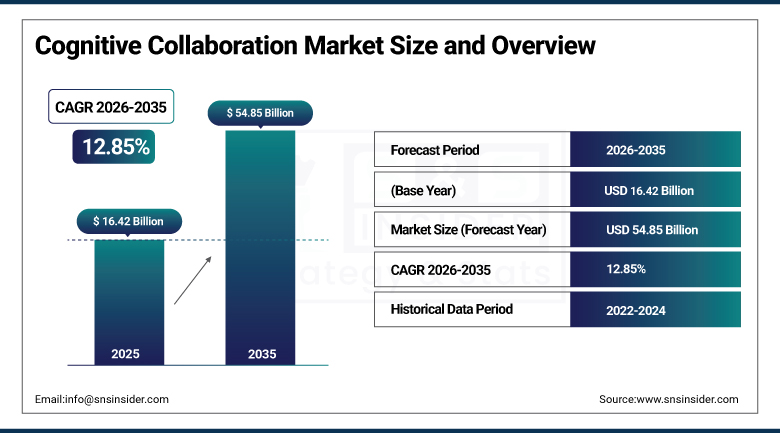
The Cognitive Collaboration Market was valued at USD 16.42 Billion in 2025 and is expected to reach USD 54.85 Billion by 2035, growing at a CAGR of 12.85% from 2026 to 2035.
The Cognitive Collaboration Market is experiencing continuous and ever-increasing growth due to the adoption of AI-enabled platforms that leverage natural language processing, machine learning, and context-based analytics to aid human decision making in routine work processes. Increasing adoption of cognitive collaboration tools in unified communication, project management, and virtual meetings allows businesses to automate routine coordination processes, derive actionable intelligence from unstructured dialogues, and create personalized experiences of collaboration for their dispersed and hybrid workforce. Growing use cases of generative AI co-pilots, autonomous meeting agents, and workflow orchestration tools in enterprise software stack continue to increase the market opportunity for cognitive collaboration providers, while growing IT spending on productivity tools based on AI technology further propels the market growth.
In 2026, Cisco Systems expanded agentic capabilities within its Webex platform by introducing task agents, notetaker agents, and scheduling agents alongside RoomOS 26 and deeper integrations with Microsoft 365 Copilot, Salesforce and Amazon Q, enabling AI agents to work alongside employees across enterprise collaboration workflows.
To Get more information On Cognitive Collaboration Market - Request Free Sample Report
Cognitive Collaboration Market Trends:
-
Enterprises are rapidly embedding generative AI copilots directly into everyday meeting, messaging, and document workflows.
-
Autonomous meeting agents capable of note-taking, scheduling and task follow-up are becoming standard across unified communications suites.
-
Vendors are prioritizing deep interoperability between cognitive collaboration platforms and adjacent enterprise systems such as CRM and ERP.
-
Hybrid and remote work models continue to drive demand for context-aware, always-on virtual collaboration assistants.
-
Industry-specific cognitive collaboration configurations are gaining traction across healthcare, BFSI, and manufacturing verticals.
U.S. Cognitive Collaboration Market Outlook:
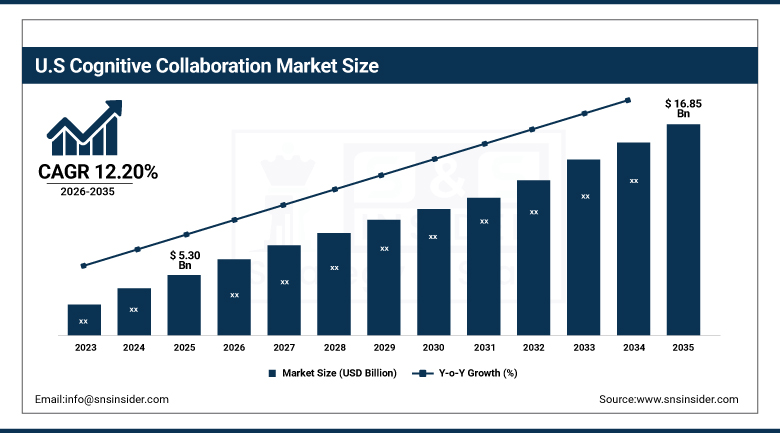
The U.S. Cognitive Collaboration Market was valued at USD 5.30 Billion in 2025 and is projected to reach USD 16.85 Billion by 2035, growing at a CAGR of 12.20% during 2026–2035.
The U.S. Cognitive Collaboration Market is witnessing rapid growth owing to increasing acceptance of AI and collaboration through cloud-based collaboration platforms and hybrid work styles. Many organizations in the technology industry, financial sector, healthcare industry, and professional services are adopting cognitive collaboration technologies in order to automate their processes, summarizing the meetings, facilitating knowledge sharing, and improving employee productivity. In addition, substantial investments in enterprise digitization and advanced communication network are helping in furthering adoption. The availability of key technology players and mature cloud ecosystem is also prompting constant innovation in the area of cognitive collaboration solutions.
In May 2026, Microsoft expanded Copilot Studio with generally available computer-using agents alongside a redesigned workflows experience and Work IQ extensibility, enabling U.S. enterprises to deploy autonomous agents capable of operating across legacy systems that lack modern APIs.
Cognitive Collaboration Market Segment Analysis: :
-
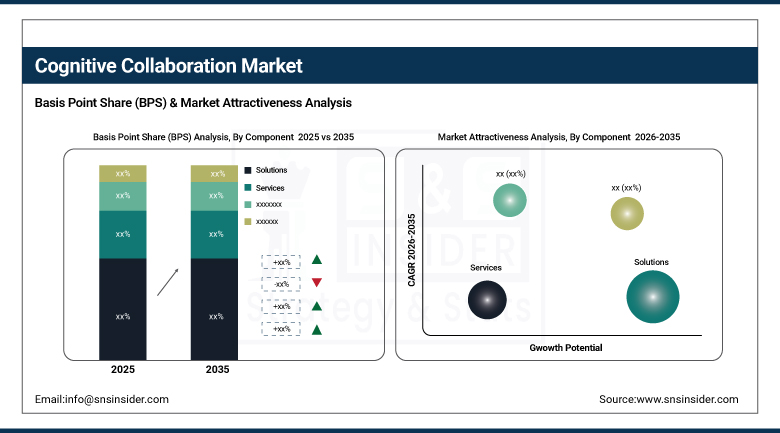
By Component, Solutions dominated the Cognitive Collaboration Market with a 64.20% share in 2025, while Services is the fastest-growing component segment with a CAGR of 15.60% from 2026–2035.
-
By Deployment Mode, Cloud dominated the Cognitive Collaboration Market with a 68.40% share in 2025, while Hybrid is the fastest-growing deployment segment with a CAGR of 16.40% from 2026–2035.
-
By Organization Size, Large Enterprises dominated the Cognitive Collaboration Market with a 61.80% share in 2025, while Small & Medium Enterprises is the fastest-growing segment with a CAGR of 15.90% from 2026–2035.
-
By Application, IT & Telecom dominated the Cognitive Collaboration Market with a 26.30% share in 2025, while Healthcare is the fastest-growing application segment with a CAGR of 16.90% from 2026–2035.
By Component, Solutions leads while Services grows fastest.
Solutions emerged as the dominant segment with a 64.20% share of revenue in the Cognitive Collaboration Market in 2025. Software platforms equipped with natural language processing, machine learning, and predictive analytics capabilities in meeting, messaging, and workflow applications represent the main source of spending by enterprises as they seek direct implementations of collaborative AI applications. The consistent development of agentic capabilities and the availability of pre-configured cognitive solutions that can be easily integrated with existing unified communications and productivity suites have enabled the dominance of this segment in both mature and nascent enterprise technology ecosystems.
The Services segment is likely to witness the highest CAGR of 15.60% between 2026-2035. The growing requirement by enterprises for integration services, customizations, change management services, and managed services to help operationalize the use of cognitive collaboration tools is contributing towards this high growth. Organizations transitioning from piloting such technologies to widespread enterprise implementations have a strong need for consulting, training, and optimization services.
By Deployment Mode, Cloud leads while Hybrid grows fastest.
The Cloud segment represented a market share of 68.40% in the Cognitive Collaboration Market in 2025. Cloud-deployment is expected to continue dominating due to the scalable nature of cloud deployments, reduced cost, and ability to integrate continuously upgraded AI models without any additional hardware upgrade at the on-site end, thus making it easier for companies of all sizes to upgrade their collaborative environment.
The Hybrid deployment type is projected to witness the highest CAGR of 16.40%. Companies working in regulated environments or having legacy systems can leverage the benefits of hybrid deployment, where they can use the cognitive intelligence provided through cloud services, but have control over their data residing on-premises.
By Organization Size, Large Enterprises lead while SMEs grow fastest.
The Large Enterprises segment accounted for 61.80% of the market in 2025. Large enterprises will remain the main buyers of advanced cognitive collaboration solutions because of their big IT budgets, complex multi-geography processes across functional teams and early adoption of enterprise-class AI copilots offered by traditional software providers.
The Small & Medium Enterprises are projected to have the highest CAGR of 15.90% during 2025-2035. Reduced subscription fees for AI-enabled collaboration tools, increasing availability of built-in cognitive capabilities in popular productivity suites and increasing pressure on small businesses to be at least as productive as their big competitors are speeding up adoption of these solutions.
By Application, IT & Telecom leads while Healthcare grows fastest.
The IT & Telecom segment was the leading segment for Cognitive Collaboration Market with 26.30% revenue share in 2025. Technology and telecommunications firms have been among the earliest adopters of cognitive collaboration technologies and continue to be the most prominent adopters, using cognitive collaboration technologies for coordinating their geographically scattered engineering, product development, and customer support teams through AI-powered collaboration to expedite their processes and foster better knowledge management between teams.
Healthcare was anticipated to experience the highest CAGR of 16.90% during 2026-2035. Increased adoption of cognitive technologies for improving clinician collaboration, note-taking, virtual visits, and managing huge amounts of structured and unstructured healthcare data has been the major factor behind the rising adoption of cognitive collaboration technologies.
Regional Insights:
|
Region |
Major Country |
Share within Region, 2025 (%) |
|
North America |
United States |
82.30% |
|
Europe |
Germany |
24.60% |
|
Asia Pacific |
China |
38.40% |
|
Middle East & Africa |
UAE |
27.90% |
|
Latin America |
Brazil |
35.40% |
North America Cognitive Collaboration Market Insights
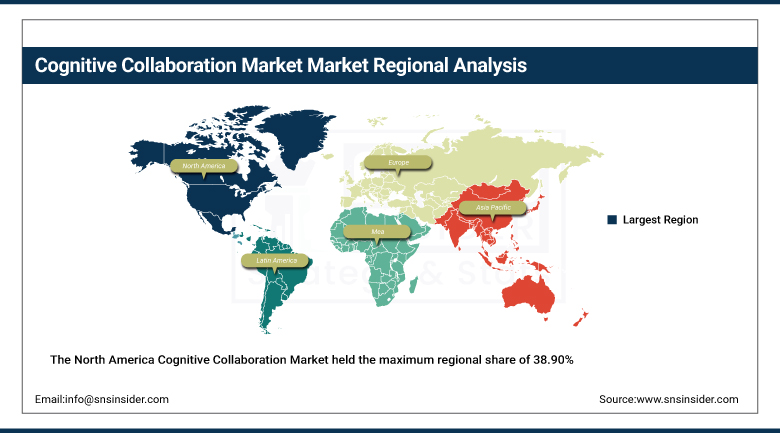
The North America Cognitive Collaboration Market held the maximum regional share of 38.90%, driven by the highly concentrated nature of leading AI and enterprise software players in the region, widespread cloud-based collaboration infrastructure deployment, and considerable investments made by large and mid-enterprises in generative AI and agentic automation solutions. Large enterprises in the region are actively deploying cognitive features in their meeting, messaging, and workflow applications, aided by mature broadband and data center infrastructure that can deliver latency-free real-time cognitive features. Favorable regulations for enterprise software innovation along with the high levels of digital literacy in the region keep sustaining the demand among large enterprises, as well as capable mid and small enterprises that want to leverage cognitive automation to increase their productivity.
Among all countries, the US was the leader in the North America Cognitive Collaboration Market in 2025 with 82.30% share of the regional market on account of the presence of dominant hyperscale cloud players and enterprise software vendors, heavy investments made by enterprises in IT modernization, and the fast rollout of AI copilots in large companies, government organizations, and regulated industries like healthcare and financial services. Canada is aiding the regional growth by increasing adoption of AI collaboration technologies by mid-sized enterprises and digital transformation projects in the government sector.
Get Customized Report as per Your Business Requirement - Enquiry Now
Europe Cognitive Collaboration Market Insights
The Europe region remained a significant contributor to the Cognitive Collaboration Market in 2025 and is poised to witness consistent growth in terms of deployment of compliance-based, data-sovereignty cognitive collaboration solutions over the forecast period. This is because of the highly regulated nature of the region, the presence of an extensive enterprise software portfolio, and the increasing requirement from multinational companies to have AI-driven collaboration solutions which can be deployed on regional infrastructure platforms.
Germany is one of the major markets in Europe owing to its large manufacturing and financial-services enterprise base actively piloting cognitive collaboration tools to streamline cross-functional coordination, along with the presence of strong regional systems-integration partners. Other countries such as the United Kingdom, France and the Netherlands, home to sizable financial and professional-services sectors are also contributing to market growth through expanding enterprise AI adoption and growing investment in workplace digital-transformation programs.
Asia Pacific Cognitive Collaboration Market Insights
The Asia Pacific Cognitive Collaboration Market is expected to register the fastest growth rate during the forecast period 2026-2035, supported by rapidly expanding enterprise cloud adoption, large-scale digital-transformation programs across both established and emerging economies, and rising investment by regional technology conglomerates in proprietary AI-powered collaboration platforms tailored to local language and workflow requirements. Growing government-led initiatives promoting AI adoption across public and private enterprises are further accelerating regional uptake of cognitive collaboration tools.
China is one of the main growth drivers in the Asia Pacific Cognitive Collaboration Market, owing to its expansive enterprise technology ecosystem and rapidly growing domestic development of AI-powered productivity platforms serving both large state-owned enterprises and a fast-expanding private sector. India and Japan, both major global technology and services hubs, are also contributing to regional growth through expanding IT services exports that increasingly embed cognitive collaboration capabilities and rising domestic enterprise demand for AI-powered virtual assistants across banking, manufacturing, and technology sectors.
Middle East & Africa and Latin America Cognitive Collaboration Market Insights
Middle East & Africa and Latin American regions are gradually expanding cognitive collaboration adoption as enterprise digital-transformation investment grows across both regions, supported by increasing government-led smart-economy initiatives and growing multinational corporate presence requiring standardized, AI-enabled collaboration infrastructure across regional offices.
Brazil is set to be a prominent Latin American market fueled by its large financial-services and telecommunications sectors requiring efficient cross-team coordination tools and growing domestic enterprise cloud adoption. The Middle East & Africa region has the UAE and Saudi Arabia investing heavily in national AI strategies and smart-government programs that are gradually increasing enterprise demand for cognitive collaboration platforms across banking, energy, and public-sector organizations.
Growth Drivers: Rising enterprise AI adoption and agentic automation demand driving market growth
The increasing incorporation of generative AI, machine learning, and natural language processing into business communication and productivity applications, along with increasing requirements for rapid and context-driven decision making in organizations, are among the key factors driving growth in the Cognitive Collaboration Market. The use of cognitive collaboration solutions enables businesses to automate routine coordination activities, gain insights from meetings and discussions, and tailor workflows for their distributed teams, which helps to boost the productivity and decrease time consumption for administrative tasks in nearly every activity area, from sales and customer service to product design and human resources.
Constant innovations in large language models and voice intelligence technology have led to significant improvements in the quality and effectiveness of such features of AI-enabled collaboration solutions as meeting assistants, real-time transcription, and task automation capabilities. Increasing investments by enterprises in agentic AI systems that are able to independently perform complex multi-step processes, as well as the demand for tight collaboration between collaboration solutions and business systems like CRM and ERP, and the growing popularity of hybrid work, where virtual coordination is needed at all times, will be other important growth drivers during the forecast period.
Restraints: Data privacy concerns and integration complexity limiting market expansion
Another significant barrier to growth of the market is the increased concern regarding data privacy and confidentiality issues in light of access to confidential data provided to AI-based systems. Companies working in regulated sectors like healthcare, finance, and governmental organizations are reluctant to implement cognitive collaboration solutions that involve processing of sensitive conversational data, especially when the data is transferred across borders for model training.
Moreover, the technical complexity of integrating cognitive collaboration platforms with existing legacy communication systems, enterprise resource planning software, and identity-management infrastructure continues to slow enterprise-wide rollout timelines. Organizations must also invest considerably in change-management and employee training to ensure adoption of AI-driven collaboration features, while inconsistent model accuracy across languages, accents, and industry-specific terminology adds further friction to large-scale deployment, particularly for multinational organizations operating across diverse linguistic environments.
Opportunities: Vertical-specific AI agents and voice-intelligence expansion creating new growth avenues
Increased demands for industry-specific cognitive collaboration models, availability of autonomous multiple agent systems which can coordinate activities departmentally, and increase in innovation funding of biotechnology type for enterprise AI would lead to several growth opportunities in the Cognitive Collaboration Market. Increased demand for audit-able and compliant AI agents that can perform in regulated workflow in healthcare, banking, and government sectors would continue to fuel demand in the market.
There is considerable potential for growth in voice-intelligence and ambient-agent technology capable of proactively surfacing relevant information without requiring explicit user prompts, reducing time spent on manual information retrieval within enterprises. The expansion of enterprise cloud and AI infrastructure across emerging economies in Asia Pacific and Latin America, combined with growing government support for digital-workplace transformation will further drive demand for cognitive collaboration platforms across small, medium, and large organizations alike.
Recent Developments:
-
2026: Cisco unveiled the Webex Meeting Prep Agent and Board Pro G3 collaboration hardware at Cisco Live, alongside an AI-native Workforce Engagement Management solution for Webex Contact Center.
-
2026: Zoom introduced its AI Productivity Suite for the Japanese market, enabling organizations to automatically generate presentations, reports, and meeting summaries within localized collaboration workflows.
Cognitive Collaboration Market Key Players:
-
Cisco Systems, Inc.
-
Google LLC
-
Zoom Communications, Inc.
-
Amazon Web Services, Inc.
-
Salesforce, Inc.
-
Atlassian Corporation
-
International Business Machines Corporation (IBM)
-
Oracle Corporation
-
Avaya LLC
-
8x8, Inc.
-
NICE Ltd.
-
Five9, Inc.
-
AudioCodes Ltd.
-
Sangoma Technologies Corporation
-
HP Inc. (Poly)
-
Verint Systems Inc.
-
GoTo, Inc.
-
Genesys Cloud Services, Inc.
Cognitive Collaboration Market Report Scope:
| Report Attributes | Details |
|---|---|
| Market Size in 2025 | USD 16.42 Billion |
| Market Size by 2035 | USD 54.85 Billion |
| CAGR | CAGR of 12.85% From 2026 to 2035 |
| Base Year | 2025 |
| Forecast Period | 2026-2035 |
| Historical Data | 2022-2024 |
| Report Scope & Coverage | Market Size, Segments Analysis, Competitive Landscape, Regional Analysis, DROC & SWOT Analysis, Forecast Outlook |
| Key Segments | • By Component (Solutions, Services) • By Deployment Mode (Cloud, On-Premises, Hybrid) • By Organization Size (Large Enterprises, Small & Medium Enterprises) • By Application (IT & Telecom, BFSI, Healthcare, Retail & Consumer Goods) |
| Regional Analysis/Coverage | North America (US, Canada), Europe (Germany, UK, France, Italy, Spain, Russia, Poland, Rest of Europe), Asia Pacific (China, India, Japan, South Korea, Australia, ASEAN Countries, Rest of Asia Pacific), Middle East & Africa (UAE, Saudi Arabia, Qatar, South Africa, Rest of Middle East & Africa), Latin America (Brazil, Argentina, Mexico, Colombia, Rest of Latin America). |
| Company Profiles | Cisco Systems, Inc., Microsoft Corporation, Google LLC, Zoom Communications, Inc., Amazon Web Services, Inc., Salesforce, Inc., Atlassian Corporation, International Business Machines Corporation (IBM), Oracle Corporation, Avaya LLC, RingCentral, Inc., 8x8, Inc., NICE Ltd., Five9, Inc., AudioCodes Ltd., Sangoma Technologies Corporation, HP Inc. (Poly), Verint Systems Inc., GoTo, Inc., Genesys Cloud Services, Inc. |

Frequently Asked Questions
The market is driven by rising integration of generative AI and natural language processing into enterprise collaboration platforms, growing enterprise demand for agentic automation, and continued advancement in voice-intelligence technology.
The IT & Telecom segment dominated the Cognitive Collaboration Market in 2025, accounting for approximately 26.30% market share.
The North America region dominated the Cognitive Collaboration Market in 2025 with a 38.90% market share, driven by the region's dense concentration of leading AI and enterprise software vendors.
