
Depolymerization Catalysts Market Report Scope & Overview:
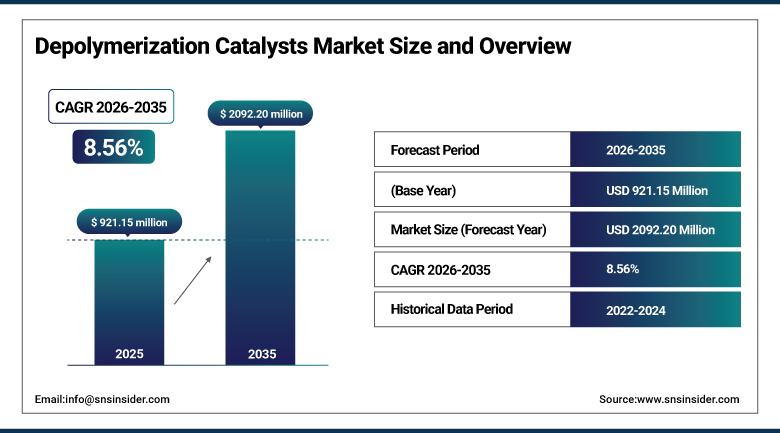
The Depolymerization Catalysts Market was valued at USD 921.15 Million in 2025 and is expected to reach USD 2092.20 Million by 2035, growing at a CAGR of 8.56% from 2026-2035.
Depolymerization catalysts market is consistently gaining traction due to the rising requirement for chemical recycling and recovery of polymers. Increasing utilization of plastic and polyester products in industries like packaging, automotive, and others has created huge quantities of polymer waste which is hard to recycle using traditional methods, thus creating demand for more sophisticated technologies and specific catalysts. Investments in advanced chemical recycling technologies such as glycolysis, alcoholysis, hydrolysis, aminolysis and other depolymerization techniques are boosting the recovery of useful monomers and chemicals from waste polymer products. Companies are paying attention to the efficiency and effectiveness of the processes in terms of selectivity, conversion and catalyst stability. Sustainability and recovery of useful materials in context of circular economy is driving technological advancements.
In February 2025, researchers advanced polymer depolymerization research by evaluating catalytic approaches for converting difficult-to-recycle polymer waste into valuable chemical feedstocks. The research highlighted the importance of catalyst selectivity, reaction efficiency, conversion rates, and product purity in improving the performance and economic viability of chemical recycling processes. Such developments support the adoption of advanced depolymerization catalysts for PET, polyester, polyurethane, and other polymer waste streams.
To Get more information Depolymerization Catalysts Market - Request Free Sample Report
Depolymerization Catalysts Market Trends
-
Growing adoption of chemical recycling and polymer waste recovery is driving demand for advanced depolymerization catalysts.
-
Rising PET, polyester, polyurethane, and mixed polymer waste is increasing demand for scalable depolymerization technologies.
-
Growing demand for monomer and chemical feedstock recovery is supporting specialized catalyst solutions.
-
Focus on catalyst selectivity, conversion efficiency, product purity, stability, and process economics is creating market opportunities.
-
Advancements in glycolysis, alcoholysis, hydrolysis, aminolysis, enzymatic depolymerization, and catalyst formulations are supporting market adoption.
The U.S. Depolymerization Catalysts Market Outlook
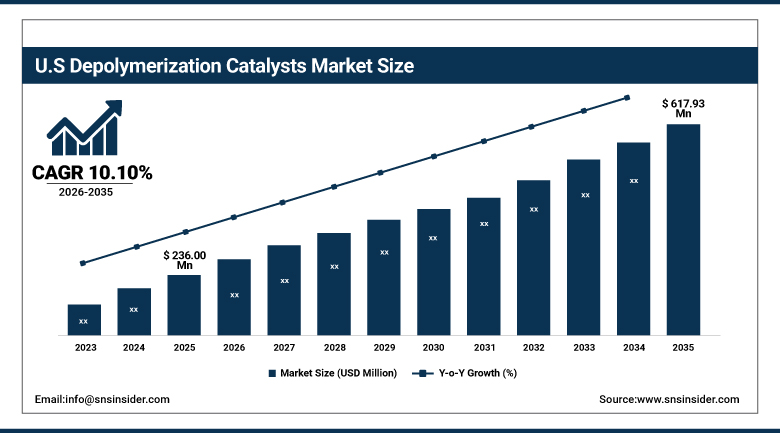
The U.S. depolymerization catalysts market was valued at USD 236.00 Million in 2025 and is expected to reach around USD 617.93 Million by 2035, growing at a CAGR of 10.10% from 2026–2035.
There has been significant growth in the U.S. market for depolymerization catalysts because of the rising requirement for advanced polymer recycling systems and extraction of valuable chemical feedstock from plastic waste. The rise in the production of post-consumer and post-industrial polymer waste is increasing the demand for effective chemical recycling and depolymerization. The growing investment in advanced recycling technology and catalysts is helping in increasing polymer conversion efficiency and quality. The establishment of chemical recycling plants and polymer processing units in the nation will help in raising the demand for depolymerization catalysts in the future.
In August 2026, developments in U.S. advanced plastic recycling continued to support the expansion of chemical recycling and depolymerization technologies, as companies and research organizations focused on improving the conversion of difficult-to-recycle polymer waste into reusable chemical feedstocks. These developments are expected to support demand for high-performance depolymerization catalysts, particularly for PET, polyester, polyurethane, and mixed polymer waste streams, while improving conversion efficiency, product purity, and the economic viability of chemical recycling processes.
Depolymerization Catalysts Market Segment Analysis
-
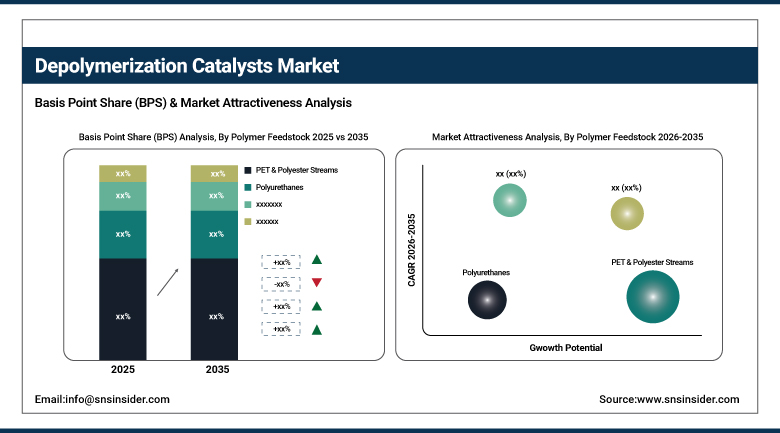
By polymer feedstock, PET & polyester streams dominated the depolymerization catalysts market with a 42.00% share in 2025, while pet & polyester streams are projected to be the fastest-growing segment, registering an estimated 9.39% CAGR during 2026–2035.
-
By catalyst type, metal-based catalysts dominated the depolymerization catalysts market with a 38.00% share in 2025, while metal-based catalysts are projected to remain the leading segment, registering an estimated 9.38% CAGR during 2026–2035.
-
By process route, glycolysis & alcoholysis dominated the depolymerization catalysts market with a 37.00% share in 2025, while aminolysis & other chemistries are projected to be the fastest-growing segment, registering an estimated 9.09% CAGR during 2026–2035.
-
By end-use value chain, chemical recyclers & advanced recyclers dominated the depolymerization catalysts market with a 40.00% share in 2025, while brand owners & consortium projects are projected to be the fastest-growing segment, registering an estimated 9.26% CAGR during 2026–2035.
By Polymer Feedstock, PET & polyester streams dominated the depolymerization catalysts market, while PET & polyester streams are expected to grow fastest.
The PET & polyester streams captured a prominent share in the market during 2025 as a result of the wide usage of PET and polyester plastics in a variety of packaging, textile, consumer goods, and industrial applications. An increase in the generation of PET and polyester waste along with the growing demand for closed loop recycling and recovery of valuable monomers is leading to the implementation of depolymerization catalysts. Innovations in catalytic glycolysis, alcoholysis, hydrolysis, and other depolymerization processes are also enhancing the efficiency and purity of the process.
The PET & Polyester Streams are expected to register the highest CAGR over the forecast period from 2026 to 2035.
By Process Route, glycolysis & alcoholysis dominated the depolymerization catalysts market, while aminolysis & other chemistries are expected to grow fastest.
Glycolysis & alcoholysis was leading the market in 2025 due to their proven usage in the chemical recycling of PET, polyester, polyurethane, and other polymers. They help convert polymer waste into chemical intermediates and feedstocks, which is in increasing demand today. Increased efficiency of catalysts, reactions, selectivity, and product recovery is expected to drive the usage of glycolysis and alcoholysis processes.
Aminolysis & other chemistries are expected to be the fastest-growing segment during the forecast period 2026-2035. Rising focus on new depolymerization routes and demand for higher purity chemical intermediates are some of the reasons driving the adoption of these processes.
By Catalyst Type, metal-based catalysts dominated the depolymerization catalysts market, while metal-based catalysts are expected to grow fastest.
Metal-Based Catalysts were dominating the market during 2025 owing to the high catalytic efficiency, use in polymer depolymerization reaction, and improving the reaction rate and polymer conversion efficiency. The rising need for effective chemical recycling of PET, polyester, polyurethane, and other polymers is aiding the application of metal-based catalysis. Further developments in catalyst selectivity, stability, conversion efficiency, and process economics are also bolstering its application.
Metal-Based Catalysts are expected to grow at a substantial rate during the forecast period from 2026 to 2035. Increasing adoption of advanced chemical recycling technologies, developing new metal-based catalysts, and rising need to improve monomer purity are some of the factors driving the market demand for metal-based catalysts for polymer depolymerization.
Regional Insights
|
Region |
Major Country |
Share within Region, 2025(%) |
|---|---|---|
|
North America |
United States |
82.40% |
|
Europe |
Germany |
34.30% |
|
Asia Pacific |
China |
48.54% |
|
Middle East & Africa |
Saudi Arabia |
23.50% |
|
Latin America |
Brazil |
23.00% |
North America Depolymerization Catalysts Market Insights
The North America market for polymer depolymerization catalysts is anticipated to exhibit steady growth throughout the period of 2026 to 2035 owing to rising volumes of plastic waste, expansion of chemical recycling systems, adoption of circular economy practices, and investment in polymer recycling technologies. The investments made in chemical recycling plants along with the innovation in catalytic systems for converting difficult-to-recycle polymer waste such as PET, polyester, and polyurethane into valuable monomers and chemical feedstocks are contributing to the positive outlook for the region.
The United States is projected to lead the market for polymer depolymerization catalysts in North America with a market share of around 82.40% in 2025. The leading position of the United States in the market can be attributed to the presence of large polymer and plastic industry in the country, growing investments in recycling facilities, rising focus on sustainable materials, and technological advancements in polymer conversion.
Get Customized Report as per Your Business Requirement - Enquiry Now
Europe Depolymerization Catalysts Market Insights
It is projected that the European market for depolymerization catalysts will grow consistently during the forecast period because of the rising need for plastic waste recycling, sustainability efforts, circular economy goals, and investment in advanced recycling technology. The rise in efforts towards extracting valuable monomers and chemical compounds from hard-to-recycle polymer waste will fuel the demand for advanced depolymerization catalysts.
Germany is expected to continue being one of the major national markets in Europe on account of its chemical and manufacturing sectors, plastics processing industry, sustainability programs, and advanced recycling technology investments. Moreover, countries like the UK, France, Italy, and the Netherlands have been contributing to regional demand by investing in the recycling of polymers.
Asia Pacific Depolymerization Catalysts Market Insights
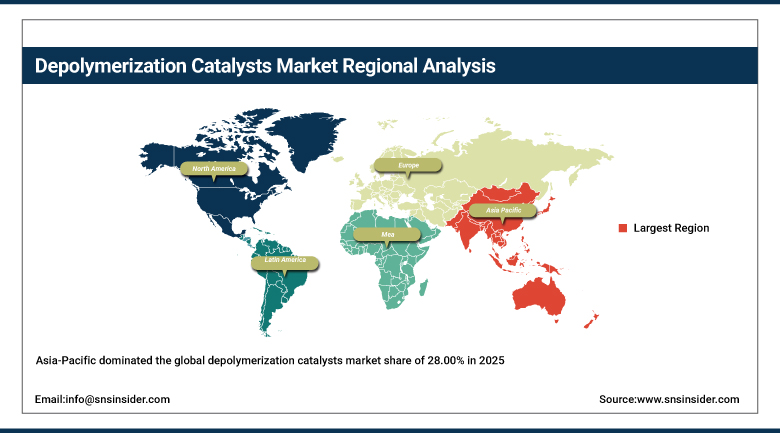
Asia-Pacific dominated the global depolymerization catalysts market share of 38.02% in 2025, and it is expected to grow at the highest CAGR during the forecast period (2023-2035) and reach 33.00% market share by 2035. This growth is fueled by the presence of large bases of plastics and polymers manufacturing, high plastic waste generation, rapid industrialization, growing capacity for chemical recycling, and adoption of the principles of circular economy.
China will remain a key market player in the Asia-Pacific region owing to the presence of the large industry base of plastics and chemicals production, high generation of plastic waste, growing investment in chemical recycling, and emphasis on sustainable recovery of materials. Japan and South Korea will remain key contributors due to their advanced industries of chemicals, automotive, electronics, and materials, whereas India is likely to witness increasing demand in the wake of growing waste management and recycling activities.
Middle East & Africa and Latin America Depolymerization Catalysts Market Insights
The depolymerization catalyst markets in the Middle East & Africa and Latin America will grow consistently between 2026 and 2035 due to the increasing amount of plastic waste produced, sustainability measures, development of plastic recycling infrastructure and investments in advanced polymer recovery and chemical recycling technology. Increased focus on circular plastics supply chain and reduced reliance on virgin polymers is creating demand for advanced depolymerization catalyst technology.
Saudi Arabia will continue to be an important market within the Middle East & Africa region, driven by investments into chemicals and petrochemicals industries, economic diversification, sustainability programs and circular plastics projects development. In Latin America, Brazil will continue to be a crucial country market thanks to the large plastics and chemicals industry, recycling activities, sustainability measures and interest in circular plastics value chain. Other Latin American markets will also add to the regional growth due to plastic recycling infrastructure development, chemical recycling projects and sustainable materials initiatives.
Growth Driver: Increasing demand for efficient polymer recycling and valuable chemical feedstock recovery is driving market growth
The increasing demand for efficient chemical recycling of polymer waste is one of the major drivers of the global depolymerization catalysts market. The rising usage of plastics and polymers in different industries including packaging, automotive, textiles, consumer goods, and others has led to higher amounts of post-consumer and post-industrial polymer waste. As a result, there is an increasing requirement for efficient depolymerization methods that allow the transformation of complex polymers such as PET, polyester, polyurethane, and other polymers into valuable chemicals.
Moreover, catalyst formulation development, catalytic reaction pathway development, glycolysis, alcoholysis, hydrolysis, aminolysis, and enzymatic depolymerization advancements drive the market growth. There are ongoing investments in the implementation of advanced chemical recycling plants and the development of the circular economy.
Restraint: Complex polymer waste composition and depolymerization challenges can limit market adoption
The complicated and diverse composition of polymer waste creates difficulties during the depolymerization process. Differences in the type of polymer used, additive type, dyes used, fillers, contaminants, and degradation of the material can influence the catalyst, reaction efficiency, purity of products obtained, and process economics in general. Such issues become especially relevant in cases when the recycling of mixed plastic and polyolefinic waste is needed.
Furthermore, to obtain high yields and purity of the final product, it is crucial to have control over such parameters as the amount of catalyst used, reaction temperature, pressure, residence time, solvent used, etc. The relatively high price of the equipment and process itself can create problems for smaller companies that need to recycle their waste.
Opportunity: Growing chemical recycling demand and circular polymer value chains create new market opportunities
The trend towards waste plastic reduction and circular economy initiatives opens up major prospects for depolymerization catalyst suppliers. With an increase in the amount of hard-to-recycle polymer waste, there will be a higher need for technologies that can effectively transform the waste polymers into useful monomers, intermediates, and materials. Modern depolymerization catalysts can help make the process more efficient and selective and aid in material recovery from PET, polyester, polyurethane, and other polymer streams.
Moreover, increasing investment in modern chemical recycling plants, sustainable packaging, and recycled content initiatives, as well as circular polymer value chain creation, provides many opportunities for efficient catalyst technology development. Furthermore, increased cooperation between chemical recyclers, polymer and resin suppliers, brand owners, and technology providers will enable the implementation of advanced depolymerization technologies and open more opportunities for catalyst development.
Recent Developments
-
March 2026: Group14 Technologies began production at its BAM-3 facility in South Korea, with annual capacity of up to 2,000 metric tons of silicon battery materials, supporting the expansion of silicon-based anode materials for lithium-ion batteries.
-
March 2026: Clariant successfully demonstrated its HDMax catalyst for upgrading plastic waste-derived pyrolysis oil into cracker-grade feedstock in collaboration with Borealis, supporting the development of advanced catalytic solutions for circular plastics and chemical recycling.
-
2026: BASF continued advancing its ChemCycling chemical recycling activities, using processes including depolymerization and pyrolysis to convert plastic waste into chemical feedstocks and support the production of recycled materials at industrial scale.
-
2026: Eastman continued expanding its molecular recycling initiatives, building on its methanolysis-based technology and the commercial-scale Kingsport facility, while advancing additional molecular recycling projects in France and Texas.
-
2026: CARBIOS continued advancing its enzymatic PET biorecycling technology and its planned Longlaville facility in France, supporting the commercialization of enzymatic depolymerization for PET and polyester waste.
Depolymerization Catalysts Companies are:
-
Clariant AG
-
BASF SE
-
Johnson Matthey
-
Evonik Industries AG
-
Mitsubishi Chemical Group
-
Indorama Ventures
-
Eastman Chemical Company
-
Loop Industries
-
INEOS Styrolution
-
Carbios
-
Axens
-
Ioniqa Technologies
-
gr3n
-
JEPLAN, Inc.
-
Garbo S.r.l.
-
Reju
-
Wankai New Materials
-
Honeywell UOP.
Depolymerization Catalysts Market Report Scope:
| Report Attributes | Details |
|---|---|
| Market Size in 2025 | USD 921.15 Million |
| Market Size by 2035 | USD 2,092.20 Million |
| CAGR | CAGR of 8.56% From 2026 to 2035 |
| Base Year | 2025 |
| Forecast Period | 2026-2035 |
| Historical Data | 2022-2024 |
| Report Scope & Coverage | Market Size, Segments Analysis, Competitive Landscape, Regional Analysis, DROC & SWOT Analysis, Forecast Outlook |
| Key Segments | • By Polymer Feedstock (PET & Polyester Streams, Polyurethanes, Mixed Plastics & Polyolefin Streams, Other Polymers) • By Catalyst Type (Metal-Based Catalysts, Organocatalysts, Enzymatic Systems, Other Catalyst Concepts) • By Process Route (Glycolysis & Alcoholysis, Hydrolysis, Aminolysis & Other Chemistries, Other Depolymerization Routes) • By End-Use Value Chain (Chemical Recyclers & Advanced Recyclers, Polymer & Resin Producers, Brand Owners & Consortium Projects, Other Stakeholders) |
| Regional Analysis/Coverage | North America (US, Canada), Europe (Germany, UK, France, Italy, Spain, Russia, Poland, Rest of Europe), Asia Pacific (China, India, Japan, South Korea, Australia, ASEAN Countries, Rest of Asia Pacific), Middle East & Africa (UAE, Saudi Arabia, Qatar, South Africa, Rest of Middle East & Africa), Latin America (Brazil, Argentina, Mexico, Colombia, Rest of Latin America) |
| Company Profiles | Clariant AG, BASF SE, Johnson Matthey, Evonik Industries AG, Mitsubishi Chemical Group, SK Geo Centric, Indorama Ventures, Eastman Chemical Company, Loop Industries, INEOS Styrolution, Carbios, Axens, Ioniqa Technologies, gr3n, JEPLAN, Inc., Saipem S.p.A., Garbo S.r.l., Reju, Wankai New Materials, Honeywell UOP |

Frequently Asked Questions
The depolymerization catalysts market is expected to grow at a CAGR of 8.56% from 2026 to 2035.
The depolymerization catalysts market was valued at approximately USD 921.15 million in 2025.
The market is primarily driven by the increasing demand for chemical recycling of polymer waste, growing volumes of post-consumer and post-industrial plastics, expansion of advanced recycling infrastructure, rising demand for recovered monomers and chemical feedstocks, and increasing investments in advanced depolymerization and catalyst technologies.
PET & Polyester Streams dominated the depolymerization catalysts market in 2025, accounting for a 42.00% share.
Asia-Pacific dominated the depolymerization catalysts market in 2025, accounting for a 38.00% share.
