
Direct Lithium Extraction Adsorbent Market Report Scope & Overview:
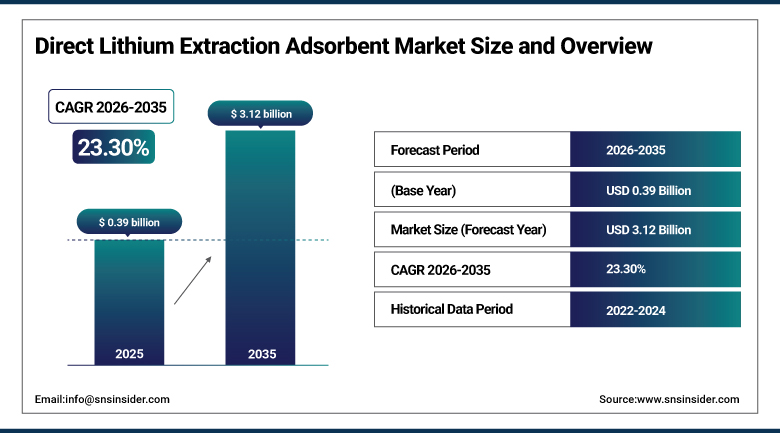
The Direct Lithium Extraction Adsorbent Market was valued at USD 0.39 Billion in 2025 and is expected to reach USD 3.12 Billion by 2035, growing at a CAGR of 23.30% from 2026–2035.
The direct lithium extraction adsorbent market is witnessing steady growth owing to the increasing demand for lithium to support electric vehicle batteries, energy storage systems, and the broader transition toward clean energy technologies. Growing concerns over conventional lithium extraction methods, including high water consumption, land use, and lengthy production cycles, are encouraging the adoption of direct lithium extraction (DLE) technologies that offer more selective and potentially efficient lithium recovery. The increasing development of lithium resources from brine, lithium-rich clays, geothermal water, and oilfield and produced water is creating greater demand for high-performance adsorbent materials capable of selectively extracting lithium ions from complex feed streams. Inorganic adsorbents, organic adsorbents, and composite adsorbents are increasingly being developed to improve lithium selectivity, adsorption capacity, regeneration efficiency, and operational stability.
In July 2026, advances in direct lithium extraction technologies increased demand for high-performance adsorbents offering greater lithium selectivity, faster adsorption, and improved regeneration. For the direct lithium extraction adsorbent market, this trend highlights growing adoption of advanced inorganic, organic, and composite adsorbents for efficient lithium recovery from brines and unconventional lithium resources.
To Get more information Direct Lithium Extraction Adsorbent Market - Request Free Sample Report
Direct Lithium Extraction Adsorbent Market Trends
-
Growing adoption of direct lithium extraction (DLE) technologies is increasing demand for high-performance adsorbents with improved lithium selectivity, adsorption capacity, and regeneration efficiency.
-
Rising lithium demand from electric vehicles, lithium-ion batteries, and grid-scale energy storage is accelerating investment in efficient lithium recovery technologies.
-
Expansion of lithium extraction from brines, lithium-rich clays, geothermal water, and oilfield and produced water is creating new opportunities for specialized adsorbent materials.
-
Advancements in adsorption-based DLE, ion-exchange DLE, and hybrid technologies are improving lithium recovery efficiency, selectivity, and processing speed.
-
Growing focus on reducing water consumption, land requirements, and environmental impacts associated with conventional lithium extraction is supporting the adoption of DLE technologies.
-
Adsorbent manufacturers, lithium producers, and DLE technology developers are increasingly developing advanced inorganic, organic, and composite adsorbents to improve lithium recovery performance, operating efficiency, and scalability across diverse lithium-bearing resources.
The U.S. Direct Lithium Extraction Adsorbent Market Outlook
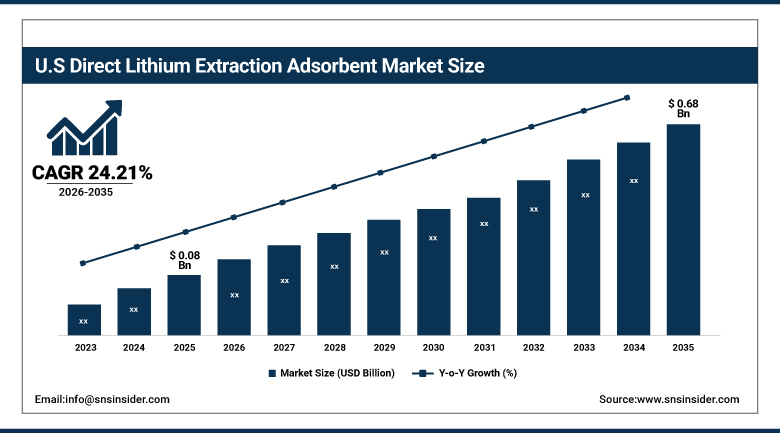
The U.S. direct lithium extraction adsorbent market was valued at USD 0.08 Billion in 2025 and is expected to reach around USD 0.68 Billion by 2035, growing at a CAGR of 24.21% from 2026–2035.
The U.S. direct lithium extraction adsorbent market is expanding owing to rising lithium demand from electric vehicles, lithium-ion batteries, grid-scale energy storage, and clean energy applications. Growing efforts to strengthen domestic lithium supply chains and reduce reliance on imported battery materials are encouraging investments in advanced lithium extraction technologies. Increasing development of lithium resources from brines and other unconventional sources is creating demand for high-performance adsorbents that can improve lithium selectivity, recovery efficiency, and regeneration performance.
Organizations across the lithium mining, battery materials, energy, and chemical sectors are increasingly exploring direct lithium extraction technologies to shorten processing times and reduce water and land requirements compared with conventional extraction methods. Advancements in adsorption-based DLE, ion-exchange systems, and hybrid extraction technologies are further supporting market development. Increasing investments in domestic lithium projects and commercialization of DLE technologies are expected to strengthen long-term demand for advanced adsorbents in the U.S. market.
In May 2026, EnergyX announced plans with Compass Minerals to develop a 30,000-ton-per-year commercial-scale direct lithium extraction and refining facility near Utah’s Great Salt Lake. The project will use EnergyX’s proprietary DLE technology and is expected to strengthen domestic lithium production in the U.S. For the U.S. direct lithium extraction adsorbent market, this development highlights growing demand for advanced sorbents and adsorbents that can support selective, scalable lithium recovery from domestic brine resources.
Direct Lithium Extraction Adsorbent Market Segment Analysis
-
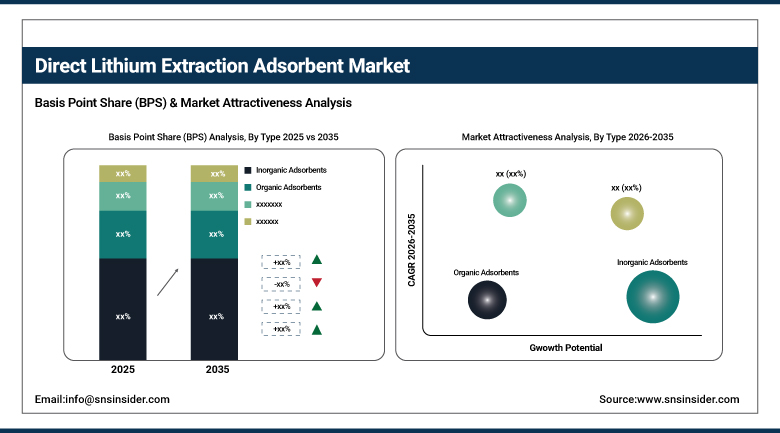
By Type, inorganic adsorbents dominated the market with a 52.00% share in 2025, while composite adsorbents are the fastest-growing segment, registering a CAGR of 27.89% during 2026 to 2035.
-
By Application, brine dominated the market with a 58.00% share in 2025, while geothermal water is the fastest-growing segment, registering a CAGR of 24.19% during 2026 to 2035.
-
By DLE Technology, adsorption-based DLE dominated the market with a 55.00% share in 2025 and is also the fastest-growing segment, registering a CAGR of 24.19% during 2026 to 2035.
-
By End-Use Industry, batteries dominated the market with a 48.00% share in 2025, while electric vehicles are the fastest-growing segment, registering a CAGR of 27.90% during 2026 to 2035.
By Type, inorganic adsorbents dominated the direct lithium extraction adsorbent market, while composite adsorbents are the fastest-growing segment.
The inorganic adsorbents segment held the leading position in the direct lithium extraction adsorbent market in 2025. Its dominance is supported by the established use of inorganic materials for selective lithium adsorption, particularly across brine-based direct lithium extraction processes. These adsorbents offer favorable lithium selectivity, adsorption capacity, chemical stability, and regeneration characteristics, making them suitable for repeated extraction cycles. Increasing investment in direct lithium extraction projects and the need to improve lithium recovery efficiency are further supporting demand for inorganic adsorbents.
The composite adsorbents segment is projected to register the fastest growth during 2026–2035. Increasing research and development efforts are focused on combining different adsorption materials to improve lithium selectivity, adsorption kinetics, regeneration performance, and operational durability. Growing deployment of DLE technologies across diverse lithium-bearing resources is expected to further accelerate adoption of advanced composite adsorbents.
By DLE Technology, adsorption-based DLE dominated the direct lithium extraction adsorbent market, while adsorption-based DLE is also the fastest-growing segment.
The adsorption-based DLE segment dominated the direct lithium extraction adsorbent market in 2025. Its leading position is attributed to the ability of selective adsorbent materials to capture lithium ions from complex feed streams while supporting efficient regeneration and repeated extraction cycles. Increasing development of advanced inorganic, organic, and composite adsorbents is improving the performance of adsorption-based systems and strengthening their suitability for commercial lithium recovery.
The adsorption-based DLE segment is expected to experience the fastest growth during 2026–2035. Continued advancements in adsorbent chemistry, lithium selectivity, adsorption kinetics, regeneration efficiency, and material durability are improving the commercial potential of adsorption-based extraction systems. Increasing deployment of DLE projects and growing efforts to develop efficient lithium recovery technologies are expected to further accelerate segment growth.
By End-Use Industry, batteries dominated the direct lithium extraction adsorbent market, while electric vehicles are the fastest-growing segment.
The batteries segment dominated the direct lithium extraction adsorbent market in 2025. Its leadership is driven by the growing requirement for lithium as a critical raw material in lithium-ion battery production for electric vehicles, energy storage systems, and portable electronic devices. Increasing battery manufacturing capacity and efforts to establish secure domestic lithium supply chains are strengthening demand for efficient lithium extraction technologies and advanced adsorbent materials.
The electric vehicles segment is projected to register the fastest growth during 2026–2035. Rapid expansion of EV manufacturing and increasing demand for high-capacity lithium-ion batteries are driving greater requirements for reliable lithium supply. Growing investments in battery materials and domestic lithium production are expected to encourage adoption of DLE technologies, supporting increased demand for high-performance adsorbents across the electric vehicle supply chain.
Regional Insights
|
Region |
Major Country |
Share within Region, 2025(%) |
|---|---|---|
|
North America |
United States |
84.00% |
|
Europe |
Germany |
27.38% |
|
Asia Pacific |
China |
45.72% |
|
Middle East & Africa |
Saudi Arabia |
22.84% |
|
Latin America |
Brazil |
21.63% |
North America Direct Lithium Extraction Adsorbent Market Insights
The North America region is expected to remain a significant market for the direct lithium extraction adsorbent market throughout the forecast period with CAGR of around 18.41%. Regional growth is supported by increasing lithium demand for electric vehicles, lithium-ion batteries, energy storage systems, and clean energy applications. The region is also benefiting from efforts to strengthen domestic lithium supply chains and reduce dependence on imported battery materials. Growing investments in direct lithium extraction projects, particularly those targeting brine and unconventional lithium resources, are creating demand for advanced adsorbents with high lithium selectivity, adsorption capacity, and regeneration efficiency.
The United States represents the largest country market in North America, supported by increasing investments in domestic lithium production, battery manufacturing, and critical mineral supply chains. The development of DLE projects and growing interest in recovering lithium from domestic brine resources are strengthening demand for adsorption-based extraction technologies. Canada is also emerging as an important market, supported by lithium resource development, battery-material investments, and increasing interest in advanced extraction technologies.
Europe Direct Lithium Extraction Adsorbent Market Insights
The demand for direct lithium extraction adsorbents in Europe is supported by growing efforts to establish secure regional lithium supply chains and reduce dependence on imported raw materials. Increasing electric vehicle production, battery manufacturing, energy storage deployment, and clean energy investments are strengthening demand for lithium recovery technologies. Germany represents a major country market, supported by its large automotive and industrial sectors, expanding battery manufacturing ecosystem, and strong focus on sustainable raw-material sourcing.
Organizations and lithium developers across Europe are increasingly exploring direct lithium extraction technologies to improve lithium recovery efficiency and reduce the environmental footprint associated with conventional extraction methods. The UK, France, Italy, and other European markets are also contributing to regional demand through investments in battery materials, critical minerals, and innovative lithium recovery technologies.
Asia Pacific Direct Lithium Extraction Adsorbent Market Insights
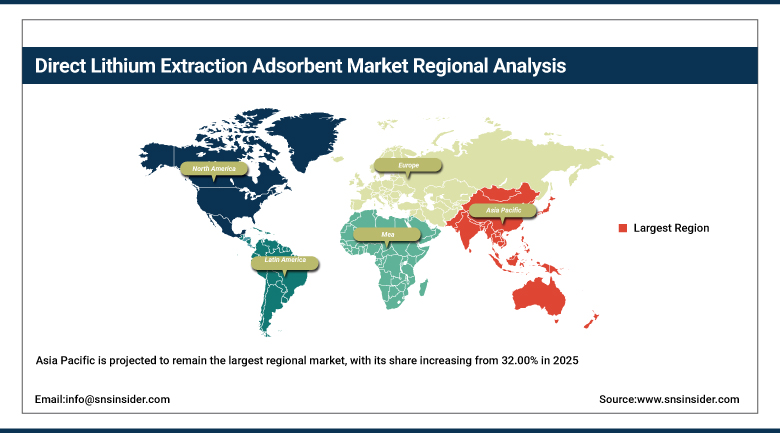
Asia Pacific is projected to remain the largest regional market, with its share increasing from 32.00% in 2025. Regional growth is supported by rapid expansion of electric vehicle production, lithium-ion battery manufacturing, energy storage systems, and clean energy infrastructure. The region's extensive battery supply chain and increasing requirements for secure lithium supplies are encouraging investments in advanced lithium extraction technologies. China represents the largest country market in the region, supported by its dominant position in battery manufacturing, electric vehicle production, lithium processing, and energy storage.
Japan and South Korea remain important markets due to their advanced battery, automotive, electronics, and energy-storage industries. India is also expected to experience increasing demand as battery manufacturing capacity expands and investments in electric mobility and energy storage accelerate. Growing development of unconventional lithium resources and increasing adoption of DLE technologies are expected to support demand for high-performance adsorbents across the region.
Get Customized Report as per Your Business Requirement - Enquiry Now
Middle East & Africa and Latin America Direct Lithium Extraction Adsorbent Market Insights
The Middle East & Africa and Latin America markets are expected to experience continued growth through 2035, supported by increasing lithium demand, resource development, and investments in advanced extraction technologies. In the Middle East & Africa, Saudi Arabia represents a significant country market as the country expands its focus on mining diversification, critical minerals, industrial development, and clean-energy supply chains. Growing exploration of mineral resources and interest in advanced extraction technologies could create additional opportunities for DLE adsorbent suppliers.
In Latin America, Brazil represents an important country market, supported by its growing lithium industry, mineral-resource development, and increasing interest in battery-material supply chains. Argentina and Chile also contribute significantly to regional lithium development due to their substantial brine resources and established lithium production activities. Increasing adoption of direct lithium extraction technologies across the region is expected to create opportunities for advanced adsorbents capable of improving lithium recovery efficiency and supporting more sustainable resource development.
Growth Driver: Rising lithium demand and the need for efficient extraction are driving market growth
The rapid expansion of electric vehicles, lithium-ion batteries, grid-scale energy storage, and clean energy technologies is a major factor driving demand for the direct lithium extraction adsorbent market. Growing lithium consumption is increasing pressure on producers to develop efficient and scalable extraction methods capable of supporting expanding battery-material supply requirements. Direct lithium extraction technologies can enable selective lithium recovery from brines and other lithium-bearing resources while potentially reducing processing time and resource consumption compared with conventional extraction approaches.
The growing development of lithium resources from brine, lithium-rich clays, geothermal water, and oilfield and produced water is further increasing demand for high-performance adsorbents. Advancements in adsorbent selectivity, adsorption capacity, regeneration efficiency, and material durability are supporting wider adoption across lithium extraction projects. These developments are strengthening demand for inorganic, organic, and composite adsorbents and supporting market growth across lithium producers, battery-material suppliers, and DLE technology developers.
Restraint: High development costs, adsorbent degradation, and technical challenges can limit market adoption
The development and commercialization of direct lithium extraction adsorbents can involve significant research, testing, pilot-scale validation, and infrastructure costs. Adsorbent performance can vary depending on lithium concentration, feed composition, impurities, temperature, and operating conditions, creating challenges for achieving consistent recovery performance across different lithium resources. Maintaining high selectivity while ensuring long-term adsorption capacity and effective regeneration can also increase technical complexity.
The costs associated with advanced adsorbent materials, DLE equipment, process integration, pilot testing, and specialized technical expertise can limit adoption, particularly for smaller lithium developers. In addition, potential issues related to adsorbent fouling, degradation, regeneration requirements, and material disposal may affect operating economics. Variability in lithium-bearing resources and the limited long-term commercial operating history of some DLE systems can also create uncertainty for large-scale deployment.
Opportunity: Growing commercialization of DLE and development of advanced adsorbent technologies create new market opportunities
The increasing commercialization of direct lithium extraction projects is creating significant opportunities for adsorbent manufacturers and DLE technology developers. Demand is rising for advanced materials capable of selectively recovering lithium from complex brines, geothermal water, lithium-rich clays, and other unconventional resources while supporting high recovery rates and repeated regeneration cycles.
Advancements in composite adsorbents, selective inorganic materials, organic adsorbents, and hybrid adsorption-ion exchange systems are creating opportunities to improve lithium recovery efficiency and operating stability. The expansion of domestic lithium supply chains, increasing investment in battery-material production, and growing focus on reducing water consumption and environmental impacts are expected to further support adoption. Increasing deployment of DLE projects across North America, Asia Pacific, Latin America, and other lithium-producing regions is expected to create additional opportunities for specialized adsorbent suppliers and technology providers.
Recent Developments
-
May 2026: DuPont expanded its lithium extraction portfolio with advanced adsorbents, ion-exchange resins, and related separation technologies designed to improve lithium recovery and process efficiency in direct lithium extraction applications.
-
June 2026: EnergyX advanced its direct lithium extraction technology platform, focusing on selective lithium recovery, high-performance sorbent materials, and scalable processing for brine-based lithium resources.
-
2026: Sunresin New Materials Co., Ltd. continued advancing specialized adsorption and ion-exchange materials for lithium extraction, supporting improved lithium selectivity, recovery efficiency, and adsorbent regeneration.
-
2026: Lilac Solutions continued developing its ion-exchange-based direct lithium extraction technology, with emphasis on scalable lithium recovery from brines and efficient reinjection of processed brine.
Direct Lithium Extraction Adsorbent Companies are:
-
EnergyX
-
DuPont
-
Sunresin New Materials Co., Ltd.
-
Xi'an Lanshen New Material Technology Co., Ltd.
-
Lilac Solutions
-
Standard Lithium
-
International Battery Metals
-
Eramet
-
Vulcan Energy Resources
-
Aquatech International
-
Koch Technology Solutions
-
Summit Nanotech
-
LightOre
-
SLB
-
E3 Lithium
-
LithiumBank Resources
-
Watercycle Technologies
-
Adionics
Direct Lithium Extraction Adsorbent Market Report Scope:
| Report Attributes | Details |
|---|---|
| Market Size in 2025 | USD 0.39 Billion |
| Market Size by 2035 | USD 3.12 Billion |
| CAGR | CAGR of 23.30% From 2026 to 2035 |
| Base Year | 2025 |
| Forecast Period | 2026-2035 |
| Historical Data | 2022-2024 |
| Report Scope & Coverage | Market Size, Segments Analysis, Competitive Landscape, Regional Analysis, DROC & SWOT Analysis, Forecast Outlook |
| Key Segments | • By Type (Inorganic Adsorbents, Organic Adsorbents, Composite Adsorbents, Others) • By Application (Brine, Lithium-Rich Clays, Geothermal Water, Oilfield & Produced Water, Others) • By DLE Technology (Adsorption-Based DLE, Ion-Exchange DLE, Adsorption–Ion Exchange Hybrid, Others) • By End-Use Industry (Batteries, Energy Storage, Electric Vehicles, Pharmaceuticals, Industrial & Chemical, Others) |
| Regional Analysis/Coverage | North America (US, Canada), Europe (Germany, UK, France, Italy, Spain, Russia, Poland, Rest of Europe), Asia Pacific (China, India, Japan, South Korea, Australia, ASEAN Countries, Rest of Asia Pacific), Middle East & Africa (UAE, Saudi Arabia, Qatar, South Africa, Rest of Middle East & Africa), Latin America (Brazil, Argentina, Mexico, Colombia, Rest of Latin America) |
| Company Profiles | EnergyX, DuPont, Sunresin New Materials Co., Ltd., Xi'an Lanshen New Material Technology Co., Ltd., Lilac Solutions, Rio Tinto, Standard Lithium, International Battery Metals, Eramet, Vulcan Energy Resources, Aquatech International, Koch Technology Solutions, Summit Nanotech, CleanTech Lithium, LightOre, SLB, E3 Lithium, LithiumBank Resources, Watercycle Technologies, Adionics. |

Frequently Asked Questions
The Direct Lithium Extraction Adsorbent Market was valued at approximately USD 0.39 billion in 2025.
The market is primarily driven by rising lithium demand from electric vehicles, lithium-ion batteries, energy storage systems, and increasing investment in efficient direct lithium extraction technologies.
Inorganic Adsorbents dominated the Direct Lithium Extraction Adsorbent Market in 2025, accounting for a 52.00% share.
