
Hyper Personalization Market Report Scope & Overview:
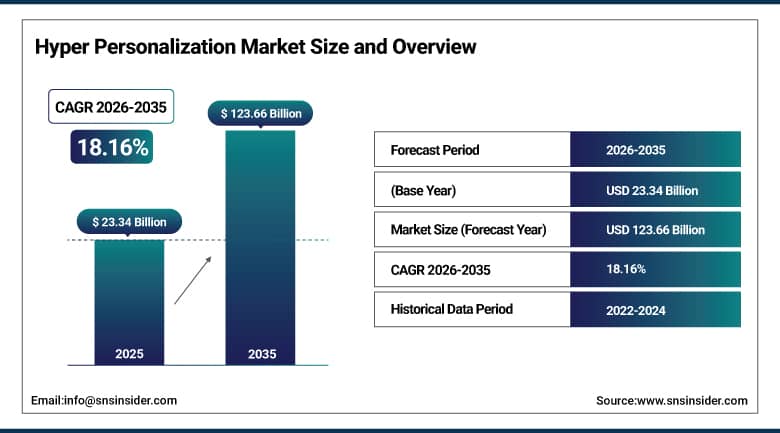
The Hyper Personalization Market was valued at USD 23.34 Billion in 2025 and is expected to reach USD 123.66 Billion by 2035, growing at a CAGR of 18.16% from 2026–2035.
Some of the key drivers behind the formation of the global hyper-personalization market include the increasing usage of artificial intelligence (AI) and machine learning (ML), growing need for personalized experiences of customers in real time, increasing popularity of customer data platforms (CDPs), and expansion of omnichannel engagement techniques. Many organizations have started using the power of predictive analytics, behavioral insights, and automation technology in order to provide customers with personalized interactions and thus increase their engagement and brand loyalty and boost their conversions. Furthermore, some other factors behind the increasing growth of this market are the increasing adoption of cloud-based personalization platforms, generative AI, NLP, and first-party customer data.
In May 2024, Newgen Software launched LumYn, a GenAI-powered hyper-personalization platform designed for the banking sector. The platform leverages AI-driven customer intelligence and predictive analytics to help financial institutions deliver personalized customer experiences, improve engagement, and enhance profitability through data-driven decision-making.
To Get More Information On Hyper Personalization Market - Request Free Sample Report
Hyper Personalization Market Trends:
-
Rising adoption of artificial intelligence (AI), machine learning (ML), and predictive analytics is driving the demand for hyper personalization solutions across industries.
-
Increasing consumer expectations for personalized, real-time digital experiences are accelerating the adoption of hyper personalization platforms in customer engagement strategies.
-
Hyper personalization enables businesses to deliver tailored recommendations, targeted marketing campaigns, enhanced customer engagement, and improved customer loyalty through data-driven insights.
-
Advancements in generative AI, natural language processing (NLP), customer data platforms (CDPs), and cloud-based personalization technologies are driving innovation in the Hyper Personalization Market.
-
Growing adoption across BFSI, Retail, Healthcare & Life Sciences, Media & Entertainment, and Travel & Hospitality is supporting sustained market growth.
U.S. Hyper Personalization Market Outlook:
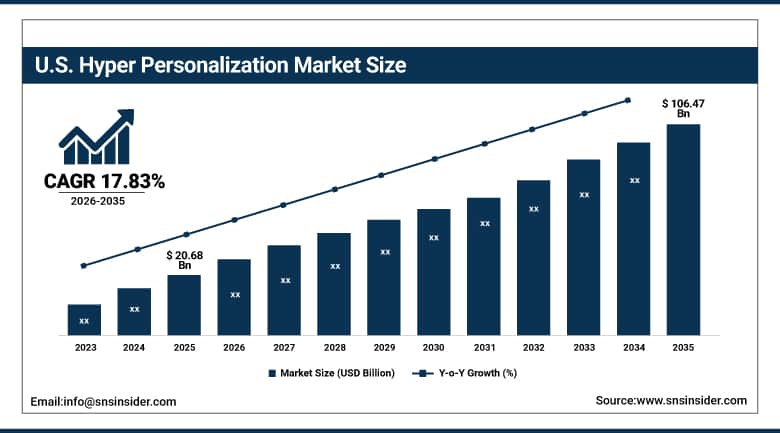
The U.S. Hyper Personalization Market was valued at USD 20.68 Billion in 2025 and is expected to reach around USD 106.47 Billion by 2035, growing at a CAGR of 17.83% from 2026–2035.
Increasing adoption of AI, ML, and advanced data analytics solutions, along with the rise in the need for personalized digital experiences, is contributing to the growth of the Hyper Personalization Market in the United States. Various industries such as retail, BFSI, healthcare, media & entertainment, and travel & hospitality are increasingly adopting hyper-personalization solutions powered by AI to achieve improved customer engagement, loyalty, and marketing efficiency through data-driven and real-time interactions.
Further, technological advances in generative AI, NLP, CDPs, and cloud-based personalization technologies are driving the growth of the Hyper Personalization Market in the United States. Increasing investments from technology vendors and enterprises in AI-based customer experience platforms and predictive analytics are further aiding market growth.
In March 2025, Adobe introduced Adobe Experience Platform Agent Orchestrator and Brand Concierge at Adobe Summit 2025, enabling businesses to deploy AI agents that deliver personalized, real-time, and conversational customer experiences at scale across digital channels, further strengthening enterprise hyper personalization capabilities.
Hyper Personalization Market Segment Analysis:
-
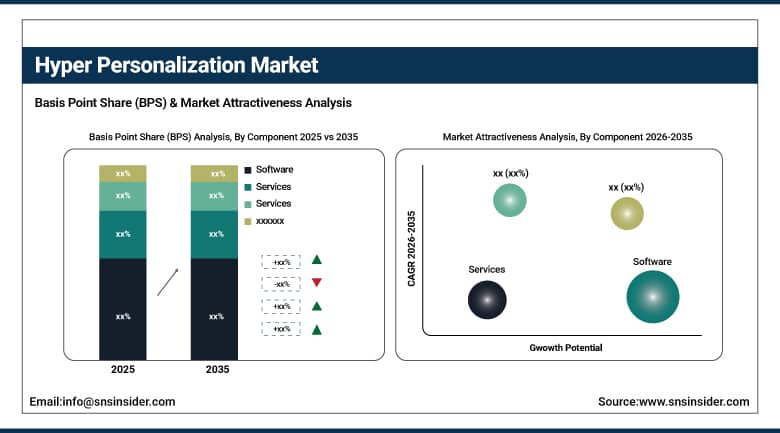
By component, software dominated the hyper personalization market with a 62.30% share in 2025, while services are projected to be the fastest-growing segment, registering a 19.41% CAGR during 2026–2035.
-
By deployment mode, cloud dominated the hyper personalization market with a 68.70% share in 2025 and is also projected to be the fastest-growing segment, registering a 18.97% CAGR during 2026–2035.
-
By enterprise size, large enterprises dominated the hyper personalization market with a 71.40% share in 2025, while small & medium enterprises (SMEs) are projected to be the fastest-growing segment, registering a 20.60% CAGR during 2026–2035.
-
By industry vertical, retail dominated the hyper personalization market with a 28.60% share in 2025, while healthcare & life sciences is projected to be the fastest-growing segment, registering a 21.25% CAGR during 2026–2035.
By component, software dominated the hyper personalization market, while services are expected to grow fastest
The software category dominated the market for hyper personalization solutions in 2025, attributed to the extensive use of AI-based personalization tools, CDPs, recommendation engines, and marketing automation systems by enterprises. Enterprises are making investments in software solutions to analyze real-time customer data and provide personalized experiences and engagements and optimized marketing campaigns through multiple digital channels. The fast adoption of cloud-native SaaS platforms and generative AI and predictive analytics solutions has made the software category dominate even more.
The services segment is anticipated to experience the highest growth rate during the forecast period, attributable to the rising requirement of consulting, implementation, system integration, and management services. With the increasing number of AI-enabled personalization projects undertaken by enterprises, enterprises need the skills of professionals for integrating these solutions in their IT infrastructure.
By deployment mode, cloud dominated the hyper personalization market, while on-premises is expected to grow fastest
Cloud emerged as the dominant player within the hyper personalization market in 2025 due to its scalable nature, flexibility, low cost of deployment, and capability to handle high volume customer data in real-time. Cloud-based systems offer the advantage of deploying AI-based personalization platforms quickly, integrating it with customer data platform, and updating personalization models without the need for any major investment in infrastructure. The rise in adoption of personalization platforms based on SaaS and multi-cloud environment contributed to the growth of this segment.
On the other hand, on-premise is anticipated to register the highest CAGR over the forecast period as companies belonging to highly regulated sectors like BFSI and healthcare seek more control over customer data, security, privacy, and compliance while implementing advanced personalization functionalities.
By enterprise size, large enterprises dominated the hyper personalization market, while small & medium enterprises (SMEs) are expected to grow fastest
In 2025, large companies dominated the hyper-personalization market owing to their large customer databases, huge spending on IT infrastructure, and huge investments in AI, machine learning, and advanced analytics. Large companies employ hyper-personalization techniques to improve customer engagement, retain customers, create cross-selling opportunities, and optimize their omnichannel marketing efforts.
On the other hand, small & medium enterprises (SMEs) are estimated to witness the fastest growth throughout the forecast period because of cheaper personalization platforms based on the cloud and subscription pricing model. Moreover, SMEs have started using hyper-personalization technology for enhancing their customer experiences and digital marketplace presence.
By industry vertical, retail dominated the hyper personalization market, while healthcare & life sciences is expected to grow fastest
Retail emerged as the major contributor towards the growth of the hyper personalization market in 2025 as a result of rising implementation of AI-based product recommendations, personalized marketing campaigns, dynamic pricing techniques, and omnichannel customer engagement strategies. Retailers are making use of real-time insights about their customers and behavioral analytics in order to deliver enhanced shopping experience, higher conversion, and customer loyalty.
On the other hand, the healthcare & life sciences sector was forecasted to experience the highest growth rate over the forecast period due to the increasing implementation of AI-enabled patient engagement tools, personalized healthcare services, digital health apps, and predictive analytics. The growing trend towards patient-centered care, remote healthcare delivery, and personalized treatment suggestions is anticipated to fuel the adoption further.
Regional Insights:
|
Region |
Major Country |
Share within Region, 2025(%) |
|---|---|---|
|
North America |
United States |
88.60% |
|
Europe |
Germany |
22.80% |
|
Asia Pacific |
China |
38.50% |
|
Middle East & Africa |
Saudi Arabia |
27.90% |
|
Latin America |
Brazil |
42.50% |
North America Hyper Personalization Market Insights
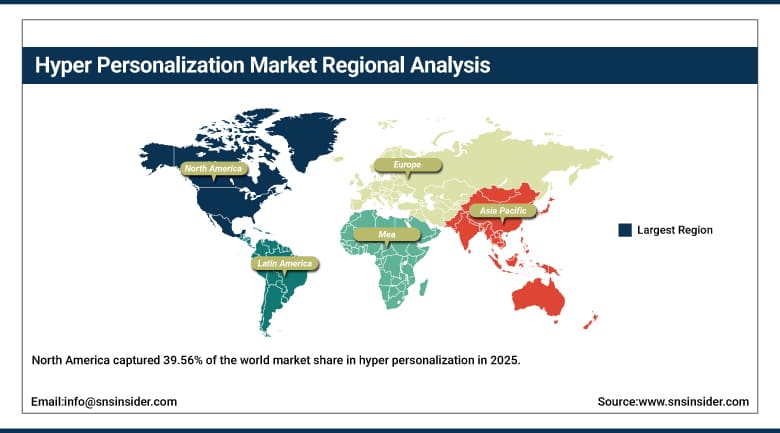
North America captured 39.56% of the world market share in hyper personalization in 2025. The key market drivers include the quick uptake of artificial intelligence (AI), machine learning (ML), customer data platforms (CDPs), and cloud-based hyper-personalization. Others include the growing demand for personalized consumer experiences in different industries. Increasing investments in digital transformation, omnichannel customer engagements, predictive analytics, and generative AI technologies are boosting the adoption of hyper personalization solutions. In the same year, the U.S. held 88.60% of the hyper personalization market in North America.
The key drivers of growth in the region include increasing investments by enterprises in AI-powered consumer engagement platforms, increased adoption of cloud-based personalization technologies, expanded use of first-party consumer data, and growing demand for personalized digital services in the retail, BFSI, healthcare, media & entertainment, and travel & hospitality sectors. Furthermore, the continuous advancements in generative AI, natural language processing (NLP), and predictive analytics are expected to boost growth in the U.S. and North America.
Get Customized Report as Per Your Business Requirement - Enquiry Now
Europe Hyper Personalization Market Insights
The Europe Hyper Personalization market is growing owing to increasing adoption of AI-enabled customer engagement systems, stringent data privacy laws like GDPR, and increased focus on digital transformation projects. In 2025, Germany held 22.80% share of the Europe Hyper Personalization market, backed by its robust technology environment, superior digital infrastructure, and the use of AI-enabled marketing and customer experience platforms.
Growth drivers for the market include rising demand for customized customer experience, increasing use of cloud-based personalization platforms, favorable regulatory environment for adopting responsible AI, and regular investments in customer analytics and automation technology. The continued process of digital transformation is likely to foster the growth of the market in Europe over the long run.
Asia Pacific Hyper Personalization Market Insights
Asia Pacific will witness the highest growth rate in terms of the hyper personalization market CAGR because of the increasing digitization, e-commerce activities, usage of smartphones, and investments in artificial intelligence and cloud computing. In 2025, China held a 38.50% share of the Asia Pacific hyper personalization market because of its sizable consumer base in digital mode, developed ecosystem of e-commerce, adoption of artificial intelligence, and investment in customer experience technologies.
This regional market is anticipated to see benefits owing to an increasing demand for personalized digital solutions, growing cloud infrastructure, increasing investments in AI-enabled marketing solutions, and adoption of hyper personalization technology in various industries like retail, BFSI, healthcare, media & entertainment, and travel & hospitality.
Middle East & Africa and Latin America Hyper Personalization Market Insights
The market for hyper personalization in the Middle East & Africa region is seeing sustained growth owing to the digital transformation trends in the region, adoption of cloud computing, and rising spending on AI-based customer engagement tools. The Middle East & Africa region had a share of 27.90% in the regional hyper personalization market in 2025 owing to the initiatives taken under Vision 2030 and the investments made in smart technologies.
The hyper personalization market in Latin America is witnessing growth owing to rising enterprise spending in AI, digital commerce, and customer experience management solutions. The Latin America market for hyper personalization had a share of 42.50% in 2025 owing to the presence of a large digital economy and an increasing e-commerce industry.
Growth Driver: Rising adoption of AI-driven customer engagement accelerating hyper personalization market growth
The adoption of artificial intelligence (AI), machine learning (ML), big data analytics, and real-time customer insights has become one of the key factors driving the market for hyper personalization. Hyper personalization solutions are being increasingly adopted by companies in the retail sector, BFSI, healthcare, media & entertainment, travel & hospitality, and e-commerce sectors in order to offer a personalized customer experience and increase engagement and conversion rate. With the help of the availability of data about the customer through digital sources and the use of predictive analytics, it is now possible for organizations to offer personalized recommendations, content, and marketing campaigns.
Restraints: Data privacy concerns and complex integration may restrain hyper personalization market growth
Expansion of the hyper personalization industry is hindered by rising issues of data security, data privacy, and regulation. Enterprises need to handle substantial amounts of highly confidential customer information under regulations like GDPR and CCPA, which makes the process quite complicated and expensive. Also, incorporating the use of hyper personalization into an enterprise's system can be challenging and entail considerable costs and technical skill, as hyper personalization needs to be integrated with enterprise systems, CRM systems, and other legacy IT.
Opportunities: Growing adoption of AI, predictive analytics, and omnichannel customer engagement
The rising need for personalized digital experiences at various customer touchpoints has resulted in numerous opportunities in the hyper personalization market space. Ongoing developments in AI, generative AI, machine learning, predictive analytics, and real-time data processing have been allowing companies to provide highly personalized experiences through websites, mobile applications, social media, and interconnected devices. Rising spending on customer data platforms (CDPs), cloud-based personalization software, and marketing automation platforms is opening up more market opportunities. With the growing focus on customer experience, digital transformation, and data-driven decision making, the adoption of hyper personalization solutions is likely to rise sharply during the forecast period.
Recent Developments:
-
2026: Salesforce expanded its AI-powered personalization capabilities by enhancing Agentforce and Data Cloud to enable real-time, hyper-personalized customer interactions across sales, marketing, and customer service.
-
2026: Adobe Inc. introduced new generative AI features across Adobe Experience Cloud, helping enterprises deliver personalized digital experiences and automate customer journey orchestration.
-
2025: Twilio Inc. strengthened its CustomerAI platform by integrating customer data and AI-driven insights to improve real-time hyper-personalized engagement across multiple communication channels.
-
2025: SAP SE expanded its AI-powered customer experience portfolio by enhancing SAP Customer Experience solutions with advanced personalization and predictive customer engagement capabilities.
Hyper Personalization Market Key Players:
-
Adobe Inc.
-
Oracle Corporation
-
SAP SE
-
IBM Corporation
-
Microsoft Corporation
-
Google LLC
-
Amazon Web Services, Inc.
-
Braze, Inc.
-
CleverTap
-
Insider Pte. Ltd.
-
Dynamic Yield Ltd.
-
Optimizely, Inc.
-
SAS Institute Inc.
-
Sitecore
-
Bloomreach
-
Acquia Inc.
-
Contentful GmbH
-
Iterable, Inc.
Hyper Personalization Market Report Scope:
| Report Attributes | Details |
|---|---|
| Market Size in 2025 | USD 23.34 Billion |
| Market Size by 2035 | USD 123.66 Billion |
| CAGR | CAGR of 18.16% From 2026 to 2035 |
| Base Year | 2025 |
| Forecast Period | 2026-2035 |
| Historical Data | 2022-2024 |
| Report Scope & Coverage | Market Size, Segments Analysis, Competitive Landscape, Regional Analysis, DROC & SWOT Analysis, Forecast Outlook |
| Key Segments | • By Component (Software, Services) • By Deployment Mode (Cloud, On-Premises) • By Enterprise Size (Large Enterprises, Small & Medium Enterprises (SMEs)) • By Industry Vertical (BFSI, Retail, Healthcare & Life Sciences, Media & Entertainment, Travel & Hospitality, Others) |
| Regional Analysis/Coverage | North America (US, Canada, Mexico), Europe (Eastern Europe [Poland, Romania, Hungary, Turkey, Rest of Eastern Europe] Western Europe] Germany, France, UK, Italy, Spain, Netherlands, Switzerland, Austria, Rest of Western Europe]), Asia Pacific (China, India, Japan, South Korea, Vietnam, Singapore, Australia, Rest of Asia Pacific), Middle East & Africa (Middle East [UAE, Egypt, Saudi Arabia, Qatar, Rest of Middle East], Africa [Nigeria, South Africa, Rest of Africa], Latin America (Brazil, Argentina, Colombia, Rest of Latin America) |
| Company Profiles | Adobe Inc., Salesforce, Inc., Oracle Corporation, SAP SE, IBM Corporation, Microsoft Corporation, Google LLC, Amazon Web Services, Inc., Twilio Inc., Braze, Inc., CleverTap, Insider Pte. Ltd., Dynamic Yield Ltd., Optimizely, Inc., SAS Institute Inc., Sitecore, Bloomreach, Acquia Inc., Contentful GmbH, Iterable, Inc. |
Frequently Asked Questions
The hyper personalization market is expected to grow at a CAGR of 18.16% from 2026 to 2035.
The hyper personalization market was valued at USD 23.34 billion in 2025.
The market is driven by the growing adoption of AI and machine learning, increasing demand for real-time personalized customer experiences, and rising digital transformation across industries.
The software segment dominated the hyper personalization market in 2025 with a 62.30% share.
North America dominated the hyper personalization market in 2025 with a 40.50% share.
