
Internal Developer Platform (IDP) Market Report Scope & Overview:
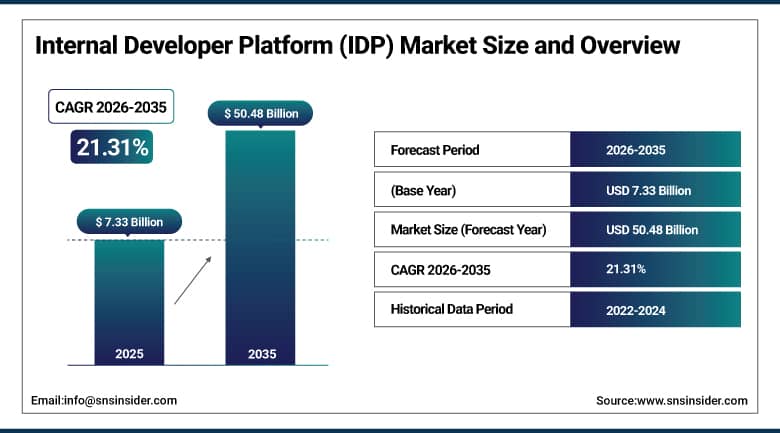
Internal Developer Platform (IDP) Market was valued at USD 7.33 Billion in 2025 and is expected to reach USD 50.48 Billion by 2035, growing at a CAGR of 21.31% from 2026–2035.
The major drivers fueling the expansion of the global internal developer platform (IDP) market are the fast acceptance of cloud-native architecture, rising usage of Kubernetes, and rising demand for developer productivity and platform engineering. There is a growing tendency among companies to adopt internal developer platforms (IDPs) for standardizing software delivery, automating infrastructure provisioning, simplifying CI/CD processes, and enabling self-service to developers. In addition, the increasing implementation of DevOps and GitOps practices, rise in microservices architecture applications, investments in platform engineering, increasing demand for Infrastructure as Code (IaC), and need for improved governance, security, and compliance are boosting the internal developer platform (IDP) market.
In May 2026, Google Cloud introduced enhanced Google Kubernetes Engine (GKE) capabilities, including multi-networking APIs and persistent IP allocation, enabling platform engineering teams to simplify Kubernetes networking, improve workload management, and strengthen support for internal developer platforms across hybrid and multi-cloud environments.
Market Size and Forecast
-
Market Size 2026E: USD 8.87 Billion
-
Market Size 2035: USD 50.48 Billion
-
CAGR: 21.31% from 2026 to 2035
-
Fastest Growing Region: Asia-Pacific
-
Largest Region: North America
To Get More Information On Internal Developer Platform (IDP) Market - Request Free Sample Report
Internal Developer Platform (IDP) Market Trends
-
Growing adoption of cloud-native architectures, Kubernetes, and microservices is accelerating demand for internal developer platforms (IDPs) across enterprise environments.
-
Self-service developer portals, infrastructure automation, and standardized platform workflows improve developer productivity, software delivery speed, and operational efficiency.
-
Integration with DevOps toolchains, CI/CD pipelines, Infrastructure as Code (IaC), Kubernetes, and cloud platforms enables consistent application deployment across hybrid and multi-cloud environments.
-
Platform engineering practices strengthen governance, security, compliance, and policy enforcement while reducing infrastructure complexity and operational overhead.
-
Cloud-based and hybrid deployments enable scalable, secure, and centralized internal developer platforms (IDPs) that support modern software development across distributed enterprise environments.
U.S. Internal Developer Platform (IDP) Market Outlook
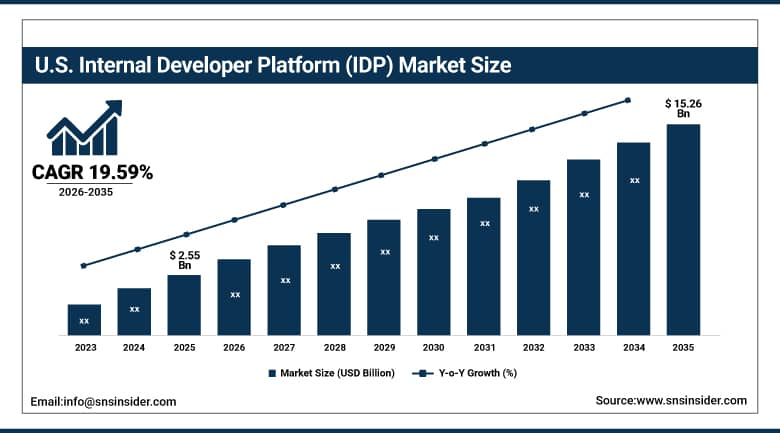
The U.S. Internal Developer Platform (IDP) Market was valued at USD 2.55 Billion in 2025 and is expected to reach around USD 15.26 Billion by 2035, growing at a CAGR of 19.59% from 2026–2035.
There is a surge in the growth rate of IDPs in the United States owing to the rise in cloud-native apps, Kubernetes, DevOps practices, and platform engineering among enterprises. Various organizations within different verticals are increasingly adopting internal developer platforms to streamline the process of software delivery, improve management of the infrastructure, automate CI/CD pipeline, and provide a self-service model to developers. They are helping in automating the infrastructure, governing using policies, providing observability, and enabling integration in a hybrid and multi-cloud environment. Besides, investments made in platform engineering, IaC, GitOps, and developer experience have resulted in the growth of the market.
In April 2025, Google Cloud introduced new Google Kubernetes Engine (GKE) enhancements in the United States, including advanced networking and workload management capabilities, enabling enterprises to simplify Kubernetes operations, improve platform engineering workflows, and strengthen internal developer platforms across hybrid and multi-cloud environments. The update enhanced infrastructure automation, application deployment, and developer self-service while improving scalability and operational efficiency.
Internal Developer Platform (IDP) Market Segment Analysis
-
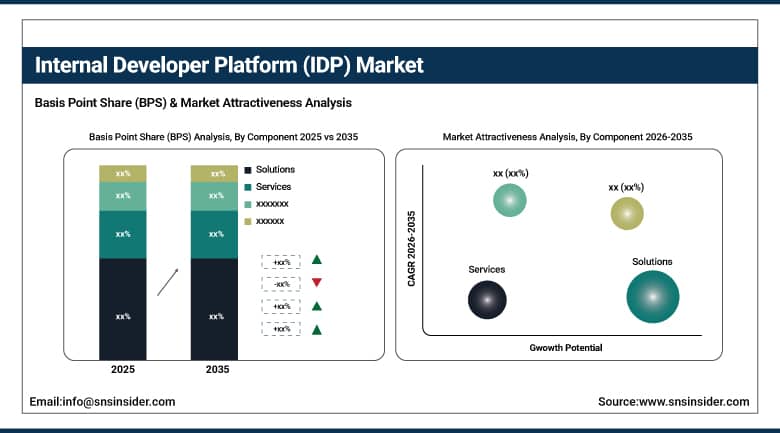
By Component, solutions dominated the internal developer platform (IDP) market with an 81.80% share in 2025, while services are projected to be the fastest-growing segment, registering a CAGR of 24.03% during 2026–2035.
-
By Deployment, cloud dominated the internal developer platform (IDP) market with a 43.20% share in 2025, while hybrid is projected to be the fastest-growing segment, registering a CAGR of 25.58% during 2026–2035.
-
By Platform Capability, developer self-service portal dominated the internal developer platform (IDP) market with a 34.87% share in 2025, while observability and telemetry are projected to be the fastest-growing segment, registering a CAGR of 21.85% during 2026–2035.
-
By Organization Size, large enterprises dominated the internal developer platform (IDP) market with a 72.60% share in 2025, while small & medium-sized enterprises (SMEs) are projected to be the fastest-growing segment, registering a CAGR of 23.84% during 2026–2035.
-
By End User, BFSI dominated the internal developer platform (IDP) market with a 30.00% share in 2025, while healthcare is projected to be the fastest-growing segment, registering a CAGR of 22.28% during 2026–2035.
By Component, solutions dominated the internal developer platform (IDP) market, while the services segment is expected to grow fastest
In 2025, the solutions sub-segment held the largest share of the Internal Developer Platform (IDP) Market owing to the growing popularity of platform engineering solutions that streamline the process of software development, automate the process of provisioning the required infrastructure, and standardize application delivery within an enterprise environment. The rising demand for developer self-service, infrastructure automation, CI/CD orchestration, and governance features has led to the adoption of full-fledged Internal Developer Platforms.
The services sub-segment is expected to be the fastest-growing during the forecast period owing to the growing demand for consulting services, implementation services, integration services, customization services, and managed services in order to deploy and optimize Internal Developer Platforms effectively.
By Platform Capability, developer self-service portal dominated the internal developer platform (IDP) market, while the observability and telemetry segment is expected to grow fastest
According to Platform Capability, developer self-service portal held the leading market share in the Internal Developer Platform (IDP) Market, whereas the observability and telemetry segment is projected to have the highest growth rate during the forecast period. The developer self-service portal segment was the largest in 2025 owing to its ability to simplify infrastructure access, standardize development workflows, and enable developers to provision resources independently while improving productivity and reducing operational complexity across cloud-native environments.
The observability and telemetry segment is expected to register the highest CAGR in the future owing to the increasing need for real-time monitoring, performance analytics, distributed tracing, and proactive issue detection across complex microservices and Kubernetes environments. As enterprises continue to scale cloud-native applications and platform engineering initiatives, demand for advanced observability capabilities to optimize developer experience, platform reliability, and operational efficiency is expected to grow significantly.
By End User, BFSI dominated the internal developer platform (IDP) market, while the healthcare segment is expected to grow fastest
The BFSI segment held the largest share of the internal developer platform (IDP) market in 2025, driven by the increasing need for secure, scalable, and compliant software development environments. Financial institutions are rapidly adopting internal developer platforms to standardize development workflows, automate infrastructure provisioning, strengthen DevSecOps practices, and accelerate the delivery of digital banking, payment, and customer-facing applications. The growing focus on cloud-native modernization and regulatory compliance continues to support the segment's leadership.
The healthcare segment is expected to register the highest CAGR during the forecast period, driven by accelerating digital transformation, increased adoption of cloud-based healthcare applications, electronic health records (EHRs), telehealth platforms, and AI-enabled healthcare solutions. Healthcare organizations are increasingly deploying internal developer platforms to improve developer productivity, automate software delivery, enhance security, and accelerate the deployment of mission-critical applications while ensuring compliance with stringent data privacy regulations.
Regional Insights
|
Region |
Major Country |
Share within Region, 2025(%) |
|---|---|---|
|
North America |
United States |
87.40% |
|
Europe |
Germany |
24.60% |
|
Asia Pacific |
China |
41.90% |
|
Middle East & Africa |
Saudi Arabia |
30.20% |
|
Latin America |
Brazil |
39.10% |
North America Internal Developer Platform (IDP) Market Insights
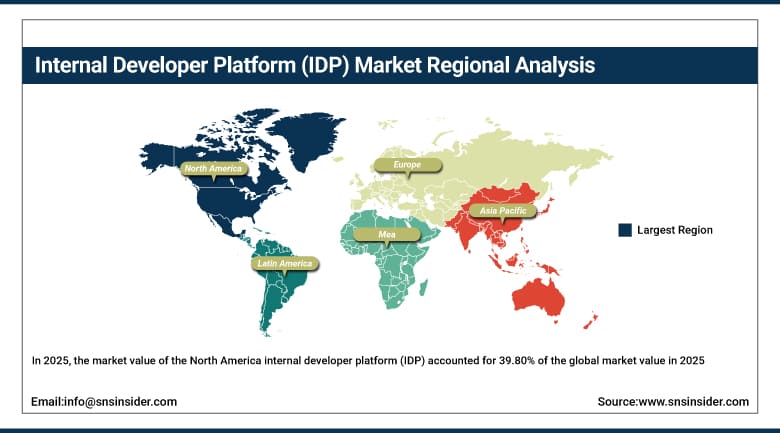
In 2025, the market value of the North America internal developer platform (IDP) accounted for 39.80% of the global market value in 2025 due to the rapid adoption of cloud native apps, Kubernetes, DevOps, platform engineering, and digital transformation efforts in enterprises. Additionally, the US represented 87.40% of the North America internal developer platform (IDP) market in 2025 due to the presence of cloud service providers, platform engineering solution vendors, and investments in software development modernization efforts.
Growing adoption of microservices architecture, CI/CD automation, Infrastructure as Code (IaC), hybrid/multi-cloud environment, and self-service platforms for developers is driving the market growth in the region. Additionally, increasing emphasis on improving developer efficiency, standardizing software delivery processes, governance and security measures, and fast deployment of applications is driving the adoption of internal developer platform (IDP) solutions, thereby driving the market growth in the US and North America.
Get Customized Report as Per Your Business Requirement - Enquiry Now
Europe Internal Developer Platform (IDP) Market Insights
Europe remains a key region in the internal developer platform (IDP) market due to the increasing adoption of cloud-native application development, platform engineering practices, Kubernetes, and enterprise digital transformation initiatives. Germany accounted for 24.60% of the Europe internal developer platform (IDP) market in 2025, supported by its advanced manufacturing sector, strong Industry 4.0 initiatives, and growing investments in cloud infrastructure, DevOps automation, and software engineering modernization.
The growth of the internal developer platform (IDP) market in Europe is driven by increasing adoption of microservices architectures, CI/CD automation, Infrastructure as Code (IaC), developer self-service platforms, and hybrid and multi-cloud environments. Furthermore, rising investments in platform engineering, application modernization, governance and security automation, and cloud-native software development across manufacturing, BFSI, healthcare, IT & telecommunications, retail, and public sector organizations are expected to support sustained market growth over the forecast period.
Asia Pacific Internal Developer Platform (IDP) Market Insights
The Asia-Pacific internal developer platform (IDP) market is expected to register the highest CAGR during the forecast period, driven by rapid digital transformation, expanding cloud infrastructure, and increasing adoption of cloud-native applications, Kubernetes, microservices, and platform engineering practices. China accounted for 41.90% of the Asia-Pacific internal developer platform (IDP) market in 2025, supported by its large enterprise base, expanding cloud ecosystem, and substantial investments in software development modernization and digital infrastructure.
Growing adoption of DevOps and platform engineering, increasing implementation of CI/CD automation, rising investments in Infrastructure as Code (IaC), and government-led digital transformation initiatives are creating significant growth opportunities across the region. Furthermore, the expanding use of hybrid and multi-cloud environments, developer self-service platforms, application modernization, governance and security automation, and cloud-native software development is expected to accelerate the adoption of internal developer platform (IDP) solutions throughout the forecast period.
Middle East & Africa and Latin America Insights
The Middle East & Africa and Latin America are emerging markets for the internal developer platform (IDP) market, driven by accelerating digital transformation, increasing cloud adoption, and growing investments in platform engineering, DevOps, and cloud-native application development. Organizations across both regions are implementing internal developer platforms to standardize software development workflows, enable developer self-service, automate infrastructure provisioning, and improve governance across hybrid and multi-cloud environments. In 2025, Saudi Arabia accounted for 30.20% of the Middle East & Africa internal developer platform (IDP) market, supported by national digital transformation initiatives, expanding cloud infrastructure investments, and increasing enterprise adoption of Kubernetes and platform engineering.
Growing investments in cloud computing, Kubernetes, DevOps, CI/CD automation, Infrastructure as Code (IaC), and AI-enabled software development are creating significant growth opportunities across both regions. Increasing demand for developer self-service portals, infrastructure automation, application modernization, observability, security automation, and standardized software delivery workflows is expected to accelerate adoption of internal developer platforms.
Growth Driver: Rising adoption of cloud-native applications and platform engineering accelerating internal developer platform (IDP) market growth
The growing adoption of cloud-native applications, Kubernetes, microservices, and automated software delivery pipelines has become a key factor driving the demand for internal developer platform (IDP) solutions across industries. Organizations are increasingly deploying internal developer platforms to standardize infrastructure provisioning, enable developer self-service, automate CI/CD workflows, and improve governance across cloud and hybrid environments. The rapid expansion of DevOps, platform engineering, Infrastructure as Code (IaC), and enterprise automation is further accelerating market growth.
The increasing implementation of platform engineering practices, rising demand for standardized developer experiences, governance and security automation, and the continuous growth of hybrid and multi-cloud environments are further supporting the internal developer platform (IDP) market. Additionally, growing investments in digital transformation, application modernization, Kubernetes adoption, cloud-native software development, and enterprise developer productivity are expected to drive sustained market growth over the forecast period.
Restraints: High implementation costs, integration complexity, and operational challenges may restrain internal developer platform (IDP) market growth
High implementation costs and integration complexity remain major challenges for the internal developer platform (IDP) market. Deploying internal developer platform solutions often requires significant investments in cloud infrastructure, Kubernetes platforms, automation tools, CI/CD pipelines, Infrastructure as Code (IaC), and skilled platform engineering teams, making adoption costly for small and medium-sized enterprises. In addition, compatibility issues with legacy applications, fragmented development toolchains, and complex hybrid and multi-cloud environments can delay implementation and increase deployment complexity.
Furthermore, organizations must address challenges related to platform governance, security standardization, infrastructure automation, and continuous management of developer workflows while integrating source code repositories, CI/CD tools, observability platforms, container orchestration systems, and cloud services across distributed environments. Limited platform engineering expertise, concerns over operational complexity, resistance to organizational change, and integration challenges with existing enterprise development ecosystems may further restrain the growth of the internal developer platform (IDP) market during the forecast period.
Opportunities: Growing adoption of platform engineering, cloud-native applications, and developer self-service platforms
The increasing adoption of platform engineering practices and cloud-native applications presents significant growth opportunities for the internal developer platform (IDP) market. Organizations are deploying advanced internal developer platforms to standardize infrastructure provisioning, automate software delivery, enable developer self-service, strengthen governance, and improve developer productivity across enterprise environments. Continuous advancements in Kubernetes, Infrastructure as Code (IaC), CI/CD automation, observability, and developer portals are further expanding the capabilities of internal developer platform solutions.
In addition, rising investments in digital transformation, expanding adoption of hybrid and multi-cloud infrastructures, and increasing enterprise demand for standardized software development workflows are creating new opportunities for market participants. Growing demand for unified developer platforms across cloud and on-premises environments, increasing adoption of DevOps and application modernization initiatives, and continuous innovation in platform engineering technologies are expected to support the long-term growth of the internal developer platform (IDP) market.
Recent Developments
-
May 2026: Humanitec expanded its Platform Orchestrator capabilities with enhanced automation, governance, and integration features, enabling enterprises to accelerate platform engineering and developer self-service across hybrid and multi-cloud environments.
-
April 2026: Microsoft enhanced Azure DevOps and GitHub integrations with improved AI-assisted development workflows and platform engineering capabilities, helping organizations streamline CI/CD automation, infrastructure provisioning, and cloud-native application delivery.
-
September 2024: Humanitec introduced an integrated reference architecture with Cortex, enabling organizations to build enterprise-grade internal developer platforms by combining developer portals with platform orchestration for standardized software delivery.
-
February 2024: Humanitec released open-source reference architectures for AWS, Microsoft Azure, and Google Cloud Platform, helping enterprises accelerate deployment of internal developer platforms with standardized cloud-native infrastructure and platform engineering best practices.
Internal Developer Platform (IDP) Market Key Players
-
IBM Corporation
-
Amazon Web Services, Inc.
-
Google LLC
-
Red Hat, Inc.
-
GitLab Inc.
-
CloudBees, Inc.
-
Humanitec GmbH
-
Platform.sh SAS
-
Harness Inc.
-
Port.io Ltd.
-
OpsLevel Inc.
-
D2iQ, Inc.
-
Mirantis, Inc.
-
SUSE S.A. (Rancher)
-
Kubermatic GmbH
-
Qovery SAS
-
Upbound Inc.
-
HashiCorp, Inc.
Internal Developer Platform (IDP) Market Report Scope:
| Report Attributes | Details |
|---|---|
| Market Size in 2025 | USD 7.33 Billion |
| Market Size by 2035 | USD 50.48 Billion |
| CAGR | CAGR of 21.31% From 2026 to 2035 |
| Base Year | 2025 |
| Forecast Period | 2026-2035 |
| Historical Data | 2022-2024 |
| Report Scope & Coverage | Market Size, Segments Analysis, Competitive Landscape, Regional Analysis, DROC & SWOT Analysis, Forecast Outlook |
| Key Segments | • By Component (Solutions, Services) • By Platform Capability (Infrastructure Automation Layer, Developer Self-Service Portal, CI/CD Orchestration, Observability and Telemetry) • By Deployment (Cloud, On-Premises, Hybrid) • By Organization Size (Small & Medium Enterprises (SMEs), Large Enterprises) • By End User (BFSI, IT and Telecommunications, Healthcare, Retail, Others) |
| Regional Analysis/Coverage | North America (US, Canada, Mexico), Europe (Eastern Europe [Poland, Romania, Hungary, Turkey, Rest of Eastern Europe] Western Europe] Germany, France, UK, Italy, Spain, Netherlands, Switzerland, Austria, Rest of Western Europe]), Asia Pacific (China, India, Japan, South Korea, Vietnam, Singapore, Australia, Rest of Asia Pacific), Middle East & Africa (Middle East [UAE, Egypt, Saudi Arabia, Qatar, Rest of Middle East], Africa [Nigeria, South Africa, Rest of Africa], Latin America (Brazil, Argentina, Colombia, Rest of Latin America) |
| Company Profiles | Microsoft Corporation, IBM Corporation, Amazon Web Services, Inc., Google LLC, Red Hat, Inc., GitLab Inc., CloudBees, Inc., Humanitec GmbH, Platform.sh SAS, Harness Inc., Port.io Ltd., OpsLevel Inc., Cortex Applications, Inc., D2iQ, Inc., Mirantis, Inc., SUSE S.A. (Rancher), Kubermatic GmbH, Qovery SAS, Upbound Inc., HashiCorp, Inc. |
Frequently Asked Questions
The market is driven by the increasing adoption of cloud-native applications, Kubernetes, microservices, platform engineering, DevOps automation, and the growing need to improve developer productivity through standardized software delivery and self-service infrastructure.
The Solutions segment dominated the internal developer platform (IDP) market in 2025 with an 81.80% share.
North America dominated the internal developer platform (IDP) market in 2025 with a 39.80% share.
