
IoT Environmental Sensor Market Report Scope and Overview:
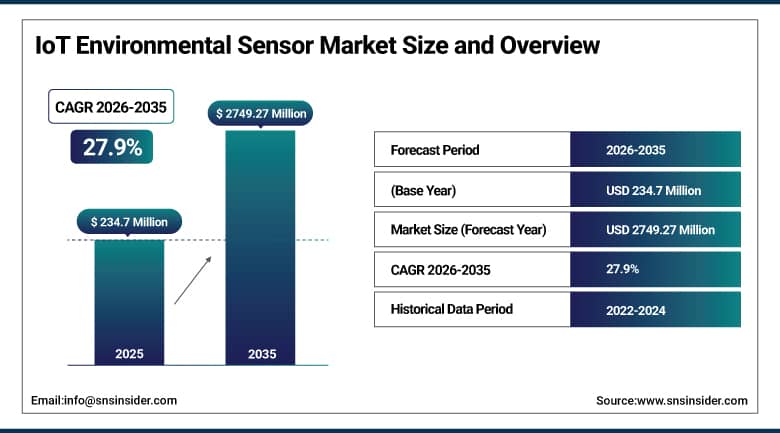
The IoT Environmental Sensor Market size was valued at USD 234.7 Million in 2025 and is projected to reach USD 2749.27 Million by 2035, registering a CAGR of 27.9% from 2026 to 2035.
The IoT Environmental Sensors Market is revolutionizing environmental sensing by integrating sensors like temperature sensors, humidity sensors, gas sensors, and water quality sensors into networked systems in smart cities, industries, and agriculture. Key features of the market include increased deployment of wireless sensor networks using technologies like LoRaWAN and cellular IoT, use of artificial intelligence for predicting environmental factors, and increasing need for emissions and air quality monitoring due to regulations. The market is experiencing significant growth in areas such as precision agriculture, smart city infrastructure of municipalities, and industrial predictive maintenance because both governments and businesses are making major investments in connected sensors that can provide environmental sensing in real time.
Honeywell acquired CAES Systems Holdings worth $1.9 billion in the entire year of 2025, improving its capability of sensing and RF-signal management applications in industrial and infrastructure environmental monitoring.
To Get More Information On IoT Environmental Sensor Market - Request Free Sample Report
IoT Environmental Sensor Market Trends
-
Growing deployment of wireless sensor networks utilizing LoRaWAN and cellular IoT continues expanding rural and remote environmental monitoring coverage.
-
Rising integration of artificial intelligence for predictive environmental analytics continues enabling proactive pollution and hazard mitigation strategies.
-
Increasing adoption of multi-parameter sensor platforms continues simplifying deployment complexity across smart city and industrial monitoring networks.
-
Expanding regulatory mandates for continuous emissions and air quality monitoring continues driving sustained sensor procurement across municipalities.
-
Growing precision agriculture adoption continues accelerating deployment of soil moisture and irrigation optimization sensor networks.
U.S. IoT Environmental Sensor Market Size Outlook
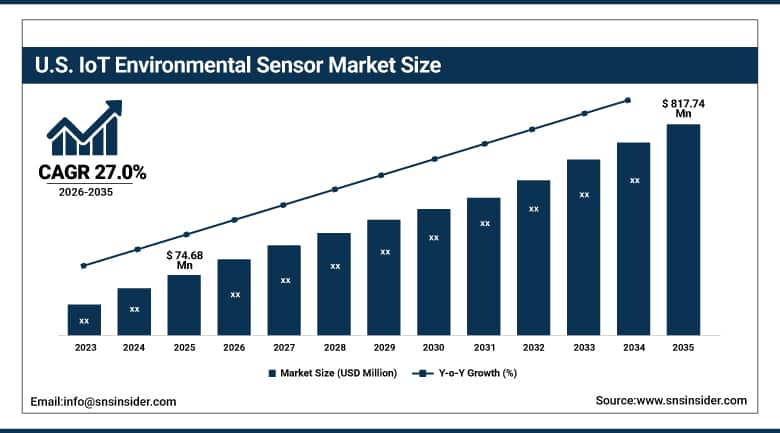
The U.S. IoT Environmental Sensor Market was valued at approximately USD 74.68 Million in 2025 and is projected to reach approximately USD 817.74 Million by 2035, registering a CAGR of approximately 27.0% from 2026 to 2035.
Demand across the United States continued to be shaped by strict environmental compliance requirements from EPA air and water quality regulations, sustained smart building management investment in commercial real estate, and a deep concentration of leading sensor and semiconductor technology developers. Rising deployment of wireless, AI-integrated environmental sensor networks by domestic municipalities and industrial operators continued reinforcing the country's position as both a mature and highly innovative market tracked in this report. Growing adoption across data center environmental monitoring, healthcare facility compliance, and hyperscale AI infrastructure cooling added further layers of sustained domestic demand well beyond the technology's traditional industrial monitoring use case.
Aclima secured a $27 million contract from the California Air Resources Board throughout 2025 to deploy its Statewide Mobile Monitoring Initiative, using vehicle-mounted networked air-quality sensors to map pollutants across selected communities.
IoT Environmental Sensor Market Segment Analysis
-
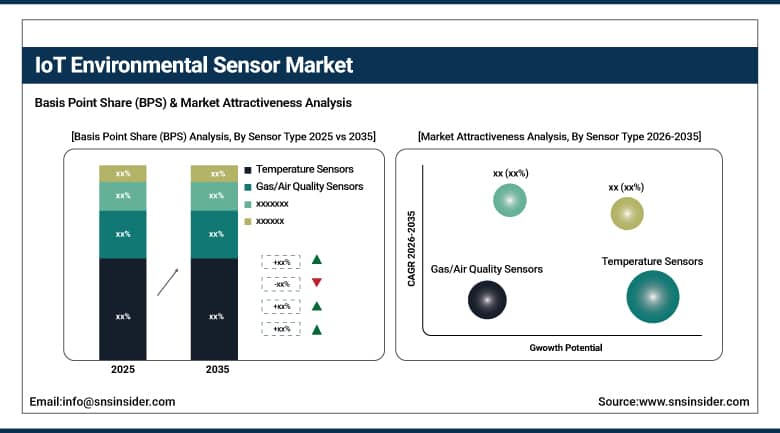
By Sensor Type, Temperature Sensors segment dominated the IoT Environmental Sensor Market in 2025 with 30% share; Gas/Air Quality Sensors segment is the fastest growing segment.
-
By Application, Smart Agriculture segment dominated the market in 2025 with 28% share; Smart Cities segment is the fastest growing segment.
-
By Connectivity, Wireless segment dominated the market in 2025 with 64% share; Wireless segment is also the fastest growing segment.
-
By End-User, Industrial segment dominated the market in 2025 with 26% share; Agriculture segment is the fastest growing segment.
By Sensor Type, Temperature Leads While Gas/Air Quality Sensors Grow Fastest
The Temperature Sensors segment dominated the IoT Environmental Sensor Market in 2025 owing to their foundational role across HVAC systems, industrial processes, smart buildings, and healthcare facilities, providing critical inputs for equipment protection and process control. Facility operators continue relying on temperature sensing as the primary input for automated climate and process control response. Continued proliferation of smart building management systems has kept temperature sensors the largest single revenue contributor within the sensor type landscape tracked in this report.
The Gas/Air Quality Sensors segment is the fastest growing in the IoT Environmental Sensor Market owing to escalating urban air pollution concerns, public health awareness, and municipal smart city initiatives deploying dense sensor networks across metropolitan areas. Cities worldwide deploy extensive air quality sensor networks measuring particulate matter and gaseous pollutants, enabling real-time health warnings and pollution episode prediction. Growing regulatory emphasis on continuous air quality monitoring continues accelerating demand for gas and air quality sensing technology across the industry.
By Application, Smart Agriculture Dominates While Smart Cities Record Fastest Growth
Smart Agriculture accounted for the majority share in the IoT Environmental Sensors Market in 2025 owing to the growing use of precision agriculture by both developed and developing countries in order to ensure optimum irrigation, cut down costs and obtain maximum yield despite water scarcity. Agricultural landowners continue using soil moisture, temperature and humidity sensors on their farm lands to monitor their resource usage based on data. Growing investments in precision agriculture globally have made it the biggest revenue generator for the market.
The Smart Cities segment is the fastest growing in the IoT Environmental Sensor Market owing to accelerating municipal investment in distributed sensor networks monitoring air quality, water quality, noise levels, and environmental parameters across urban centers. Municipal governments increasingly integrate sensor data with machine learning algorithms to optimize traffic flow, manage waste collection, and predict environmental hazards proactively. Growing government mandates for continuous urban environmental monitoring continues driving sustained growth in smart city sensor deployment.
By Connectivity, Wireless Dominates and Also Grows Fastest
The Wireless segment dominated the IoT Environmental Sensor Market in 2025 due to rapid rollout of 5G networks, expanding cellular IoT coverage through LTE-M and NB-IoT technologies, and widespread adoption of wireless protocols including LoRaWAN and Bluetooth mesh. Wireless sensor networks eliminate installation costs and complexity associated with running cables through buildings and outdoor environments, accelerating adoption particularly in retrofit applications. Sustained wireless infrastructure investment has kept this connectivity type the largest overall contributor to market revenue.
The Wireless segment also represents the fastest growing connectivity category in the IoT Environmental Sensor Market as battery technology advancement extends sensor operational lifespans and expanding LoRaWAN network coverage enables seamless environmental monitoring across previously unconnected regions. Municipalities and enterprises increasingly favor wireless deployment for its scalability and reduced installation complexity relative to wired alternatives. Growing rural and remote area connectivity expansion continues accelerating wireless sensor network adoption across the industry.
By End-User, Industrial Leads While Agriculture Grows Fastest
The Industrial segment dominated the IoT Environmental Sensor Market in 2025 due to sustained manufacturing demand for monitoring air quality, emissions, and energy usage across production facilities driven by regulatory pressures and sustainability commitments. Manufacturers continue prioritizing environmental sensor deployment given the segment’s scale and recurring compliance monitoring requirements. Sustained global industrial automation investment has kept this end-user segment the largest overall contributor to market revenue.
The Agriculture segment is the fastest growing in the IoT Environmental Sensor Market owing to accelerating precision farming adoption across water-stressed regions seeking to optimize irrigation scheduling and reduce water consumption while maintaining or increasing crop yields. Farmers increasingly deploy soil moisture, temperature, and humidity sensors integrated directly into irrigation and farm equipment systems. Growing global food security concerns and water scarcity continue driving sustained growth in agriculture-oriented environmental sensor demand.
Regional Analysis
|
Region |
Major Country |
Share within Region, 2025 (%) |
|---|---|---|
|
North America |
United States |
85.00% |
|
Europe |
Germany |
24.00% |
|
Asia Pacific |
China |
38.00% |
|
Middle East and Africa |
UAE |
26.50% |
|
Latin America |
Brazil |
30.00% |
North America IoT Environmental Sensor Market Insights
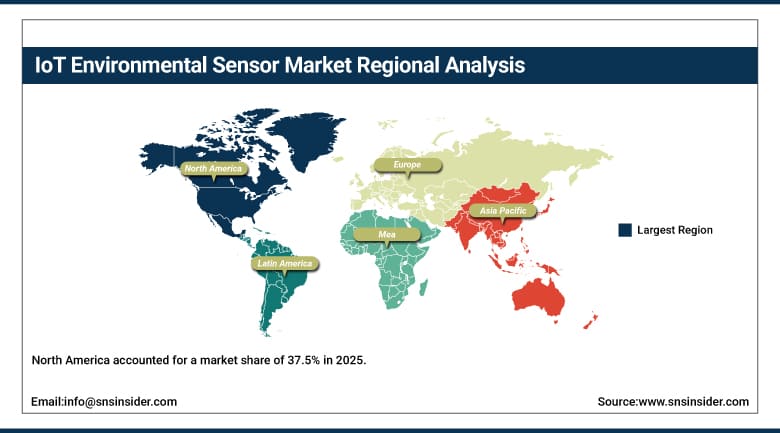
North America accounted for a market share of 37.5% in 2025. Strict environmental compliance requirements from EPA air and water quality regulations, sustained smart building management investment in commercial real estate, and a deep concentration of leading sensor and semiconductor technology developers continued reinforcing the region’s strong position. Growing deployment of wireless, AI-integrated environmental sensor networks across industrial, healthcare, and municipal applications further strengthened North America’s standing as a mature, highly innovative market tracked in this report, with continued regulatory compliance investment expected to sustain regional demand through the forecast period.
The United States accounted for roughly 85.00% of regional revenue, anchored by its deep concentration of leading sensor and semiconductor technology developers and substantial regulatory compliance investment. Canada added further regional demand through its own growing industrial and environmental monitoring sector, and that combined strength kept the continent the largest addressable market for IoT environmental sensor vendors through the forecast period.
Get Customized Report as Per Your Business Requirement - Enquiry Now
Europe IoT Environmental Sensor Market Insights
Europe held a meaningful share of global revenue, driven by stringent environmental regulations, sustainability commitments, and industrial leadership in automation and sensor technology. The EU’s Green Deal commitment to carbon neutrality mandates comprehensive environmental monitoring across manufacturing, agriculture, and urban centers, creating sustained demand for air quality, water quality, and soil monitoring sensors across the continent.
Germany led demand at roughly 24.00% of European revenue, supported by strict agricultural nitrogen runoff regulations and its substantial industrial automation base. France and the Netherlands contributed additional demand, and continued European Green Deal-backed investment should keep regional demand for IoT environmental sensor technology climbing steadily through the forecast period.
Asia Pacific IoT Environmental Sensor Market Insights
Asia Pacific is advancing at the fastest pace among all regions, registering a CAGR of 22.5% from 2026 to 2035, driven by rapid urbanization across China, India, and Indonesia, coupled with massive government investments in smart city infrastructure and agricultural modernization. That combination of manufacturing scale and genuine downstream demand across smart cities, industrial, and agricultural applications kept the region’s growth trajectory well ahead of every other region tracked in this report, with continued government-backed digital infrastructure investment adding a further, sustained layer of demand.
China led the pack, supported by its New Infrastructure initiative directing substantial capital investment toward smart city development and 5G network deployment. India contributed meaningful additional demand through its Smart Cities Mission targeting integrated IoT sensor networks across numerous cities, with Southeast Asian nations’ rapid urbanization and precision agriculture adoption both reinforcing the region’s position as the fastest-growing IoT environmental sensor market tracked in this report.
MEA and Latin America IoT Environmental Sensor Market Insights
The Middle East and Africa and Latin America both showed steady growth, driven by expanding agricultural modernization, growing government focus on water resource management, and rising demand for operational compliance monitoring across oil and gas operations in both regions. As these markets continued building out modern environmental monitoring infrastructure, IoT environmental sensor technology proved a genuinely valuable enabler of increasingly efficient, locally supported resource management systems.
The UAE led Middle East and Africa demand, supported by oil and gas operational compliance monitoring and emerging renewable energy system deployment. Saudi Arabia contributed further demand through its own industrial diversification programs. In Latin America, Brazil accounted for the largest share of regional revenue, with sensor-enabled irrigation optimization in drought-prone agricultural regions continuing to anchor regional demand for IoT environmental sensor technology.
Market Dynamics
Growth Drivers: Smart City Deployment and Precision Agriculture Digitalization
The industry is driven by massive adoption of smart city infrastructure across North America, Europe, and Asia Pacific, growing precision agriculture adoption in India and Southeast Asia, increased deployment in Industrial IoT applications for predictive maintenance, and integration with environmental compliance monitoring systems mandated by regulatory bodies. As municipalities and enterprises continue prioritizing real-time environmental data over periodic manual checks, the need for expanded IoT sensor deployment continues driving sustained investment across the industry.
Rising climate change awareness and strengthening environmental regulations continue reinforcing this driver, with mandatory reporting frameworks and air quality directives creating structural demand for continuous environmental data collection. Growing 5G network rollout combined with edge computing capabilities continues defining a further layer of sustained demand, and that combination of regulatory pressure and connectivity infrastructure improvement is exactly what keeps overall demand climbing at such a steady, sustained pace.
Restraints: Semiconductor Supply Chain Volatility and Field Calibration Talent Shortage
Semiconductor component supply chain volatility continues posing a genuine restraint on faster market-wide expansion, as extended lead times for microcontroller and MEMS sensor components constrain new sensor shipment volumes and compress manufacturer margins. That volatility has kept some municipal and consumer-grade sensor rollout investment delayed relative to industrial priority allocation.
A growing field calibration talent deficit continues posing a further restraint, as rapid sensor installation scale-up outpaces availability of trained technicians capable of performing periodic recalibration. Calibration backlogs extending routine maintenance cycles in high-growth metropolitan deployment zones keep some sensor data integrity concerns more administratively complicated to manage than lower-density deployment scenarios would otherwise require.
Opportunities: Sensor-Data Subscription Monetization and Agritech Expansion
Rising sensor-data subscription monetization represents a genuinely significant opportunity, as vendors increasingly shift from one-time hardware sales toward recurring, outcome-based data-licensing contracts across installed sensor fleets. Vendors positioned early in subscription-based analytics platforms stand to capture meaningful share as this capability continues expanding from hardware-only business models into broader recurring revenue structures.
Expanding adjacent agritech soil-sensing applications offer a second substantial opportunity, as precision agriculture adoption accelerates across India, Brazil, and Sub-Saharan Africa. Vendors with proven, cost-effective environmental sensor technology stand to capture meaningful share as global food security concerns and water scarcity continue driving sensor-enabled irrigation optimization across established and emerging agricultural markets alike.
Recent Developments:
-
2025: Honeywell completed its $1.9 billion acquisition of CAES Systems Holdings, expanding its advanced sensing and RF-signal-management capabilities for connected industrial and critical-infrastructure environmental monitoring applications.
-
2025: Aclima secured a $27 million contract from the California Air Resources Board to deploy its Statewide Mobile Monitoring Initiative, using vehicle-mounted networked air-quality sensors to map pollutants across selected communities.
-
2024: Bosch Sensortec expanded its MEMS environmental sensor portfolio with new integrated multi-parameter modules combining temperature, humidity, and air quality measurement for smart building and consumer IoT applications.
IoT Environmental Sensor Companies are:
-
Honeywell International Inc.
-
Siemens AG
-
STMicroelectronics N.V.
-
TE Connectivity Ltd.
-
NXP Semiconductors N.V.
-
Analog Devices, Inc.
-
Robert Bosch GmbH (Bosch Sensortec GmbH)
-
Murata Manufacturing Co., Ltd.
-
General Electric Company
-
Sensirion AG
-
Amphenol Advanced Sensors
-
ABB Ltd.
-
Schneider Electric SE
-
Infineon Technologies AG
-
Panasonic Corporation
-
Emerson Electric Co.
-
Digi International Inc.
-
Aclima, Inc.
IoT Environmental Sensor Market Report Scope:
| Report Attributes | Details |
|---|---|
| Market Size in 2025 | USD 234.7 Million |
| Market Size by 2035 | USD 2749.27 Million |
| CAGR | CAGR of 27.9% From 2026 to 2035 |
| Base Year | 2025 |
| Forecast Period | 2026-2035 |
| Historical Data | 2022-2024 |
| Report Scope & Coverage | Market Size, Segments Analysis, Competitive Landscape, Regional Analysis, DROC & SWOT Analysis, Forecast Outlook |
| Key Segments | • By Sensor Type (Temperature Sensors, Humidity Sensors, Gas/Air Quality Sensors, Water Quality Sensors, Pressure Sensors, Others) • By Application (Smart Agriculture, Smart Cities, Industrial Monitoring, Environmental Monitoring, Others) • By Connectivity (Wired, Wireless) • By End-User (Industrial, Agriculture, Healthcare/Medical, Consumer Electronics, Automotive, Energy & Utilities) |
| Regional Analysis/Coverage | North America (US, Canada), Europe (Germany, UK, France, Italy, Spain, Russia, Poland, Rest of Europe), Asia Pacific (China, India, Japan, South Korea, Australia, ASEAN Countries, Rest of Asia Pacific), Middle East & Africa (UAE, Saudi Arabia, Qatar, South Africa, Rest of Middle East & Africa), Latin America (Brazil, Argentina, Mexico, Colombia, Rest of Latin America). |
| Company Profiles | Texas Instruments Incorporated, Honeywell International Inc., Siemens AG, STMicroelectronics N.V., TE Connectivity Ltd., NXP Semiconductors N.V., Analog Devices, Inc., Robert Bosch GmbH (Bosch Sensortec GmbH), OMRON Corporation, Murata Manufacturing Co., Ltd., General Electric Company, Sensirion AG, Amphenol Advanced Sensors, ABB Ltd., Schneider Electric SE, Infineon Technologies AG, Panasonic Corporation, Emerson Electric Co., Digi International Inc., Aclima, Inc. |

Frequently Asked Questions
Key players in the IoT Environmental Sensor Market include Texas Instruments, Honeywell, Siemens, STMicroelectronics, and TE Connectivity, among others.
Key opportunities in the IoT Environmental Sensor Market include sensor-data subscription monetization and expanding soil-sensing and precision agriculture applications.
The market is driven by smart city deployment, precision agriculture digitalization, Industrial IoT adoption, environmental compliance monitoring, and expanding wireless connectivity infrastructure.
The Temperature Sensors segment dominated the IoT Environmental Sensor Market, accounting for approximately 30% market share in 2025.
North America dominated the IoT Environmental Sensor Market in 2025 with a 37.5% share, driven by stringent environmental regulations, smart building investments, industrial IoT adoption, and a strong concentration of sensor and semiconductor technology developers.
