
Lithium-Ion Black-Mass Flotation Reagents Market Report Scope & Overview:
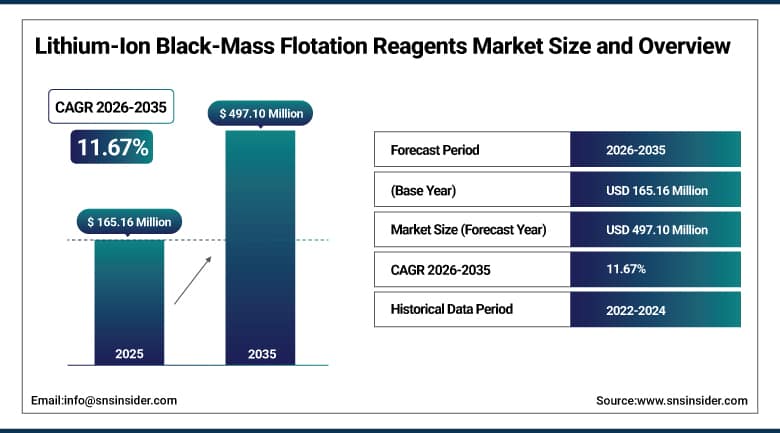
Lithium-Ion Black-Mass Flotation Reagents Market was valued at USD 165.16 Million in 2025 and is expected to reach USD 497.10 Million by 2035, growing at a CAGR of 11.67% from 2026–2035.
The lithium-ion black mass flotation reagents market is experiencing consistent growth due to the growing need for battery recycling and material recovery solutions. The increased adoption of lithium-ion batteries in EVs, consumer electronics, and energy storage systems has led to an increase in the supply of black mass and thereby the growth of the market.
Investments in the latest technologies for battery recycling such as flotation reagents have increased the recovery of graphite, cathode active materials, nickel, cobalt, and lithium. The focus of companies has been on the selectivity of reagents, flotation, recovery, and purity of the process. Growing demand for sustainable recycling and recovery of critical minerals in the circular economy is propelling technological advancements. The use of advanced flotation reagents and chemicals in automated recycling processes is further boosting the growth of the market.
In February 2025, researchers published a study on evaluating lithium-ion black-mass battery recycling, highlighting the importance of standardized characterization and processing methods for improving recovery efficiency. The research supports the development of optimized black-mass separation and flotation processes for recovering valuable battery materials.
To Get More Information On Lithium-Ion Black-Mass Flotation Reagents Market - Request Free Sample Report
Lithium-Ion Black-Mass Flotation Reagents Market Trends
-
Growing adoption of lithium-ion battery recycling is driving demand for advanced flotation reagents for efficient black-mass separation and material recovery.
-
Rising deployment of electric vehicles is increasing the volume of end-of-life lithium-ion batteries, supporting demand for black-mass processing and flotation-based recovery technologies.
-
Increasing demand for recovery of graphite, cathode active materials, nickel, cobalt, and lithium is supporting the growth of specialized flotation reagent solutions.
-
Growing focus on improving recovery efficiency, material purity, reagent selectivity, and processing economics is creating opportunities for lithium-ion black-mass flotation reagent manufacturers.
-
Advancements in flotation chemistry, reagent formulations, black-mass processing, and battery recycling technologies are improving separation performance and supporting market adoption.
The U.S. Lithium-Ion Black-Mass Flotation Reagents Market Outlook
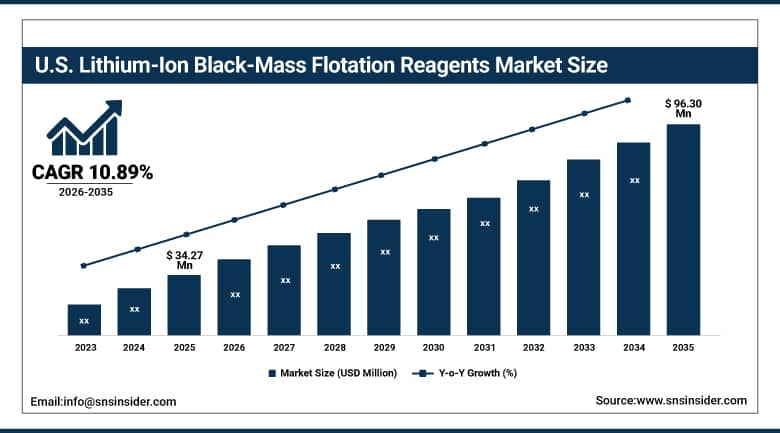
The U.S. Lithium-Ion Black-Mass Flotation Reagents Market was valued at USD 34.27 Million in 2025 and is expected to reach around USD 96.30 Million by 2035, growing at a CAGR of 10.89% from 2026–2035.
The U.S. market for lithium-ion black-mass flotation reagents is growing at a stable rate due to high demand for lithium-ion batteries' recycling technology and recovery of critical minerals. The increase in the adoption of lithium-ion batteries in electric cars, electronics devices, and energy storage systems leads to more quantities of lithium-ion batteries being generated. More investments are made in advanced recycling technology and flotation techniques that improve recovery rates and purity of recovered materials. The growth in battery manufacturing and recycling operations in the country will drive the demand for flotation reagents in the market. Manufacturers will be focusing on selective reagent formulation, recovery of graphite, cathode active materials, nickel, cobalt, and lithium.
In August 2026, the U.S. Commerce Department announced restrictions on exports of lithium-ion battery black mass, effective August 27, to strengthen domestic recycling and critical-mineral supply chains. The move is expected to increase the availability of black mass for U.S. recyclers and support demand for domestic separation and recovery technologies, including flotation-based processing.
Lithium-Ion Black-Mass Flotation Reagents Market Segment Analysis
-
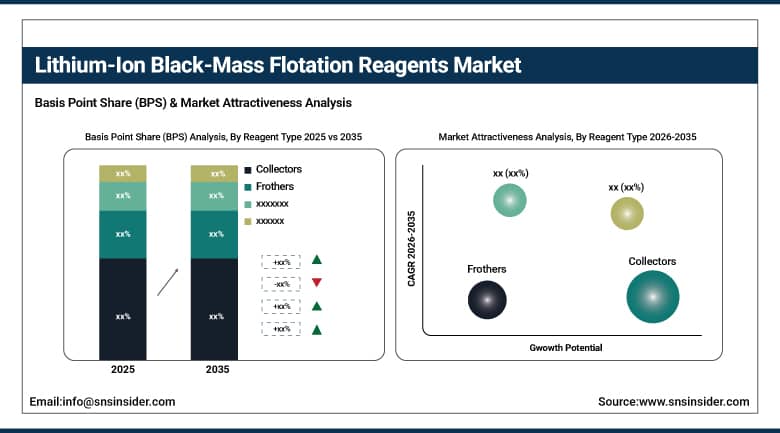
By Reagent Type, collectors dominated the lithium-ion black-mass flotation reagents market with a 34.83% share in 2025, while collectors are projected to be the largest segment, registering a 13.05% CAGR during 2026–2035.
-
By Black-Mass Source, electric vehicle batteries dominated the lithium-ion black-mass flotation reagents market with a 54.16% share in 2025, while electric vehicle batteries are projected to be the fastest-growing segment, registering a 13.50% CAGR during 2026–2035.
-
By Recovery Objective, nickel & cobalt recovery dominated the lithium-ion black-mass flotation reagents market with a 39.51% share in 2025, while lithium recovery is projected to be the fastest-growing segment, registering a 19.83% CAGR during 2026–2035.
-
By Battery Chemistry, NMC batteries dominated the lithium-ion black-mass flotation reagents market with a 46.73% share in 2025, while LFP batteries are projected to be the fastest-growing segment, registering a 17.72% CAGR during 2026–2035.
-
By End User, battery recyclers dominated the lithium-ion black-mass flotation reagents market with a 52.00% share in 2025, while research & pilot facilities are projected to be the fastest-growing segment, registering a 16.88% CAGR during 2026–2035.
By Reagent Type, collectors dominated the lithium-ion black-mass flotation reagents market, while collectors is expected to grow fastest.
The collectors will lead the market during 2025 due to their significant contribution in improving the selective separation of valuable materials from the black mass of lithium-ion batteries. The increased demand for better recovery of graphite, cathode active materials, and other critical battery materials has been boosting the application of collectors. The improvement in flotation chemistry and reagents is likely to further help in achieving better efficiency and higher recovery.
collectors is anticipated to grow with the highest CAGR throughout the forecast period of 2026 to 2035. The rising demand for lithium as critical battery material along with the growing lithium-ion battery recycling operations is propelling the development of new technologies that enhance the recovery efficiency of lithium.
By Recovery Objective, nickel & cobalt recovery dominated the lithium-ion black-mass flotation reagents market, while lithium recovery is expected to grow fastest.
Nickel and Cobalt recovery were the dominating types of the market in 2025 due to the high economic value of these important materials used in the production of batteries and also because of their use in the production of cathode materials. The growing need for an effective and efficient recovery of valuable metals from spent lithium-ion batteries is encouraging the use of flotation reagents and black mass separation.
The Lithium recovery is projected to exhibit the highest growth rate over the forecast period 2026-2035. The growing demand for lithium used in the manufacture of batteries, concerns for critical minerals and also investments in the recycling of batteries are encouraging efficient recovery of lithium.
By Battery Chemistry, NMC batteries dominated the lithium-ion black-mass flotation reagents market, while LFP batteries are expected to grow fastest.
The NMC type of batteries held a dominant position in the market in 2025 due to their usage in electric vehicles and other performance-focused applications of lithium-ion batteries. The popularity of NMC batteries and the resultant supply of NMC black mass have been instrumental in fostering demand for flotation reagents for recycling of valuable battery materials.
The LFP batteries are likely to have the highest CAGR during the forecast period of 2026-2035. The growing trend of using LFP batteries in electric vehicles and energy storage systems has resulted in increasing volumes of LFP battery waste that can be recycled.
Regional Insights
|
Region |
Major Country |
Share within Region, 2025(%) |
|---|---|---|
|
North America |
United States |
82.40% |
|
Europe |
Germany |
34.30% |
|
Asia Pacific |
China |
48.54% |
|
Middle East & Africa |
Saudi Arabia |
23.50% |
|
Latin America |
Brazil |
23.00% |
Asia Pacific Lithium-Ion Black-Mass Flotation Reagents Market Insights
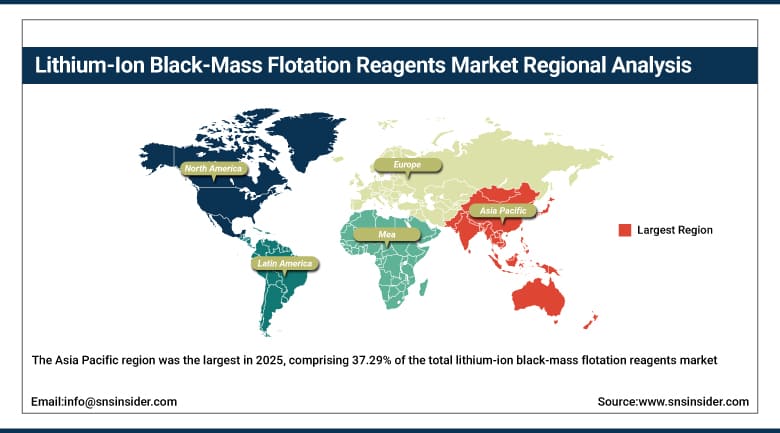
The Asia Pacific region was the largest in 2025, comprising 37.29% of the total lithium-ion black-mass flotation reagents market share and forecasted to dominate until 2035 with fastset CAGR growth of around 12.02%, because of its large lithium-ion batteries production capacity, quick uptake of electric vehicles, growing usage of energy storage systems, and established battery materials supply chain.
China will continue to be a major player in the Asia Pacific region because of its large battery manufacturing industry and existing battery materials supply chain, growing demand for electric vehicles, and increasing investment in battery recycling and recovery of critical materials. Japan and South Korea will continue to play significant roles because of their established automotive, electronics, and battery industries, and India will witness increasing demand with the growth of its electric mobility, battery manufacturing, and energy storage industries.
Get Customized Report as Per Your Business Requirement - Enquiry Now
North America Lithium-Ion Black-Mass Flotation Reagents Market Insights
There is going to be consistent growth in North America throughout 2026-2035 driven by increasing EVs usage, battery recycling, manufacturing capacity, and critical material recovery. North America is also getting benefited by battery recycling facility investments, as well as the development of new technology which is helping in recovering graphite, nickel, cobalt, lithium, and other critical metals from black mass.
The United States is going to dominate the market share in North America, and it is estimated that it will occupy 82.40% of the regional market share in 2025. The dominance of the United States in the regional market is due to its growing electric vehicles and battery manufacturing industry, investments in battery recycling, and increasing focus on strengthening critical minerals supply chain.
Europe Lithium-Ion Black-Mass Flotation Reagents Market Insights
The black-mass flotation reagents market in Europe will experience stable growth over the forecast period due to increased use of electric vehicles, recycling of lithium-ion batteries, sustainability efforts, and development of local battery material value chains. Increased attention to the extraction of critical elements from waste batteries is driving the demand for sophisticated black mass treatment and flotation techniques.
Germany is anticipated to continue being one of the key national markets in Europe, fueled by its strong automotive sector, increased use of electric cars, development of the battery production industry, and the development of circular battery material value chains. In addition, such countries in Europe as the UK, France, Italy, among others, have been contributing to the regional demand.
Middle East & Africa and Latin America Lithium-Ion Black-Mass Flotation Reagents Market Insights
There will be consistent growth within the lithium-ion black-mass flotation reagents markets in the Middle East & Africa and Latin America from 2026 to 2035, driven by developments in electric mobility, deployment of renewable energy, construction of energy storage projects, and investments in the development of battery recycling operations and critical material recovery projects. There will be increasing opportunities in the region for advanced black-mass treatment and flotation reagents technologies owing to the increasing efforts to develop local clean-energy and battery value chains.
Saudi Arabia will continue to be an important market in the Middle East & Africa, due to investments in electric mobility, renewable energy, economic diversification, and energy storage solutions. In Latin America, Brazil will continue to be an important country-level market due to its automotive industry, electric mobility solutions, renewable energy capacity, and emerging battery industry. Other Latin American countries will also contribute to the growth of the region, thanks to their electric vehicles adoption, energy storage projects, and battery recycling operations.
Growth Driver: Increasing demand for efficient battery recycling and critical material recovery is driving market growth
One of the driving forces behind the rise in the global lithium-ion black-mass flotation reagents market is the growing need for lithium-ion battery recycling in an efficient way. The use of electric vehicles, consumer electronics, and power systems has seen an exponential rise, which has led to a large number of lithium-ion batteries that have reached the end of their lives and, thus, producing more black mass. There is a need for effective methods of separation that can recover graphite, cathode active materials, nickel, cobalt, and lithium from them.
In addition, developments in the fields of flotation chemistry, reagent chemistry, black-mass treatment, and separation processes are driving the growth of the market. Investments in the recycling facilities and domestic critical minerals supplies are encouraging the use of advanced flotation reagents.
Restraint: Complex black-mass composition and separation challenges can limit market adoption
The complicated and changing nature of the composition of black mass from lithium-ion batteries poses a huge problem for any form of flotation processes. There is variation that may be observed due to differences in the type of battery being processed, differences in size and surface characteristics of particles, and differences in the composition of the particles themselves, which will affect the effectiveness of the flotation process.
Moreover, there is a need for high-quality recovery, which will necessitate control over the number of reagents, the slurrying process, the properties of the particles, the pH of the process, and other flotation factors. Also, the high cost of implementation, the need for special equipment, and varying quality of the feedstock can pose problems for smaller recycling facilities.
Opportunity: Growing electric vehicle battery recycling and critical mineral demand creates new market opportunities
The proliferation of electric vehicles presents substantial prospects for the manufacturers of lithium-ion black-mass flotation reagents. With an increase in the volume of dead electric vehicle batteries, the abundance of black mass increases, along with a demand for the development of innovative technologies that would help to extract valuable battery materials. Advanced flotation reagents can assist in the extraction of graphite, cathode active materials, nickel, cobalt, and other valuable elements.
Further, the proliferation of energy storage facilities and demand for critical battery minerals also presents opportunities for the development of more advanced recycling methods. In addition to that, increasing investments in battery recycling plants and domestic supplies of battery materials present yet another prospect for advanced flotation reagents and recycling technologies.
Recent Developments
-
March 2026: Group14 Technologies began production at its BAM-3 facility in South Korea, with annual capacity of up to 2,000 metric tons of silicon battery materials, supporting the expansion of silicon-based anode materials for lithium-ion batteries.
-
July 2026: Sila secured $300 million in new funding to accelerate the expansion of its silicon-carbon anode material manufacturing operations in Washington State, supporting commercialization of high-energy-density battery technologies.
-
May 2026: Amprius Technologies reported strong first-quarter 2026 revenue growth and increased its 2026 revenue outlook, reflecting continued commercialization and demand for its silicon-anode battery technology.
-
2026: Panasonic Energy continued advancing next-generation silicon-anode material technologies to support higher-energy-density lithium-ion batteries, particularly for electric vehicle applications.
-
2026: Enovix continued advancing its silicon-anode battery technology for high-performance applications, supporting the broader commercialization of silicon-based anode materials and next-generation lithium-ion batteries.
Lithium-Ion Black-Mass Flotation Reagents Companies are:
-
BASF SE
-
Solvay SA
-
Clariant AG
-
Evonik Industries AG
-
Arkema S.A.
-
Kemira Oyj
-
Huntsman Corporation
-
Croda International Plc
-
Mitsubishi Chemical Group Corporation
-
Ecolab Inc.
-
SNF Group
-
Battery X Metals Inc.
-
Li-Cycle Holdings Corp.
-
Ascend Elements
-
RecycLiCo Battery Materials Inc.
-
LOHUM
-
Attero Recycling
-
BatX Energies.
Lithium-Ion Black-Mass Flotation Reagents Market Report Scope:
| Report Attributes | Details |
|---|---|
| Market Size in 2025 | USD 165.16 Million |
| Market Size by 2035 | USD 497.10 Million |
| CAGR | CAGR of 11.65% From 2026 to 2035 |
| Base Year | 2025 |
| Forecast Period | 2026-2035 |
| Historical Data | 2022-2024 |
| Report Scope & Coverage | Market Size, Segments Analysis, Competitive Landscape, Regional Analysis, DROC & SWOT Analysis, Forecast Outlook |
| Key Segments | • By Reagent Type (Collectors, Frothers, Depressants, Dispersants, pH Modifiers, Specialty & Proprietary Blends) • By Black-Mass Source (Electric Vehicle Batteries, Consumer Electronics Batteries, Energy Storage System Batteries, Manufacturing Scrap, Industrial & Power-Tool Batteries) • By Recovery Objective (Graphite/Anode Recovery, Cathode Active Material Recovery, Nickel & Cobalt Recovery, Lithium Recovery, Multi-Material Recovery) • By Battery Chemistry (NMC Batteries, LFP Batteries, NCA Batteries, LCO Batteries, Others) • By End User (Battery Recyclers, Battery Manufacturers, Material Recovery Companies, Chemical & Reagent Suppliers, Research & Pilot Facilities) |
| Regional Analysis/Coverage | North America (US, Canada), Europe (Germany, UK, France, Italy, Spain, Russia, Poland, Rest of Europe), Asia Pacific (China, India, Japan, South Korea, Australia, ASEAN Countries, Rest of Asia Pacific), Middle East & Africa (UAE, Saudi Arabia, Qatar, South Africa, Rest of Middle East & Africa), Latin America (Brazil, Argentina, Mexico, Colombia, Rest of Latin America) |
| Company Profiles | BASF SE, Solvay SA, Clariant AG, Evonik Industries AG, Nouryon, Arkema S.A., Kemira Oyj, Huntsman Corporation, Croda International Plc, Mitsubishi Chemical Group Corporation, Ecolab Inc., SNF Group, Battery X Metals Inc., Li-Cycle Holdings Corp., Redwood Materials, Inc., Ascend Elements, RecycLiCo Battery Materials Inc., LOHUM, Attero Recycling, BatX Energies. |

Frequently Asked Questions
The lithium-ion black-mass flotation reagents market is expected to grow at a CAGR of 11.67% from 2026 to 2035.
The lithium-ion black-mass flotation reagents market was valued at approximately USD 165.16 million in 2025.
The market is primarily driven by the increasing adoption of electric vehicles, growing volumes of end-of-life lithium-ion batteries, expansion of battery recycling infrastructure, rising demand for critical material recovery, and increasing investments in advanced black-mass processing technologies.
Collectors dominated the lithium-ion black-mass flotation reagents market in 2025, accounting for a 34.83% share.
Asia Pacific dominated the lithium-ion black-mass flotation reagents market in 2025, accounting for a 37.29% share.
