
Long Read Sequencing Market Report Scope & Overview:
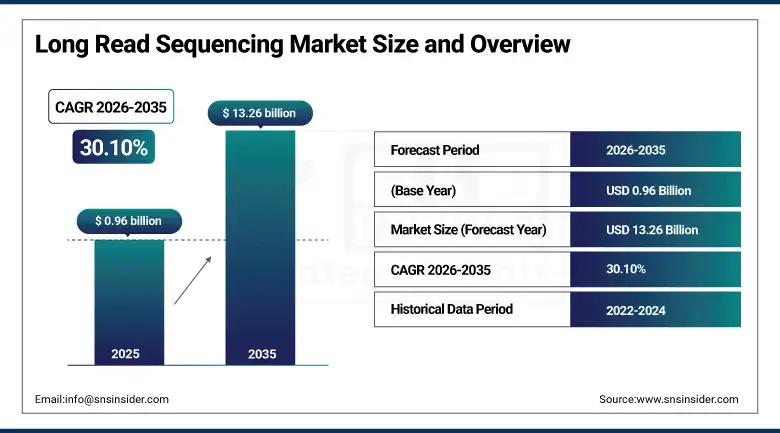
The Long Read Sequencing Market was valued at USD 0.96 Billion in 2025 and is expected to reach USD 13.26 Billion by 2035, growing at a CAGR of 30.10% from 2026 to 2035.
The Long Read Sequencing Market is experiencing rapid growth because of the increased requirement for whole genome analysis, advancement in technology which provides long sequences of high accuracy, and increased use of precision medicine. More applications of this technology can be found in whole genome sequencing, rare diseases, cancer research, metagenomics, and epigenetics. In addition, the increased investment in the field of genomics and decrease in the cost of sequencing are also contributing to market growth. Furthermore, the need to discover complex genetic changes which cannot be easily detected by short-read sequencing technologies is another factor driving market growth.
The European Commission’s 1+ Million Genomes Initiative (1+MG) has united more than 25 countries to facilitate secure cross-border access to genomic and health data. This collaborative framework strengthens genomic research capabilities, promotes data interoperability, and accelerates adoption of advanced long-read sequencing technologies across Europe.
To Get more information On Long Read Sequencing Market - Request Free Sample Report
Long Read Sequencing Market Trends
-
Rising demand for comprehensive genomic analysis and accurate detection of complex genetic variations is driving the long read sequencing market.
-
Growing adoption in whole genome sequencing, rare disease research, cancer genomics, and epigenetics studies is boosting market growth.
-
Expansion of precision medicine initiatives and large-scale genomics programs is fueling technology deployment.
-
Increasing focus on resolving structural variants, repetitive genomic regions, and haplotype phasing is shaping adoption trends.
-
Advancements in nanopore sequencing, single-molecule real-time (SMRT) sequencing, and bioinformatics tools are enhancing sequencing accuracy and throughput.
The U.S. Long Read Sequencing Market Outlook
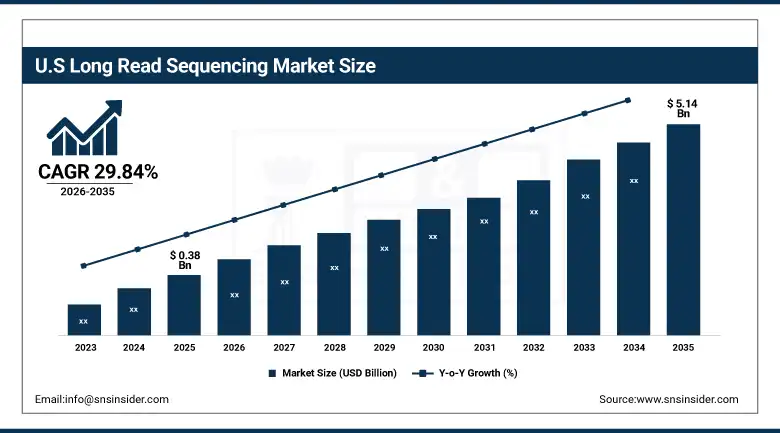
The U.S. Long Read Sequencing Market was valued at approximately USD 0.38 Billion in 2025 and is expected to reach approximately USD 5.14 Billion by 2035, growing at a CAGR of approximately 29.84%.
The United States is the world's largest and most commercially advanced long read sequencing market, anchored by the concentration of leading genomics research universities and institutes, the largest biopharmaceutical industry globally whose drug discovery and development programmes are generating growing long read sequencing demand, and the progressive integration of long read genomics into clinical diagnostic workflows at major academic medical centres. The National Institutes of Health's continued investment in genomics infrastructure, including the All of Us Research Programme and various genome sequencing initiatives, sustains large-scale institutional long read sequencing procurement.
Pacific Biosciences accelerated long-read sequencing adoption through its Revio platform, offering over 99.9% HiFi accuracy and 360 gigabases per run. The system enabled cost-effective population-scale whole genome sequencing, driving deployment across pharmaceutical companies, research institutes, and national genomics initiatives worldwide.
Long Read Sequencing Market Segment Analysis
-
By Offering, consumables segment dominated the long read sequencing market in 2025 with 57% share; services segment is the fastest growing segment.
-
By Technology, nanopore sequencing segment dominated the market in 2025 with 49% share; single-molecule real-time (smrt) sequencing segment is the fastest growing segment.
-
By Workflow, sequencing segment dominated the market in 2025 with 52% share; data analysis segment is the fastest growing segment.
-
By Application, whole genome sequencing segment dominated the market in 2025 with 43% share; epigenetics segment is the fastest growing segment.
-
By End User, academic & research institutes segment dominated the market in 2025 with 46% share; pharmaceutical & biotechnology companies segment is the fastest growing segment.
By Offering, consumables segment dominated the long read sequencing market, services segment is the fastest growing
The Consumables segment dominated the Long Read Sequencing Market in 2025 because of the repetitive consumption of sequencing kits, reagents, flow cells, sample prep, and library prep consumables in every sequencing process. The rise in the use of long-read sequencing among research laboratories, clinical diagnostic centers, and genomic research has raised the number of sequencing processes, resulting in repeat purchases of consumables. The continuous developments in technology and an increase in genomic research programs have been the other key drivers in consumable consumption in this market.
The Services segment is the fastest growing in the Long Read Sequencing Market because of the increasing trend in outsourcing sequencing services by research laboratories, hospitals, and biotechnology companies for cost-effective and customized sequencing services. Various organizations do not find it financially viable to invest in sophisticated sequencing equipment and professionals because of which they prefer outsourced sequencing services to their own sequencing laboratory. Moreover, there is increasing demand for bioinformatics services and genome analysis services.
By Technology, nanopore sequencing segment dominated the long read sequencing market, single-molecule real-time (SMRT) sequencing segment is the fastest growing
Nanopore Sequencing dominated the market in 2025 owing to its ability to create ultra-long reads, portability, real-time sequencing data generation, and adaptability. With the help of this technology, researchers can quickly determine structural variations, complex genomic sections, and epigenetic changes, and at the same time reduce the turnaround time. The rising use of this technology in clinical research, infection surveillance, agriculture, and environmental analysis has increased the adoption rate of this technology. Ongoing developments regarding improvement in accuracy and efficiency have further strengthened the market position.
The Single-Molecule Real-Time (SMRT) Sequencing segment is experiencing the fastest growth owing to an increase in the demand for high-quality long-read sequencing data. High consistency provided by the technology enables efficient characterization of structural variations, transcriptome analysis, and complex genomic regions. Rising application of the technology in rare disease analysis, cancer genomics, and large population-based sequencing programs has accelerated adoption rates. Innovations in sequencing technologies and increased throughput have contributed toward fast growth of the SMRT sequencing segment.
By Workflow, sequencing segment dominated the long read sequencing market, data analysis segment is the fastest growing
The Sequencing segment dominated the market in 2025 owing to being the central activity in the workflow of long-read sequencing. There has been an increase in the demand for high-quality genomic data from various fields including clinical diagnosis, research centers, biotech, and pharmaceutical organizations which has boosted the adoption of sequencing activities. With improvements in sequencing technology and advancements in the chemistry of sequencing, more people are showing interest in adopting such techniques. Since every genomic study requires the results obtained through sequencing, this segment remains the leading spender in the workflow.
The Data Analysis segment is the fastest growing due to the rapid increase in the generation of complex genomic data through long-read sequencing techniques. This makes it necessary for researchers to develop efficient tools for analyzing such large volumes of data using bioinformatics, AI-based analytics, and cloud computing services. Increasing importance of precision medicine, variant analysis, epigenetics, and clinical decision-making has been fueling the need for efficient analytical techniques.
By Application, whole genome sequencing segment dominated the long read sequencing market, epigenetics segment is the fastest growing
Whole Genome Sequencing dominated the market in 2025 due to the comprehensive nature of long-read technology and its ability to detect structural variants. The increasing usage of whole genome studies in the field of disease research, personalized treatment approaches, population genomics, and rare diseases has increased the demand for such technologies. Whole genome sequencing is often used by researchers who require all the genetic information in one go. Genomic initiatives launched by the government and decreasing sequencing costs have further contributed to the dominance of the segment.
The Epigenetics segment is witnessing the fastest growth due to growing awareness about regulation of genes and diseases that cannot be determined from DNA sequence variations. Long read sequencing technologies allow for direct measurement of DNA methylation and other epigenetic changes, without having to undertake complex sample preparation procedures. Rising scientific interest in oncology, neurodegenerative diseases, developmental biology, and precision medicine is adding to the demand for the technology. Significant investments in advanced genomics and increasing applications of epigenetic biomarkers are fueling growth in the segment.
Regional Analysis
|
Region |
Major Country |
Share within Region, 2025 (%) |
|---|---|---|
|
North America |
United States |
84.73% |
|
Europe |
United Kingdom |
32.84% |
|
Asia Pacific |
China |
38.47% |
|
Middle East & Africa |
Israel |
22.84% |
|
Latin America |
Brazil |
43.84% |
North America Long Read Sequencing Market Insights
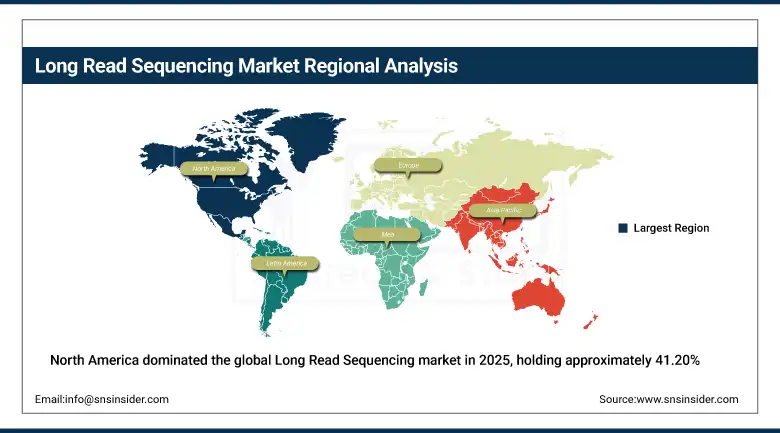
North America dominated the global Long Read Sequencing market in 2025, holding approximately 41.20% of global revenues. The United States accounts for approximately 84.73% of regional revenue through its world-leading genomics research ecosystem, NIH-funded large-scale sequencing programmes, the concentration of pharmaceutical and biotechnology companies whose R&D pipelines generate growing long read sequencing demand, and the progressive integration of long read clinical genomics into academic medical centre diagnostic workflows. Canada contributes supplementary demand through Genome Canada's sequencing infrastructure programmes and growing clinical genomics adoption across its provincial public health laboratory networks.
National Human Genome Research Institute (NHGRI) reports that the cost of sequencing a human genome has fallen from nearly $100 million in 2001 to below $1,000 today, significantly expanding access to genomic technologies and enabling large-scale research and clinical applications.
National Institutes of Health invests billions of dollars annually in genomics and biomedical research programs, supporting large-scale initiatives, sequencing technologies, and precision medicine development across academic, clinical, and translational research ecosystems in the United States.
Get Customized Report as per Your Business Requirement - Enquiry Now
Europe Long Read Sequencing Market Insights
Europe held approximately 28.47% of global Long Read Sequencing revenues in 2025. The United Kingdom leads European market development through the Wellcome Sanger Institute, Genomics England's 100,000 Genomes Project heritage, and one of the world's most advanced national clinical genomics infrastructure programmes. Germany, France, the Netherlands, and Sweden each contribute meaningful regional demand through their academic genomics research programmes and growing clinical application development. Oxford Nanopore Technologies' UK headquarters positioning creates a natural home market presence that sustains early adoption within British academic and clinical sequencing programmes and provides strong reference site density for continental European sales development.
Rare diseases affect nearly 30 million people across Europe, generating substantial demand for high-precision genomic testing. Long-read sequencing enables improved detection of structural variants, repeat expansions, and complex genetic alterations, supporting earlier diagnosis, personalized treatment strategies, and enhanced rare disease research outcomes.
Asia Pacific Long Read Sequencing Market Insights
Asia Pacific is the fastest-growing regional Long Read Sequencing market, projected to expand at a CAGR of approximately 33.47% through 2035.
According to the World Health Organization, Asia accounts for more than 60% of the global population, driving substantial long-term demand for genomic research, precision healthcare applications, and large-scale population health initiatives supporting improved disease prevention and healthcare outcomes.
China accounts for approximately 38.47% of Asia Pacific revenues through BGI Genomics' large-scale sequencing operations, government investment in precision medicine initiatives, and a rapidly growing pharmaceutical and biotechnology sector whose drug development programmes generate increasing long read sequencing demand. Japan, South Korea, Singapore, India, and Australia each contribute meaningful regional demand through their respective national genomics programmes, academic research centres, and growing clinical genomics infrastructure. BGI's development of competitive short read platforms has indirectly validated the long read segment by raising awareness and infrastructure for genomics broadly across the region.
GenomeIndia Project aims to sequence 10,000 genomes to build a comprehensive reference dataset representing India’s genetic diversity, supporting precision medicine, disease research, and population-specific genomic insights across diverse ethnic groups and strengthening national biomedical research infrastructure.
MEA & Latin America Long Read Sequencing Market Insights
Middle East and Latin America represent smaller but growing Long Read Sequencing markets where national genomics programmes, growing biotechnology sector development, and increasing academic research investment are creating expanding institutional demand. Israel leads MEA revenues at approximately 22.84% of the regional total through its globally recognised biotechnology sector, strong academic genomics research at Weizmann Institute and Hebrew University, and its position as a regional innovation hub whose startup ecosystem includes multiple genomics-related companies.
Brazil leads Latin American revenues at approximately 43.84% of the regional total through its Genomics Brazil initiative and the growing integration of genomic tools into its public health research infrastructure at institutions including Fiocruz and Instituto Butantan.
Market Dynamics
Growth Drivers: Continuous platform accuracy improvements enable clinical adoption across oncology, infectious diseases, and rare genetic diagnostics.
Long read sequencing's commercial growth is structurally different from mature scientific instrument markets because it is driven by capability expansion rather than market share redistribution. Each significant advance in nanopore or SMRT sequencing accuracy, throughput, or cost opens genuinely new application categories that were previously inaccessible rather than simply capturing customers from competing platforms.
The achievement of greater than 99% raw accuracy enabled clinical diagnostic applications. The achievement of competitive per-genome costs enabled population genomics. The achievement of telomere-to-telomere reference quality assembly enabled repetitive genome research. Each of these capability milestones created new addressable markets whose size and revenue potential added to rather than substituted for prior application segments.
Restraints: Higher per-run costs than short-read sequencing and complex bioinformatics limit adoption in constrained environments.
Despite rapidly declining costs, long read whole genome sequencing per base costs remain above equivalent short read costs in the most standard human resequencing applications where the incremental genomic information gained from long reads does not justify the price premium for all use cases. Research programmes operating under constrained budgets that must maximise the number of samples sequenced per unit of cost face a genuine trade-off between long read completeness and short read sample throughput economics.
The computational requirements of long read data analysis, including the substantially larger raw data file sizes generated by nanopore sequencing and the more complex assembly and structural variant calling algorithms required to process long read data, impose bioinformatics infrastructure and expertise requirements that create barriers for laboratories whose computational resources were established for short read workflows.
Opportunities: Regulatory approvals for clinical diagnostics and direct patient sequencing expand addressable market and commercial revenue potential.
The transition of long read sequencing from research into routine clinical diagnostics represents the most commercially significant near-term market expansion opportunity. FDA 510(k) and PMA submissions for long read-based clinical diagnostic applications are advancing for oncology liquid biopsy, constitutional rare disease whole genome sequencing, and prenatal diagnosis applications. Each clinical diagnostic approval that long read platforms achieve creates a new recurring clinical revenue stream whose volume scales with the global prevalence of the target condition and the clinical adoption rate of molecular genomic testing as the diagnostic standard of care.
Recent Developments:
-
2025: Oxford Nanopore Technologies launched its Q20 Plus sequencing chemistry achieving modal read accuracy above 99.5% with R10.4.1 flow cells across human, microbial, and metagenomic applications, enabling qualification processes for clinical diagnostic use cases and substantially expanding the range of research applications where nanopore accuracy satisfies analytical requirements.
-
2025: Pacific Biosciences expanded Revio system installations to hundreds of sites globally across pharmaceutical companies, national genomics programmes, and academic medical centres, with the system's HiFi chemistry demonstrating competitive per-genome costs for large cohort whole genome sequencing projects that accelerated adoption by previously short-read-exclusive population genomics programmes.
-
2024: BGI Genomics launched its Complete Genomics T20x2 long read sequencing system incorporating proprietary combinatorial probe anchor synthesis technology, providing an alternative long read platform whose competitive pricing model targeted the Asia Pacific academic and clinical research market with particular emphasis on Chinese national genomics infrastructure programmes.
Long Read Sequencing Market Key Players are:
-
Pacific Biosciences (PacBio)
-
Oxford Nanopore Technologies
-
Illumina Inc.
-
BGI Genomics
-
MGI Tech
-
Thermo Fisher Scientific
-
QIAGEN N.V.
-
F. Hoffmann-La Roche Ltd.
-
Agilent Technologies Inc.
-
10x Genomics Inc.
-
Element Biosciences
-
Azenta Life Sciences
-
Takara Bio Inc.
-
New England Biolabs (NEB)
-
Eurofins Genomics
-
Quantapore Inc.
-
Universal Sequencing Technology Corporation (USTC)
-
Novogene Corporation
-
MicrobesNG
-
Sage Science Inc.
Long Read Sequencing Market Report Scope:
| Report Attributes | Details |
|---|---|
| Market Size in 2025 | USD 0.96 Billion |
| Market Size by 2035 | USD 13.26 Billion |
| CAGR | CAGR of 30.10% From 2026 to 2035 |
| Base Year | 2025 |
| Forecast Period | 2026-2035 |
| Historical Data | 2022-2024 |
| Report Scope & Coverage | Market Size, Segments Analysis, Competitive Landscape, Regional Analysis, DROC & SWOT Analysis, Forecast Outlook |
| Key Segments | • By Offering (Instruments, Consumables, Services) • By Technology (Nanopore Sequencing, Single-Molecule Real-Time (SMRT) Sequencing, Synthetic Long-Read Sequencing) • By Workflow (Sample Preparation, Sequencing, Data Analysis) • By Application (Whole Genome Sequencing, Targeted Sequencing, Metagenomics, Epigenetics, Whole Exome Sequencing, Others) • By End User (Academic & Research Institutes, Hospitals, Clinics & Diagnostic Laboratories, Pharmaceutical & Biotechnology Companies, Others) |
| Regional Analysis/Coverage | North America (US, Canada), Europe (Germany, UK, France, Italy, Spain, Russia, Poland, Rest of Europe), Asia Pacific (China, India, Japan, South Korea, Australia, ASEAN Countries, Rest of Asia Pacific), Middle East & Africa (UAE, Saudi Arabia, Qatar, South Africa, Rest of Middle East & Africa), Latin America (Brazil, Argentina, Mexico, Colombia, Rest of Latin America). |
| Company Profiles | Pacific Biosciences (PacBio), Oxford Nanopore Technologies, Illumina Inc., BGI Genomics, MGI Tech, Thermo Fisher Scientific, QIAGEN N.V., F. Hoffmann-La Roche Ltd., Agilent Technologies Inc., 10x Genomics Inc., Element Biosciences, Azenta Life Sciences, Takara Bio Inc., New England Biolabs (NEB), Eurofins Genomics, Quantapore Inc., Universal Sequencing Technology Corporation (USTC), Novogene Corporation, MicrobesNG, Sage Science Inc. |
Frequently Asked Questions
The Long Read Sequencing Market is expected to grow at a CAGR of 30.10% from 2026 to 2035.
The Long Read Sequencing Market was valued at USD 0.96 Billion in 2025.
Continuous platform accuracy improvements enable clinical adoption across oncology, infectious diseases, and rare genetic diagnostics.
The whole genome sequencing segment dominated the Long Read Sequencing Market with 30.00% share in 2025.
North America dominated the Long Read Sequencing Market in 2025, holding approximately 41.20% of global revenues.
