
Neuromorphic Edge Computing Market Report Scope & Overview:
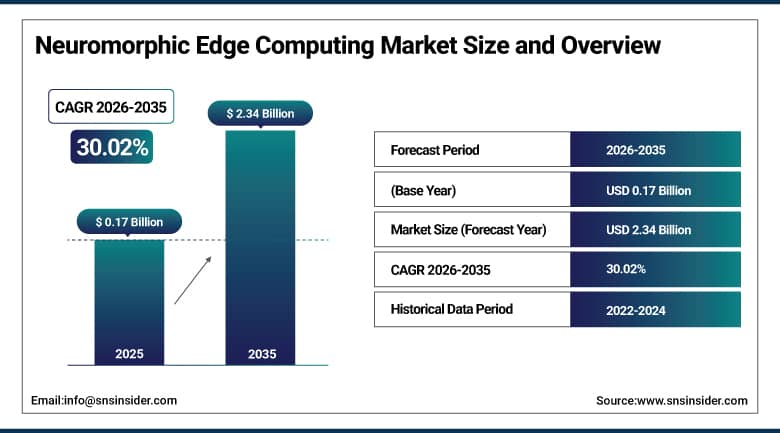
The Neuromorphic Edge Computing Market was valued at USD 0.17 Billion in 2025 and is expected to reach USD 2.34 Billion by 2035, growing at a CAGR of 30.02% from 2026–2035.
The Neuromorphic Edge Computing Market is experiencing strong growth due to increasing demand for low-latency, energy-efficient, intelligent computing at the edge. The expansion of artificial intelligence, Internet of Things (IoT), robotics, autonomous systems, smart devices, and real-time analytics is driving demand for neuromorphic computing solutions capable of processing data efficiently closer to the source. Investments in neuromorphic chips, processors, memory architectures, sensors, and specialized software are enhancing computational efficiency, responsiveness, scalability, and power performance. Companies are focusing on improving processing speed, energy efficiency, event-driven computing, real-time decision-making, and adaptive learning capabilities. Growing demand for intelligent edge processing across consumer electronics, automotive, healthcare, industrial automation, aerospace & defense is accelerating technological advancements.
In March 2026, the neuromorphic computing ecosystem advanced through international research and industry initiatives focused on brain-inspired processors, spiking neural networks, event-driven sensing, and energy-efficient edge intelligence. Events and research programs in 2026 are emphasizing neuromorphic architectures for robotics, automation, edge computing, biosignal processing, and real-time AI, supporting broader commercialization of low-power intelligent computing technologies.
To Get More Information On Neuromorphic Edge Computing Market - Request Free Sample Report
Neuromorphic Edge Computing Market Trends
-
Growing demand for low-latency and energy-efficient edge computing is driving the adoption of neuromorphic computing technologies for processing data closer to the point of generation.
-
Rising deployment of artificial intelligence, Internet of Things (IoT), robotics, autonomous systems, smart devices, and edge AI applications is increasing demand for brain-inspired computing architectures capable of real-time data processing.
-
Increasing adoption of spiking neural networks, event-driven processing, neuromorphic processors, and specialized AI accelerators is supporting the development of high-performance and energy-efficient edge computing solutions.
-
Growing focus on reducing power consumption, processing latency, data transmission requirements, and dependence on centralized cloud infrastructure is creating opportunities for neuromorphic edge computing technology providers.
-
Advancements in neuromorphic hardware, memristive technologies, spiking neural networks, event-based sensing, on-chip learning, and AI algorithms are improving computational efficiency and supporting the adoption of neuromorphic edge computing solutions.
U.S. Neuromorphic Edge Computing Market Outlook
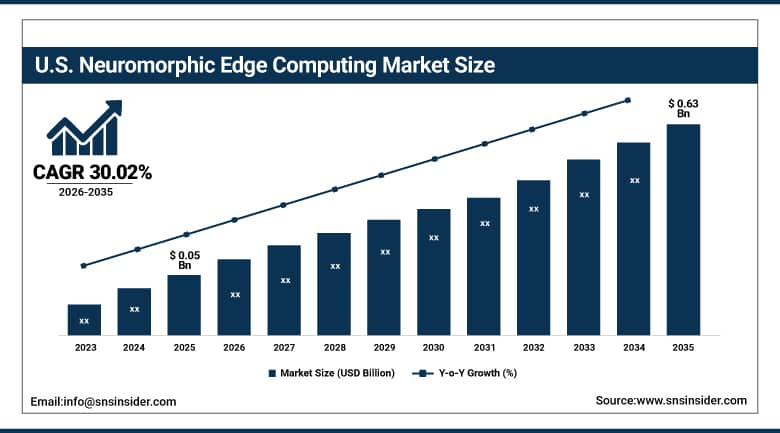
The U.S. Neuromorphic Edge Computing Market was valued at USD 0.05 Billion in 2025 and is expected to reach around USD 0.63 Billion by 2035, growing at a CAGR of 30.02% from 2026–2035.
The U.S. neuromorphic edge computing market is expanding steadily, supported by increasing demand for low-latency, energy-efficient, and intelligent computing capabilities at the network edge. The rapid adoption of artificial intelligence, edge AI, Internet of Things (IoT), robotics, autonomous systems, smart infrastructure, and intelligent devices is creating strong demand for computing architectures capable of processing data locally and responding in real time. Growing investments in advanced edge computing infrastructure and AI-enabled systems are encouraging the integration of neuromorphic processors, spiking neural networks, event-driven computing, and specialized AI accelerators. The need to reduce power consumption, data transmission requirements, processing latency, and dependence on centralized cloud infrastructure is further strengthening the deployment of neuromorphic solutions across industrial, automotive, healthcare, defense, and consumer applications.
In March 2026, the NICE 2026 conference at the Georgia Institute of Technology in Atlanta highlighted advances in spiking neural networks, neuromorphic computing applications, event-driven sensing, neuromorphic sensors, edge computing, robotics, and AI software frameworks. The developments are expected to strengthen U.S. research and commercialization of neuromorphic edge systems by improving real-time processing, energy efficiency, and intelligent sensing capabilities.
Neuromorphic Edge Computing Market Segment Analysis
-
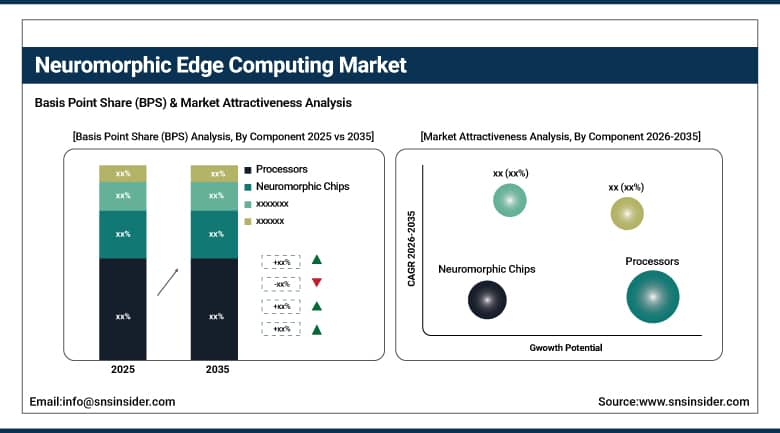
By Component, processors dominated the neuromorphic edge computing market with a 32.41% share in 2025, while neuromorphic chips are projected to be the fastest-growing segment, registering a 31.76% CAGR during 2026–2035.
-
By Deployment Environment, on-device edge dominated the neuromorphic edge computing market with a 42.63% share in 2025, while edge data centers are projected to be the fastest-growing segment, registering a 36.28% CAGR during 2026–2035.
-
By Application, image processing dominated the neuromorphic edge computing market with a 37.84% share in 2025, while AI & machine learning is projected to be the fastest-growing segment, registering a 38.86% CAGR during 2026–2035.
-
By End Use, consumer electronics dominated the neuromorphic edge computing market with a 35.72% share in 2025, while automotive is projected to be the fastest-growing segment, registering a 33.79% CAGR during 2026–2035.
By Component, processors dominated the neuromorphic edge computing market, while neuromorphic chips are expected to grow fastest.
Processors held the leading position in the neuromorphic edge computing market in 2025, supported by their critical role in executing neural computations and enabling real-time intelligence across edge devices and systems. The increasing demand for low-latency AI processing, energy-efficient computing, and localized data analysis is driving the deployment of advanced neuromorphic processors
Neuromorphic chips are anticipated to register the highest CAGR during the forecast period from 2026 to 2035. Their ability to enable highly parallel, event-driven, and energy-efficient computation is encouraging adoption across emerging edge AI applications.
By Deployment Environment, on-device edge dominated the neuromorphic edge computing market, while edge data centers are expected to grow fastest.
On-device edge held the leading position in the neuromorphic edge computing market in 2025, supported by increasing demand for real-time processing, low latency, and energy-efficient intelligence directly at the point of data generation. The growing adoption of smart devices, intelligent sensors, robotics, autonomous systems, and edge AI applications is increasing the need for localized computing capabilities. Neuromorphic architectures are particularly suited to on-device environments because their event-driven processing enables efficient AI workloads while reducing power consumption and dependence on centralized cloud infrastructure.
Edge data centers are anticipated to register the highest CAGR during the forecast period from 2026 to 2035. The increasing volume of AI workloads, real-time data processing requirements, and distributed computing deployments is creating strong demand for advanced processing capabilities closer to end users and data sources.
By Application, image processing dominated the neuromorphic edge computing market, while AI & machine learning are expected to grow fastest.
Image processing held the leading position in the neuromorphic edge computing market in 2025, supported by the increasing adoption of intelligent vision systems, event-based sensing, robotics, autonomous platforms, and smart devices. Neuromorphic computing enables efficient processing of visual information through event-driven architectures, allowing systems to respond rapidly while optimizing computational and energy requirements.
AI & machine learning are anticipated to register the highest CAGR during the forecast period from 2026 to 2035. The rapid expansion of edge AI, autonomous decision-making, intelligent robotics, and real-time analytics is increasing demand for computing architectures capable of executing AI workloads efficiently at the edge.
Regional Analysis
|
Region |
Major Country |
Share within Region, 2025(%) |
|---|---|---|
|
North America |
United States |
82.40% |
|
Europe |
Germany |
34.30% |
|
Asia Pacific |
China |
48.54% |
|
Middle East & Africa |
Saudi Arabia |
23.50% |
|
Latin America |
Brazil |
23.00% |
North America neuromorphic edge computing market insights
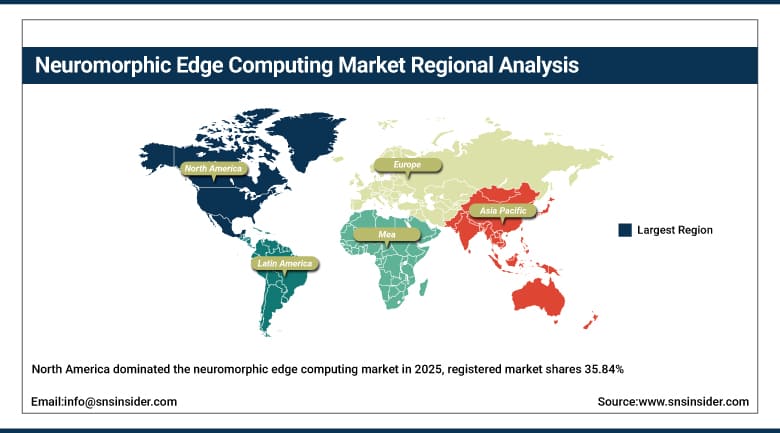
North America dominated the neuromorphic edge computing market in 2025, registered market shares 35.84%, supported by its strong technology ecosystem, advanced computing infrastructure, and significant investments in artificial intelligence, edge computing, and intelligent connected systems. The region has a well-established presence of technology companies, semiconductor developers, cloud service providers, and research institutions that are advancing neuromorphic processors, spiking neural networks, event-driven computing, and specialized AI architectures. Growing demand for low-latency and energy-efficient processing across autonomous systems, robotics, industrial automation, healthcare, aerospace & defense, and consumer electronics is strengthening adoption of neuromorphic edge computing technologies.
Get Customized Report as Per Your Business Requirement - Enquiry Now
Europe neuromorphic edge computing market insights
The neuromorphic edge computing market in Europe is expected to witness steady growth over the forecast period, supported by increasing adoption of artificial intelligence, edge computing, industrial automation, robotics, intelligent transportation systems, and connected technologies. Growing investments in energy-efficient computing architectures and real-time data processing are encouraging organizations to evaluate neuromorphic solutions for applications requiring low latency and reduced power consumption. The region's strong industrial base and focus on digital transformation are further supporting demand for advanced edge intelligence technologies.
Asia Pacific neuromorphic edge computing market insights
Asia Pacific is expected to grow at the fastest CAGR during 2026–2035, CAGR 32.94%, driven by rapid digital transformation, expanding artificial intelligence adoption, increasing deployment of edge computing, and growing investments in intelligent connected devices. Countries including China, Japan, South Korea, India, Singapore, and other economies across the region are investing substantially in AI infrastructure, robotics, autonomous systems, smart manufacturing, and IoT technologies. The increasing need for real-time data processing, low-latency decision-making, and energy-efficient computation is creating substantial demand for neuromorphic edge computing architectures.
The rapid expansion of consumer electronics, industrial automation, automotive technologies, smart infrastructure, and AI-enabled applications is further supporting regional adoption. Increasing investments in neuromorphic hardware, specialized AI processors, event-based sensing, spiking neural networks, and edge AI are strengthening the technology ecosystem across Asia Pacific. The region's growing emphasis on energy-efficient computing and localized intelligence is expected to accelerate deployment of neuromorphic solutions and support strong market expansion through 2035.
Middle East & Africa and Latin America neuromorphic edge computing market insights
The neuromorphic edge computing market in the Middle East & Africa and Latin America is expected to witness consistent growth from 2026 to 2035, supported by increasing digital transformation, adoption of artificial intelligence, expansion of IoT ecosystems, and growing deployment of intelligent edge technologies. Rising investments in smart infrastructure, industrial automation, connected devices, autonomous systems, and real-time analytics are creating opportunities for energy-efficient and low-latency computing architectures. Increasing adoption of edge computing is also encouraging organizations to process data closer to end users and connected devices, supporting demand for neuromorphic technologies.
In Latin America, Brazil is anticipated to remain a key country-level market due to its large technology ecosystem, expanding IoT deployment, industrial automation, smart infrastructure, and increasing adoption of AI-enabled applications. Other countries across both regions are also expected to contribute to market growth through investments in digital infrastructure, intelligent systems, automation, and localized edge computing capabilities.
Growth Driver: Increasing demand for low-latency and energy-efficient edge intelligence is driving market growth
One of the key factors driving the growth of the global neuromorphic edge computing market is the increasing demand for real-time, low-latency, and energy-efficient data processing at the edge. The expansion of artificial intelligence, machine learning, Internet of Things (IoT), robotics, autonomous systems, smart devices, and industrial automation is creating substantial demand for computing architectures capable of processing data locally and responding rapidly. As conventional computing architectures face increasing requirements for real-time processing and energy efficiency, organizations are increasingly evaluating neuromorphic technologies that can deliver intelligent processing closer to the point of data generation.
In addition, advancements in neuromorphic processors, spiking neural networks, event-driven computing, event-based sensing, and specialized AI accelerators are improving computational efficiency and enabling intelligent processing across resource-constrained edge environments. Increasing investments in edge AI, autonomous systems, smart infrastructure, and intelligent devices are further encouraging the deployment of neuromorphic computing solutions.
Restraint: High development costs and technological complexity can limit market adoption
The high development costs and technological complexity associated with neuromorphic edge computing can restrict market adoption, particularly among smaller enterprises and organizations with limited technology budgets. Neuromorphic processors, specialized hardware, event-based sensors, and supporting software architectures require significant investments in research, development, integration, and deployment. The need to adapt existing computing infrastructure and software environments to neuromorphic architectures may also increase implementation costs and extend deployment timelines.
Moreover, the relatively specialized nature of neuromorphic computing requires technical expertise in areas such as spiking neural networks, event-driven processing, neuromorphic hardware design, and AI model optimization. Compatibility challenges with conventional computing platforms, limited availability of standardized development environments, evolving architectures, and integration requirements can further increase technological complexity.
Opportunity: Rapid expansion of edge AI and intelligent autonomous systems creates new market opportunities
The rapid expansion of edge AI, autonomous systems, robotics, and intelligent connected devices presents significant opportunities for neuromorphic edge computing providers. Increasing deployment of AI-enabled devices and real-time applications is generating substantial demand for computing architectures capable of processing information locally with low latency and reduced energy consumption. As edge environments increasingly require continuous processing of sensor and event-driven data, neuromorphic technologies can provide opportunities to improve computational efficiency and enable intelligent decision-making closer to the data source.
Furthermore, growing adoption of neuromorphic processors, spiking neural networks, event-based vision systems, on-chip learning, and specialized AI accelerators is creating opportunities across automotive, industrial automation, healthcare, consumer electronics, aerospace & defense, and other emerging applications.
Recent Developments
-
2026: Intel Corporation continued advancing neuromorphic computing technologies, including specialized neuromorphic processors and brain-inspired architectures, to support energy-efficient, low-latency AI processing for edge computing and intelligent devices.
-
2026: International Business Machines Corporation (IBM) continued developing neuromorphic computing and brain-inspired AI technologies, supporting energy-efficient processing, spiking neural networks, and next-generation edge intelligence applications.
-
2026: BrainChip Holdings Ltd. continued expanding its neuromorphic computing portfolio, including Akida-based processors and AI solutions designed to enable low-power, real-time inference across edge devices, intelligent sensors, and embedded systems.
-
2026: SynSense AG continued advancing neuromorphic processor and event-based sensing technologies, supporting ultra-low-power, real-time AI processing for edge devices, robotics, industrial automation, and intelligent sensing applications.
Neuromorphic Edge Computing Market Key Players are:
-
Intel Corporation
-
International Business Machines Corporation (IBM)
-
BrainChip Holdings Ltd.
-
Innatera Nanosystems B.V.
-
Qualcomm Technologies, Inc.
-
Samsung Electronics Co., Ltd.
-
General Vision Inc.
-
GrAI Matter Labs
-
Prophesee S.A.
-
Applied Brain Research Inc.
-
HRL Laboratories LLC
-
SK hynix Inc.
-
Knowm Inc.
-
POLYN Technology Ltd.
-
SpiNNcloud Systems GmbH
-
Sony Semiconductor Solutions Corporation
-
Syntiant Corp.
-
Microchip Technology Incorporated.
Neuromorphic Edge Computing Market Report Scope:
| Report Attributes | Details |
|---|---|
| Market Size in 2025 | USD 0.17 Billion |
| Market Size by 2035 | USD 2.34 Billion |
| CAGR | CAGR of 30.02% From 2026 to 2035 |
| Base Year | 2025 |
| Forecast Period | 2026-2035 |
| Historical Data | 2022-2024 |
| Report Scope & Coverage | Market Size, Segments Analysis, Competitive Landscape, Regional Analysis, DROC & SWOT Analysis, Forecast Outlook |
| Key Segments | • By Component (Neuromorphic Chips, Processors, Memory, Sensors, Software) • By Deployment Environment (On-Device Edge, Edge Gateway, Embedded Systems, Edge Data Centers) • By Application (Image Processing, Signal Processing, Data Processing, Object Detection, AI & Machine Learning) • By End Use (Consumer Electronics, Automotive, Healthcare, Industrial Automation, Aerospace & Defense) |
| Regional Analysis/Coverage | North America (US, Canada), Europe (Germany, UK, France, Italy, Spain, Russia, Poland, Rest of Europe), Asia Pacific (China, India, Japan, South Korea, Australia, ASEAN Countries, Rest of Asia Pacific), Middle East & Africa (UAE, Saudi Arabia, Qatar, South Africa, Rest of Middle East & Africa), Latin America (Brazil, Argentina, Mexico, Colombia, Rest of Latin America) |
| Company Profiles | Intel Corporation, International Business Machines Corporation (IBM), BrainChip Holdings Ltd., SynSense AG, Innatera Nanosystems B.V., Qualcomm Technologies, Inc., Samsung Electronics Co., Ltd., General Vision Inc., GrAI Matter Labs, Prophesee S.A., Applied Brain Research Inc., Numenta Inc., HRL Laboratories LLC, SK hynix Inc., Knowm Inc., POLYN Technology Ltd., SpiNNcloud Systems GmbH, Sony Semiconductor Solutions Corporation, Syntiant Corp., Microchip Technology Incorporated. |

Frequently Asked Questions
Key players in the neuromorphic edge computing market include Intel Corporation, International Business Machines Corporation (IBM), BrainChip Holdings Ltd., SynSense AG, and Innatera Nanosystems B.V., among others.
Key opportunities in the neuromorphic edge computing market include the rapid expansion of edge AI and intelligent autonomous systems, growing deployment of neuromorphic processors, and spiking neural networks across automotive, industrial, healthcare, robotics, and consumer applications.
The market is driven by increasing demand for low-latency, energy-efficient, and real-time AI processing at the network edge, along with rising adoption of artificial intelligence, Internet of Things (IoT), robotics, autonomous systems, smart devices, and industrial automation.
The Processors segment dominated the neuromorphic edge computing market.
The North America region dominated the neuromorphic edge computing market in 2025.
