
Single-Use Ureteroscope Market Report Scope and Overview:
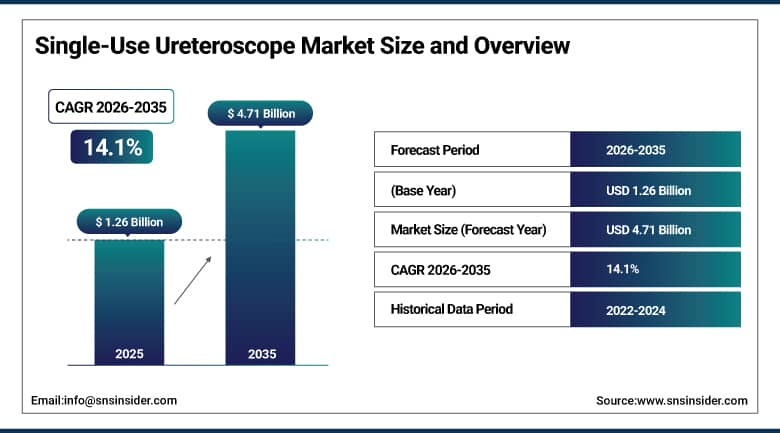
The Single-Use Ureteroscope Market was valued at approximately USD 1.26 Billion in 2025 and is projected to reach approximately USD 4.71 Billion by 2035, registering a CAGR of 14.1% from 2026 to 2035.
Market growth is being driven by the rising global prevalence of kidney stones and other upper urinary tract disorders, alongside growing surgeon preference for disposable endoscopic devices that eliminate the cross-contamination and reprocessing risks associated with reusable flexible scopes. Expanding adoption of ureteroscopy as the preferred approach for minimally invasive stone management, rising procedure volumes in ambulatory surgical centers, and continued improvement in single-use digital imaging quality are collectively widening clinical acceptance. Additional momentum is coming from favorable outpatient reimbursement policy changes and growing manufacturing capacity among both established endoscopy companies and newer disposable-device specialists entering the urology space.
⮞In September 2025, Olympus Corporation announced an exclusive global distribution agreement with MacroLux Medical covering single-use cystoscopes, ureteroscopes, and suction access sheaths. The partnership extends Olympus's disposable urology portfolio across selected markets in North America, Europe, and Asia Pacific.
To Get More Information On Single-Use Ureteroscope Market - Request Free Sample Report
Single-Use Ureteroscope Market Trends
-
Growing surgeon preference for disposable scopes over reusable flexible ureteroscopes continues reducing reliance on hospital reprocessing infrastructure.
-
Rising procedure migration toward ambulatory surgical centers continues expanding demand for single-use devices that avoid centralized sterilization requirements.
-
Expanding integration of AI-enhanced visualization software continues improving stone detection and procedural efficiency during ureteroscopy.
-
Increasing manufacturing entry from disposable-device specialists continues intensifying price competition against established reusable-scope manufacturers.
-
Growing outpatient reimbursement support for single-use endoscopic devices continues accelerating adoption across ambulatory care settings.
U.S. Single-Use Ureteroscope Market Outlook
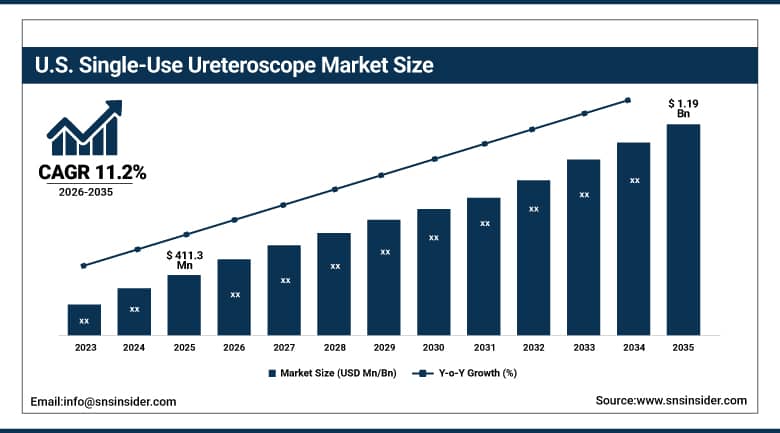
The U.S. Single-Use Ureteroscope Market was valued at approximately USD 411.3 Million in 2025 and is projected to reach approximately USD 1.19 Billion by 2035, registering a CAGR of approximately 11.2% from 2026 to 2035.
The U.S. market is underpinned by a high prevalence of urolithiasis, a well-established base of hospital and ambulatory urology practices, and a favorable outpatient reimbursement environment following the Centers for Medicare & Medicaid Services' continued pass-through coding support for single-use endoscopic devices. This reimbursement structure has meaningfully accelerated the shift of ureteroscopy procedures into ambulatory surgical centers, where the infection-control and workflow advantages of disposable scopes carry particular weight. Sustained new-product activity among both multinational endoscopy manufacturers and newer disposable-device entrants is keeping the domestic market the largest and most competitive globally.
⮞In August 2026, the U.S. FDA granted 510(k) clearance to Boston Scientific's LithoVue Elite Digital Flexible Ureteroscope System under submission K261153. The regulatory decision reflects continued development of advanced flexible ureteroscopy technology for urinary tract visualization and intervention.
Single-Use Ureteroscope Market Segment Analysis
-
By Product Type, Flexible Single-Use Ureteroscopes segment dominated the market in 2025 with 72% share; Semi-Rigid Single-Use Ureteroscopes segment is the fastest growing segment.
-
By Technology, Standard Digital Imaging Systems segment dominated the market in 2025 with 61% share; AI-Enhanced Visualization Systems segment is the fastest growing segment.
-
By Application, Urolithiasis (Kidney Stone Management) segment dominated the market in 2025 with 64% share; Urinary Stricture Treatment segment is the fastest growing segment.
-
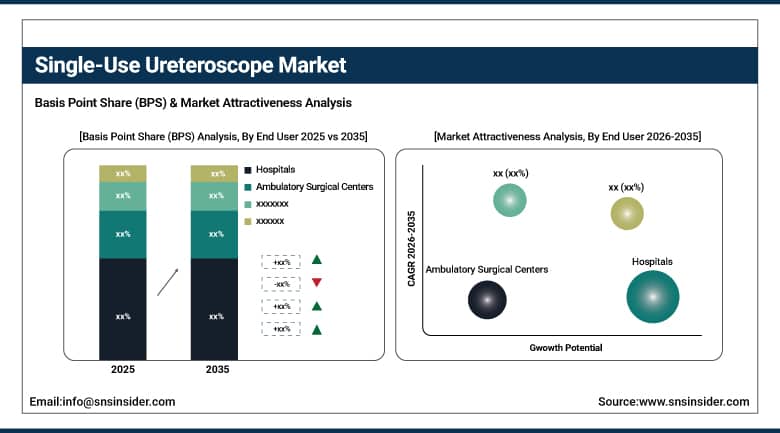
By End-User, Hospitals segment dominated the market in 2025 with 54% share; Ambulatory Surgical Centers segment is the fastest growing segment.
By End-User: Hospitals Dominate, Ambulatory Surgical Centers Expand Fastest
The Hospitals segment accounted for the largest end-user share, reflecting hospitals' continued role as the primary site for complex ureteroscopy procedures and their established purchasing relationships with major endoscopy manufacturers. Hospital urology departments have been early adopters of single-use scopes specifically for cases involving infection risk or where reprocessing turnaround could otherwise delay same-day scheduling.
The Ambulatory Surgical Centers segment is the fastest-growing end-user category, supported directly by outpatient reimbursement policy changes, including continued Medicare pass-through coding support for single-use endoscopic devices, that have made ambulatory ureteroscopy procedures more financially viable. Without the capital cost and staffing requirements of an on-site reprocessing suite, ambulatory centers have found single-use scopes particularly well suited to their lower-overhead procedural model.
⮞In May 2025, Hunan Vathin Medical Instrument received U.S. FDA 510(k) clearance for its single-use flexible ureteroscope under submission K250785. The clearance adds another disposable endoscopic option for appropriately equipped hospitals and outpatient surgical facilities seeking flexible ureteroscopy capabilities.
By Product Type: Flexible Ureteroscopes Lead, Semi-Rigid Devices Grow Fastest
The Flexible Single-Use Ureteroscopes segment accounted for the largest revenue share in 2025, reflecting flexible scopes' established role as the preferred instrument for accessing the upper urinary tract and treating stones located in the kidney rather than being limited to the lower ureter. Surgeons have overwhelmingly favored disposable flexible platforms for retrograde intrarenal surgery, as consistent optical performance on every use removes the image-quality degradation that reusable flexible scopes experience after repeated reprocessing cycles. This durability advantage has directly supported flexible single-use devices' dominant position within overall category revenue.
The Semi-Rigid Single-Use Ureteroscopes segment is projected to expand at the fastest rate, fueled by increasing volumes of ureteroscopy procedures targeting stones located in the lower or middle ureters, which continue utilizing semi-rigid devices owing to their clinical efficacy. Increasing development activity involving semi-rigid disposable scope models seeks to capitalize upon procedural cost sensitivity in ambulatory surgical centers and foreign nations, where semi-rigid instruments' mechanical simplicity enables reduced prices compared to more advanced flexible scopes.
⮞In August 2026, Scivita Medical Technology received U.S. FDA 510(k) clearance for its SUV-5C-B single-use flexible ureteroscope. The authorization expands the portfolio of cleared disposable flexible ureteroscopy devices, supporting greater product choice in minimally invasive upper urinary tract procedures.
By Technology: Standard Digital Imaging Dominates, AI-Enhanced Visualization Advances Fastest
The Standard Digital Imaging Systems segment held the largest technology share, reflecting the maturity of CMOS chip-tip camera technology that has become the baseline visualization standard across nearly all commercially available single-use ureteroscopes. This technology delivers image quality broadly comparable to reusable digital flexible scopes at a substantially lower manufacturing cost, which has made it the default choice for the large majority of disposable devices currently sold across hospital and ambulatory settings.
The AI-Enhanced Visualization Systems segment is registering the fastest growth, as manufacturers begin integrating software capable of automated stone detection, real-time image enhancement, and procedural analytics into single-use platforms. Though still representing a comparatively small share of total device sales, growing surgeon interest in tools that can shorten procedure time and improve stone clearance rates is driving accelerated investment in this segment relative to standard imaging alternatives.
⮞In April 2026, Anhui Happiness Workshop Instruments obtained U.S. FDA 510(k) clearance for its 7.5 Fr single-use digital flexible ureteroscope and HV-200 videoscope imaging processor. The authorization demonstrates ongoing commercial development of integrated digital visualization platforms for disposable ureteroscopy.
By Application: Urolithiasis Leads, Urinary Stricture Treatment Grows Fastest
The Urolithiasis (Kidney Stone Management) segment led the market by application, consistent with ureteroscopy's position as the gold-standard minimally invasive approach for treating kidney and ureteral stones. Rising global prevalence of urolithiasis, linked to dietary patterns, climate factors, and metabolic conditions, has continued to expand procedure volumes, and single-use scopes have captured a growing share of these procedures as surgeons prioritize consistent optical performance during laser lithotripsy.
The Urinary Stricture Treatment segment is expanding at the fastest pace, driven by increasing application of ureteroscopy to diagnose and manage ureteral strictures along with established use in stone disease management. Increased availability of disposable scopes within the outpatient setting enabled urologists to extend use to a wider variety of upper urinary tract diagnostic and therapeutic interventions outside of stone disease management.
⮞In September 2025, Boston Scientific obtained U.S. FDA 510(k) clearance for updated LithoVue Elite single-use digital flexible ureteroscopes incorporating pressure monitoring. The technology supports urinary tract visualization and intraluminal pressure assessment during endoscopic procedures, including stone-management interventions.
Regional Analysis
|
Region |
Major Country |
Share within Region, 2025 (%) |
|
North America |
United States |
85.00% |
|
Europe |
Germany |
23.50% |
|
Asia Pacific |
China |
32.60% |
|
Middle East and Africa |
UAE |
24.80% |
|
Latin America |
Brazil |
32.90% |
North America Single-Use Ureteroscope Market Insights
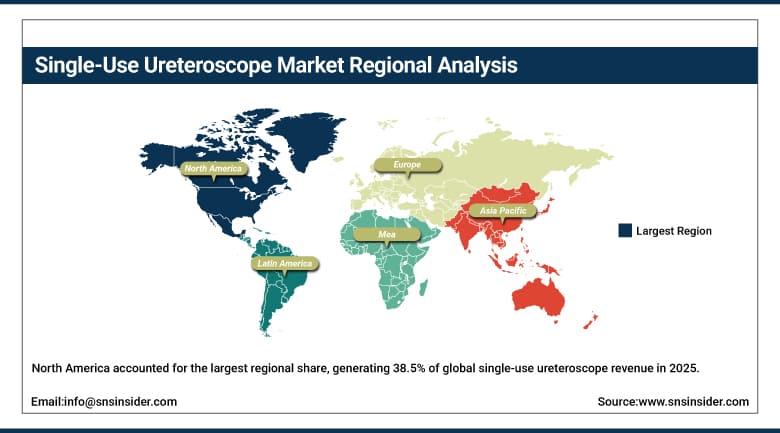
North America accounted for the largest regional share, generating 38.5% of global single-use ureteroscope revenue in 2025. This leadership position reflects a high prevalence of urolithiasis, advanced healthcare infrastructure, and a strong concentration of leading endoscopy manufacturers headquartered across the region. Outpatient reimbursement policy support for single-use endoscopic devices has further reinforced regional adoption relative to markets where ambulatory procedure reimbursement remains less developed.
The United States represented approximately 85.00% of North American revenue, driven by extensive hospital and ambulatory surgical center infrastructure and continued new-product launches from manufacturers headquartered domestically. Canada contributed a smaller but steady share through growing adoption within its public hospital urology departments, together keeping North America the largest addressable market for single-use ureteroscope vendors.
⮞In September 2026, Guangzhou Red Pine Medical Instrument received U.S. FDA 510(k) clearance for its RP-U-C06 series of single-use video flexible ureterorenoscopes. The authorization demonstrates continued entry of international disposable endoscopy manufacturers into the U.S. regulatory market.
Get Customized Report as Per Your Business Requirement - Enquiry Now
Europe Single-Use Ureteroscope Market Insights
Europe held a meaningful share of global revenue, supported by well-established urology practice standards and growing national health-service interest in disposable devices as a means of reducing hospital-acquired infection risk and reprocessing costs. Regulatory alignment under the EU Medical Device Regulation continues to support multi-country commercialization for manufacturers securing initial approval.
Germany accounted for approximately 23.50% of European revenue, supported by a strong concentration of endoscopy manufacturers headquartered domestically and well-developed urology clinical infrastructure. The UK and France contributed substantial additional demand, and continued national health-service attention toward infection-control policy is expected to support steady growth in single-use ureteroscope adoption through the forecast period.
⮞A separate, Europe-specific 2025–2026 launch or authorization with an independently verified date was not established from the sources reviewed. The September 2025 Olympus–MacroLux announcement supports European distribution, including Germany and the United Kingdom, but it is already used in the Report Scope and Overview. I recommend avoiding a duplicate.
Asia Pacific Single-Use Ureteroscope Market Insights
Asia Pacific is projected to register the fastest regional growth, with a CAGR of 17.5% from 2026 to 2035, due to rising prevalence rates of urolithiasis conditions within a young and fast-growing patient demographic, maturing hospital infrastructure with widespread availability of operating rooms for minimally invasive procedures, and growing government spending to enhance minimally invasive surgical capabilities across major national markets.
China represented the largest share of regional revenue, supported by a substantial domestic manufacturing base for disposable endoscopic devices and growing hospital adoption of single-use urology platforms. India contributed meaningful additional demand given its large and growing urolithiasis patient population, while South Korea's advanced medical device manufacturing capability continues to support regional product development and export activity.
⮞In June 2026, South Korea's Dyne Medical Group announced U.S. FDA 510(k) clearance for its DYNE PORT endoscopic connector, designed for use alongside its URUS flexible ureteroscope. The development strengthens the company's supporting urology-device portfolio and illustrates the growing international commercialization efforts of South Korean endoscopy manufacturers.
MEA and Latin America Single-Use Ureteroscope Market Insights
The Middle East and Africa and Latin America together represent a comparatively smaller share of global revenue, though growth across both regions has remained steady, tied to expanding urology surgical capacity and rising government investment in modernizing hospital infrastructure. In markets where sterilization and reprocessing infrastructure remains limited outside major urban centers, single-use ureteroscopes are increasingly viewed as a practical way to extend safe ureteroscopy access more broadly.
The UAE led demand within Middle East and Africa, supported by a well-capitalized private healthcare sector and growing medical tourism activity centered on advanced urological care. Saudi Arabia contributed further regional demand through its own healthcare capacity expansion programs. Brazil accounted for the largest share within Latin America, where rising urolithiasis prevalence has continued to support growing demand for both reusable and single-use ureteroscopy platforms.
Market Dynamics
Growth Drivers: Infection Control Priorities and Rising Procedure Volumes
Growth is being driven by the rising global prevalence of urolithiasis, linked to dietary and metabolic factors, which continues to expand overall procedure volumes for ureteroscopy as the preferred minimally invasive treatment approach. Growing surgeon and hospital emphasis on eliminating cross-contamination risk associated with reusable flexible scope reprocessing is directly favoring single-use alternatives, particularly following heightened infection-control scrutiny across surgical specialties in recent years.
Expanding outpatient reimbursement support, including continued Medicare pass-through coding for single-use endoscopic devices in the United States, is accelerating the shift of ureteroscopy procedures into ambulatory surgical centers where disposable scopes offer clear operational advantages. Continued improvement in single-use digital imaging quality, narrowing the performance gap with premium reusable flexible scopes, is further reinforcing surgeon confidence in adopting disposable devices for increasingly complex procedures.
⮞In February 2025, Dongguan ZSR Biomedical Technology received U.S. FDA 510(k) clearance for its ZSR-URS series of single-use digital flexible ureteroscopes. The authorization adds to the range of disposable ureteroscopy systems available for clinical procurement, reflecting growing competition in devices designed for single-patient use.
Restraints: Per-Procedure Cost and Environmental Considerations
The increased cost of disposables per case in comparison with the average per-case cost associated with reusable scopes over numerous procedures represents a critical barrier. This barrier exists especially in cases where high-output hospital urology units have built robust reprocessing capabilities, making it essential for organizations deciding upon the shift toward disposables to assess the economics of disposable devices versus investments in reprocessing technologies and personnel.
Growing scrutiny of medical device waste and environmental sustainability represents a further restraint, as single-use scopes generate substantially more disposable material per procedure than reusable alternatives. Several European health systems have begun incorporating environmental impact considerations into procurement decisions, and manufacturers face growing pressure to address device recyclability and packaging waste as part of broader sustainability commitments across the healthcare sector.
Opportunities: Ambulatory Care Expansion and Emerging Market Penetration
The clearest growth opportunity lies in continued procedure migration toward ambulatory surgical centers, where disposable scopes align naturally with lower-overhead operating models that lack dedicated reprocessing infrastructure. Manufacturers that develop pricing and service models specifically suited to ambulatory center economics are well positioned to capture share as outpatient ureteroscopy volumes continue expanding across reimbursement-supportive markets.
A further opportunity exists across emerging markets where reusable scope reprocessing infrastructure remains limited outside major hospital centers. Lower-cost single-use platforms developed by manufacturers based in China, India, and other price-sensitive markets are positioned to expand ureteroscopy access into secondary and tertiary care facilities that previously lacked the sterilization capability to safely support reusable flexible scope programs.
⮞In December 2025, Guangzhou Red Pine Medical Instrument obtained U.S. FDA 510(k) clearance for its RP-U-C03 single-use video flexible ureterorenoscope series and associated endoscopic image processors. The authorization highlights international manufacturers' opportunities to introduce disposable visualization platforms into the U.S. urology-device market.
Recent Developments:
-
December 2025: Zhejiang Geyi Medical Instrument received U.S. FDA 510(k) clearance for its GY-UR series of single-use digital flexible ureteroscopes and associated endoscope camera system. The cleared portfolio includes 7.5 Fr, 8.4 Fr and 9.3 Fr configurations, expanding available device specifications for flexible ureteroscopy.
-
March 2025: Scivita Medical Technology obtained U.S. FDA 510(k) clearance for its Urology Videoscope System, covering multiple single-use flexible ureteroscope and cystoscope configurations alongside compatible imaging processors. The clearance supports broader availability of integrated disposable urology visualization systems.
Single-Use Ureteroscope Market Key players are:
-
Stryker Corporation
-
Richard Wolf GmbH
-
Coloplast A/S
-
Cook Group Incorporated
-
Rocamed SAM
-
PUSEN Medical
-
OTU Medical Inc.
-
Maxer Endoscopy GmbH
-
Vimex Endoscopy
-
NeoScope Inc.
-
Dornier MedTech
-
Pentax Medical (HOYA Corporation)
-
SCHÖLLY FIBEROPTIC GmbH
-
Elmed Medical Systems
-
ProSurg Inc.
-
Zhuhai Seesheen Medical Technology
-
Advin Health Care
Single-Use Ureteroscope Market Report Scope:
| Report Attributes | Details |
|---|---|
| Market Size in 2025 | USD 1.26 Billion |
| Market Size by 2035 | USD 4.71 Billion |
| CAGR | CAGR of 14.1% From 2026 to 2035 |
| Base Year | 2025 |
| Forecast Period | 2026-2035 |
| Historical Data | 2022-2024 |
| Report Scope & Coverage | Market Size, Segments Analysis, Competitive Landscape, Regional Analysis, DROC & SWOT Analysis, Forecast Outlook |
| Key Segments | • By Product Type (Flexible Single-Use Ureteroscopes, Semi-Rigid Single-Use Ureteroscopes) • By Technology (Standard Digital Imaging Systems, AI-Enhanced Visualization Systems) • By Application (Urolithiasis (Kidney Stone Management), Urinary Stricture Treatment, Upper Tract Urothelial Tumor Diagnosis, Others) • By End-User (Hospitals, Ambulatory Surgical Centers, Urology Clinics) |
| Regional Analysis/Coverage | North America (US, Canada), Europe (Germany, UK, France, Italy, Spain, Russia, Poland, Rest of Europe), Asia Pacific (China, India, Japan, South Korea, Australia, ASEAN Countries, Rest of Asia Pacific), Middle East & Africa (UAE, Saudi Arabia, Qatar, South Africa, Rest of Middle East & Africa), Latin America (Brazil, Argentina, Mexico, Colombia, Rest of Latin America). |
| Company Profiles | Boston Scientific Corporation, Olympus Corporation, Karl Storz SE & Co. KG, Stryker Corporation, Richard Wolf GmbH, Coloplast A/S, Cook Group Incorporated, Rocamed SAM, PUSEN Medical, OTU Medical Inc., Maxer Endoscopy GmbH, Vimex Endoscopy, NeoScope Inc., Dornier MedTech, Pentax Medical (HOYA Corporation), SCHÖLLY FIBEROPTIC GmbH, Elmed Medical Systems, ProSurg Inc., Zhuhai Seesheen Medical Technology, Advin Health Care |

Frequently Asked Questions
Key players in the Single-Use Ureteroscope Market include Boston Scientific Corporation, Olympus Corporation, Karl Storz SE & Co. KG, Stryker Corporation, Richard Wolf GmbH, and PUSEN Medical, among others.
Key opportunities in the single-use ureteroscope market include continued procedure migration toward ambulatory surgical centers, expansion into emerging markets with limited reprocessing infrastructure, and development of lower-cost disposable ureteroscopy platforms.
The market is driven by the rising prevalence of urolithiasis and upper urinary tract disorders, growing surgeon preference for disposable scopes, reduced cross-contamination and reprocessing risks, increasing ureteroscopy procedure volumes, and improving single-use digital imaging quality.
The Flexible Single-Use Ureteroscopes segment dominated the Single-Use Ureteroscope Market, accounting for approximately 72% market share.
The North America region dominated the Single-Use Ureteroscope Market in 2025 with a 38.5% share, driven by high urolithiasis prevalence, advanced healthcare infrastructure, strong endoscopy manufacturer presence, and favorable outpatient reimbursement support.
