
Motor Driver IC Market Report Scope and Overview:
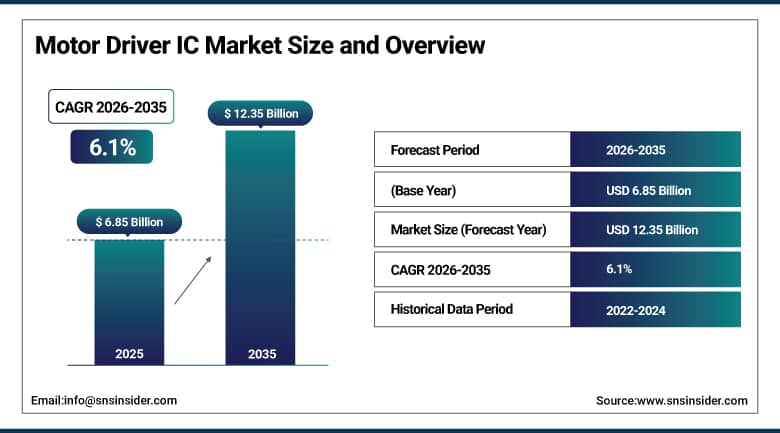
The Motor Driver IC Market size was valued at USD 6.85 Billion in 2025 and is projected to reach USD 12.35 Billion by 2035, registering a CAGR of 6.1% from 2026 to 2035.
Motor Driver IC Market is contributing to the exact control of the speed, torque, and direction of billions of electric motors because of its function of acting as a key interface between the motor winding and control electronics. Market dynamics include an increase in electrification of vehicles resulting in increased use of motors in each vehicle, adoption of brushless DC and servo motors instead of brushed motors, and the use of silicon carbide and gallium nitride-based power semiconductors in applications involving high-voltage inverters. High growth can be seen in industries such as industrial automation, robotics, and smart appliances because of heavy investments made by the automotive Original Equipment Manufacturers (OEMs) and the manufacturing industry in intelligent motor control solutions.
Texas Instruments launched the DRV8214 series of brushed DC motor drivers during the year 2025 that includes current sensing and stall detection capabilities.
To Get More Information On Motor Driver IC Market - Request Free Sample Report
Motor Driver IC Market Trends
-
Growing electrification of vehicles continues increasing motor count per platform, expanding demand for high-voltage traction motor driver ICs.
-
Rising adoption of brushless DC and servo motors continues replacing traditional brushed motor designs across industrial and automotive applications.
-
Increasing integration of silicon carbide power semiconductors continues improving efficiency in high-voltage traction inverter motor driver applications.
-
Expanding industrial automation and robotics deployment continues driving demand for precise, intelligent motor control IC technology.
-
Growing integration of current sensing and functional safety diagnostics continues raising system-level differentiation among motor driver IC vendors.
U.S. Motor Driver IC Market Size Outlook
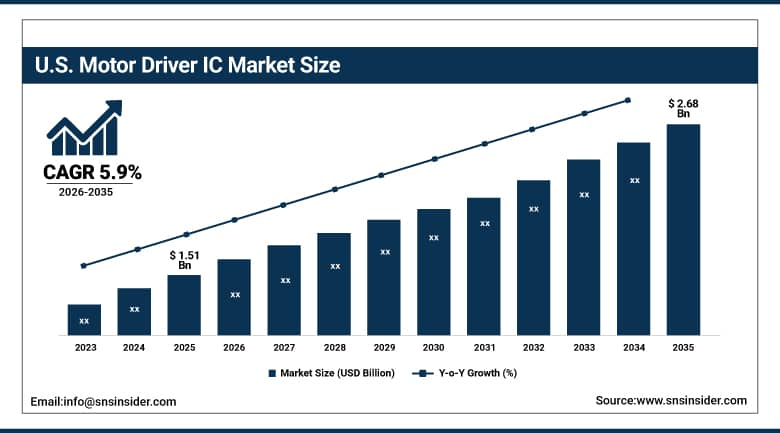
The U.S. Motor Driver IC Market was valued at approximately USD 1.51 Billion in 2025 and is projected to reach approximately USD 2.68 Billion by 2035, registering a CAGR of approximately 5.9% from 2026 to 2035.
The United States demand continued to be shaped by rapid electric vehicle platform electrification, sustained industrial automation and robotics investment, and a deep concentration of leading analog and power semiconductor developers. Rising deployment of silicon carbide and gallium nitride-based motor driver ICs by domestic automotive and industrial customers continued reinforcing the country's position as both a premium-quality hub and a genuine innovation leader for high-voltage motor control technology. Growing adoption across smart appliances, medical devices, and defense applications added further layers of sustained domestic demand well beyond the technology's traditional automotive and industrial use case.
Infineon Technologies expanded its MOTIX motor driver IC portfolio throughout 2025 with new silicon carbide gate driver variants, targeting electric vehicle traction inverter applications requiring high junction temperature tolerance above 175 degrees Celsius.
Motor Driver IC Market Segment Analysis
-
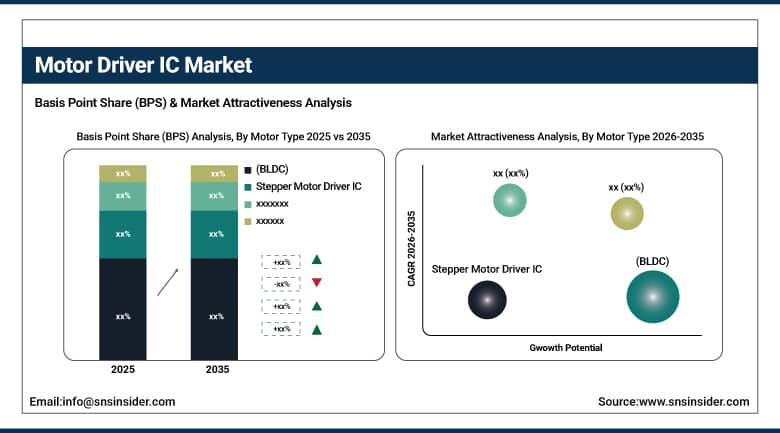
By Motor Type, Brushless DC (BLDC) Driver IC dominated the Motor Driver IC Market with a 45.00% share in 2025, while Stepper Motor Driver IC is the fastest-growing segment with a CAGR of 6.80% from 2026–2035.
-
By Voltage Range, 25V–48V dominated the market with a 47.00% share in 2025, while 49V–240V is the fastest-growing segment with a CAGR of 7.20% from 2026–2035.
-
By Semiconductor Material, Silicon dominated the market with a 78.00% share in 2025, while Silicon Carbide (SiC) is the fastest-growing segment with a CAGR of 8.50% from 2026–2035.
-
By End-Use Industry, Automotive dominated the market with a 41.00% share in 2025, while Industrial Automation & Robotics is the fastest-growing segment with a CAGR of 7.90% from 2026–2035.
By Motor Type, BLDC Leads While Stepper Motor Driver IC Grows Fastest
The Brushless DC (BLDC) Driver IC segment dominated the Motor Driver IC Market in 2025 owing to its superior efficiency, longer operational lifespan, and broad adoption across automotive, industrial, and consumer electronics applications requiring precise speed and torque control. Designers continue favoring BLDC driver ICs for their reduced maintenance requirements relative to brushed alternatives. Continued electrification of vehicles and appliances has kept BLDC driver ICs the largest single revenue contributor within the motor type landscape tracked in this report.
The Stepper Motor Driver IC segment is the fastest growing in the Motor Driver IC Market owing to rising demand for precise positioning control in robotics, 3D printing, and automated warehouse systems requiring fine-grained motion control. Designers increasingly favor stepper motor driver ICs for applications demanding accurate, repeatable positioning without complex feedback systems. Growing automation and robotics investment continues accelerating demand for stepper motor driver IC technology across the industry.
By Voltage Range, 25V-48V Dominates While 49V-240V Records Fastest Growth
The 25V-48V voltage range segment dominated the Motor Driver IC Market in 2025 due to its favorable balance of power handling, efficiency, and cost-effectiveness for robotics, conveyors, HVAC systems, and electric mobility applications. System designers continue relying on this voltage range for its scalability and fine granularity of motion control across industrial automation platforms. Sustained industrial automation and electrified transport investment has kept this voltage tier the largest overall contributor to market revenue.
The 49V-240V segment is the fastest growing in the Motor Driver IC Market owing to rising demand for higher-power motor control in industrial automation and electric vehicle traction applications requiring elevated voltage handling capability. Automotive platforms migrating to 48V and higher architectures increasingly require motor driver ICs qualified for this expanded voltage range. Growing industrial automation and EV traction system investment continues accelerating demand for this voltage segment across the industry.
By Semiconductor Material, Silicon Leads While SiC Grows Fastest
The Silicon segment dominated the Motor Driver IC Market in 2025 due to its established cost-effectiveness, mature manufacturing processes, and broad compatibility with mainstream motor control applications across consumer, industrial, and automotive electronics. Designers continue relying on silicon-based motor driver ICs for their proven reliability and lower cost relative to wide-bandgap alternatives. Sustained mainstream motor driver IC production has kept silicon the largest overall contributor to market revenue.
The Silicon Carbide (SiC) segment is the fastest growing in the Motor Driver IC Market owing to rising demand for high-voltage traction inverter applications requiring superior switching efficiency and junction temperature tolerance above 175 degrees Celsius. Electric vehicle manufacturers increasingly favor SiC-based gate driver ICs to reduce switching losses and improve power density in traction inverters. Accelerating global electric vehicle production continues driving sustained growth in SiC-based motor driver IC demand.
By End-Use Industry, Automotive Leads While Industrial Automation Grows Fastest
The Automotive segment dominated the Motor Driver IC Market in 2025 due to rapid vehicle electrification increasing motor count per platform across power steering, seating, HVAC, and traction applications. Automakers continue prioritizing motor driver IC integration given the segment’s scale and recurring vehicle electrification investment cycles. Sustained global vehicle electrification investment has kept this end-use industry the largest overall revenue contributor across the market.
The Industrial Automation & Robotics segment is the fastest growing in the Motor Driver IC Market owing to rising deployment of automated warehouse systems, collaborative robots, and precision manufacturing equipment requiring sophisticated motor control capability. Equipment manufacturers increasingly demand motor driver ICs supporting fine-grained motion control and functional safety diagnostics. Accelerating global industrial automation investment continues driving sustained growth in this end-use industry segment.
Regional Analysis
|
Region |
Major Country |
Share within Region, 2025 (%) |
|---|---|---|
|
North America |
United States |
85.00% |
|
Europe |
Germany |
25.00% |
|
Asia Pacific |
China |
38.00% |
|
Middle East and Africa |
UAE |
26.00% |
|
Latin America |
Brazil |
29.50% |
Asia Pacific Motor Driver IC Market Insights
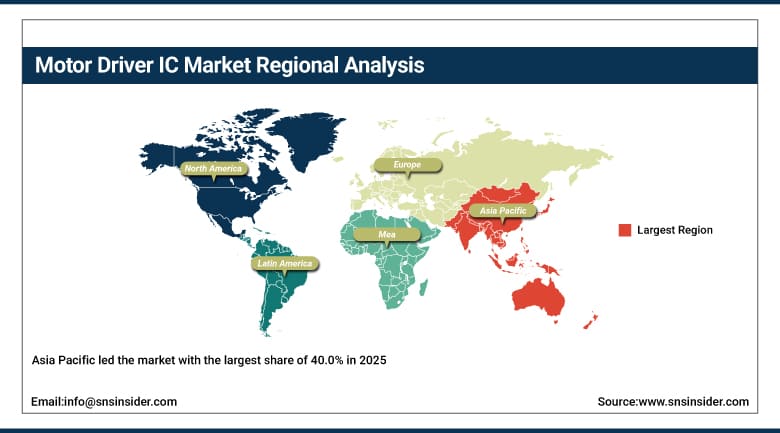
Asia Pacific led the market with the largest share of 40.0% in 2025 and is also advancing at the fastest pace among all regions, registering a CAGR of 7.4% from 2026 to 2035, driven by concentrated electronics and automotive manufacturing capacity, rapid industrial automation adoption, and significant government-backed investment in domestic semiconductor capability across the region’s largest economies. That combination of manufacturing scale and genuine downstream demand across consumer electronics, automotive, and industrial applications kept the region’s growth trajectory well ahead of every other region tracked in this report, with expanding electric vehicle production adding a further, sustained layer of demand.
China led the pack, supported by its substantial domestic electronics and automotive manufacturing base and rapid expansion of industrial automation and electric vehicle production. Japan and South Korea contributed meaningful additional demand, with China’s expanding manufacturing ecosystem and Japan’s advanced motor control technology capability both reinforcing the region’s position as the largest and fastest-growing motor driver IC market tracked in this report.
Get Customized Report as Per Your Business Requirement - Enquiry Now
North America Motor Driver IC Market Insights
Rapid electric vehicle platform electrification, sustained industrial automation and robotics investment, and a deep concentration of leading analog and power semiconductor developers continued reinforcing the region’s strong position. Growing deployment of silicon carbide and gallium nitride-based motor driver ICs across automotive, industrial, and healthcare applications further strengthened North America’s standing as a premium-quality, innovation-driven market tracked in this report, with continued electric vehicle platform investment expected to sustain regional demand through the forecast period.
The United States anchored by its deep concentration of leading analog and power semiconductor developers and substantial electric vehicle and industrial automation investment. Canada added further regional demand through its own growing automotive and industrial manufacturing sectors, and that combined strength kept the continent a resilient, premium-value addressable market for motor driver IC vendors through the forecast period, with continued electric vehicle production expected to sustain regional demand.
Europe Motor Driver IC Market Insights
Europe held a meaningful share of global revenue, supported by strong automotive and industrial automation demand and continued expansion of electric vehicle production capability across the region’s major economies. Regulatory momentum around energy efficiency mandates continued shaping regional product development priorities without meaningfully slowing commercialization across the continent, while sustained automotive electrification investment kept the region among the more resilient motor driver IC markets tracked in this report.
Germany led demand of European revenue, supported by its substantial automotive sector and advanced industrial automation adoption. France and Italy contributed additional demand, and continued European investment in automotive electrification and industrial robotics should keep regional demand for motor driver IC technology climbing steadily through the forecast period.
MEA and Latin America Motor Driver IC Market Insights
The Middle East and Africa and Latin America both showed steady growth, driven by expanding electric vehicle manufacturing investment, growing government focus on industrial diversification, and rising demand for automated manufacturing capability across both regions. As these markets continued building out modern automotive and industrial infrastructure, motor driver IC technology proved a genuinely valuable enabler of increasingly capable, locally assembled vehicles and industrial equipment.
The UAE led Middle East and Africa demand, supported by the country’s growing industrial diversification and electric vehicle manufacturing investment. Saudi Arabia contributed further demand through its own industrial diversification programs. In Latin America, Brazil accounted for the largest share of regional revenue, with growing automotive and industrial manufacturing investment continuing to anchor regional demand for motor driver IC technology.
Market Dynamics
Growth Drivers: Rising Vehicle Electrification and Industrial Automation Investment
The industry is driven by rising electrification of vehicles increasing motor count per platform, growing adoption of brushless DC and servo motors, expanding integration of silicon carbide and gallium nitride power semiconductors, and increasing industrial automation and robotics deployment. As automakers and industrial equipment manufacturers continue prioritizing energy-efficient, intelligent motor control, the need for expanded motor driver IC adoption continues driving sustained investment across the industry.
Rising energy efficiency regulations continue reinforcing this driver, as governments and industry bodies increasingly mandate motor efficiency upgrades across appliances, industrial equipment, and vehicles. Growing robotics and automated warehouse system deployment continues defining a further layer of sustained demand, and that combination of regulatory pressure and automation investment is exactly what keeps overall demand climbing at such a steady, sustained pace.
Restraints: Automotive Qualification Complexity and Thermal Management Challenges
The lengthy and complex automotive qualification process required for motor driver ICs used in safety-critical vehicle applications continues posing a genuine restraint on faster market-wide expansion, particularly for smaller semiconductor suppliers without the qualification resources that established automotive-grade suppliers can commit. That complexity has kept advanced automotive motor driver IC development concentrated among a comparatively small number of well-resourced suppliers.
Ongoing thermal management challenges in high-power motor driver IC applications continue posing a further restraint, as increasing power density requirements push junction temperature limits in compact automotive and industrial form factors. Limited availability of qualified high-temperature packaging solutions in certain deployment scenarios keeps some demanding application qualification processes more administratively complicated than standard motor driver deployment would otherwise require.
Opportunities: Wide-Bandgap Semiconductor Adoption and Smart Appliance Expansion
Rising adoption of silicon carbide and gallium nitride wide-bandgap semiconductors represents a genuinely significant opportunity, as electric vehicle and industrial customers increasingly demand higher efficiency, higher power density motor control solutions beyond traditional silicon capability. Vendors positioned early in wide-bandgap motor driver IC technology stand to capture meaningful share as this capability continues expanding from premium traction inverter applications into broader industrial and consumer use cases.
Expanding smart appliance and connected system adoption offers a second substantial opportunity, as consumer electronics manufacturers increasingly integrate variable-speed motor control and energy optimization capability into next-generation appliances. Vendors with proven, cost-effective motor driver IC technology stand to capture meaningful share as global smart appliance adoption continues scaling across established and emerging consumer markets alike.
Recent Developments:
-
2026: Toshiba began sample shipments of the TB9M040FTG SmartMCD™ device, integrating an MCU, three-phase BLDC motor driver, power MOSFETs, and other control functions for compact automotive motor applications.
-
2026: Toshiba launched the TB67S579FTG next-generation stepper motor driver IC with Advanced Microstep Technology, targeting lower vibration and noise across consumer, commercial, and industrial applications.
-
2024: Allegro MicroSystems launched its A89301 sensorless BLDC motor driver IC, designed for compact industrial automation and robotics applications requiring precise speed and torque control.
Motor Driver IC Companies are:
-
STMicroelectronics N.V.
-
Infineon Technologies AG
-
onsemi (ON Semiconductor Corporation)
-
Renesas Electronics Corporation
-
Toshiba Corporation
-
Microchip Technology Incorporated
-
Analog Devices, Inc.
-
NXP Semiconductors N.V.
-
Allegro MicroSystems, Inc.
-
Monolithic Power Systems, Inc.
-
Diodes Incorporated
-
Melexis NV
-
Sanken Electric Co., Ltd.
-
New Japan Radio Co., Ltd.
-
Vishay Intertechnology, Inc.
-
Semtech Corporation
-
Wolfspeed, Inc.
-
Navitas Semiconductor Corporation
Motor Driver IC Market Report Scope:
| Report Attributes | Details |
|---|---|
| Market Size in 2025 | USD 6.85 Billion |
| Market Size by 2035 | USD 12.35 Billion |
| CAGR | CAGR of 6.1% From 2026 to 2035 |
| Base Year | 2025 |
| Forecast Period | 2026-2035 |
| Historical Data | 2022-2024 |
| Report Scope & Coverage | Market Size, Segments Analysis, Competitive Landscape, Regional Analysis, DROC & SWOT Analysis, Forecast Outlook |
| Key Segments | • By Motor Type (Brushed DC Driver IC, Brushless DC (BLDC) Driver IC, Stepper Motor Driver IC, AC Motor Driver IC), • By Voltage Range (Up to 24V, 25V-48V, 49V-240V, Above 240V), • By Semiconductor Material (Silicon, Silicon Carbide (SiC), Gallium Nitride (GaN)), • By End-Use Industry (Automotive, Industrial Automation & Robotics, Consumer Electronics, Healthcare Equipment, Others) |
| Regional Analysis/Coverage | North America (US, Canada), Europe (Germany, UK, France, Italy, Spain, Russia, Poland, Rest of Europe), Asia Pacific (China, India, Japan, South Korea, Australia, ASEAN Countries, Rest of Asia Pacific), Middle East & Africa (UAE, Saudi Arabia, Qatar, South Africa, Rest of Middle East & Africa), Latin America (Brazil, Argentina, Mexico, Colombia, Rest of Latin America). |
| Company Profiles | Texas Instruments Incorporated, STMicroelectronics N.V., Infineon Technologies AG, onsemi (ON Semiconductor Corporation), Renesas Electronics Corporation, Toshiba Corporation, ROHM Co., Ltd., Microchip Technology Incorporated, Analog Devices, Inc., NXP Semiconductors N.V., Allegro MicroSystems, Inc., Monolithic Power Systems, Inc., Diodes Incorporated, Melexis NV, Sanken Electric Co., Ltd., New Japan Radio Co., Ltd., Vishay Intertechnology, Inc., Semtech Corporation, Wolfspeed, Inc., Navitas Semiconductor Corporation. |

Frequently Asked Questions
Asia Pacific dominated the Motor Driver IC Market in 2025, holding an estimated 40.0% share of total global market revenue.
The major growth factor is rising vehicle electrification, growing industrial automation and robotics adoption, and expanding integration of wide-bandgap power semiconductors.
The Brushless DC (BLDC) Driver IC segment dominated the Motor Driver IC Market by motor type, representing the largest share of revenue in 2025.
Key opportunities include electric vehicles, industrial robotics, smart appliances, automotive automation, BLDC motors, and energy-efficient motor control.
