
According to the latest SNS Insider Organic Electronics Market report, the global market is growing quickly as device makers, panel producers and material suppliers move more products to organic materials. These materials are light and flexible, and they can be made at lower temperatures than silicon. That makes them a good fit for displays, lighting, solar films and wearable devices.
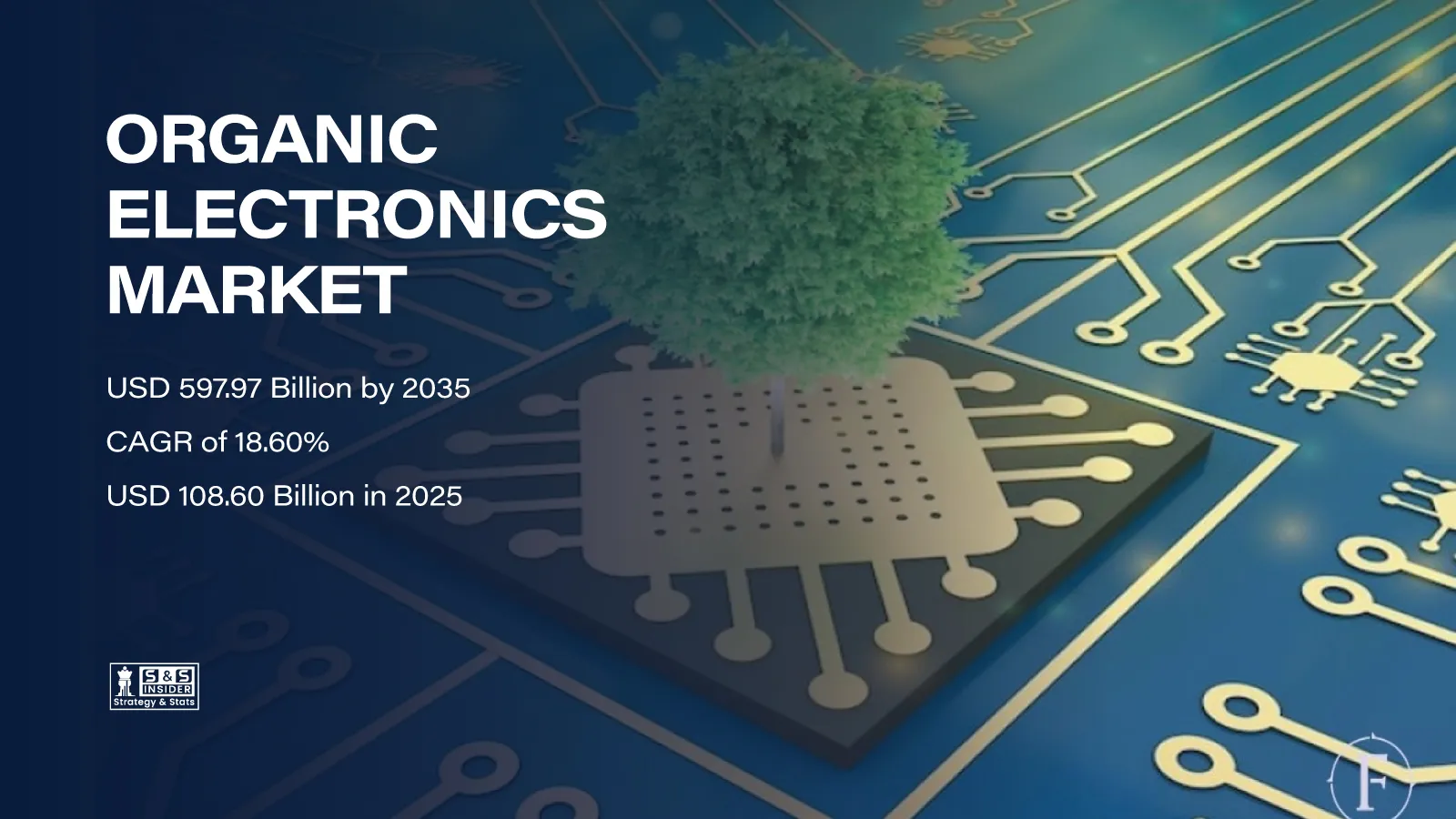
The global organic electronics market was valued at USD 108.60 Billion in 2025 and is estimated at USD 128.80 Billion in 2026. It is projected to reach USD 597.97 Billion by 2035, growing at a CAGR of 18.60% during 2026–2035.
OLED panels are spreading from phones and televisions into laptops, tablets and monitors. Panel makers are building larger production lines to meet this demand, which lowers the cost of each panel over time.
Displays create most of today's demand. Organic solar cells, automotive panels and wearable devices are widening the range of uses. Progress in emitter and charge transport materials keeps improving brightness, efficiency and product life.
Asia Pacific is both the largest regional market and the fastest growing one, supported by large panel production bases in China, South Korea and Japan.
Market Size and Forecast
|
Market Indicator |
Value |
|
Market Size, 2025 |
USD 108.60 Billion |
|
Market Size, 2026 |
USD 128.80 Billion |
|
Market Forecast, 2035 |
USD 597.97 Billion |
|
CAGR, 2026–2035 |
18.60% |
|
Leading Region, 2025 |
Asia Pacific (47.20%) |
|
Fastest-Growing Region |
Asia Pacific (20.70% CAGR) |
Demand Drivers and Constraints
Primary Demand Drivers
-
OLED growth in IT devices: Laptop, tablet and monitor makers are moving to OLED panels for better contrast, thinner designs and lower power use.
-
Foldable and flexible displays: Phones and other devices that bend or fold depend on organic layers that stay intact when flexed.
-
New panel capacity in China: Large new production lines raise output and help bring panel prices down.
-
Automotive and wearable demand: Car dashboards, lighting and smartwatches use organic panels because they can take curved and compact shapes.
-
Materials and research support: New emitter materials, licensing deals and government research funding support better products and wider use of organic solar cells.
Potential Growth Constraints
-
Weak smartphone demand in some years.
-
Excess panel capacity and pressure on prices.
-
Trade friction and long qualification times with customers.
-
Chemical rules and high material costs.
-
Shorter product life for some organic materials compared with inorganic ones.
Demand Structure by Material
Organic Semiconductors (2025 Market Share: 43.50%)
Organic semiconductors accounted for 43.50% of the organic electronics market in 2025. These materials form the active layers in OLED panels, transistors and solar cells. Each new panel line needs a steady supply of high-purity semiconductor materials, so demand follows display output closely. Suppliers keep improving how these materials move charge and how long they last, which helps panels stay bright for longer. As OLED use spreads to more device types through 2035, organic semiconductors are expected to keep the largest share of material demand.
Current trend: Rising use of high-purity semiconductor materials in new OLED production lines.
Major trends: Longer-lasting emitters, higher charge mobility, solution processing, and stable supply agreements.
Conductive Materials (Forecast CAGR: 21.18%)
Conductive materials are projected to grow at the fastest CAGR of 21.18% during 2026–2035. Flexible and printed devices need electrodes and wiring that bend without breaking, and organic conductive polymers meet that need. They are also used in sensors, touch layers and printed circuits. As foldable phones, wearable patches and flexible solar films grow in volume, makers need more of these materials. Printing methods also lower production costs, which opens more uses for conductive materials in low-cost electronics.
Current trend: Growing use of conductive polymers in flexible and printed devices.
Major trends: Transparent electrodes, printed circuits, stretchable conductors, and roll-to-roll production.
Demand Structure by Technology
OLED (2025 Market Share: 57.60%)
OLED held 57.60% of the market in 2025, making it the leading technology. OLED panels give deep blacks, strong color and thin designs, and they are now standard in premium phones and televisions. Panel makers are adding larger production lines for laptops and monitors, which raises total output. Automotive makers are also using OLED for dashboards and lighting. These shifts keep OLED at the center of the organic electronics market through the forecast period.
Current trend: Expansion of OLED from phones into IT devices and vehicles.
Major trends: Gen 8.6 production lines, tandem OLED structures, foldable panels, and phosphorescent emitters.
OPV (Forecast CAGR: 21.92%)
Organic photovoltaics are expected to grow at a CAGR of 21.92% through 2035. OPV films are light and flexible and can be fixed to walls, windows and curved surfaces where rigid panels do not fit. Building owners and factories are testing them as a way to add solar power without heavy mounting. Product certifications are opening new markets for these films. As efficiency improves and costs fall, more building and industrial users are expected to adopt them.
Current trend: Growing use of lightweight solar films on buildings and industrial sites.
Major trends: Building-integrated solar, printed modules, product certification, and higher conversion efficiency.
Demand Structure by Application
Displays (2025 Market Share: 62.40%)
Displays represented 62.40% of the organic electronics market in 2025. Phones, televisions, laptops, monitors and watches all use organic display panels, and unit volumes are very large. Each new device generation adds features such as higher refresh rates and foldable screens, which raise the value of each panel. Panel makers in Asia keep adding capacity to serve global brands. Displays are expected to remain the main source of revenue as OLED spreads across more device sizes.
Current trend: Rising OLED adoption across mid-size and large IT screens.
Major trends: Foldable screens, high refresh rates, low-power panels, and larger panel sizes.
Solar Cells (Forecast CAGR: 22.14%)
Solar cells are projected to grow at the fastest application CAGR of 22.14% during 2026–2035. Organic solar films can be printed on thin, flexible sheets and installed on surfaces that cannot carry heavy panels. This makes them useful for factory walls, building facades, vehicles and portable devices. Government research funding and clean energy goals support early projects. As production scales and efficiency improves, solar cells are expected to become a larger share of organic electronics demand.
Current trend: Early commercial installations of organic solar films on industrial buildings.
Major trends: Flexible solar modules, building facades, indoor energy harvesting, and printed production.
Demand Structure by End User
Consumer Electronics (2025 Market Share: 49.80%)
Consumer electronics accounted for 49.80% of global market revenue in 2025, making it the largest end-user group. Phones, televisions, tablets, laptops and wearables use organic panels and components in large numbers. Brands use OLED screens to set premium models apart, and they are now bringing the same technology to mid-range devices. Replacement cycles create steady demand each year. Growth in foldable phones and OLED laptops is expected to keep this group in the lead.
Current trend: Wider use of OLED screens in mid-range phones and laptops.
Major trends: Foldable devices, thinner designs, longer battery life, and premium display features.
Automotive (Forecast CAGR: 21.76%)
Automotive is projected to grow at the fastest end-user CAGR of 21.76% through 2035. Carmakers are adding larger and curved displays to dashboards and center consoles, and organic panels fit these shapes well. OLED tail lights and interior lighting give designers more freedom. Electric vehicles add more screens and digital controls, which raises demand for each car. Organic solar films are also being tested on vehicles and plants. These uses are expected to make automotive a key growth area.
Current trend: Rising use of curved OLED displays and lighting in new vehicles.
Major trends: Curved dashboards, OLED tail lights, pillar-to-pillar screens, and vehicle-integrated solar.
Key Market Participants
The organic electronics market includes display panel makers, organic material suppliers and organic solar module producers.
Key participants include Samsung Display, LG Display, BOE Technology, Universal Display, Merck KGaA and Heliatek.
Competition centers on production scale, panel yields, material performance and patent strength. Companies that can lower panel costs, secure long-term material supply and serve new uses such as vehicles and solar films are in a good position as demand widens.
Regional Market Dynamics
Asia Pacific (2025 Market Share: 47.20%; Forecast CAGR: 20.70%)
Asia Pacific led the global organic electronics market with a 47.20% share in 2025 and is expected to grow the fastest, at a CAGR of 20.70% through 2035. China leads the region with a 41.80% share, supported by large new OLED production lines and strong local demand for phones. South Korea is home to leading panel makers and advanced material research. Japan, Taiwan and India add demand through electronics manufacturing and rising device sales.
Direction: Continued leadership and fastest growth supported by new panel capacity and large device production.
North America (2025 Market Share: 25.80%)
North America held a 25.80% share of the market in 2025. The United States accounts for 80.50% of the region, with a market value of USD 22.56 Billion in 2025 and a projected CAGR of 17.20%. Demand comes from consumer electronics brands, automotive makers and material licensing companies. Research programs in organic solar and printed electronics add further activity. New product certifications are also opening the region to organic solar films.
Direction: Steady growth supported by device demand, material innovation and early solar adoption.
Europe (Third-Largest Regional Market: 18.90%)
Europe held an 18.90% share in 2025, making it the third-largest regional market. Germany leads the region with a 34.60% share, supported by strong automotive demand, chemical makers and organic solar producers. The United Kingdom, France and the Netherlands add demand through research and specialty manufacturing. Strict chemical rules raise compliance costs, but they also push suppliers toward safer and more efficient materials.
Direction: Moderate growth driven by automotive use, material research and building-integrated solar.
Middle East & Africa
The Middle East and Africa held a 4.60% share in 2025. Saudi Arabia leads the region with a 29.40% share, supported by rising device imports, smart city projects and interest in new solar technologies. Gulf countries are testing lightweight solar films for buildings in hot climates. Other markets in the region remain small and depend mostly on imported consumer electronics.
Direction: Early-stage growth supported by device demand and clean energy programs.
Latin America
Latin America is a smaller but developing market for organic electronics. Brazil leads the region with a 48.30% share, supported by large consumer electronics sales and local device assembly. Mexico adds demand through electronics and automotive manufacturing linked to North American supply chains. Price sensitivity and reliance on imports limit faster uptake, but growing OLED use in mid-range phones is widening demand.
Direction: Gradual growth supported by consumer device sales and regional manufacturing.
Market Outlook (2026–2035)
The global organic electronics market is forecast to reach USD 597.97 Billion by 2035, reflecting steady investment in panel capacity and new materials.
OLED adoption in IT devices, flexible displays and new production lines in Asia will remain the main growth drivers. Automotive and solar uses are expected to gain importance over the forecast period.
Progress in conductive materials and organic solar films will widen demand beyond consumer screens into buildings, vehicles and industrial sites.
Asia Pacific will remain the center of production and growth, while North America and Europe will contribute through device demand, material research and automotive use.
Overall, the organic electronics market is set for strong growth through 2035. Success will depend more and more on production scale, panel yields, material performance and the ability to serve new uses such as vehicles and solar films.



