
AI Network Fabric Market Report Scope & Overview:
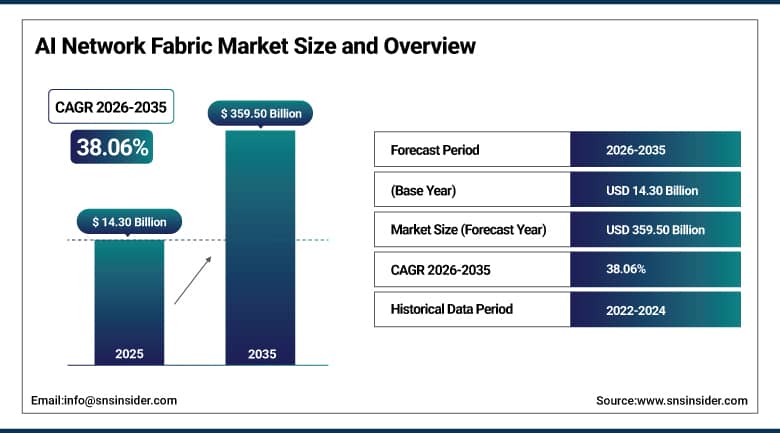
The AI Network Fabric Market size was valued at USD 14.30 Billion in 2025 and is expected to reach USD 359.50 Billion by 2035, growing at a CAGR of 38.06% from 2026–2035.
The AI network fabric market is experiencing consistent growth due to the growing need for high-speed, low-latency, and scalable networking solutions for AI and high-performance computing workloads. The increasing adoption of artificial intelligence, generative AI, large language models, and accelerated computing across enterprises and cloud environments has led to rising demand for AI network fabrics and thereby supported market growth. Investments in advanced networking technologies such as Ethernet-based AI fabrics, InfiniBand, NVLink / NVSwitch, and emerging UALink solutions have increased the efficiency of data transfer between GPUs, CPUs, storage systems, and other computing resources. The focus of companies has been on high bandwidth, low latency, scalability, network optimization, and efficient resource utilization.
In July 2026, NVIDIA introduced Spectrum-6 Ethernet switching for gigascale AI factories. The 102.4-terabit-per-second switch system is designed to connect very large GPU clusters and support AI trainings and other compute-intensive workloads, reinforcing the shift toward high-bandwidth Ethernet-based AI fabrics.
To Get More Information On AI Network Fabric Market - Request Free Sample Report
AI Network Fabric Market Trends
-
Growing adoption of AI technologies is driving demand for advanced AI network fabrics that enable high-speed data transfer and efficient communication between GPUs, CPUs, storage systems, and other computing resources.
-
Rising deployment of generative AI, large language models, and accelerated computing is increasing demand for high-bandwidth, low-latency networking solutions, supporting the adoption of AI network fabric technologies.
-
Increasing demand for scalable AI infrastructure across hyperscalers, cloud service providers, enterprises, and research institutions is supporting the growth of specialized AI networking solutions.
-
Growing focus on improving network performance, bandwidth utilization, scalability, latency, and resource efficiency is creating opportunities for AI network fabric manufacturers and technology providers.
-
Advancements in Ethernet-based AI fabrics, InfiniBand, NVLink / NVSwitch, UALink, high-performance switches, optical interconnects, DPUs / SmartNICs, and network management software are improving networking performance and supporting market adoption.
U.S. AI Network Fabric Market Size Outlook
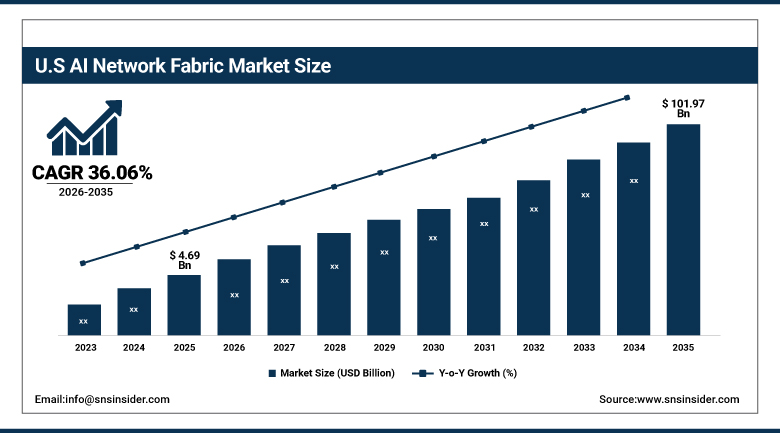
The U.S. AI Network Fabric Market was valued at USD 4.69 Billion in 2025 and is expected to reach around USD 101.97 Billion by 2035, growing at a CAGR of 36.06% from 2026–2035.
The U.S. market for AI network fabric is growing at a stable rate due to increasing demand for advanced networking technologies that support AI workloads, accelerated computing, and high-performance data center infrastructure. The growing adoption of artificial intelligence, generative AI, large language models, and GPU-intensive applications is increasing the need for high-speed, low-latency, and scalable networking solutions. More investments are being made in advanced AI infrastructure, Ethernet-based AI fabrics, InfiniBand, NVLink / NVSwitch, and emerging UALink technologies to improve data transfer speeds, network efficiency, and resource utilization. The expansion of AI data centers and cloud computing infrastructure in the country is expected to drive demand for AI network fabric solutions.
n August 2026, Ciena reported that 90% of surveyed service providers expect high-capacity AI-driven network services to be a primary revenue-growth driver over the next three to five years. The company also found that 88% of respondents see an urgent need for optical-network upgrades to support enterprise AI connectivity, highlighting rising demand for high-capacity networking infrastructure for distributed AI workloads.
AI Network Fabric Market Segment Analysis
-
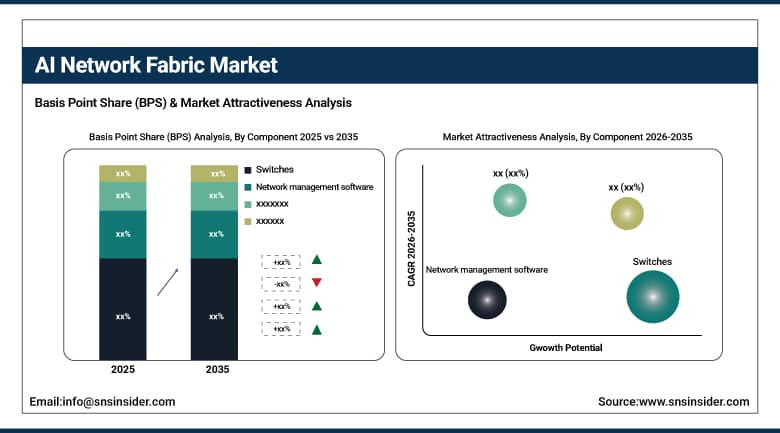
By Component, switches dominated the AI network fabric market with a 31.47% share in 2025, while network management software is projected to be the fastest-growing segment, registering a 43.64% CAGR during 2026–2035.
-
By Fabric Technology, ethernet-based AI fabric dominated the AI network fabric market with a 34.28% share in 2025, while uplinks-based fabric is projected to be the fastest-growing segment, registering a 48.36% CAGR during 2026–2035.
-
By Fabric Type, scale-out fabric dominated the AI network fabric market with a 37.84% share in 2025, while scale-up fabric is projected to be the fastest-growing segment, registering a 41.40% CAGR during 2026–2035.
-
By Workload, AI trainings dominated the AI network fabric market with a 35.26% share in 2025, while AI inference is projected to be the fastest-growing segment, registering a 43.33% CAGR during 2026–2035.
-
By End User, hyperscalers & cloud service providers dominated the AI network fabric market with a 38.74% share in 2025, while large enterprises are projected to be the fastest-growing segment, registering a 44.33% CAGR during 2026–2035.
By Component, switches dominated the AI network fabric market, while network management software is expected to grow fastest.
Switches held the dominant position in the AI network fabric market in 2025 due to their critical role in providing high-speed connectivity and efficient data transfer across AI computing infrastructure. The increasing deployment of GPU clusters, AI servers, and high-performance data centers is driving demand for advanced network switches capable of handling high bandwidth, low latency, and intensive east-west traffic. The growing adoption of Ethernet-based AI fabrics and the expansion of hyperscale AI infrastructure are further supporting the demand for high-performance switches
Network management software is anticipated to grow with the highest CAGR during the forecast period of 2026 to 2035. The rapid expansion and increasing complexity of AI networks are creating a greater need for software solutions that provide network monitoring, traffic optimization, performance management, automation, and real-time visibility. As AI clusters become larger and more distributed, network management software can help organizations optimize bandwidth utilization, identify bottlenecks, manage network resources, and maintain reliable communication between computing resources.
By Fabric Technology, ethernet-based AI fabric dominated the AI network fabric market, while uplink-based fabric is expected to grow fastest.
Ethernet-based AI fabric held the dominant position in the AI network fabric market in 2025 due to its widespread deployment, established ecosystem, scalability, and compatibility with existing data center infrastructure. The increasing adoption of AI workloads across hyperscalers, cloud service providers, and enterprises is supporting demand for Ethernet-based networking solutions that can provide high bandwidth and efficient connectivity across large-scale computing environments.
Uplink-based fabric is anticipated to grow with the highest CAGR during the forecast period of 2026 to 2035. The increasing demand for open and scalable interconnect technologies is supporting the development of UALink-based architectures for connecting accelerators and enabling efficient communication within AI computing systems. As AI workloads become increasingly distributed across multiple accelerators, the need for high-bandwidth and low-latency scale-up connectivity is expected to increase.
By Fabric Type, scale-out fabric dominated the AI network fabric market, while scale-up fabric is expected to grow fastest.
Scale-out fabric held the dominant position in the AI network fabric market in 2025 due to its importance in connecting large numbers of GPUs, servers, and other computing resources across AI clusters. The increasing deployment of large-scale AI training infrastructure requires networking architectures that can efficiently connect growing numbers of computing nodes while maintaining high bandwidth and low latency. The expansion of hyperscale data centers and AI computing clusters is therefore supporting demand for scale-out fabric solutions.
Scale-up fabric is anticipated to grow with the highest CAGR during the forecast period of 2026 to 2035. The growing need for faster communication between accelerators within individual AI computing systems is increasing demand for high-performance scale-up architectures. AI models are becoming larger and more computationally intensive, requiring efficient communication between GPUs and other accelerators to reduce data-transfer bottlenecks and improve overall processing performance.
Regional Insights
|
Region |
Major Country |
Share within Region, 2025(%) |
|---|---|---|
|
North America |
United States |
82.40% |
|
Europe |
Germany |
34.30% |
|
Asia Pacific |
China |
48.54% |
|
Middle East & Africa |
Saudi Arabia |
23.50% |
|
Latin America |
Brazil |
23.00% |
North America AI Network Fabric Market Insights
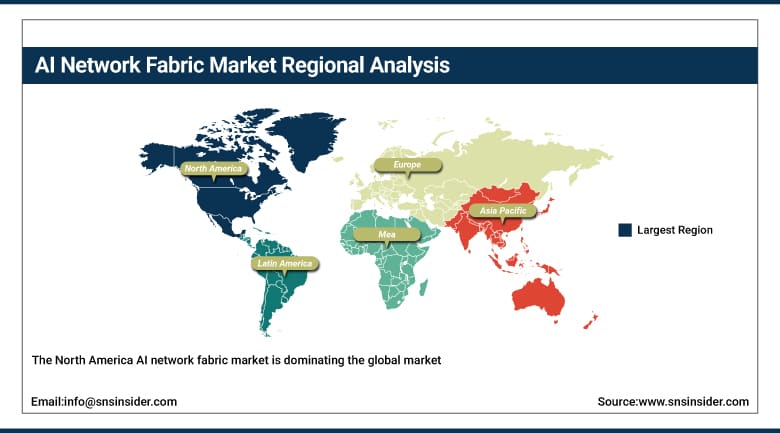
The North America AI network fabric market is dominating the global market and is expected to maintains its leading position during 2026–2035, driven by increasing demand for high-speed, low-latency networking infrastructure for AI workloads, generative AI applications, large language models, accelerated computing, and high-performance data centers. North America dominated the AI network fabric market in 2025, accounting for a 39.84% market share, and is expected to retrain its leading position throughout the forecast period. The region is benefiting from significant investments in AI infrastructure, hyperscale data centers, GPU clusters, advanced Ethernet networking, InfiniBand, optical interconnects, and network management technologies that support efficient communication between GPUs, CPUs, storage systems, and other computing resources.
The United States is expected to dominate the regional market of the North America market share in 2025. The country's dominance is supported by strong technology infrastructure, widespread deployment of hyperscale and cloud data centers, increasing adoption of AI and generative AI, and substantial investments in GPU-based computing and high-performance networking solutions.
Get Customized Report as Per Your Business Requirement - Enquiry Now
Europe AI Network Fabric Market Insights
The Europe AI network fabric market will experience stable growth over the forecast period due to increasing adoption of artificial intelligence, expansion of cloud and data center infrastructure, growing demand for high-performance computing, and investments in advanced networking technologies. Increasing deployment of AI workloads across enterprises, research institutions, cloud service providers, and industrial organizations is driving demand for high-bandwidth and low-latency AI network fabrics. Increased attention to data center modernization, energy-efficient computing, and scalable AI infrastructure is also supporting demand for advanced switches, network adapters, optical transceivers, and AI networking solutions.
Asia Pacific AI Network Fabric Market Insights
The Asia Pacific AI network fabric market is the fastest-growing region and is expected to register strong growth with CAGR 43.04% during 2026–2035, supported by rapid AI adoption, expansion of data center infrastructure, increasing deployment of generative AI and large language models, and growing investments in high-performance computing. The region is also benefiting from the expansion of cloud infrastructure, hyperscale data centers, semiconductor and electronics industries, and advanced networking technologies required to support increasingly intensive AI workloads.
China will continue to be a major market in the Asia Pacific region due to its large technology ecosystem, extensive adoption of AI and cloud platforms, expanding data center infrastructure, and growing investments in high-performance computing and AI networking. Japan and South Korea will continue to play significant roles due to their established technology, electronics, semiconductor, telecommunications, and industrial sectors, while
Middle East & Africa and Latin America AI Network Fabric Market Insights
There will be consistent growth within the AI network fabric markets in the Middle East & Africa and Latin America from 2026 to 2035, driven by increasing AI adoption, cloud computing, data center development, digital transformation, and investments in advanced computing infrastructure. There will be increasing opportunities in these regions for high-speed networking technologies, AI-optimized Ethernet fabrics, switches, optical connectivity, network adapters, and network management solutions as organizations expand their AI and data-intensive computing capabilities.
Saudi Arabia will continue to be an important market in the Middle East & Africa, due to investments in artificial intelligence, cloud infrastructure, digital transformation, smart cities, data centers, and economic diversification initiatives. In Latin America, Brazil will continue to be an important country-level market due to its large enterprise sector, expanding digital economy, cloud adoption, data center investments, and growing deployment of AI technologies
Market Dynamics
Growth Driver: Increasing demand for high-performance AI infrastructure and scalable networking is driving market growth
One of the driving forces behind the rise in the global AI network fabric market is the growing need for high-performance networking infrastructure to support increasingly intensive AI workloads. The rapid adoption of artificial intelligence, generative AI, large language models, and accelerated computing has increased the demand for high-speed, low-latency, and scalable connectivity between GPUs, CPUs, storage systems, and other computing resources. As AI models and computing clusters continue to increase in size and complexity, efficient network fabrics are becoming essential for maintaining data transfer performance and minimizing communication bottlenecks.
In addition, developments in Ethernet-based AI fabrics, InfiniBand, NVLink / NVSwitch, UALink, high-performance switches, optical interconnects, and network management software are driving the growth of the market. Investments in hyperscale data centers, AI infrastructure, cloud computing, and high-performance computing are encouraging the adoption of advanced AI network fabric solutions.
Restrain: High infrastructure costs and complex network architectures can limit market adoption
The high cost and complexity associated with deploying advanced AI network fabric infrastructure pose challenges to market adoption. AI-optimized networking environments require high-performance switches, network adapters / NICs, optical transceivers, network processors / ASICs, DPUs / SmartNICs, and specialized network management software, which can increase the overall cost of deployment and infrastructure upgrades.
Moreover, the integration and management of high-speed AI networks require specialized technical expertise and sophisticated network architectures. Organizations may face challenges related to network compatibility, interoperability, scalability, bandwidth management, latency optimization, and infrastructure upgrades. The high initial investment, complexity of deployment, and shortage of skilled professionals can create barriers, particularly for smaller enterprises and organizations with limited IT infrastructure budgets.
Opportunity: Growing adoption of generative AI and AI data centers creates new market opportunities
The proliferation of generative AI, large language models, and accelerated computing presents substantial opportunities for manufacturers and technology providers in the AI network fabric market. As organizations deploy increasingly large GPU clusters and AI computing systems, the demand for high-bandwidth, low-latency networking solutions is increasing. Advanced AI network fabrics can enable efficient communication between GPUs and other computing resources, improving data transfer performance and supporting the scalability of AI workloads.
Further, the expansion of hyperscale data centers, AI cloud infrastructure, GPU-as-a-Service platforms, and high-performance computing facilities presents opportunities for the development of advanced networking technologies. In addition, increasing investments in Ethernet-based AI fabrics, UALink, optical connectivity, DPUs / SmartNICs, and network management solutions provide further opportunities for AI network fabric providers to develop scalable, efficient, and AI-optimized networking solutions.
Recent Developments
-
2026: NVIDIA introduced Spectrum-6, a 102.4-terabit-per-second Ethernet switch system designed for gigascale AI factories, supporting the connectivity of hundreds of thousands of GPUs and CPUs for large-scale AI training, inference, and agentic AI workloads.
-
2026: Broadcom expanded its AI infrastructure portfolio with advanced Ethernet switches, 800G AI NICs, optical connectivity, SerDes, and PCIe technologies designed to support scale-up, scale-out, and scale-across AI networks, strengthening its position in high-performance AI networking.
-
2026: Arista Networks introduced its 7060XE7 Series, a next-generation 1.6-terabit networking platform designed for rack-scale AI infrastructure and optimized for scale-up and scale-out AI fabrics. The portfolio is designed to address the increasing bandwidth, power, and thermal requirements of large-scale AI clusters.
-
2026: NVIDIA advanced its NVLink networking technology with sixth-generation NVLink and NVLink 6 Switch, providing high-bandwidth, low-latency scale-up connectivity for large GPU-based AI systems and supporting AI factories with increasingly intensive computing requirements. (developer.nvidia.com)
AI Network Fabric Companies are:
-
NVIDIA Corporation
-
Broadcom Inc.
-
Cisco Systems, Inc.
-
Marvell Technology, Inc.
-
Hewlett Packard Enterprise Company
-
Dell Technologies Inc.
-
Huawei Technologies Co., Ltd.
-
Intel Corporation
-
Juniper Networks, Inc.
-
Super Micro Computer, Inc.
-
Astera Labs, Inc.
-
Credo Technology Group Holding Ltd.
-
Coherent Corp.
-
Lumentum Holdings Inc.
-
Ciena Corporation
-
Nokia Corporation
-
Ericsson AB
-
Lenovo Group Limited.
AI Network Fabric Market Report Scope:
| Report Attributes | Details |
|---|---|
| Market Size in 2025 | USD 14.30 Billion |
| Market Size by 2035 | USD 359.50 Billion |
| CAGR | CAGR of 38.06% From 2026 to 2035 |
| Base Year | 2025 |
| Forecast Period | 2026-2035 |
| Historical Data | 2022-2024 |
| Report Scope & Coverage | Market Size, Segments Analysis, Competitive Landscape, Regional Analysis, DROC & SWOT Analysis, Forecast Outlook |
| Key Segments | • By Component (Switches, Network adapters / NICs, Optical transceivers & cables, Network processors / ASICs, DPUs / SmartNICs, Network management software) • By Fabric Technology (Ethernet-based AI fabric, InfiniBand-based AI fabric, NVLink / NVSwitch-based fabric, UALink-based fabric, Other emerging fabrics) • By Fabric Type (Scale-out fabric, Scale-up fabric, Front-end fabric, GPU backend fabric, Storage backend fabric) • By Workload (AI training, AI inference, Model fine-tuning, Generative AI / LLM workloads, High-performance computing (HPC), Other AI workloads) • By End User (Hyperscalers & Cloud Service Providers, AI Cloud / GPU-as-a-Service Providers, Large Enterprises, Government & Defense, Research & Academic Institutions, Colocation Providers) |
| Regional Analysis/Coverage | North America (US, Canada), Europe (Germany, UK, France, Italy, Spain, Russia, Poland, Rest of Europe), Asia Pacific (China, India, Japan, South Korea, Australia, ASEAN Countries, Rest of Asia Pacific), Middle East & Africa (UAE, Saudi Arabia, Qatar, South Africa, Rest of Middle East & Africa), Latin America (Brazil, Argentina, Mexico, Colombia, Rest of Latin America) |

Frequently Asked Questions
The AI Network Fabric Market is expected to grow at a CAGR of 38.06% from 2026 to 2035.
The AI Network Fabric Market was valued at approximately USD 14.30 billion in 2025.
The market is primarily driven by the increasing adoption of artificial intelligence, generative AI, large language models, accelerated computing, expansion of AI data centers, growing demand for high-bandwidth and low-latency networking, and increasing investments in advanced AI infrastructure.
Switches dominated the AI Network Fabric Market in 2025, accounting for a 31.47% share.
North America dominated the AI Network Fabric Market in 2025, accounting for a 39.84% share.
