
AI Radio Access Network Optimization Market Report Scope & Overview:
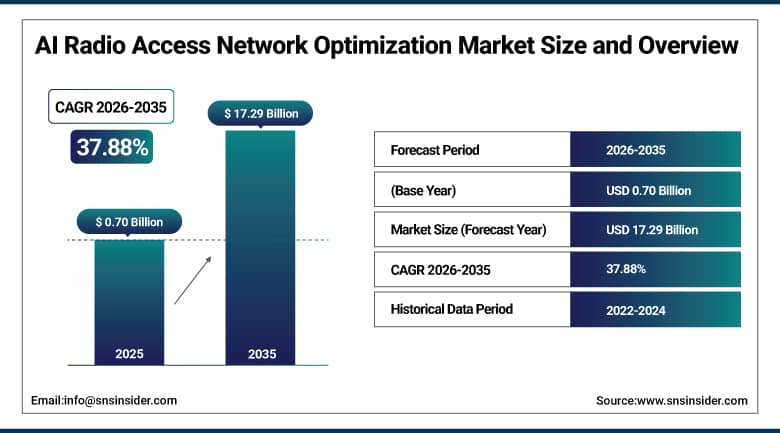
The AI Radio Access Network Optimization Market was valued at USD 0.70 billion in 2025 and is expected to reach USD 17.29 billion by 2035, growing at a CAGR of 37.88% from 2026-2035.
The AI Radio Access Network Optimization Market is experiencing rapid growth due to the increasing complexity of networks, the rise in mobile data traffic, and the requirement for intelligent and automated management of network performance. Telecom companies are increasingly opting for AI-powered optimization tools to optimize resource allocation, traffic management, network capacity, and quality of services in real time. The rising deployment of 5G technology, open radio access network, edge computing, and cloud-native network architecture is expected to increase the demand for sophisticated RAN optimization solutions. In addition, developments in the domain of artificial intelligence, machine learning, predictive analytics, and automation are making it possible for operators to detect faults proactively, optimize energy consumption, and predict maintenance needs.
NIST states that next-generation RANs involve disaggregated network elements and increased complexity, creating a need for intelligent controllers and automated solutions based on machine learning.
To Get More Information On AI Radio Access Network Optimization Market - Request Free Sample Report
AI Radio Access Network Optimization Market Trends
-
Rising 5G and 5G-Advanced deployment is driving demand for AI-based RAN optimization to improve network performance, capacity, and resource efficiency.
-
Increasing network complexity is accelerating adoption of AI-driven traffic management, load balancing, predictive maintenance, and automated resource allocation across RAN environments.
-
Growing adoption of Open RAN and RAN Intelligent Controllers is enabling programmable, near-real-time optimization through AI-powered applications and interfaces.
-
Rising focus on energy efficiency is encouraging AI-based optimization of radio resources, network configurations, and power consumption across cellular infrastructure.
U.S. AI Radio Access Network Optimization Market Outlook
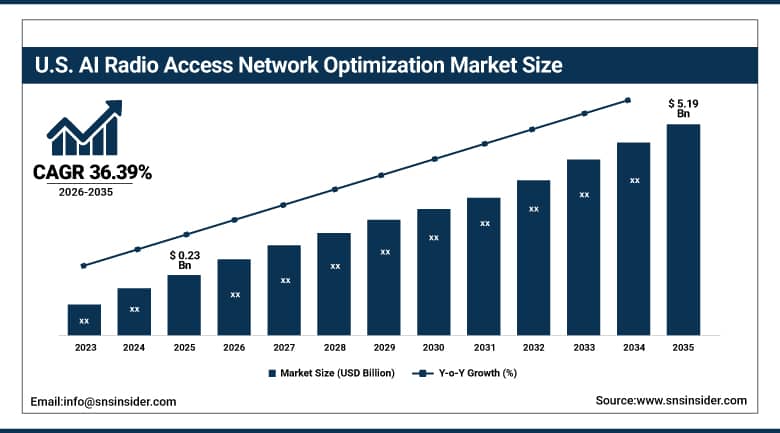
The U.S. AI Radio Access Network Optimization Market was valued at USD 0.23 billion in 2025 and is expected to reach USD 5.19 billion by 2035, growing at a CAGR of 36.39% from 2026-2035.
The U.S. AI Radio Access Network Optimization Market is experiencing tremendous growth owing to factors like growing network complexity, high mobile traffic volumes, and increasing demand for intelligence and automated network performance management. Telecom companies are using AI-powered RAN optimization techniques in order to enhance resource utilization, traffic management, capacity and services quality in real-time. Moreover, the deployment of 5G, Open RAN, edge computing, and cloud native network architecture is adding more demand for optimization techniques. In addition to this, advances in areas of AI, machine learning, predictive analytics, and network automation are making it possible to proactively detect faults, optimize energy usage, and predict maintenance needs. The need to optimize network operation, cut down on cost, optimize energy use, and offer low latency connectivity is further boosting the adoption of AI-powered RAN optimization solutions in the US.
NTIA announced in March 2026 that its Public Wireless Supply Chain Innovation Fund would shift toward U.S.-based AI-native network architecture and develop a funding opportunity focused on integrating AI into RANs.
AI Radio Access Network Optimization Market Segment Analysis
-
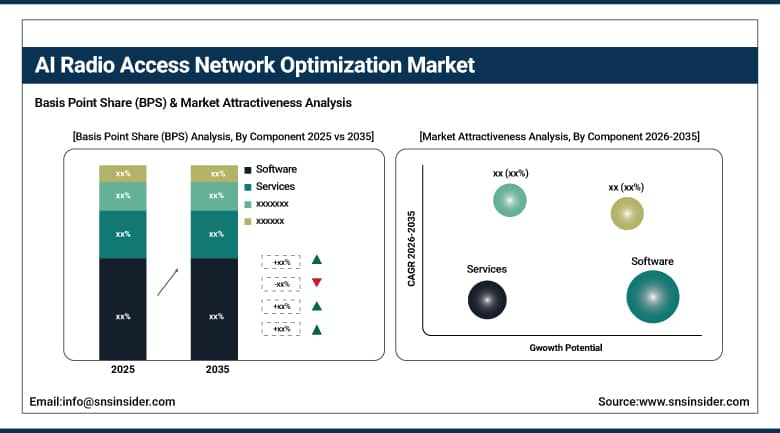
By Component, Software dominates the AI Radio Access Network Optimization Market with 48% share in 2025; Services are expected to grow at the fastest CAGR of 40.58% from 2026–2035.
-
By Deployment Mode, Cloud dominates the AI Radio Access Network Optimization Market with 62% share in 2025; Cloud is expected to grow at the fastest CAGR of 38.49% from 2026–2035.
-
By Application, Performance Management dominates the AI Radio Access Network Optimization Market with 29% share in 2025; Energy Optimization is expected to grow at the fastest CAGR of 40.99% from 2026–2035.
-
By Network Type, 5G dominates the AI Radio Access Network Optimization Market with 59% share in 2025; 5G is expected to grow at the fastest CAGR of 40.16% from 2026–2035.
-
By End-User, Telecom Operators dominate the AI Radio Access Network Optimization Market with 76% share in 2025; Enterprises are expected to grow at the fastest CAGR of 41.15% from 2026–2035.
By Component, Software dominates the AI Radio Access Network Optimization Market, Services grow fastest.
The Software segment dominated the AI Radio Access Network Optimization Market with the highest revenue share of about 48% in 2025, motivated by the growing usage of AI-based analysis, automation, and intelligent networking management. Software helps in real-time performance monitoring, traffic optimization, predictive analysis, and automation, thus assisting telecom operators in making their networks more efficient and less complicated to manage.
The Services segment is expected to grow at the fastest CAGR of 40.58% from 2026–2035, Backed by the growing demand for consulting, implementation, integration, customization, and optimization management services. The telecom companies will need specific skills to implement the AI-driven optimization tools, as well as integrate them with the existing infrastructure and enhance its efficiency.
By Deployment Mode, Cloud dominates the AI Radio Access Network Optimization Market, Cloud grows fastest.
The Cloud segment dominated the AI Radio Access Network Optimization Market with the highest revenue share of about 62% in 2025, due to the fact that it is scalable, flexible, and allows centralized AI-based management of the network. With cloud deployment, operators can analyze high amounts of data generated by the network, optimize resources, and manage geographically distributed radio access network.
The Cloud segment is expected to grow at the fastest CAGR of 38.49% from 2026–2035, fueled by increasing uptake of cloud native networks and rising need for scalable AI optimizations. Cloud technology provides flexibility in computing power, quick software deployment, centralized analysis, and infrastructure scalability in a cost-effective way. Increasing uptake of virtualized RAN, Open RAN, edge-cloud integration, and automation of network operations also aids cloud-based optimizations.
By Application, Performance Management dominates the AI Radio Access Network Optimization Market, Energy Optimization grows fastest.
The Performance Management segment dominated the AI Radio Access Network Optimization Market with the highest revenue share of about 29% in 2025, motivated by rising need for constant monitoring and optimization of performance of the network. The use of AI technology for performance management assists the operator in detecting problems within the network, optimizing traffic, predicting problems, improving quality of service, and efficient utilization of network resources.
The Energy Optimization segment is expected to grow at the fastest CAGR of 40.99% from 2026–2035, due to increasing demands for lowering the energy consumption of the network. The use of AI technology allows power management to be done dynamically through optimization of the use of network resources based on traffic. This is done by switching the infrastructure to power-saving mode.
By Network Type, 5G dominates the AI Radio Access Network Optimization Market, 5G grows fastest.
The 5G segment dominated the AI Radio Access Network Optimization Market with the highest revenue share of about 59% in 2025, Enabled by the deployment of fast 5G networks and growing network complexity. The 5G networks produce vast amounts of operational data that needs to be intelligently optimized for efficient traffic management, resource allocation, interference, and quality management, leading to the demand for AI-based RAN optimization technologies.
The 5G segment is expected to grow at the fastest CAGR of 40.16% from 2026–2035, due to ongoing expansion of 5G across the globe, densification of networks, and increase in the need for high-speed connectivity. AI-based optimization supports resource management, predictive maintenance, traffic management, and energy efficiency. With increasing use of private 5G, IoT, and advanced applications, optimization needs continue to grow.
By End User, Telecom Operators dominate the AI Radio Access Network Optimization Market, Enterprises grow fastest.
The Telecom Operators segment dominated the AI Radio Access Network Optimization Market with the highest revenue share of about 76% in 2025, Due to their well-established infrastructure, wide subscriber base, and constant need to improve the performance of the network. Operators implement AI to enable the automation of network management and to enhance service quality, lower operating expenses, optimize capacity, and effectively manage 5G deployment.
The Enterprises segment is expected to grow at the fastest CAGR of 41.15% from 2026–2035, Enabled by the growing deployment of private 5G, IoT, and artificial intelligence-driven connectivity solutions for enterprises. Enterprises are embracing RAN optimization to enhance network reliability, resource automation, reduce power consumption, and enable applications with low latency requirements in manufacturing, logistics, healthcare, and other digitally transformed industries.
Regional Analysis
|
Region |
Major Country |
Share within Region, 2025 (%) |
|---|---|---|
|
North America |
United States |
90.5% |
|
Europe |
Germany |
23.0% |
|
Asia Pacific |
China |
42.5% |
|
Middle East & Africa |
UAE |
17.0% |
|
Latin America |
Brazil |
35.0% |
North America AI Radio Access Network Optimization Market Insights
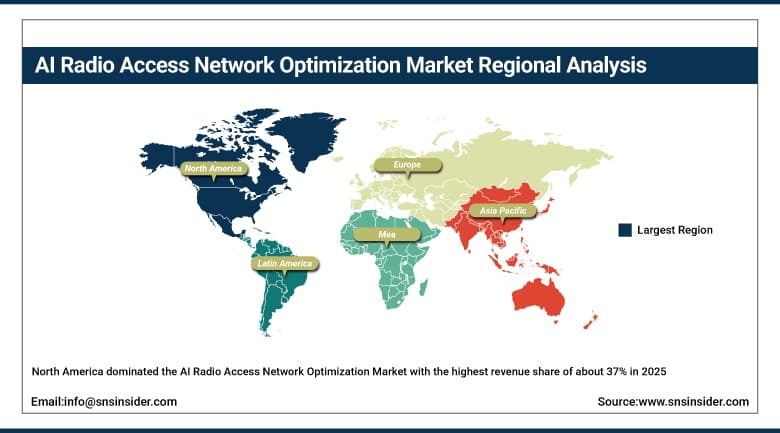
North America dominated the AI Radio Access Network Optimization Market with the highest revenue share of about 37% in 2025, supported by 5G infrastructure, high-levels of AI adoption, and heavy investments in network automation. Increasing need for performance enhancement, energy conservation, and predictive analysis is spurring the uptake of such technologies. The presence of key telecom players and technology vendors further cements the market dominance of the region.
The United States AI Radio Access Network Optimization Market accounted for a market share of 90.5%, Fuelled by an advanced telecommunications infrastructure, 5G deployment and significant investments in AI and network automation. The growing need for intelligent network optimization and energy-efficient networks will drive the growth of the market. Efforts towards digital transformation, Open RAN deployments, and investments in next generation connectivity infrastructure will enhance the US standing.
Get Customized Report as Per Your Business Requirement - Enquiry Now
Europe AI Radio Access Network Optimization Market Insights
Europe’s AI Radio Access Network Optimization Market it benefits from sophisticated telecommunication infrastructure, expansion of 5G network coverage, and rising use of artificial intelligence. Rising demand for automation in network management and energy efficiency as well as improved network performance is motivating adoption. Investment in Open RAN, network upgrades, cybersecurity, and digital infrastructure, as well as robust regulation in telecommunication technology innovations, is contributing to market growth.
The Germany AI Radio Access Network Optimization Market accounted for a market share of 23.0%, Fueled by modern telecommunication infrastructures, 5G usage, and investments in AI and network virtualization. The increasing need for intelligent network optimization and edge computing technologies contributes to market growth. Digital transformation initiatives, Open RAN adoption, and investments in green network infrastructure help in enhancing the position of Germany in Europe.
Asia Pacific AI Radio Access Network Optimization Market Insights
Asia Pacific is expected to grow at the fastest CAGR of about 41.70% from 2026–2035, driven by the rapid 5G deployment, growing mobile data traffic, and complex network. Growing investments in the application of artificial intelligence in telecommunications, edge computing, and network automation are helping to boost the adoption rate. Digitalization plans of the government, telecom infrastructure development, and need for efficient and high-performance networks contribute to market growth in the region.
The China AI Radio Access Network Optimization Market accounted for a market share of 42.5%, Motivated by massive 5G deployment, advanced telecommunication infrastructure, and substantial investment in artificial intelligence and networking technology. Growth factors include higher mobile data volume, greater requirements for automated network management, and the emergence of edge computing. Digital transformation, telecom upgrades, and energy-efficient networking investments bolster China’s market strength.
Middle East & Africa and Latin America AI Radio Access Network Optimization Market Insights
The Middle East & Africa and Latin America AI Radio Access Network Optimization Markets These opportunities will be bolstered by the expansion of 5G infrastructure, the increasing pace of digital transformation and increased need for efficient network management. The growth in mobile connections and data flows is driving the adoption of AI-based optimization. There are many more opportunities resulting from government digitization initiatives, smart cities investments and network upgrade.
The UAE AI Radio Access Network Optimization Market accounted for a market share of 17.0%, The factors that have propelled the rapid growth in this segment include fast adoption of 5G, advanced telecommunication networks and increased investments in artificial intelligence. The rising requirement for intelligent networking, edge computing and high-speed connections is also adding to the growing market demand. Smart city projects, digital transformation of government and investments in energy efficient networks are some more factors.
Growth Drivers: Growing demand for intelligent network automation and real-time RAN optimization is accelerating market growth
The increasing complexity of 5G networks is driving telecom operators toward AI-powered RAN optimization solutions capable of continuously monitoring and improving network performance. AI and ML have potential uses in traffic predictions, resource allocation, interference management, mobility improvements, anomaly detection, predictive maintenance, and automated configuration of networks. Further, the O-RAN architecture enhances these features using the Non-RT RIC and Near-RT RIC components that allow for AI and ML driven policies and near real-time network optimization. The O-RAN release 5 has seen improvements on the AI and ML workflow services along with the introduction of AI-based optimization of massive MIMO beamforming in cellular wireless access networks.
Restraints: High implementation complexity and integration challenges can limit AI-based RAN optimization adoption
AI-powered RAN optimization requires integration of network data sources, AI/ML models, RIC platforms, orchestration systems, and existing RAN infrastructure while maintaining stringent performance and reliability requirements. Operators would have to bring solutions together for O-RU, O-DU, O-CU, RIC, SMO, and cloud solutions, and this could make deployment harder. Operators running multi-vendor solutions could face interoperability and consistency problems in data. While standardization in O-RAN interfaces and testing could help improve interoperability, extensive validation will be required to deploy optimization using AI at a large scale. This is bound to make deployment expensive, difficult, and time-consuming, especially when operators run complicated legacy networks.
Opportunities: Expansion of AI-driven energy optimization and predictive network management is creating significant growth opportunities
Telecom operators are increasingly using AI and machine learning to reduce network energy consumption while maintaining network performance and quality of service. Traffic prediction and dynamic allocation of resources, finding unused components, and controlling network devices based on the varying workload are among the possible functions of AI-based optimization. The O-RAN Alliance has discovered some of the ways in which AI/ML-based technologies can be used to save energy by managing workload, shutting down cells and carriers dynamically, and optimizing the power consumption of O-RUs. Additionally, rApps powered by AI are able to predict the future workload using data about the network and outside factors and apply corresponding energy-saving measures automatically.
Recent Developments:
-
2026: Ericsson advanced AI-RAN optimization with its new AI in RAN software, introducing AI-native scheduling, AI-managed beamforming, and multi-layer coordination to improve RAN performance, spectral efficiency, and energy efficiency.
-
2026: Nokia Corporation expanded AI-driven RAN optimization through its MantaRay SON and AI-enabled 5G solutions, including deployment with TIM Brasil to improve network performance and reduce energy consumption while preparing the network for AI-driven services.
-
2026: NVIDIA strengthened its AI-RAN optimization portfolio through NVIDIA AI Aerial, enabling AI-powered automation, dynamic allocation of compute resources, and AI/5G workload optimization on shared accelerated infrastructure for 5G and 6G networks.
-
2025: Nokia Corporation strengthened its AI-RAN optimization strategy through its partnership with NVIDIA, combining Nokia RAN software with NVIDIA accelerated computing to enable AI-based improvements in spectral efficiency, energy efficiency, and overall network performance.
AI Radio Access Network Optimization Market Key Players are:
-
Ericsson
-
Nokia
-
Huawei Technologies
-
Samsung Electronics
-
ZTE Corporation
-
Mavenir Systems
-
NVIDIA
-
Qualcomm Technologies
-
NEC Corporation
-
Cisco Systems
-
Juniper Networks
-
Intel Corporation
-
Amdocs
-
VIAVI Solutions
-
Parallel Wireless
-
Radisys Corporation
-
Airspan Networks
-
Infovista
-
TEOCO
-
Rakuten Symphony
AI Radio Access Network Optimization Market Report Scope:
| Report Attributes | Details |
|---|---|
| Market Size in 2025 | USD 0.7 Billion |
| Market Size by 2035 | USD 17.29 Billion |
| CAGR | CAGR of 37.88% From 2026 to 2035 |
| Base Year | 2025 |
| Forecast Period | 2026-2035 |
| Historical Data | 2022-2024 |
| Report Scope & Coverage | Market Size, Segments Analysis, Competitive Landscape, Regional Analysis, DROC & SWOT Analysis, Forecast Outlook |
| Key Segments | • By Component (Software, Hardware, Services) • By Deployment Mode (On-Premises, Cloud) • By Application (Network Planning and Design, Performance Management, Self-Organizing Networks, Energy Optimization, Others) • By Network Type (4G/LTE, 5G, Others) • By End-User (Telecom Operators, Enterprises, Others) |
| Regional Analysis/Coverage | North America (US, Canada), Europe (Germany, UK, France, Italy, Spain, Russia, Poland, Rest of Europe), Asia Pacific (China, India, Japan, South Korea, Australia, ASEAN Countries, Rest of Asia Pacific), Middle East & Africa (UAE, Saudi Arabia, Qatar, South Africa, Rest of Middle East & Africa), Latin America (Brazil, Argentina, Mexico, Colombia, Rest of Latin America). |
| Company Profiles | Ericsson, Nokia, Huawei Technologies, Samsung Electronics, ZTE Corporation, Mavenir Systems, NVIDIA, Qualcomm Technologies, NEC Corporation, Cisco Systems, Juniper Networks, Intel Corporation, Amdocs, VIAVI Solutions, Parallel Wireless, Radisys Corporation, Airspan Networks, Infovista, TEOCO, and Rakuten Symphony. |

Frequently Asked Questions
The market is driven by increasing network complexity and data traffic, along with growing adoption of AI-powered optimization, 5G networks, Open RAN, and automated network management.
The North America region dominated the AI Radio Access Network Optimization Market in 2025 with a 37.00% share, driven by high firearm sales and strong defense procurement.
