
Bio-Based Epoxy Resins Market Report Scope and Overview:
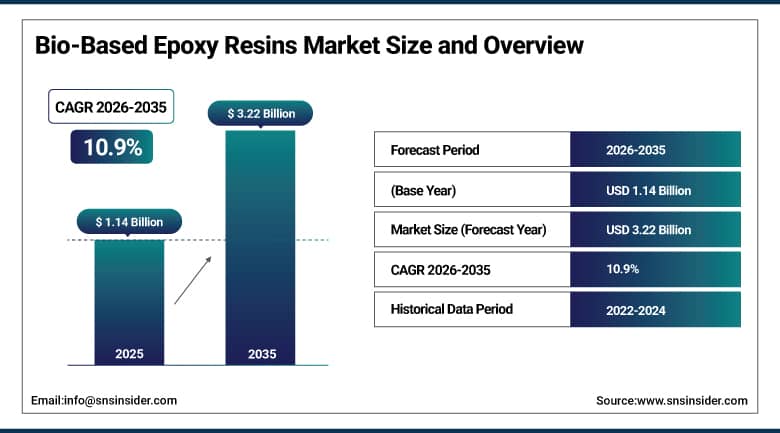
The Bio-Based Epoxy Resins Market size was worth USD 1.14 Billion in 2025 and is projected to reach USD 3.22 Billion by 2035, registering a 10.9% CAGR during 2026-2035.
The Bio-Based Epoxy Resins Market is changing the future outlook of sustainable thermosetting chemistry by substituting increasing amounts of epoxy feedstock based on petrochemical sources with eco-friendly alternatives, such as plant oils, lignin, and natural phenolics. The market can be described in terms of a surge in the number of low-carbon resins sought after by coating, composite, and adhesive producers, increasing use of cardanol and lignin pathways for epoxy resins, hardeners' development from renewable sources, and application in automotive, wind blade, and BPA-free electrical laminates.
⮞Sicomin Epoxy Systems expanded its Chateauneuf-les-Martigues production facility in France during 2026 to scale output of its SR GreenPoxy range of high bio-based-content structural resins, which is anticipated to double the company's annual bio-epoxy manufacturing capacity from 2027 onwards
To Get More Information On Bio-Based Epoxy Resins Market - Request Free Sample Report
Bio-Based Epoxy Resins Market Trends
-
Expanding cardanol and lignin-based resin capacity continues easing dependence on vegetable-oil feedstock alone.
-
Growing bio-based hardener development continues strengthening the renewable content of finished epoxy systems.
-
Rising long-term offtake agreements between OEMs and bio-resin producers continue securing dedicated supply volume.
-
Increasing REACH and EPA regulatory pressure on bisphenol A continues accelerating adoption of bio-based alternatives.
-
Growing wind energy and automotive lightweighting investment continues diversifying demand beyond traditional coatings use.
U.S. Bio-Based Epoxy Resins Market Outlook
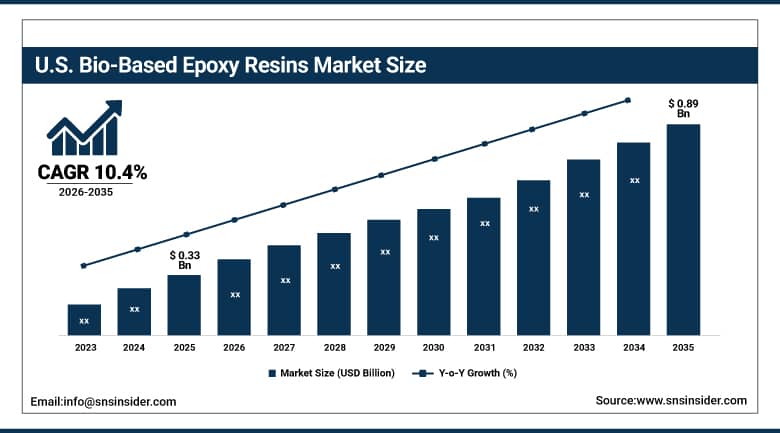
The U.S. Bio-Based Epoxy Resins Market was valued at approximately USD 0.33 Billion in 2025 and is projected to reach approximately USD 0.89 Billion by 2035, registering a 10.4% CAGR from 2026 to 2035.
The demand for the product was also greatly affected by the robust adoption of USDA’s BioPreferred program, significant investment in capacities to produce domestic soy and cardanol based resins, and large demand for low carbon resin products by automobile manufacturers and wind energy manufacturers. Growth in the capacities to extract lignin within the country and production of bio-based epoxy by local chemical majors increased the standing of the U.S. as one of the largest producers and addressable market for bio-based epoxy resins in North America.
⮞Huntsman Corporation confirmed in 2026 that it had expanded commercial-scale output of its Araldite bio-based epoxy hardener range at its domestic U.S. facilities, having already qualified the product line with more than a dozen composite and coatings formulators nationwide.
Bio-Based Epoxy Resins Market Segment Analysis
-
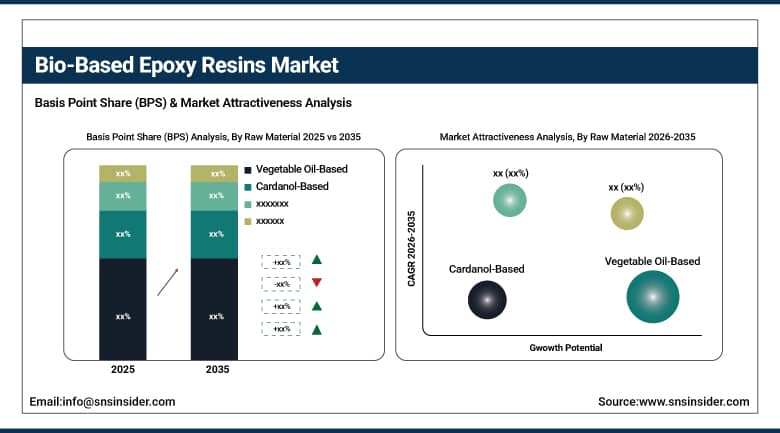
By Raw Material, Vegetable Oil-Based segment dominated the Bio-Based Epoxy Resins Market in 2025 with 47% share; Cardanol-Based segment is the fastest growing segment, registering a CAGR of approximately 12.5% during 2026–2035.
-
By Resin Type, Bio-Based Bisphenol A Epoxy Resin segment dominated the market in 2025 with 49% share; Bio-Based Aliphatic/Cycloaliphatic Epoxy Resin segment is the fastest growing segment, registering a CAGR of approximately 12.07%.
-
By Application, Coatings & Paints segment dominated the market in 2025 with 37% share; Composites & Laminates segment is the fastest growing segment, registering a CAGR of approximately 12.3%.
-
By End-Use Industry, Automotive & Transportation segment dominated the market in 2025 with 26% share; Wind Energy segment is the fastest growing segment, registering a CAGR of approximately 13.0%.
-
By Formulation Type, Two-Component Systems segment dominated the market in 2025 with 61% share; One-Component Systems segment is the fastest growing segment, registering a CAGR of approximately 11.8%.
By Raw Material, Vegetable Oil-Based Leads, While Cardanol-Based Grows Fastest
Vegetable Oil-Based segment dominated the Bio-Based Epoxy Resins Marekt in 2025 due to the easy availability, well-understood epoxidation technology, and economical pricing of soybean, linseed, and palm feedstocks compared to new bio-based alternatives. Years of experience in using epoxides based on vegetable oil in paints, coatings, and adhesive formulations ensured the consistent quality of production process and final products.
The Cardanol-Based resin is the most rapidly growing segment within Bio-Based Epoxy Resins market due to increased processing of cashew nut shell liquid, non-food agricultural residue, into efficient phenolic epoxy monomers. Companies, such as Cardolite and NAGASE ChemteX. It was proven that cardanol-based epoxides offer higher stability and elasticity than vegetable oil-based epoxides without competing for food-grade feedstock supplies.
⮞In March 2026, researchers published a cardanol- and tung-oil-derived epoxy thermoset study in ACS Applied Polymer Materials, demonstrating tunable crosslinking and improved thermomechanical properties, supporting continued development of renewable phenolic feedstocks for high-performance epoxy materials.
By Resin Type, Bio-Based Bisphenol A Epoxy Resin Dominates, Aliphatic/Cycloaliphatic Grades to Witness Fastest-Growth
Bio-Based Bisphenol A Epoxy Resin was the leading product type segment in the Bio-Based Epoxy Resins Market in 2025 as it serves as a drop-in substitute to traditional bisphenol A epoxy resins which can be easily replaced by bio-based epichlorohydrin without compromising on the curing agents, machinery, or performance criteria.
Aliphatic/Cycloaliphatic Epoxy Resin is anticipated to be the most rapidly growing segment in the Bio-based Epoxy Resins Market owing to increased regulation of Bisphenol A under REACH and other such systems globally. They are completely free from bisphenol A and have excellent UV resistance and electrical insulating properties along with excellent colorless transparency.
⮞In May 2026, Westlake Epoxy's Deer Park facility in Texas received ISCC PLUS certification for liquid and solid epoxy resins and epoxy blends, enabling customers to access products attributed to certified renewable feedstocks through a mass-balance approach.
By Application, Coatings & Paints Leads, While Composites & Laminates to Witness Fastest Growth Globally
Coatings & Paints application segment accounted for the largest share of the Bio-Based Epoxy Resins Market in 2025, due to the implementation of more stringent Volatile Organic Compound rules in North America and Europe, along with increased brand owner’s drive toward minimizing the carbon footprint in building, industrial, and protective coatings. The water-borne bio-epoxy resin formulation systems have become increasingly popular for use in floorings, marine, and anti-corrosion applications, as solvent-based systems get phased out.
Composites & Laminates is the fastest-growing application segment of the Bio-Based Epoxy Resins Market, due to the availability of high bio-based epoxy resins in wind turbine blades, marine structures, sporting goods, and automotive applications. For instance, Sicomin’s range of SR GreenPoxy, which was highlighted in composite ski and marine applications and Gougeon Brother’s WEST SYSTEMs products, show how formulators are increasingly formulating resins with more than 50% renewable content, while maintaining the structural properties necessary for composite laminates.
⮞In April 2025, Fraunhofer WKI presented a sandwich component combining lignocellulose and bio-based epoxy resin at Hannover Messe, demonstrating a lightweight construction concept designed for potential applications in truck and motorhome sleeping cabins.
By End-Use Industry, Automotive & Transportation Dominates, Wind Energy Emerges as Fastest-Growing Segment in the Market
The Automotive & Transportation category held the dominant share of the Global Bio-Based Epoxy Resins Market in 2025 with the rise in demand for renewable content composite materials from original equipment manufacturers (OEMs) driven by their sustainability goals and lightweighting needs for EV applications. The collaboration of Spolchemie with an automobile OEM in developing bio-based epoxy resin formulations dedicated to lightweighting demonstrates the integration of resin manufacturers in the development of vehicle components.
The Wind Energy category is anticipated to emerge as the fastest-growing application of the Bio-Based Epoxy Resins Market with the expansion in capacity of blade manufacturing and increasing patent filing related to bio-based hyper-branched epoxy resins and vanillin derived epoxy resins dedicated to blade performance. The rise in installed wind capacity in North America, Europe, and China will lead to the qualification of bio-based resins systems to meet fatigue resistance and recyclable standards.
⮞In March 2025, the European EOLIAN project reported progress on bio-based, bisphenol A-free epoxy systems designed for wind turbine blades, with PROPLAST, TEKNIKER and AEP Polymers developing repairable and recyclable materials suitable for resin-infusion composite manufacturing.
By Formulation Type, Two-Component Systems Dominate, One-Component Systems Gain Fastest Traction
The Two-Component Systems were the dominating segment formulation type in the Bio-Based Epoxy Resins Market in 2025 as structural applications of resins in composites, adhesives, and flooring need a higher crosslink density and mechanical strength, which only a two-component system can provide. The manufacturers producing composite materials for the marine industry, the wind energy sector, and the automotive industry will be using two-component systems as they are convenient and easy to use within the process of infusion and lamination.
The One-Component Systems in the formulation type will grow at the highest rate in the Bio-Based Epoxy Resins Market as coating and adhesive producers prefer such systems for their ease of application, lower risk of mistakes during mixing, and longer shelf life. This year, the producer of marine coatings, Aquarius Marine Coatings, introduced a one-component bio-based resin base for its Coppercoat antifouling system.
⮞In March 2025, Westlake Epoxy announced its EpoVIVE portfolio, incorporating products with sustainability attributes such as mass-balanced renewable raw materials and lower carbon footprints, broadening the options available to formulators seeking more sustainable epoxy solutions.
Regional Insights
|
Region |
Major Country |
Share within Region, 2025 (%) |
|---|---|---|
|
North America |
United States |
82.60% |
|
Europe |
Germany |
24.60% |
|
Asia Pacific |
China |
38.40% |
|
Middle East and Africa |
Saudi Arabia |
27.80% |
|
Latin America |
Brazil |
33.50% |
North America Bio-Based Epoxy Resins Market Insights
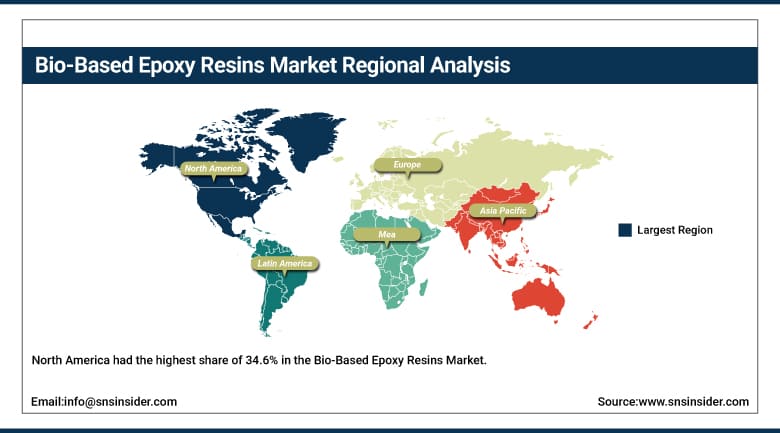
North America had the highest share of 34.6% in the Bio-Based Epoxy Resins Market. The growth was driven by the high penetration of USDA BioPreferred programs, EPA Volatile Organic Compounds, Safer Choice regulations, and existing coating, composite, and adhesive manufacturing base that substituted the bio-based resin contents in their production facilities. In addition, the deep inter-linking of domestic resin manufacturers with the automotive, wind energy, and construction industries ensured the dominance of North America as the world's largest bio-based epoxy resin consumption region.
The major contributor to this growth in North America was the U.S. in the region due to the operations of domestic companies such as Huntsman Corporation and Cardolite Corporation in addition to the increasing processing of soybean and cardanol feedstocks in the Midwest and Gulf Coast. The increased capacity of lignin extraction in Canada due to its forest and pulp industry was another reason behind the dominance of the region.
⮞In May 2026, Westlake Epoxy's Deer Park, Texas, facility obtained ISCC PLUS certification, expanding access to mass-balance-attributed renewable feedstock across liquid epoxy resins, solid epoxy resins and blends for coatings, construction, wind energy, composites and automotive applications.
Get Customized Report as Per Your Business Requirement - Enquiry Now
Europe Bio-Based Epoxy Resins Market Insights
The share of revenue generated from Europe in the Bio-Based Epoxy Resins Market was sustainable due to the restrictive REACH legislation regarding bisphenol A, established composite and wind energy manufacturing clusters, and the fast European Chemicals Agency guidelines supporting renewable feedstock replacement. The drive toward circular economy regulations and life cycle assessment reporting has also compelled the European formulators of coatings and composites to consider validated content in bio-based materials, thereby enabling their region to act as a technology leadership center for bio-epoxies.
Germany was the biggest country in terms of demand share of Europe, owing to the presence of Covestro and Evonik Industries that have large bio-based and specialty epoxy research and manufacturing capabilities. France has made a significant contribution in the demand generated from the region with Sicomin as the headquartered company engaged in the production and composite formulation. The regional movement toward BPA-free formulations will enable Europe to increase its demand for bio-based epoxies.
⮞In April 2025, Fraunhofer WKI presented a lightweight sandwich component combining lignocellulose and bio-based epoxy resin at Hannover Messe, demonstrating a construction-material concept intended for potential use in truck and motorhome sleeping cabins.
Asia Pacific Bio-Based Epoxy Resins Market Insights
The Asia-Pacific region experienced the highest growth among all regions covered in this report, with a CAGR of about 12.8% to 2035, due to the increasing chemical manufacturing capacity, government sustainability initiatives, and fast growth of production in the automotive, electronic, and wind energy sectors. The presence of a cost-effective feedstock processing facility along with downstream composite and coating applications guaranteed that the region grew faster than any other in the market globally.
China is the leading nation in the country due to its massive chemical manufacturing capacity along with its increasing production of wind turbine blades and electric vehicles. Other regions that made sure that this region became the fastest-growing region in this report included Japan, due to NAGASE ChemteX's specialty resin production, and South Korea, due to Kukdo Chemical's bio-based production facilities.
⮞In January 2025, Swancor Holding and Adani New Industries signed an agreement to develop a recyclable wind farm in India, with plans to use Swancor's EzCiclo recyclable epoxy resin system for wind turbine blades and advance blade-recycling capabilities.
MEA and Latin America Bio-Based Epoxy Resins Market Insights
The Middle East & Africa and Latin America both showed steady growth in the Bio-Based Epoxy Resins Market owing to investments in infrastructure construction and renewables, increased government funding for the development of local petrochemical diversification, and greater collaboration between local oleochemical manufacturers and foreign resin makers. The requirement for a validated low-carbon resin system became a more realistic requirement for infrastructure and industrial coating applications in these regions that were once dependent upon petroleum-based epoxy only.
Saudi Arabia is the largest market within ME&A due to the development of its petrochemical and specialty chemicals industry and increased infrastructure investment in renewable content construction material in the region. Furthermore, the region witnessed significant contribution from infrastructure coatings demand in the UAE. Brazil is the largest revenue country in Latin America owing to the existence of a large-scale oleochemicals industry in soybeans along with biodiesel adjacent feedstocks processing capabilities in Brazil.
Market Dynamics
Growth Drivers: Rising Demand for Sustainable Coatings and Expanding Bio-Refining Capacity
The market is being propelled by growing commercial demand for certified low-carbon paints and coatings, composites, and adhesives, enhanced capabilities for the manufacture of epoxidation and biorefining, increasing processing of cardanol and lignin-based feedstock streams, and rising applications in automotive lightweighting, wind turbine blade production, and electronics enclosures, without using BPA. As the number of companies that are announcing their carbon reduction goals increases continually, demand for supply of high-quality and high bio-content epoxy resins is expected to drive investments in capacities for production across the value chain.
Strategic supply and co-development agreements between paints and coatings, and composite manufacturers and suppliers of bio-based resins reinforce this trend, as downstream players increase their commitment to obtaining volume of renewable content ahead of the regulation-led phase-out of BPA. The growth of venture and corporate investments in bio-refining and cashew-processing capacities are also contributing to expansion of baseline production capacities, and collectively resulting in constantly growing demand throughout the forecast period.
⮞In March 2025, BASF and Sika announced the commercial availability of Baxxodur EC 151, an epoxy-curing amine building block developed for low-emission flooring systems, demonstrating how chemical manufacturers are commercializing formulation technologies designed to improve application efficiency and reduce volatile organic compound emissions.
Restraints: Feedstock Price Volatility and Performance Trade-offs Versus Petroleum-Based Epoxy
Volatility in prices of vegetable oil, cashew nut shell liquid, and lignin as feedstock remains an authentic constraint toward faster growth of the market as a whole, considering that smaller specialty players are not endowed with the same purchase volumes and hedging opportunities that large integrated petrochemical-based epoxy resin manufacturers have. This constraint has resulted in the fact that the only reliable large-scale production of such materials at stable prices is carried out by a relatively small number of financially sound firms, limiting the variety of suppliers for formulators.
Unresolved performance gaps between bio-based and regular petrochemical epoxy resins remain another significant constraint, since even with increasing share of bio-based ingredients, the resulting material may feature decreased heat resistance, increased viscosity, or longer processing time than the bisphenol A epoxy resin. To close this gap, further investments should be made into curing agents research and formulation technologies, which continue to evolve and require significant expenses.
Opportunities: Lignin Valorization and Expanding Wind Energy Composite Demand
Increasing investments in lignin valorization to a commercial scale is a truly critical one as suppliers no longer rely only on vegetable oil and cashew-derived raw materials, but are able to utilize plentiful and inexpensive byproducts of the pulp and paper industry. Manufacturers that will establish an advantage in technologies of lignin extraction, purification, and epoxidation will take a decent market share as the bio-based epoxy industry will go beyond specialized products toward the real industrial production of bio-based epoxy.
Another critical opportunity is connected with the expansion of the qualification of bio-based epoxy into wind energy and electric vehicle composite projects, as manufacturers of blades and vehicles are increasingly interested in resins that contain a high percentage of renewable materials. Manufacturers that will be able to provide infusion-grade bio-based epoxy that corresponds to Good Manufacturing Practice will receive more and more market shares due to renewable energy and vehicle electrification manufacturers recognize verified bio-based content as a real competitive factor.
⮞In June 2025, Sika's research on bio-based epoxy hardeners derived from vanillin and guaiacol received a cover feature in Green Chemistry, highlighting lignin-derived building blocks as potential alternatives to fossil-based chemicals in high-performance epoxy systems.
Recent Developments:
-
2025: The BIOinfusion line added to the list of bio-based epoxies offered by Entropy Resins is aimed at minimizing the content of petroleum products. Entropy Resins continues offering their range of eco-friendly epoxy products for use in various industries, such as sport and marine equipment manufacturing.
-
2025: Cardolite launched new bio-based epoxy resins that use epoxies made from cashew nutshell liquid to deliver more sustainable and flexible alternatives with better chemical resistance for various industries such as coating, adhesives, and composites.
-
2026: Aquarius Marine Coatings launched a 100% plant-based epoxy resin base for its Coppercoat antifouling coating system, reducing embodied carbon emissions by approximately 34% per unit of resin produced.
Bio-Based Epoxy Resins Companies are:
-
Sicomin Epoxy Systems
-
Huntsman Corporation
-
Aditya Birla Chemicals
-
Cardolite Corporation
-
NAGASE ChemteX Corporation
-
Covestro AG
-
Hexion Inc.
-
Evonik Industries AG
-
Olin Corporation
-
Entropy Resins, Inc.
-
ECOPOXY Inc.
-
SPOLCHEMIE (Spolek pro chemickou a hutni vyrobu, a.s.)
-
Chang Chun Group
-
Change Climate Pty Ltd
-
Gougeon Brothers, Inc.
-
Bitrez Ltd
-
Polytek Development Corp.
-
Wessex Resins & Adhesives Ltd
Bio-Based Epoxy Resins Market Report Scope:
| Report Attributes | Details |
|---|---|
| Market Size in 2025 | USD 1.14 Billion |
| Market Size by 2035 | USD 3.22 Billion |
| CAGR | CAGR of 10.9% from 2026 to 2035 |
| Base Year | 2025 |
| Forecast Period | 2026-2035 |
| Historical Data | 2022-2024 |
| Report Scope & Coverage | Market Size, Segments Analysis, Competitive Landscape, Regional Analysis, DROC & SWOT Analysis, Forecast Outlook |
| Key Segments | •By Raw Material, Vegetable Oil-Based segment dominated the Bio-Based Epoxy Resins Market in 2025 with 47% share; Cardanol-Based segment is the fastest growing segment. •By Resin Type, Bio-Based Bisphenol A Epoxy Resin segment dominated the market in 2025 with 49% share; Bio-Based Aliphatic/Cycloaliphatic Epoxy Resin segment is the fastest growing segment. •By Application, Coatings & Paints segment dominated the market in 2025 with 37% share; Composites & Laminates segment is the fastest growing segment. •By End-Use Industry, Automotive & Transportation segment dominated the market in 2025 with 26% share; Wind Energy segment is the fastest growing segment. •By Formulation Type, Two-Component Systems segment dominated the market in 2025 with 61% share; One-Component Systems segment is also the fastest growing segment. |
| Regional Analysis/Coverage | North America (US, Canada), Europe (Germany, UK, France, Italy, Spain, Russia, Poland, Rest of Europe), Asia Pacific (China, India, Japan, South Korea, Australia, ASEAN Countries, Rest of Asia Pacific), Middle East & Africa (UAE, Saudi Arabia, Qatar, South Africa, Rest of Middle East & Africa), Latin America (Brazil, Argentina, Mexico, Colombia, Rest of Latin America). |
| Company Profiles | Sicomin Epoxy Systems, Huntsman Corporation, Aditya Birla Chemicals, Cardolite Corporation, Kukdo Chemical Co., Ltd., NAGASE ChemteX Corporation, Covestro AG, Hexion Inc., Evonik Industries AG, Olin Corporation, Entropy Resins, Inc., ECOPOXY Inc., SPOLCHEMIE (Spolek pro chemickou a hutni vyrobu, a.s.), Chang Chun Group, Resoltech, Change Climate Pty Ltd, Gougeon Brothers, Inc., Bitrez Ltd, Polytek Development Corp., Wessex Resins & Adhesives Ltd |

Frequently Asked Questions
Key players include Sicomin Epoxy Systems, Huntsman Corporation, Aditya Birla Chemicals, Cardolite Corporation, and Kukdo Chemical Co., Ltd., among others.
Key opportunities include rising demand for sustainable materials, bio-based feedstock innovations, growing adoption in automotive and construction, and increasing emphasis on low-carbon composite manufacturing.
The major growth factor is rising demand for sustainable, low-carbon coatings and composites, expanding cardanol and lignin-based production capacity, and growing regulatory pressure to phase out bisphenol A.
The Vegetable Oil-Based segment dominated the Bio-Based Epoxy Resins Market by raw material, representing the largest share of revenue in 2025.
North America dominated the Bio-Based Epoxy Resins Market in 2025, holding an estimated 34.6% share of total global market revenue.
