
Cannabidiol (CBD) Market Report Scope & Overview:
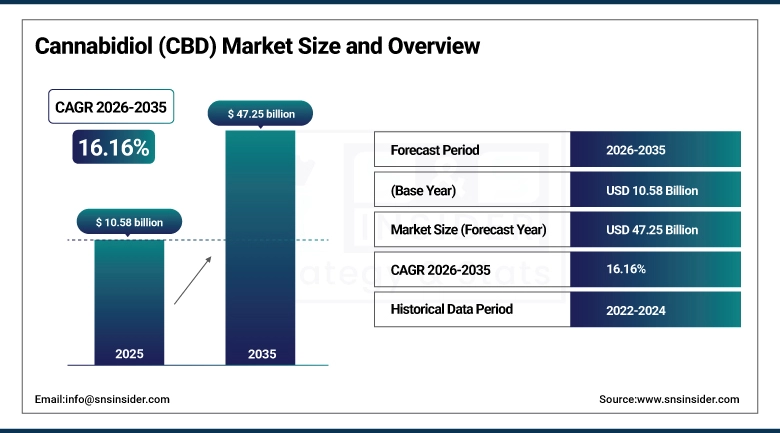
The Cannabidiol (CBD) Market was estimated at USD 10.58 Billion in 2025 and is expected to reach USD 47.25 Billion by 2035 and grow at a CAGR of 16.16% over the forecast period of 2026-2035.
Cannabidiol (CBD) Market is experiencing significant growth around the world owing to high consumer awareness about plant-based health products, higher use of CBD in pain management, treatment of anxiety, insomnia, and increasing legalization of cannabis products in many countries. Moreover, growing preference for alternative medicines, increasing utilization of CBD in the pharmaceuticals, cosmetics, F&B, and pet wellness segments are also fueling the market growth in developed as well as developing countries. Innovation in products like CBD oil, CBD edibles, CBD beverages, CBD capsules, and topical CBD treatments is also driving the market growth globally.
The incorporation of sophisticated methods in cannabinoid extraction, nanoparticle-emulsion technology, AI-powered tracking of hemp farming, and innovative cannabinoid delivery mechanisms is anticipated to witness substantial uptake up to 2026.
Among other factors, the rising preference for non-intoxicating cannabis products, the intensification of scientific research and clinical trials on cannabinoids, as well as technological progress in purification and bioavailability improvement processes will fuel market development.
Market and Forecast
-
Market Size in 2025: USD 10.58 Billion
-
Market Size by 2035: USD 47.25 Billion
-
CAGR: 16.16% from 2026 to 2035
-
Base Year: 2025
-
Forecast Period: 2026–2035
-
Historical Data: 2022–2024
To Get more information on Cannabidiol (CBD) Market - Request Free Sample Report
Cannabidiol (CBD) Market Trends
-
The growing consumer demand for plant-based wellness products and natural therapies has been boosting the use of CBD oils, edibles, capsules, and topicals.
-
Consumers' health care trends are getting influenced by the rising usage of CBD as a remedy for anxiety, pain, insomnia, and stress, thus raising the demand for CBD in the pharmaceutical and nutraceutical sectors.
-
The advancements in technology related to nanoemulsion and innovative extraction procedures for cannabinoids in beverages and wellness products enhance their effectiveness and bioavailability.
-
The rising application of AI for the monitoring of hemp cultivation, precision agriculture, and automatic systems in extracting cannabinoids has increased the efficiency and capability of processing cannabinoids on an industrial scale.
-
The legalization of CBD products made out of hemp in North America, Europe, and the Asia-Pacific region has been encouraging companies to launch cannabis products commercially.
-
The increasing investments into the development of pharmaceutical CBD formulations have raised the usage and demand for these products and stimulated innovation.
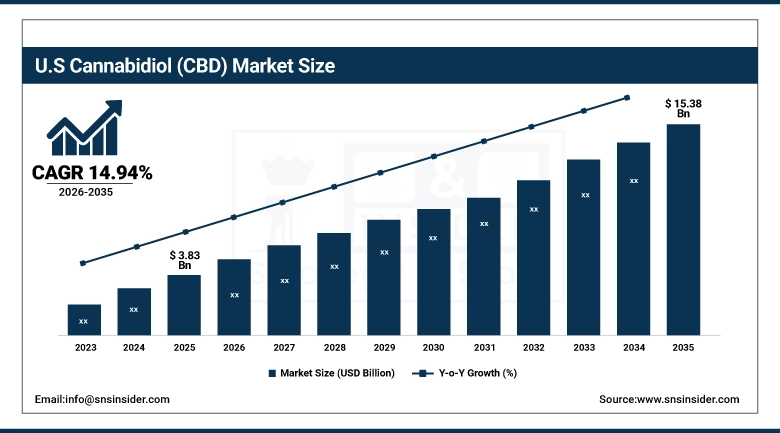
The U.S. Cannabidiol (CBD) Market was valued at USD 3.83 Billion in 2025 and is expected to reach around USD 15.38 Billion by 2035, growing at a CAGR of 14.94% from 2026–2035.
U.S. Cannabidiol (CBD) Market is believed to be among the most advanced regional markets of CBD around the world owing to growing consumer awareness about wellness items, legalized CBD products extracted from hemp plants, and high demand for plant-based therapies. Companies like Charlotte’s Web Holdings, CV Sciences, cbdMD Inc., and Medterra CBD have shown a keen interest in developing innovative products and formulations.
Regulation by the U.S. FDA on labeling, safety standards, THC limits, and marketing practices is improving consumer confidence and supporting adoption of regulated CBD products across pharmaceutical, wellness, and nutraceutical sectors.
According to the U.S. CDC, rising cases of anxiety, stress, chronic pain, and sleep disorders are increasing demand for CBD-based wellness products. As a result, demand for pharmaceutical-grade cannabidiol and clinically supported formulations is steadily growing in the U.S. market.
Cannabidiol (CBD) Market Segment Analysis
-
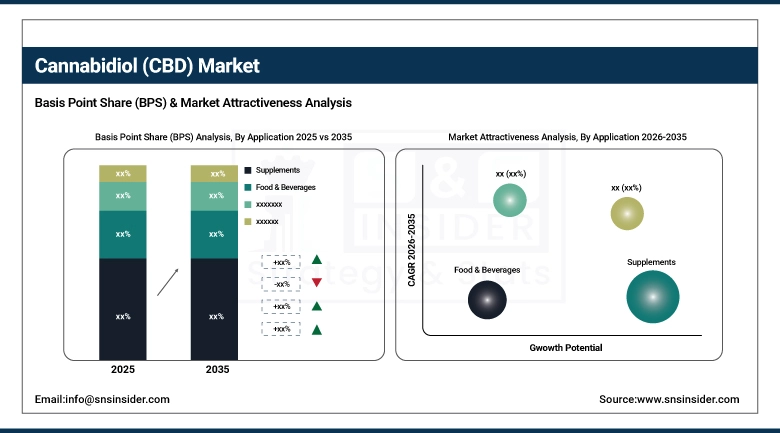
By Application, Supplements dominated the Cannabidiol CBD Market with 24.18% share in 2025; Wellness Products fastest growing (CAGR).
-
By Product Type, Full Spectrum dominated the Cannabidiol CBD Market with 42.86% share in 2025; Isolate fastest growing (CAGR).
-
By Distribution Channel, Online dominated the Athletic Footwear Market with 36.42% share in 2025 and it is also fastest growing (CAGR).
By Application, Supplements dominate the Cannabidiol CBD Market, while Wellness Products are the fastest-growing segment.
Supplements dominated the Cannabidiol CBD Market with the highest revenue share in 2025 due to increasing consumer preference for plant-based wellness products, rising usage of CBD for stress relief, immunity support, pain management, and sleep improvement, along with wider availability of capsules, gummies, and dietary formulations through online and retail channels globally.
Wellness Products segment is expected to grow at the fastest CAGR from 2026–2035 owing to rising consumer focus on holistic health, increasing adoption of premium CBD lifestyle products, expanding demand for relaxation and mental wellness solutions, and growing innovation in personalized cannabidiol formulations, spa products, aromatherapy applications, and wellness-focused subscription-based product offerings.
By Product Type, Full Spectrum dominates the Cannabidiol CBD Market, while Isolate is the fastest-growing segment.
Full Spectrum company held the largest market share for the Cannabidiol CBD market in 2025 since consumers showed an inclination toward products with a combination of multiple cannabinoids and terpenes that provided greater therapeutic value through the entourage effect. This factor, coupled with the growing popularity of natural wellness products, helped the segment dominate the market.
Isolation segment is projected to have the highest CAGR between 2026 and 2035 due to an increasing demand for CBD products without THC in pharmaceuticals, dietary supplements, and wellness-related applications. The growing consumer awareness on purity, dosing, and regulatory compliances has been driving the adoption in the market.
By Distribution Channel, Online segment dominates the Cannabidiol CBD Market and is also expected to grow fastest.
Online Segment was the leader of the Cannabidiol CBD Market with the largest revenue share in 2025 because of the growing consumer inclination towards online purchase platforms with easy availability, competitive pricing, and the option to view reviews and test reports of products. The fast-growing number of online health and wellness companies contributed to rising online CBD product sales.
Online segment is expected to grow at the fastest CAGR from 2026–2035 owing to rising internet penetration, growing adoption of direct-to-consumer sales models, and increasing demand for subscription-based wellness products. In addition, advancements in digital marketing, personalized product recommendations, and discreet product delivery services are supporting strong future growth of online CBD retail channels worldwide.
Regional Insights
|
Region |
Major Country |
Share (%) |
|---|---|---|
|
North America |
United States |
86.48% |
|
Europe |
Germany |
24.72% |
|
Asia Pacific |
China |
31.64% |
|
Middle East & Africa |
UAE |
18.35% |
|
Latin America |
Brazil |
42.58% |
North America Cannabidiol (CBD) Market Insights
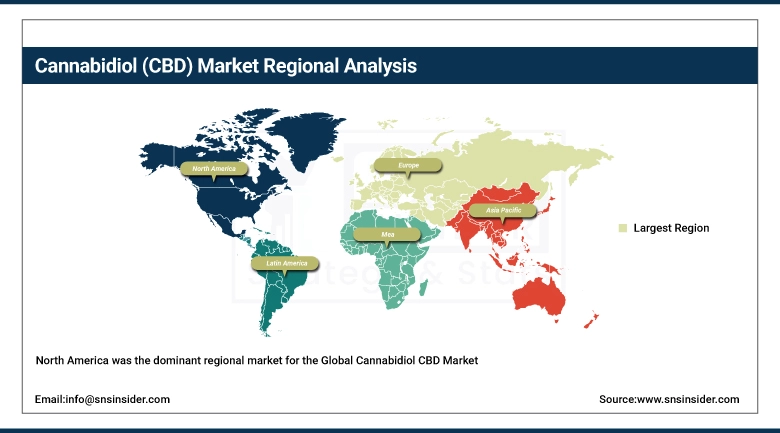
North America was the dominant regional market for the Global Cannabidiol CBD Market owing to increasing legalization of hemp-derived products, high consumer awareness regarding wellness applications, and strong presence of established CBD manufacturers and retail distribution networks. The region benefits from advanced product innovation, widespread adoption of CBD-based supplements, and growing demand for plant-based therapeutic alternatives. The U.S. remains the leading country within the region, accounting for the largest market share due to rising consumer spending on wellness products, strong e-commerce penetration, and continuous expansion of CBD applications across healthcare and personal care sectors.
Backed up by this dominance, the U.S. FDA oversees labelling, safety and cannabinoid regulations, thereby ensuring increased consumer confidence and promoting widespread commercialization. Some of the well-known organizations, such as Charlotte's Web Holdings, CV Sciences, CbdMD Inc., and Medterra CBD, have been diversifying their product range by offering CBD-based oils, gummies, beverages, and topical products.
Get Customized Report as per Your Business Requirement - Enquiry Now
Asia Pacific Cannabidiol (CBD) Market Insights
The Asia-Pacific region is expected to witness the fastest growth rate in the Cannabidiol CBD Market, driven by increased awareness about plant-based health care products, changing regulations, and consumer inclination towards alternative medicine solutions. The factors such as rapid urbanization, evolving lifestyles, and health awareness populations are driving the growth of the market in the region.
China occupies a considerable place within the Asia Pacific region owing to the increased production of hemp crops, investments in technologies related to extracting cannabinoids, and export of CBD raw materials. Japan, India, South Korea, and Australia also play a role in its growth with the help of increased adoption of wellness products and improved retail distribution channels.
Europe Cannabidiol (CBD) Market Insights
The Cannabidiol CBD Market is highly significant in Europe because of growing demand for organic wellness products, rising adoption of CBD-infused cosmetics and nutraceuticals, and increasing regulatory clarity regarding hemp-derived cannabidiol products. Major countries include Germany, the UK, France, and Italy. Expanding health-conscious consumer populations and increasing preference for natural therapeutic solutions are among the major factors driving market growth across the region.
The European Medicines Agency (EMA) and regional regulatory bodies ensure strict compliance standards related to CBD product quality, THC limits, and consumer safety, supporting wider acceptance of regulated products. Europe is also witnessing increasing demand for CBD skincare, beverages, supplements, and pharmaceutical formulations, driven by rising wellness trends, expanding retail distribution channels, and increasing investments in cannabinoid-based research and development activities.
Middle East & Africa and Latin America Cannabidiol (CBD) Market Insights
The Middle East and Africa region is witnessing steady growth in terms of the Cannabidiol CBD Market owing to increasing awareness regarding wellness and therapeutic products, growing investments in healthcare retail infrastructure, and rising interest in hemp-derived consumer goods. Countries such as UAE, South Africa, and Israel are emerging as important regional markets due to increasing acceptance of CBD wellness applications and expanding specialty retail channels.
In Latin America, nations like Brazil and Mexico have been making substantial contributions to market growth owing to the ongoing drive toward legalization, growing cannabis farming practices, and escalating need for low-cost healthcare solutions using plants. The growing knowledge about the therapeutic properties of CBD along with regulatory improvements is helping in fueling the demand for cannabidiol products.
Growth Drivers:
-
Rising consumer preference for natural wellness products and plant-based therapeutic alternatives is significantly accelerating global CBD product demand.
The growing awareness regarding the benefits of stress management, anxiety management, pain alleviation, and better sleep are greatly influencing the global acceptance of cannabidiol-based goods. With the increasing concern regarding the negative impact of artificial drugs and their side effects on human health, the consumers are opting for natural alternatives that provide the same benefits. The demand for various forms of CBD, such as CBD oil, CBD gummies, CBD capsules, CBD beverages, and CBD topical goods, is contributing towards market growth. Moreover, the quick legalization of hemp-based CBD products around the world is also facilitating market growth.
In 2026, growing preference for plant-based therapeutic alternatives over synthetic medicines is significantly boosting demand for CBD products, as consumers seek safer, long-term wellness solutions with fewer side effects across global health and lifestyle applications.
Restraints:
-
Limited clinical evidence and consumer concerns regarding product quality, dosage consistency, and long-term safety are restricting wider medical adoption.
Even though the utilization of CBD-containing products as a form of treatment is gaining popularity in today’s world, scientific research to back up some of the alleged advantages of these goods has not been done yet. The inconsistency of purity levels, incorrect labeling, and variations in the levels of active components are issues that consumers and the medical industry face when using these products. In some cases, the unlawful distribution of these products leads to the addition of excessive amounts of THC or other toxic substances.
Opportunities:
-
Increasing investment in pharmaceutical-grade cannabidiol research and cannabinoid-based therapies is creating strong future healthcare market opportunities globally.
Clinical studies on cannabidiol’s efficiency for epilepsy, chronic pain, anxiety disorders, inflammation, and neurological disorders are increasing the interest of the pharmaceutical industry in cannabis-based medications. Many health care organizations are developing purified formulations of cannabidiol, innovative delivery systems, and cannabinoid prescription drugs. The increased popularity of plant-based therapeutics among health care providers and consumers is encouraging innovation in the medical field. Furthermore, partnerships between biotech organizations, pharmaceuticals, and cannabinoid research institutions have led to many innovations in treatment methods, presenting vast possibilities for the future in the regulated health care and pharmaceutical sectors.
In 2026, the increasing use of CBD for treating conditions such as epilepsy, chronic pain, anxiety, inflammation, and sleep disorders will fuel more interest among pharmaceutical companies, owing to the increase in trials and research into prescription CBD products.
Recent Developments
-
2026: Charlotte’s Web Holdings added AI-based e-commerce technology and CBD gummies using nano-technology to its wellness portfolio. There was more efficiency in its supply chain management to ensure consistent scaling across the U.S.
-
2025: Tilray Brands Inc. advanced their CBD and wellness products portfolio with the addition of beverages and hemp products. Their market presence increased in North America through cost optimization and brand integration to boost profitability.
-
2024: Cannabinoid-focused operations were streamlined by Canopy Growth Corporation with a focus on cannabinoid research and wellness portfolio improvement. The company introduced premium products and distribution of hemp products internationally.
Cannabidiol (CBD) Market Key Players
-
Charlotte’s Web Holdings
-
CV Sciences
-
Canopy Growth Corporation
-
Tilray Brands Inc.
-
Aurora Cannabis Inc.
-
Cronos Group
-
Jazz Pharmaceuticals (GW Pharmaceuticals)
-
Elixinol Wellness Ltd.
-
NuLeaf Naturals
-
Medterra CBD
-
Green Roads
-
Lazarus Naturals
-
CBD American Shaman
-
Endoca BV
-
PharmaHemp
-
Kazmira LLC
-
Medical Marijuana Inc.
-
cbdMD Inc.
-
Pet Releaf
-
Joy Organics
Cannabidiol (CBD) Market Report Scope:
| Report Attributes | Details |
|---|---|
| Market Size in 2025 | USD 10.58 Billion |
| Market Size by 2035 | USD 47.25 Billion |
| CAGR | CAGR of 16.16% From 2026 to 2035 |
| Base Year | 2025 |
| Forecast Period | 2026-2035 |
| Historical Data | 2022-2024 |
| Report Scope & Coverage | Market Size, Segments Analysis, Competitive Landscape, Regional Analysis, DROC & SWOT Analysis, Forecast Outlook |
| Key Segments | • By Application (Supplements, Food & Beverages, Personal Care, Pharmaceuticals, Pet Wellness, Wellness Products) • By Product Type (Full Spectrum, Broad Spectrum, Isolate, Synthetic CBD) • By Distribution Channel (Online, Retail Stores, Pharmacies, Wellness Centers, Direct Sales) |
| Regional Analysis/Coverage | North America (US, Canada), Europe (Germany, UK, France, Italy, Spain, Russia, Poland, Rest of Europe), Asia Pacific (China, India, Japan, South Korea, Australia, ASEAN Countries, Rest of Asia Pacific), Middle East & Africa (UAE, Saudi Arabia, Qatar, South Africa, Rest of Middle East & Africa), Latin America (Brazil, Argentina, Mexico, Colombia, Rest of Latin America). |
| Company Profiles | Charlotte’s Web Holdings, CV Sciences, Canopy Growth Corporation, Tilray Brands Inc., Aurora Cannabis Inc., Cronos Group, Jazz Pharmaceuticals (GW Pharmaceuticals), Elixinol Wellness Ltd., NuLeaf Naturals, Medterra CBD, Green Roads, Lazarus Naturals, CBD American Shaman, Endoca BV, PharmaHemp, Kazmira LLC, Medical Marijuana Inc., cbdMD Inc., Pet Releaf, Joy Organics |
Frequently Asked Questions
North America dominated the Cannabidiol (CBD) Market in 2025.
The Supplements segment dominated the Cannabidiol (CBD) Market in 2025.
Rising consumer preference for plant-based wellness products, increasing adoption of CBD for stress, pain, anxiety, and sleep management, along with expanding legalization of hemp-derived products and growing use across pharmaceuticals, nutraceuticals, cosmetics, and wellness industries are the major growth drivers.
The Cannabidiol (CBD) Market was valued at USD 10.58 billion in 2025.
The Cannabidiol (CBD) Market is expected to grow at a CAGR of 16.16% from 2026 to 2035.
