
Coherent Radar Market Report Scope & Overview:
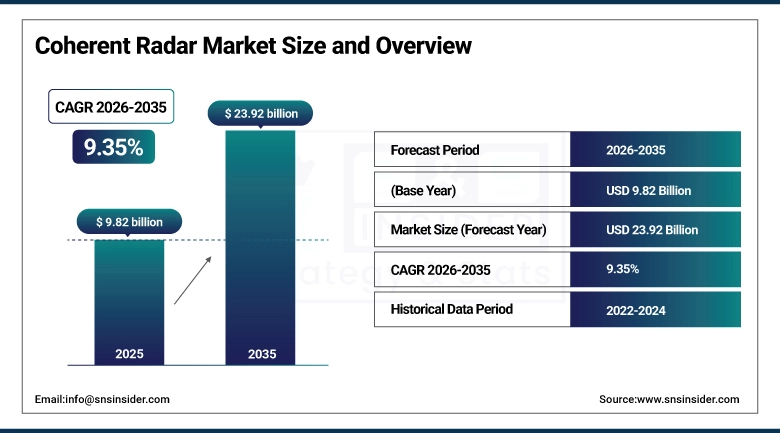
The Coherent Radar Market size is valued at USD 9.82 Billion in 2025 and is projected to reach USD 23.92 Billion by 2035, growing at a CAGR of 9.35% during the forecast period 2026–2035.
The Coherent Radar Market research study offers an exhaustive review of market forces, emerging technologies, and applications. Increasing defense modernization initiatives, growing need for aerospace surveillance, increasing use of automotive radars for autonomous cars, and increasing construction of meteorological stations are contributing to market growth between 2026 and 2035.
Radar installations crossed the 120,000 mark in 2025, attributed to rising military expenditures, swift deployment of smart cities, and advanced weather prediction systems.
To Get more information on Coherent Radar Market - Request Free Sample Report
Coherent Radar Market Trends:
-
The increasing use of radar technology in automotive, especially FMCW radar, is aiding the development of self-driving vehicles and traffic management.
-
Growing inclusion of artificial intelligence and machine learning in radar technology is improving signal processing and predictive analysis.
-
The trend toward multi band radar technology is offering benefits to both defense and meteorology segments.
-
Increased need for weather forecast and disaster management radars is boosting the adoption of radar technology in meteorological services.
-
Miniaturization of radar technology and its use in UAVs and drones is leading to innovations in the fields of surveillance and reconnaissance.
-
Rapid growth in APAC region is anticipated owing to defense investments in China and India along with fast adoption in smart city initiatives.
-
The trend toward low-cost radar design and manufacture is facilitating the development of civil radar applications, particularly in automotive and infrastructure.
-
Continuous innovations in minimizing electromagnetic interference and detecting objects at long ranges are leading to the future of radar technologies.
U.S. Coherent Radar Market Insights:
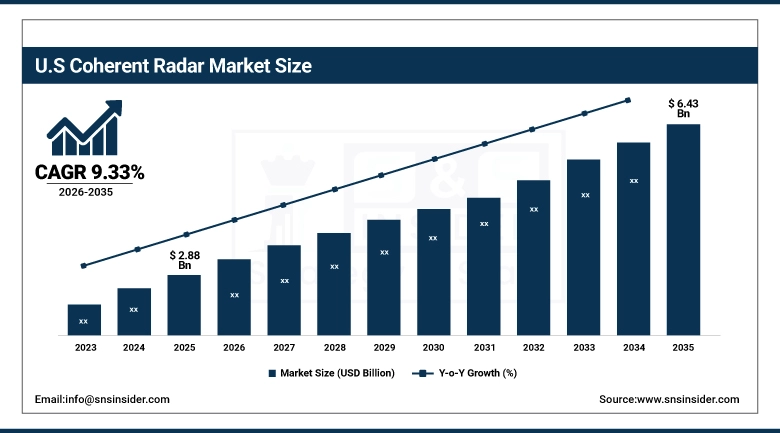
The U.S. Coherent Radar Market is anticipated to increase from USD 2.88 Billion in 2025 to USD 6.43 Billion in 2035, exhibiting a Compound Annual Growth Rate (CAGR) of 9.33%. The growth of this market can be attributed to the high number of defense modernization initiatives, increased use of aerospace surveillance, increasing usage of radar in autonomous cars, and development in meteorological surveillance systems.
Coherent Radar Market Growth Drivers:
-
Rising defense modernization programs and aerospace surveillance needs are driving demand for advanced radar technologies.
The increasing expenditure toward military radars, rising use of radars in aerospace, and increasing need for border surveillance and maritime surveillance are some of the important factors contributing toward the growth of Coherent Radar Market. The civil segment, which includes automotive and meteorology applications, is also showing a high degree of inclination toward using radars, as they can help manage traffic more efficiently, facilitate self-driving cars, and provide warnings for natural disasters.
More than 58% of defense agencies, aerospace companies, and civil infrastructure operators used highly advanced coherent radars in 2025.
Coherent Radar Market Restraints:
-
High costs of radar systems and maintenance are limiting widespread adoption in civil applications.
The high cost incurred during the initial setup of the radar system, along with ongoing costs in maintaining and calibrating them, is another factor that is likely to impede market growth. Budgeting problems faced by civil organizations, auto-manufacturers, and meteorological institutions are expected to limit the adoption rate. In addition, factors including electromagnetic interference, shortage of frequency spectrum, and technical difficulties involved in integrating with current infrastructures are also expected to limit the growth of the radar market.
In 2025, it was noted that only less than 42% of civil infrastructure providers and automotive manufacturers managed to deploy the advanced radar system.
Coherent Radar Market Opportunities:
-
Expanding applications in autonomous vehicles and smart city infrastructure are creating new growth opportunities.
The increasing incorporation of radars within ADAS, traffic control, and urban safety networks has resulted in many ways in which the market can be expanded. Increasing demand for UAVs, satellites, and disaster management has further provided a wide range of opportunities within the field of coherent radars. Constant advancements in areas such as AI-powered radar, multi-band frequency radar, and miniature radar systems have increased their adaptability within the fields of defense, aerospace, automotive, and meteorology.
According to predictions made by industry analysts, more than 65% of smart cities and next-generation vehicles will use coherent radars by 2030.
Coherent Radar Market Segmentation Analysis:
-
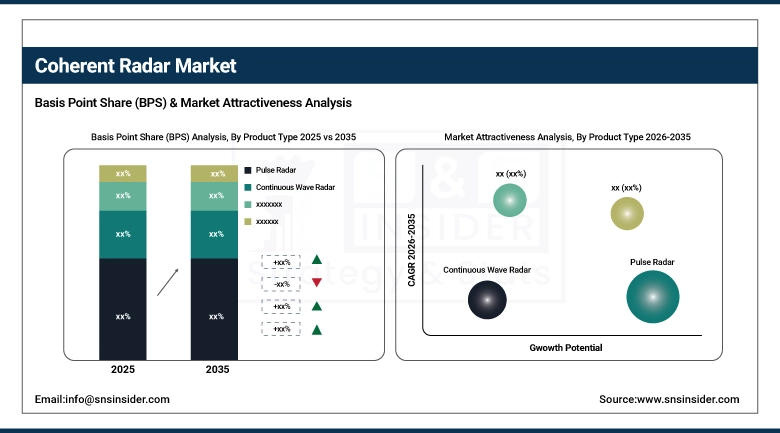
By Product Type, Pulse Radar held the largest market share of 25.46% in 2025, while Frequency Modulated Continuous Wave (FMCW) are expected to grow at the fastest CAGR of 10.34% during 2026–2035.
-
By Technology, Pulse-Doppler Radar dominated with 29.54% market share in 2025, whereas FMCW Tech Radar are projected to record the fastest CAGR of 10.83% through 2026–2035.
-
By Frequency Band, X-band accounted for the highest market share of 30.02% in 2025, while S-band are expected to grow at the fastest CAGR of 10.31% during the forecast period.
-
By Application, Defense & Military dominated with a 37.72% share in 2025, while Weather Forecasting are anticipated to expand at the fastest CAGR of 10.96% through 2026–2035.
By Product Type, Pulse Radar Leads While FMCW Radar Expands Rapidly:
Pulse Radar remains the technology with dominant market share to its well-known application in long-range detection, surveillance, and aviation. The high levels of reliability associated with Pulse Radar and its extensive use in marine, aircrafts, and border surveillance makes it the most popular choice among defense agencies.
Frequency Modulated Continuous Wave (FMCW) radar represents one of the fastest-growing categories, largely due to increased use in automobile safety and intelligent transport systems. The accuracy of short-range detection along with technological advancements that have facilitated miniaturization and artificial intelligence-based processing are key to the increasing popularity of FMCW radar.
By Technology, Pulse‑Doppler Radar Leads While FMCW Radar Expands Rapidly:
Pulse‑Doppler Radar remains the dominant technology owing the market share to its proven effectiveness in detecting moving objects and its critical role in long‑range surveillance. Its reliability and integration into sophisticated military systems make it the preferred choice for defense and aerospace applications.
Frequency Modulated Continuous Wave (FMCW) Radar represents one of the fastest‑growing technologies, largely due to its increasing use in automobile safety, autonomous vehicles, and intelligent transport systems. Advances in miniaturization and artificial intelligence‑based signal processing are key drivers of its rising adoption across civil and commercial sectors.
By Frequency Band, X‑Band Leads While S‑Band Expands Rapidly:
The X-band radar remains dominant in the market, owing to its wide application in defense surveillance, marine navigation, and weather forecasting. Its capacity to produce high-resolution images has made it the ideal option for military and aerospace applications.
The S-band radar market is experiencing fastest growth due to its usage in air traffic control, meteorology, and civil aviation. The segment is favored by its combination of range and precision, which makes it important for large-scale monitoring and disaster management systems.
By Application, Defense & Military Leads While Weather Forecasting Expands Rapidly:
Military and defense-related uses account for the dominant share of the market due to heavy deployment of radar in surveillance, border patrol, and airborne technology. There is significant growth potential in this market as a result of heavy spending by governments on technological upgrades and requirements for highly sophisticated radar technology.
Weather Forecasting is likely to be the fastest growing application area due to the increase in demand for better climate monitoring systems and meteorological research. Radar is increasingly being used as part of early warning systems and forecasts, making it an integral component of such systems.
Coherent Radar Market Regional Analysis:
North America Coherent Radar Market Insights:
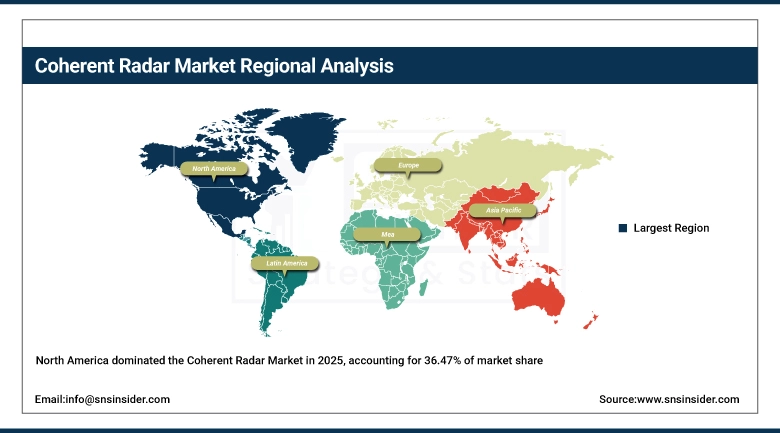
North America continues to lead the market with a market share of 36.47%, driven by robust defense modernization, state-of-the-art aerospace industry, and the extensive use of radar in civilian uses. The United States and Canada are aided by substantial government spending, existing tech suppliers, and implementation of radar in smart cities initiatives. Ongoing innovations in radar-enabled artificial intelligence, multi-band radar, and UAVs enhance the region’s supremacy, and weather organizations utilize radar in disaster planning and climatic studies.
Get Customized Report as per Your Business Requirement - Enquiry Now
U.S. Coherent Radar Market Insights:
The U.S. market is characterized by significant expenditure in defense, surveillance requirements in aerospace, and increasing use of radar in autonomous driving. Large investment in military radar systems and advancements in SAR and AI-based signal processing technology reinforce its position. The civil sector includes growth in traffic monitoring and meteorology, facilitated by smart cities and disaster management projects.
Asia‑Pacific Coherent Radar Market Insights:
The Asia Pacific region appears to be on course to become the fastest-growing regional market due to its compound annual growth rate of 11.96%, which is attributed to the increase in military spending in China, India, and Japan, and the increased civil infrastructural developments in the region. This region has been boosted by factors such as urbanization, the development of smart cities, increased demand for radar in automotive safety and disaster management. Increased investments in aerospace and satellite imagery have contributed to the growth in the region.
China Coherent Radar Market Insights:
The growth of markets in China is backed up by modernization in its military, the growth of its aerospace sector, and the construction of smart cities. China is spending a lot of money to equip radar in order to secure borders, the seas, and even the deployment of autonomous vehicles. There is also progress in terms of the development of miniaturized radar and artificial intelligence-based radar in China.
Europe Coherent Radar Market Insights:
Europe has an active radar market due to developments in aerospace engineering, defense technology, and the increasing use of radar in aviation and weather prediction applications. Nations such as Germany, France, and the United Kingdom have been developing systems based on synthetic aperture radar and multi-band radar for surveillance and disaster mitigation purposes. There has been an increase in the usage of radar in automotive technologies due to high demand for self-driving cars.
Germany Coherent Radar Market Insights:
Germany is the leader in Europe when it comes to the radar market due to the great usage in automotive, aerospace and defense sectors. The advanced automotive sector of the country makes it necessary to develop FMCW radars that will be used for autonomous cars, while the defense sector keeps spending money on the development of long-range radars. Weather organizations also use radar technology for their work.
Latin America Coherent Radar Market Insights:
The Latin American radar market is seeing consistent growth due to increased funding toward civil aviation, meteorology, and border control applications. Radar adoption for disaster management and traffic management purposes in countries such as Brazil and Mexico has been observed, alongside a gradual rise in demand owing to defense modernization efforts. Budget constraints are an issue, but international cooperation is speeding up adoption.
Middle East & Africa Coherent Radar Market Insights:
The growth within the Middle East & Africa sector is attributed to the need for modernizing their defense systems, border surveillance operations, and increased radar demand from civil aviation and meteorology. Countries in the gulf region are spending significantly on radars for military purposes, whereas the need for disaster management and infrastructure inspection through the use of radar has been observed in African countries.
Coherent Radar Market Competitive Landscape:
Raytheon Technologies
Raytheon Technologies, a major player in the American defense and aerospace industry, is a key contender in the coherent radar market. The firm is known for its advanced military radars, which are essential components in surveillance, missile tracking, and air defense systems. Raytheon invests heavily in research and development, ensuring its products are both precise and reliable. The company also maintains a robust supply chain to support its operations. The company is also working on advanced radar technologies, including synthetic aperture radar and systems for weather observation.
-
In March 2025, Raytheon announced the deployment of its latest AN/SPY‑6 radar system for U.S. Navy vessels, enhancing maritime situational awareness and missile defense capabilities.
Lockheed Martin
Lockheed Martin is a significant force within the U.S. defense contracting landscape, with a substantial presence in the coherent radar domain. Their projects encompass a variety of uses, such as airborne early warning and control systems, missile defense radars, and aerospace surveillance. Decades of experience in the defense world have shaped the company's diverse radar portfolio. This expertise is bolstered by fruitful collaborations with government entities and the ongoing evolution of radars used in both aviation and space exploration.
-
In July 2025, Lockheed Martin expanded its radar offerings by delivering new airborne surveillance radars for NATO allies, strengthening its international defense collaborations.
Northrop Grumman
Northrop Grumman is one of the important players in the United States when it comes to the aerospace and defense sectors, especially within the coherent radar market segment. In terms of technological innovation, Northrop Grumman specializes in developing radars that have high-resolution imagery capabilities, extended ranges, and flexibility for various defense applications. Additionally, the company places considerable emphasis on synthetic aperture radar and millimeter wave radar technology advancements, and partnering in aerospace and defense modernization projects.
-
In September 2025, Northrop Grumman introduced its next‑generation SABR (Scalable Agile Beam Radar) for fighter aircraft, enhancing situational awareness and combat readiness.
Coherent Radar Market Key Players:
Some of the Coherent Radar Market Companies are:
-
Raytheon Technologies
-
Lockheed Martin
-
Northrop Grumman
-
Thales Group
-
Leonardo S.p.A.
-
BAE Systems
-
Hensoldt
-
Saab AB
-
General Dynamics
-
Mitsubishi Electric
-
NEC Corporation
-
Israel Aerospace Industries (IAI)
-
Elbit Systems
-
Airbus Defence & Space
-
Indra Sistemas
-
Rheinmetall AG
-
Curtiss-Wright Corporation
-
L3Harris Technologies
-
Vaisala Oyj
-
Honeywell International
| Report Attributes | Details |
|---|---|
| Market Size in 2025 | USD 9.82 Billion |
| Market Size by 2035 | USD 23.92 Billion |
| CAGR | CAGR of 9.35% From 2026 to 2035 |
| Base Year | 2025 |
| Forecast Period | 2026-2035 |
| Historical Data | 2022-2024 |
| Report Scope & Coverage | Market Size, Segments Analysis, Competitive Landscape, Regional Analysis, DROC & SWOT Analysis, Forecast Outlook |
| Key Segments | • By Product Type (Pulse Radar, Continuous Wave Radar, Frequency Modulated Continuous Wave (FMCW), Doppler Radar, Others), • By Technology (Pulse-Doppler Radar, Continuous Wave Radar, FMCW Radar, Synthetic Aperture Radar (SAR), Others), • By Frequency Band (X-band, S-band, L-band, C-band, Others), • By Application (Defense & Military, Aerospace, Security & Surveillance, Weather Forecasting, Automotive & Traffic Management, Others) |
| Regional Analysis/Coverage | North America (US, Canada), Europe (Germany, UK, France, Italy, Spain, Russia, Poland, Rest of Europe), Asia Pacific (China, India, Japan, South Korea, Australia, ASEAN Countries, Rest of Asia Pacific), Middle East & Africa (UAE, Saudi Arabia, Qatar, South Africa, Rest of Middle East & Africa), Latin America (Brazil, Argentina, Mexico, Colombia, Rest of Latin America). |
| Company Profiles | Raytheon Technologies, Lockheed Martin, Northrop Grumman, Thales Group, Leonardo S.p.A., BAE Systems, Hensoldt, Saab AB, General Dynamics, Mitsubishi Electric, NEC Corporation, Israel Aerospace Industries (IAI), Elbit Systems, Airbus Defence & Space, Indra Sistemas, Rheinmetall AG, Curtiss-Wright Corporation, L3Harris Technologies, Vaisala Oyj, Honeywell International. |
Frequently Asked Questions
The Asia-Pacific region is projected to grow the fastest, with a CAGR of 11.96% between 2025 and 2035, driven by defense modernization in China and India, and rapid adoption in automotive radar.
The X-band is the most widely used frequency band, holding 30.02% share, as it is crucial for defense, weather monitoring, and maritime surveillance.
FMCW Tech Radar technologies are expected to grow the fastest, with CAGR of 10.83%, due to their adoption in automotive safety systems and advanced civil infrastructure.
The Weather Forecasting is the fastest-growing, with a CAGR of 10.96% from 2025 to 2035, fueled by autonomous vehicles and smart city infrastructure.
The defense & military segment is the most dominant, accounting for 37.72% of the market in 2025, driven by surveillance, missile guidance, and border security applications.
