
Commercial Aircraft Cabin Interior Market Report Scope & Overview:
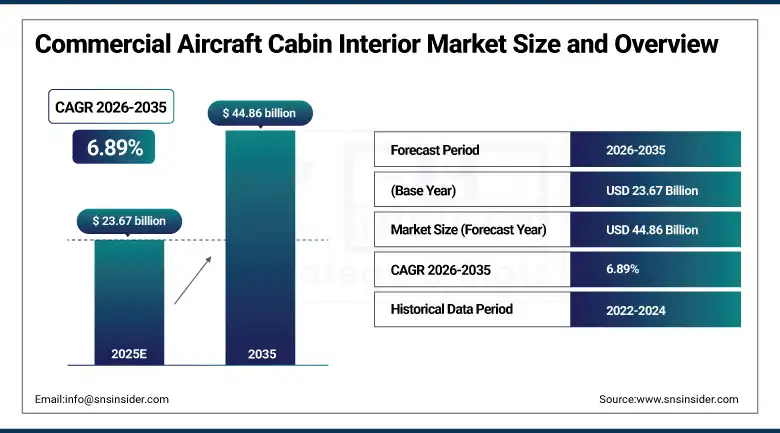
The Commercial Aircraft Cabin Interior Market was valued at USD 23.67 billion in 2025 and is expected to reach USD 44.86 billion by 2035, growing at a CAGR of 6.89% from 2026–2035.
The Commercial Aircraft Cabin Interior market is experiencing a robust growth trend owing to the increase in passenger movement by air, aircraft deliveries, and airlines investing in upgrading cabin features that can offer better passenger experience, connectivity, and comfort. The requirement for lightweight seat solutions, advanced inflight entertainment & connectivity, cabin lighting systems, and interior cabin components is increasing as the airlines are concentrating on optimizing their operations and differentiating themselves from competitors through technology and features.
Airbus SE projected demand for over 42,000 new passenger and freighter aircraft deliveries over the next 20 years, while The Boeing Company forecasts nearly 43,975 new commercial aircraft deliveries through 2043, directly driving demand for OEM cabin interior installations and aftermarket retrofits.
In addition, recent industry developments highlight ongoing innovation and retrofit momentum. In 2025, Collins Aerospace unveiled the “SkyNook” concept at the Aircraft Interiors Expo, reimagining rear-cabin spaces into semi-private passenger retreats. Also, Air India unveiled its first retrofitted Boeing 787-8 Dreamliner in 2026 as part of its fleet modernization program, featuring upgraded seating and in-flight entertainment systems.
Commercial Aircraft Cabin Interior Market Size and Forecast
-
Market Size in 2025: USD 23.67 Billion
-
Market Size by 2035: USD 44.86 Billion
-
CAGR: 6.89% from 2026 to 2035
-
Base Year: 2025
-
Forecast Period: 2026–2035
-
Historical Data: 2022–2024
To Get more information On Commercial Aircraft Cabin Interior Market - Request Free Sample Report
Commercial Aircraft Cabin Interior Market Trends
-
Rising adoption of lightweight composite materials and modular cabin components is improving fuel efficiency and operational cost savings for airlines.
-
Increasing focus on premium passenger experience is boosting deployment of advanced seating, mood lighting, and enhanced cabin aesthetics across fleets.
-
Rapid integration of high-speed satellite connectivity, smart IFEC systems, and IoT-enabled cabin technologies is enhancing onboard digital experiences.
-
Growing demand for retrofit and refurbishment programs is accelerating cabin modernization across aging narrow-body and wide-body aircraft fleets.
-
Increasing airline investments in premium economy and business-class expansion are driving demand for customized and space-efficient cabin interiors.
-
Rising adoption of sustainable, recyclable, and fire-resistant interior materials is supporting environmental compliance and ESG initiatives.
U.S. Commercial Aircraft Cabin Interior Market Size Outlook:
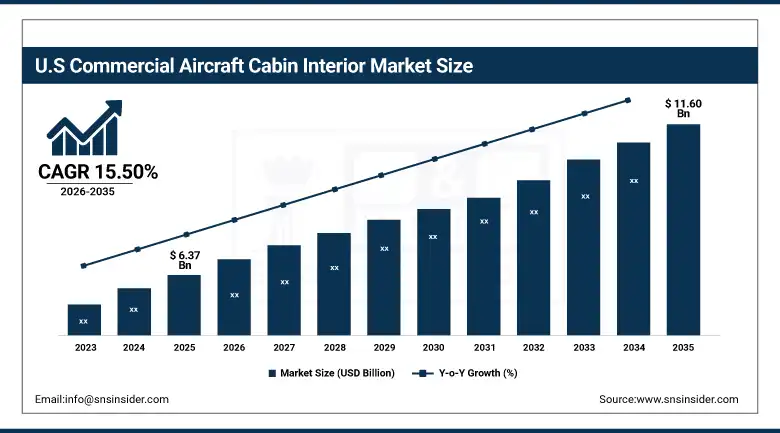
The U.S. Commercial Aircraft Cabin Interior Market was valued at USD 6.37 billion in 2025 and is expected to reach USD 11.60 billion by 2035, growing at a CAGR of 15.50% from 2026-2035. The United States Commercial Aircraft Cabin Interior Market has been established as one of the biggest globally, owing to the existence of an efficient aerospace manufacturing sector, prominent presence of major airlines, and companies such as Collins Aerospace, Panasonic Avionics Corporation, and Astronics Corporation. The continuous growth witnessed in the market can be attributed to increased fleet modernization and premium cabin interior installation projects among others.
Supporting this trend, the International Air Transport Association reported that North America remained one of the strongest aviation markets in 2024 with passenger traffic exceeding pre-pandemic levels, encouraging airlines to invest in cabin refurbishments and new aircraft deliveries.
In addition, recent developments such as Collins Aerospace securing three airline launch customers in 2026 for its Helix™ main cabin seat across nearly 200 Airbus A320 and Boeing 737 aircraft, along with the company’s 2025 introduction of aftermarket seating modification and upgrade solutions for airlines operating its Pinnacle seats, highlight the accelerating pace of cabin modernization and retrofit investment in the U.S. commercial aircraft cabin interior market.
Commercial Aircraft Cabin Interior Market Segment Highlights
-
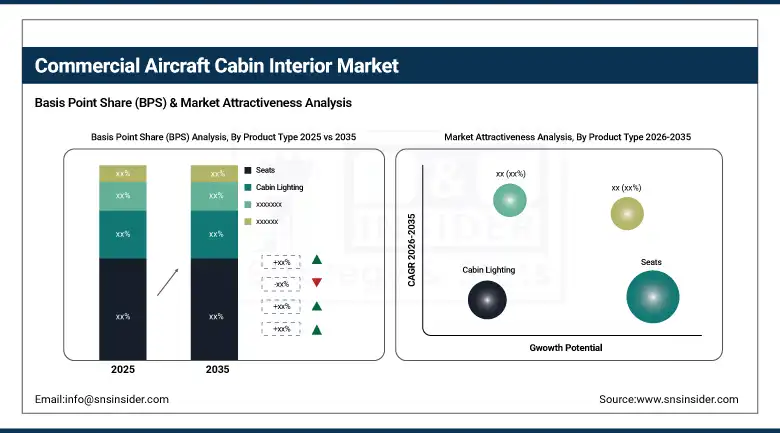
By Product Type, Seats held the largest market share of 31.60% in 2025, while In-Flight Entertainment & Connectivity (IFEC) Systems are growing at the fastest CAGR.
-
By Material Type, Composites accounted for the highest market share of 34.45% in 2025, while Plastics & Polymers are projected to grow at the fastest CAGR.
-
By Aircraft Type, Narrow-Body Aircraft dominated with a market share of 43.85% in 2025, while Business Jets are expected to grow at the fastest CAGR.
-
By End User, OEM / Line-Fit Installations held the largest market share of 61.24% in 2025, whereas Aftermarket / Retrofit Installations are projected to record the fastest CAGR.
-
By Cabin Class, Economy Class accounted for the highest market share of 49.61% in 2025, while Premium Economy Class is anticipated to witness the fastest CAGR.
By Product Type, Seats segment dominates the Commercial Aircraft Cabin Interior Market, In-Flight Entertainment & Connectivity (IFEC) Systems segment expected to grow fastest
In 2025, the Seats segment maintained its dominant position in the Commercial Aircraft Cabin Interior Market, accounting for 31.60% of total revenue. This section comprises economy, premium economy, business class, and first-class seating systems that all constitute some of the most valued parts of an aircraft. The combination of increasing aircraft deliveries, higher airline spending on premium seats, and increased demand for light-weighted, ergonomically designed.
From 2026 to 2035, the In-Flight Entertainment & Connectivity (IFEC) Systems segment is projected to record the highest CAGR during the 2026–2035 forecast period. The increase in passenger needs for fast internet, real-time broadcasting, wireless entertainment, and other connected on-board services is prompting the adoption of new generation IFEC systems.
By Material Type, Composites segment dominates the Commercial Aircraft Cabin Interior Market, Plastics & Polymers segment expected to grow fastest
The Composites segment held the largest share of 34.45% in the Commercial Aircraft Cabin Interior Market in 2025, because of the growing requirement for light but robust materials in aircraft interior structures. Many aircraft manufacturers use composite materials in passenger seats, cargo bins, side wall panels, and flooring because of their high strength-to-weight ratio and durability.
The Plastics & Polymers segment is expected to register the highest CAGR during the 2026–2035 forecast period. Increasing utilization of high-performance thermoplastics and polymers in cabin interiors is attributed to their versatility, economic viability, and resistance to fire.
By Aircraft Type, Narrow-Body Aircraft segment dominates the Commercial Aircraft Cabin Interior Market, Business Jets segment expected to grow fastest
The Narrow-Body Aircraft segment accounted for the largest market share of 43.85% in 2025, This trend is largely attributed to the sheer number of short- and medium-range flights around the world. Airline carriers have been making huge investments in their fleets of narrow-body aircraft as well as their cabin interiors to meet the rising demands of their passengers within their regions. Some of the popular narrow-body aircraft include the Airbus A320neo series and Boeing’s 737 MAX aircraft.
The Business Jets segment is projected to witness the fastest CAGR from 2026 to 2035. An increase in demand for private aircraft, luxurious flights, and premium cabin interior designs is propelling the segment’s growth.
By End User, OEM / Line-Fit Installations segment dominates the Commercial Aircraft Cabin Interior Market, Aftermarket / Retrofit Installations segment expected to grow fastest
The OEM / Line-Fit Installations segment maintained the highest end-user share of 61.24% in the Commercial Aircraft Cabin Interior Market in 2025. The OEM installations segment accounts for the main means of installation for seating systems, lighting, galleys, interior panels, and IFEC systems that are incorporated in an aircraft during its manufacture. Key companies involved in making aircraft like Airbus SE and
The Aftermarket / Retrofit Installations segment is projected to achieve the highest growth rate during 2026–2035.
By Cabin Class, Economy Class segment dominates the Commercial Aircraft Cabin Interior Market, Premium Economy Class segment expected to grow fastest
The Economy Class segment maintained the highest cabin-class share of 49.61% in the Commercial Aircraft Cabin Interior Market in 2025. Economy class is the largest seat configuration found in commercial aircraft fleets around the world. Economy class is the main revenue-producing sector for both discount airlines and traditional airlines alike.
The Premium Economy Class segment is projected to achieve the highest growth rate during 2026–2035.
Commercial Aircraft Cabin Interior Market Regional Analysis
|
Region |
Major Country |
Share within Region (%) |
|---|---|---|
|
North America |
United States |
30.33% |
|
Europe |
Germany |
27.14% |
|
Asia Pacific |
China |
28.75% |
|
Middle East & Africa |
UAE |
7.04% |
|
Latin America |
Brazil |
6.74% |
North America Commercial Aircraft Cabin Interior Market Insights
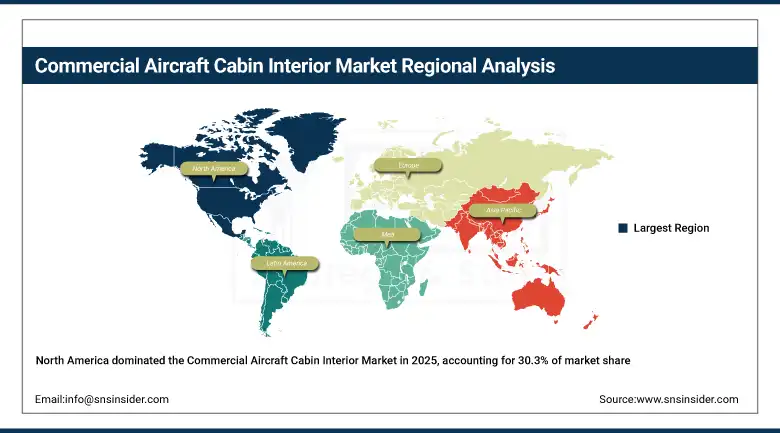
North America held the dominant position in the global Commercial Aircraft Cabin Interior Market with 30.3% revenue share in 2025, owing to the presence of major aircraft OEMs, strong airline retrofit activity, advanced aviation infrastructure, and high adoption of premium cabin technologies. The United States leads regional performance with an 88% intra-regional share, underpinned by strong demand for line-fit installations and cabin refurbishment programs across major airlines.
Get Customized Report as per Your Business Requirement - Enquiry Now
Supporting this dominance, the Federal Aviation Administration reported continued growth in U.S. commercial aircraft fleet utilization and increasing aircraft deliveries, supporting demand for seating systems, IFEC upgrades, and cabin modernization solutions.
According to The Boeing Company’s Commercial Market Outlook, North America will remain a major aircraft replacement market through 2043, driving long-term demand for OEM and aftermarket cabin interior systems.
Asia Pacific Commercial Aircraft Cabin Interior Market Insights
The Asia Pacific region is anticipated to register the highest CAGR of 7.76% over the forecast period of 2026–2035, This can be attributed to the rapid increase in the number of airline fleets, the number of passengers flying in the air, the growth in the presence of low-cost carriers, and the development of airport facilities. China and India are the two major markets contributing to growth, with China responsible for generating of the revenue in the region due to its huge domestic demand and active purchase of airplanes.
Supporting this growth, the International Air Transport Association reported Asia Pacific as the fastest-recovering aviation market with strong year-over-year passenger traffic growth in 2024, with China and India leading regional air travel expansion.
In addition, major aircraft orders and fleet modernization initiatives by airlines such as Air India, IndiGo, and Chinese carriers are accelerating demand for line-fit installations and retrofit upgrades for advanced seating, cabin lighting, and IFEC systems across the region.
Europe Commercial Aircraft Cabin Interior Market Insights
Europe held the second-largest revenue share in the global Commercial Aircraft Cabin Interior Market, accounting for 27.14% in 2025, driven by a mature aerospace ecosystem, strong regulatory standards, and continuous innovation in lightweight and sustainable cabin materials. Countries such as Germany, United Kingdom, France, and Italy are home to leading cabin interior suppliers and engineering centers, with Germany of regional revenue.
Supporting this position, Airbus SE continues increasing production of the A320neo and A350 programs, strengthening OEM demand for aircraft interior components across Europe.
In addition, the implementation of stricter EU sustainability initiatives is encouraging airlines and manufacturers to adopt recyclable composites, lightweight seating systems, and low-emission cabin materials, reinforcing Europe’s market expansion trajectory.
Middle East & Africa and Latin America Commercial Aircraft Cabin Interior Market Insights
Commercial Aircraft Cabin Interior Market in the MEA and Latin America regions is seeing continuous growth on a yearly basis due to increased investments in aircraft fleet and airport infrastructures, growing passenger traffic, and more flights per day. For the MEA region, the UAE, Saudi Arabia, and South Africa are the most advanced countries in adopting cabin interiors, contributing in total MEA market revenues, mainly through investments in premium wide-body fleet and luxurious cabin interior fittings.
Supporting development in these regions, Saudi Arabia’s Vision 2030 and ongoing airport expansion projects are accelerating aircraft procurement and increasing demand for advanced seating, cabin lighting, and IFEC systems.
In Brazil, which accounts for 54% of Latin America’s revenue, airlines are increasingly investing in narrow-body fleet renewal and cabin refurbishment programs to improve passenger experience and operational efficiency, supporting broader adoption of modern aircraft cabin interior solutions across the region.
Commercial Aircraft Cabin Interior Market Growth Drivers:
-
Rising global air passenger traffic and increasing airline investments in fleet modernization, premium cabin upgrades, and passenger experience enhancement driving adoption of advanced commercial aircraft cabin interiors
This structural transformation within the aviation sector that aims at improving the comfort levels for travelers, differentiating brands, and making operations more efficient is one of the biggest catalysts behind the Commercial Aircraft Cabin Interior market. Air carriers are now investing heavily in state-of-the-art seats, high-tech IFEC solutions, mood lighting, lighter panels, and advanced kitchens to draw customers, build loyalty, and earn additional income from ancillary sources. Increasing passenger demand for connectivity and premium comfort is spurring demand for cutting-edge cabin interiors.
Supporting this growth, the International Air Transport Association reported that global air passenger traffic in 2024 surpassed pre-pandemic levels, with total traffic increasing by more than 10% year-over-year, reflecting strong demand for airline capacity expansion and cabin modernization investments.
Airbus SE projects demand for more than 42,000 new passenger and freighter aircraft over the next 20 years, while The Boeing Company forecasts 43,975 new commercial aircraft deliveries through 2043, underscoring the massive long-term requirement for OEM-installed and aftermarket aircraft cabin interior systems.
Commercial Aircraft Cabin Interior Market Restraints:
-
High capital investment requirements for advanced cabin interior systems, retrofit programs, and certification processes creating adoption barriers, particularly for low-cost carriers and smaller regional airlines
The large costs incurred in the purchase, installation, and certification of advanced aircraft cabin interiors form a major factor restraining market growth, especially among budget, regional, and newly established airline players. The costs of installing premium seat systems, IFEC systems, mood lighting systems, lightweight composite structures, and advanced lavatory/galley modules entail heavy capital expenditure. Major re-designing and refurbishing of aircraft may entail costs of Billions of dollars per plane, depending on how complicated the process might be. Such huge expenditures are aggravated by the cost of grounding planes while they are being refurbished, as well as the labor cost involved, engineering and certification costs from aviation agencies like FAA and EASA.
Commercial Aircraft Cabin Interior Market Opportunities:
-
Accelerating adoption of smart cabins, sustainable lightweight materials, and next-generation retrofit solutions creating new growth pathways for airlines to enhance passenger experience and operational efficiency
The next big thing for the Commercial Aircraft Cabin Interior Market is about making the aircraft interiors a connected, intelligent, and eco-friendly space. The focus is shifting toward smarter cabin environments that incorporate the internet of things technology-based seats, sensor-enabled predictive maintenance, personal entertainment, and artificial intelligence-based passenger analytics. On the other hand, advancements in composite materials, recyclable polymers, and low emission interior materials have allowed the airlines to significantly reduce the weight of aircrafts, save fuel, and comply with the environment-related regulations.
Recent Developments:
-
2026: Emirates announced the next phase of its US$5 billion cabin retrofit program, expanding refurbishment to 111 additional aircraft including Airbus A380s and Boeing 777s, with upgrades such as Premium Economy cabins, next-generation in-flight entertainment systems, and high-speed connectivity.
-
2026: Diehl Aviation introduced its Space³ lavatory with Adaptive User Routing System (AURS) at the Aircraft Interiors Expo 2026, enhancing accessibility for passengers with visual and hearing impairments and advancing inclusive cabin interior innovation.
-
2026: United Airlines unveiled its ultra-premium Airbus A321XLR cabin design under the “Elevated” initiative, featuring Polaris suites with sliding doors, upgraded Premium Plus seating, and a walk-up snack bar to improve long-haul narrow-body passenger experience.
-
2025: Airbus SE prepared the launch of the enhanced A220 Airspace Cabin, offering larger overhead bins, improved mood lighting, and a unified premium interior design, with line-fit deliveries beginning in 2026 and retrofit options thereafter.
-
2024: Air India initiated a large-scale fleet modernization program involving comprehensive cabin retrofits across its Boeing 787 and 777 fleets, including new seating, upgraded IFEC systems, and refreshed cabin aesthetics to elevate passenger experience.
Commercial Aircraft Cabin Interior Companies are:
-
Collins Aerospace
-
Panasonic Avionics Corporation
-
Thales Group
-
Diehl Aviation
-
Recaro Aircraft Seating GmbH & Co. KG
-
Geven S.p.A.
-
Astronics Corporation
-
STELIA Aerospace
-
Gogo Inc.
-
Viasat, Inc.
-
Lufthansa Technik AG
-
HAECO Group
-
B/E Aerospace
-
Aviointeriors S.p.A.
-
Bucher Group
-
AIM Altitude
-
Acro Aircraft Seating Ltd.
-
Expliseat SAS
Commercial Aircraft Cabin Interior Market Report Scope
| Report Attributes | Details |
|---|---|
| Market Size in 2025 | USD 23.67 Billion |
| Market Size by 2035 | USD 44.86 Billion |
| CAGR | CAGR of 6.89% From 2026 to 2035 |
| Base Year | 2025 |
| Forecast Period | 2026-2035 |
| Historical Data | 2022-2024 |
| Report Scope & Coverage | Market Size, Segments Analysis, Competitive Landscape, Regional Analysis, DROC & SWOT Analysis, Forecast Outlook |
| Key Segments | • By Product Type (Seats, In-Flight Entertainment & Connectivity (IFEC) Systems, Cabin Lighting, Galleys, Interior Panels & Flooring, Others) • By Material Type (Composites, Aluminum Alloys, Stainless Steel, Plastics & Polymers, Fabrics & Upholstery Materials, Others) • By Aircraft Type (Narrow-Body Aircraft, Wide-Body Aircraft, Regional Jets, Business Jets, Others) • By End User (OEM / Line-Fit Installations, Aftermarket / Retrofit Installations, Others) • By Cabin Class (Economy Class, Premium Economy Class, Business Class, First Class) |
| Regional Analysis/Coverage | North America (US, Canada), Europe (Germany, UK, France, Italy, Spain, Russia, Poland, Rest of Europe), Asia Pacific (China, India, Japan, South Korea, Australia, ASEAN Countries, Rest of Asia Pacific), Middle East & Africa (UAE, Saudi Arabia, Qatar, South Africa, Rest of Middle East & Africa), Latin America (Brazil, Argentina, Mexico, Colombia, Rest of Latin America). |
| Company Profiles | Safran S.A., Collins Aerospace, Panasonic Avionics Corporation, Thales Group, Diehl Aviation, Recaro Aircraft Seating GmbH & Co. KG, JAMCO Corporation, Geven S.p.A., Astronics Corporation, STELIA Aerospace, Gogo Inc., Viasat, Inc., Lufthansa Technik AG, HAECO Group, B/E Aerospace, Aviointeriors S.p.A., Bucher Group, AIM Altitude, Acro Aircraft Seating Ltd., Expliseat SAS |
Frequently Asked Questions
The Commercial Aircraft Cabin Interior Market is expected to grow at a CAGR of 6.89% from 2026 to 2035.
The Commercial Aircraft Cabin Interior Market was valued at USD 23.67 billion in 2025.
Rising global air passenger traffic, increasing airline investments in fleet modernization, and growing demand for enhanced passenger comfort, connectivity, and premium onboard experience is the primary growth driver of the Commercial Aircraft Cabin Interior Market.
The Seat segment dominated the Commercial Aircraft Cabin Interior Market in 2025.
North America dominated the Commercial Aircraft Cabin Interior Market in 2025.
