
Defense IT Spending Market Report Scope & Overview:
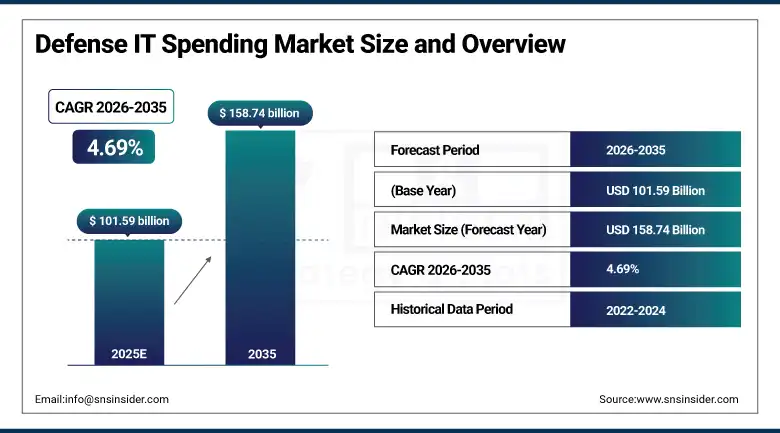
The Defense IT Spending Market was valued at USD 101.59 billion in 2025 and is projected to reach around USD 158.74 billion by 2035, growing at a CAGR of 4.69% from 2026–2035.
The Defense IT Spending Market is experiencing high structural growth, characterized by fast digital transformation of the world's armed forces, heightened geopolitical tensions, and increased funding in AI-driven defense systems. Governments are increasing their spending on secure cloud technologies, cybersecurity, and future C4I systems. The increasing complexity of multi-domain operations (land, air, sea, cyber, and space) is pushing the demand for IT systems that facilitate real-time intelligence, mission planning, and battlefield communications. Furthermore, sovereign clouds, zero trust cybersecurity, and edge computing are transforming defense IT buying trends around the world.
Recent developments highlight accelerated modernization programs and strategic ecosystem expansion across the defense IT landscape. Microsoft expanded its Azure Government and classified cloud partnerships with multiple NATO-aligned defense agencies, strengthening secure cloud adoption for mission-critical workloads. Palantir Technologies continues to secure multi-year contracts with the U.S. Department of Defense for AI-powered battlefield intelligence and data fusion platforms, reinforcing its position in defense analytics.
To Get more information On Defense IT Spending Market - Request Free Sample Report
Defense IT Spending Market Trends
-
Rising geopolitical tensions are accelerating defense IT modernization and digital battlefield adoption.
-
Growing deployment of sovereign cloud is strengthening secure and classified defense data infrastructure.
-
Increasing use of AI/ML in command and intelligence systems is improving real-time decision-making.
-
Expanding adoption of zero-trust cybersecurity is enhancing defense network protection.
-
Rising edge computing usage is enabling faster battlefield data processing and response.
-
Growing investment in simulation and digital twin training is improving mission readiness.
-
Increasing NATO interoperability requirements are driving standardized defense IT systems.
-
Accelerating legacy system modernization is shifting defense operations toward software-defined infrastructure.
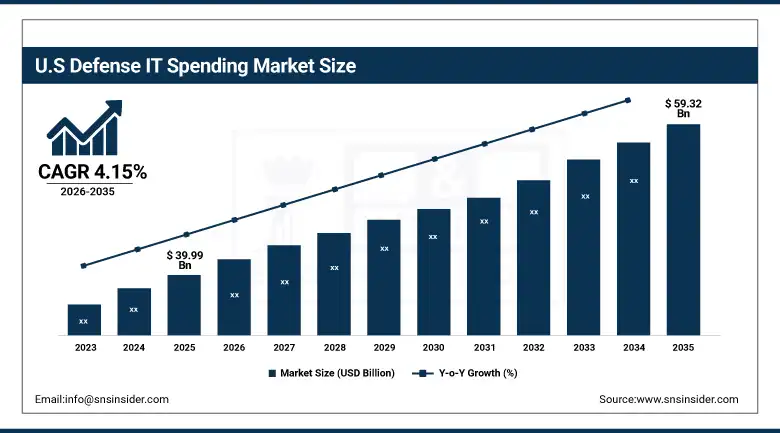
The US. Defense IT Spending Market was valued at USD 39.99 billion in 2025 and is projected to reach around USD 59.32 billion by 2035, growing at a CAGR of 4.15% from 2026–2035.
There are some key factors responsible for driving the growth in the Defense IT Spending market. The major ones include rapid digital transformation of the armed forces, rising cyber warfare, and modernization of C4I systems. Growing use of sovereign clouds, AI-powered defense analytics, and zero trust cybersecurity models has immensely enhanced operational effectiveness, situational awareness, and decision-making capabilities. Apart from these, rising investments in multi-domain operations and secure edge computing are also driving the growth in demand for defense IT solutions.
Microsoft expanded its Azure Government Secret and Top-Secret cloud capabilities to support highly classified defense workloads for U.S. and allied defense agencies. Meanwhile, Palantir Technologies secured multiple new contracts with defense organizations for AI-driven battlefield intelligence platforms, enhancing real-time data fusion and mission planning capabilities across complex operational environments.
Defense IT Spending Market Segment Highlights
-
By Component, Hardware (servers, secure networks, edge devices) dominated the Defense IT Spending Market with 45.34% share in 2025; Cloud & Edge Computing Infrastructure is the fastest growing segment.
-
By Deployment Type, On-Premise (classified and mission-critical systems) dominated the Defense IT Spending Market with 45.15% share in 2025; Cloud-Based (sovereign cloud) is the fastest growing segment.
-
By Application, Command, Control, Communications, Computers, Intelligence (C4I)s dominated the Defense IT Spending Market with 25.58% share in 2025; Cyber Defense & Security Operations is the fastest growing segment.
-
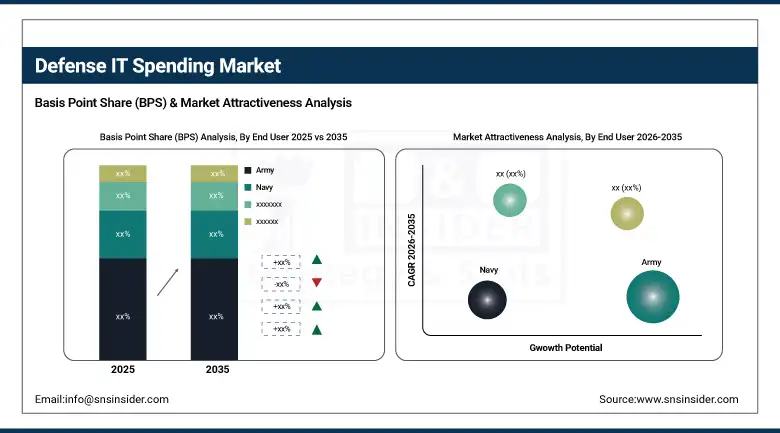
By End User Army, dominated the Defense IT Spending Market with 46.24% share in 2025; Homeland Security Agencies is the fastest growing segment.
-
By Technology, Cloud Computing (Defense Cloud / Sovereign Cloud) dominated the Defense IT Spending Market with 32.51% share in 2025; Artificial Intelligence & Machine Learning is the fastest growing segment.
Defense IT Spending Market Segment Analysis:
By Component, Hardware dominates the Defense IT Spending Market, Cloud & Edge Computing Infrastructure expected to grow fastest
In 2025, the Hardware (servers, secure networks, edge devices) segment maintained its dominant position in the Defense IT Spending Market, accounting for 45.34% of total revenue. This domination is fueled by the extensive procurement of secure communication equipment, mission-critical computer systems, and battlefield networking equipment essential for multi-domain operations. The defense departments still depend a lot on robust physical IT infrastructure for ensuring uninterrupted command, control, and intelligence capability in highly secure environments.
From 2026 to 2035, the Cloud & Edge Computing Infrastructure segment is projected to record the highest CAGR. The rapid development is fueled by increased use of sovereign cloud infrastructures, the necessity to process battlefield information in real time, and the movement towards distributed edge computing infrastructures in military operations. Increased demand for fast intelligence delivery, low latency, and scalability of mission computing infrastructures is rapidly driving the development of hybrid cloud-edge defense IT environments.
By Deployment Type, On-Premise dominates the Defense IT Spending Market, Cloud-Based expected to grow fastest
In 2025, the On-Premise (classified and mission-critical systems) segment held the largest share of 45.15%, backed up by stringent data sovereignty regulations, classified defense workloads, and the use of secure internal IT infrastructure. The defense industry prefers to use on-premise solutions for intelligence, mission-critical communications, and command centers that have minimal external exposure.
The Cloud-Based (sovereign cloud) segment is expected to register the highest CAGR from 2026 to 2035. Growth will be facilitated through increased modernization efforts, higher adoption rates of private clouds and sovereign clouds, and the need for scalable, secure, and interoperable defense information technology environments. The trend towards hybrid defense architecture and cloud computing analytics enhanced by artificial intelligence will continue to drive cloud migration in defense.
By Application, C4I dominates the Defense IT Spending Market, Cyber Defense & Security Operations expected to grow fastest
In 2025, the Command, Control, Communications, Computers, Intelligence (C4I) segment dominated the Defense IT Spending Market with a 25.58% share, driven by its central role in enabling real-time battlefield coordination, intelligence sharing, and mission execution. C4I systems form the backbone of modern defense operations, integrating communication networks, situational awareness tools, and decision-support platforms across military branches.
From 2026 to 2035, the Cyber Defense & Security Operations segment is projected to record the highest CAGR.
By End User, Army dominates the Defense IT Spending Market, Homeland Security Agencies expected to grow fastest
In 2025, the Army segment maintained its dominant position in the Defense IT Spending Market, accounting for 46.24% of total revenue. Such dominance is largely attributed to the fact that the US Army heavily depends on C4ISR technology. The massive modernization efforts being made by the US Army in battlefield digitization have also played a key role in maintaining the dominance of the US Army in the deployment of IT in military applications.
From 2026 to 2035, the Homeland Security Agencies segment is projected to record the highest CAGR.
By Technology, Cloud Computing dominates the Defense IT Spending Market, Artificial Intelligence & Machine Learning expected to grow fastest
In 2025, the Cloud Computing (Defense Cloud / Sovereign Cloud) segment maintained its dominant position in the Defense IT Spending Market, accounting for 32.51% of total revenue. The dominance can be attributed to the growing use of the sovereign cloud platform that provides security for classified workloads, scalable data storage for defense, and integration with mission critical applications. The defense sector is increasingly turning to cloud computing to facilitate interoperability and multi-domain operations.
From 2026 to 2035, the Artificial Intelligence & Machine Learning segment is projected to record the highest CAGR.
Defense IT Spending Market Regional Analysis
|
Region |
Major Country |
Share within Region (%) |
|---|---|---|
|
North America |
United States |
90.09% |
|
Europe |
Germany |
31.56% |
|
Asia Pacific |
China |
38.44% |
|
Middle East & Africa |
UAE |
21.59% |
|
Latin America |
Brazil |
35.77% |
North America Defense IT Spending Market Insights
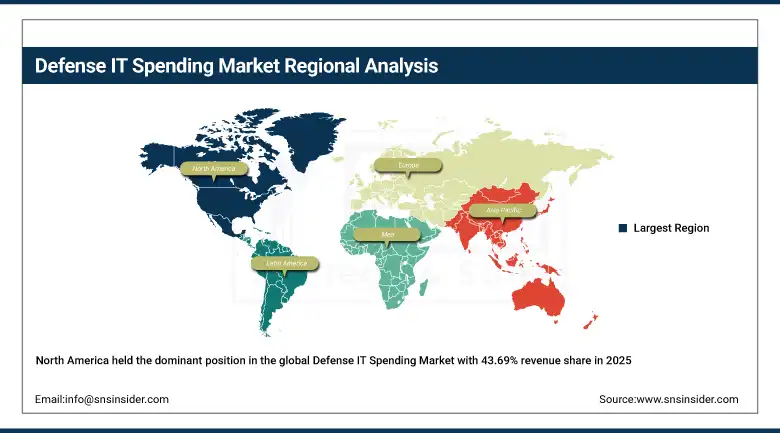
North America held the dominant position in the global Defense IT Spending Market with 43.69% revenue share in 2025, motivated by massive defense modernization programs, significant investment in cybersecurity, and early implementation of AI-based command, control, and intelligence capabilities. The continent is endowed with major defense contractors, sophisticated cloud infrastructure environments, and sizable defense IT budgets, especially in the United States. The growing use of sovereign clouds, zero-trust cybersecurity models, and battlefield management systems further reinforces the dominance of North America in defense digital transformation.
Get Customized Report as per Your Business Requirement - Enquiry Now
Asia Pacific Defense IT Spending Market Insights
Asia Pacific is projected to register the highest CAGR of 6.10% from 2026–2035, Fuelled by fast-paced military modernization programs, increasing geopolitical tensions, and heavy investments in digital defense infrastructure in countries such as China, India, Japan, South Korea, and Southeast Asia. The region is experiencing high uptake of AI-based surveillance systems, cybersecurity platforms, and cloud defense IT architectures to boost operational preparedness and cross-domain collaboration. Increasing defense budgets and emphasis on local defense technology innovation are contributing to heightened demand in the region.
Europe Defense IT Spending Market Insights
The Europe region has managed to retain a substantial portion in the Defense IT Spending Market owing to high levels of NATO integration, stringent cyber security regulations, and constant upgrades of defense communications and intelligence platforms. Nations like Germany, France, the United Kingdom, and the Nordic countries have been making heavy investments in building secure cloud infrastructure, cyber security platforms, and interoperable command and control platforms. Europe’s growing emphasis on digital sovereignty and defense cooperation is driving the demand for IT-based defense solutions. Some of the recent trends in the region include increased joint investments by Thales and Leonardo in secure defense communication and cyber defense platforms for NATO-aligned operations, along with rapid deployment of sovereign clouds in the EU for classified defense workloads.
Latin America, Middle East & Africa (LAMEA) Defense IT Spending Market Insights
The LAMEA region is witnessing a stable growth rate in the Defense IT Spending Market due to increased defense modernization, rising cyber security risks, and increasing spending on digital command and surveillance systems. Nations like Brazil, Mexico, Saudi Arabia, UAE, and South Africa are increasingly concentrating on defense IT infrastructure improvements, situational awareness systems development, and cloud-based defense IT solutions implementation.
Defense IT Spending Market Growth Drivers:
Rising adoption of sovereign cloud, AI-enabled defense systems, and zero-trust cybersecurity is driving strong growth in defense IT spending across global military organizations:
The primary structure that affects the Defense IT Spending Market is the rapid transition towards completely digitalized, network-centric, and AI-enabled defense operations. Contemporary military forces are becoming dependent on C4I (command, control, communications, computers, and intelligence) technology for the purpose of gaining real-time situational awareness and making decisions. In addition, growing tensions and cyber war risks are forcing defense authorities to upgrade their existing IT infrastructure with secure cloud services and edge computing solutions. As a result, the spending on sovereign cloud ecosystems, AI-enabled intelligence analysis, and defense communications networks has seen a sharp increase among leading military nations.
Defense IT Spending Market Restraints:
Rising complexity of multi-vendor IT environments, cybersecurity compliance requirements, and high dependency on third-party providers are creating operational challenges and limiting full control over enterprise IT ecosystems:
The primary constraint in the Managed Services Market stems from the growing fears of data security, vendor lock-in, and integration issues within hybrid IT environments. Enterprises, by outsourcing their IT needs like cloud computing, network administration, and cybersecurity, become susceptible to operational inflexibility and incur high costs when looking to switch vendors in the future. Furthermore, the need to comply with stringent regulations in industries such as BFSI, health care, and government adds to the challenge, since enterprises have to ensure that their partners comply with regulations related to data privacy, sovereignty, and cybersecurity without affecting service delivery.
Defense IT Spending Market Opportunities:
AI-driven autonomous warfare systems, defense cloud-native command platforms, and real-time edge intelligence networks:
One of the most important opportunities in the Defense IT Spending Market can be identified as the fast growth in the adoption of autonomous defense systems driven by AI technologies and cloud-native command systems that help make military decisions quickly and based on big data. Edge computing, along with battlefield sensors, unmanned systems, and surveillance systems, has created a responsive real-time intelligence ecosystem which makes operations more effective and increases their success rate. The adoption of interoperable digital defense platforms among allied nations creates many opportunities in terms of secure data exchange and predictive analysis using artificial intelligence.
Recent Developments:
-
2026: Northrop Grumman expanded its digital modernization initiatives by integrating AI-enabled mission command systems and advanced cybersecurity layers into next-generation defense platforms, improving real-time operational awareness and multi-domain coordination capabilities.
-
2026: Thales Group enhanced its secure defense communications portfolio through upgraded cyber-resilient tactical data link systems and sovereign command network solutions designed for NATO-aligned operations and critical infrastructure protection.
-
2025: BAE Systems advanced deployment of next-generation electronic warfare and defense cybersecurity systems, strengthening resilient military network protection against evolving cyber and signal-based threats.
-
2025: L3Harris Technologies expanded its integrated communication and intelligence solutions portfolio, focusing on secure battlefield networking systems and AI-supported sensor fusion platforms for enhanced mission-critical decision-making.
Defense IT Spending Market Key Players
Some of the Defense IT Spending Market Companies
-
Lockheed Martin Corporation
-
Northrop Grumman Corporation
-
RTX Corporation (Raytheon Technologies)
-
Boeing Defense, Space & Security
-
General Dynamics Corporation
-
BAE Systems plc
-
Thales Group
-
Leonardo S.p.A.
-
L3Harris Technologies Inc.
-
Airbus Defence and Space
-
Honeywell Aerospace
-
IBM Corporation (Defense & Government Services)
-
Microsoft Corporation (Defense Cloud & Azure Government)
-
Amazon Web Services (AWS GovCloud)
-
Oracle Corporation (Defense Cloud Solutions)
-
Palantir Technologies Inc.
-
Cisco Systems Inc. (Defense Networking & Security)
-
Palo Alto Networks Inc. (Defense Cybersecurity)
-
SAP SE (Defense ERP & Logistics Systems)
-
Accenture Federal Services
Defense IT Spending Market Report Scope:
| Report Attributes | Details |
|---|---|
| Market Size in 2025 | USD 101.59 Billion |
| Market Size by 2035 | USD 158.74 Billion |
| CAGR | CAGR of 4.69% From 2026 to 2035 |
| Base Year | 2025 |
| Forecast Period | 2026-2035 |
| Historical Data | 2022-2024 |
| Report Scope & Coverage | Market Size, Segments Analysis, Competitive Landscape, Regional Analysis, DROC & SWOT Analysis, Forecast Outlook |
| Key Segments | • By Component (Hardware—servers, secure networks, edge devices; Software—C4ISR systems, ERP, defense platforms; Services—managed services, integration, consulting; Cybersecurity Solutions—SIEM, endpoint security, threat intelligence; Cloud & Edge Computing Infrastructure) • By Deployment Type (On-Premise—classified and mission-critical systems; Cloud-Based—private cloud, sovereign cloud environments; Hybrid Defense IT Infrastructure) • By Application (Command, Control, Communications, Computers, Intelligence (C4I); Cyber Defense & Security Operations; Battlefield Management Systems; Logistics & Supply Chain Management; Training & Simulation Systems; Intelligence & Surveillance Systems) • By End User (Army; Navy; Air Force; Special Forces; Homeland Security Agencies; Defense Intelligence Organizations) • By Technology (Artificial Intelligence & Machine Learning; Big Data Analytics; Cloud Computing—Defense Cloud / Sovereign Cloud; Cybersecurity & Zero Trust Architecture; IoT & Edge Computing; Quantum-safe Encryption—emerging technologies) |
| Regional Analysis/Coverage | North America (US, Canada), Europe (Germany, UK, France, Italy, Spain, Russia, Poland, Rest of Europe), Asia Pacific (China, India, Japan, South Korea, Australia, ASEAN Countries, Rest of Asia Pacific), Middle East & Africa (UAE, Saudi Arabia, Qatar, South Africa, Rest of Middle East & Africa), Latin America (Brazil, Argentina, Mexico, Colombia, Rest of Latin America). |
| Company Profiles | Lockheed Martin Corporation, Northrop Grumman Corporation, RTX Corporation (Raytheon Technologies), Boeing Defense, Space & Security, General Dynamics Corporation, BAE Systems plc, Thales Group, Leonardo S.p.A., L3Harris Technologies Inc., Airbus Defence and Space, Honeywell Aerospace, IBM Corporation (Defense & Government Services), Microsoft Corporation (Defense Cloud & Azure Government), Amazon Web Services (AWS GovCloud), Oracle Corporation (Defense Cloud Solutions), Palantir Technologies Inc., Cisco Systems Inc. (Defense Networking & Security), Palo Alto Networks Inc. (Defense Cybersecurity), SAP SE (Defense ERP & Logistics Systems), Accenture Federal Services |
Frequently Asked Questions
North America dominated the Defense IT Spending Market in 2025.
The Hardware (servers, secure networks, edge devices) segment dominated the Defense IT Spending Market in 2025.
Rapid acceleration of digital battlefield transformation, rising cyber warfare threats, and increasing adoption of AI-enabled defense systems is the primary growth driver of the Defense IT Spending Market.
The Defense IT Spending Market was valued at USD 101.59 billion in 2025.
The Defense IT Spending Market is expected to grow at a CAGR of 4.69% from 2026 to 2035.
